DNS Wars
Michael Hausding (DNS Lead · Switch)
Swiss Cyber Storm 2019 · Day 1 · Management
Overview
In his talk "DNS Wars," Michael Hausding, DNS Lead at Switch, delves into the rapidly evolving and increasingly contentious landscape of the Domain Name System (DNS). What was once considered a "boring" foundational internet protocol has transformed into a critical battleground for privacy, national sovereignty, and network control. Hausding highlights the significant shift from traditional unencrypted DNS to new, encrypted protocols like DNS over TLS (DoT) and DNS over HTTPS (DoH), driven largely by privacy concerns following revelations of mass surveillance.
Key moments
- 0:00 Introduction: Why DNS is now a "war" topic
- 4:00 DNS resolvers as control points and legal blocking
- 9:45 Snowden's revelations push for encrypted DNS (DoH/DoT)
- 13:00 DNS over HTTPS (DoH) breaks network controls and blocking
- 18:00 Market consolidation and centralization of DNS resolvers
- 20:00 Browser vendors making DoH default by design
- 27:45 Q&A: Data ownership, privacy, and legal blocking
DNS Wars
Speakers: Michael Hausding, DNS Lead, Switch
Conference: Swiss Cyber Storm
YouTube: https://www.youtube.com/watch?v=vdFT-MVkx9M
Overview
In his talk "DNS Wars," Michael Hausding, DNS Lead at Switch, delves into the rapidly evolving and increasingly contentious landscape of the Domain Name System (DNS). What was once considered a "boring" foundational internet protocol has transformed into a critical battleground for privacy, national sovereignty, and network control. Hausding highlights the significant shift from traditional unencrypted DNS to new, encrypted protocols like DNS over TLS (DoT) and DNS over HTTPS (DoH), driven largely by privacy concerns following revelations of mass surveillance.
This talk is particularly pertinent as governments worldwide, including Switzerland, grapple with the implications of legally mandated content blocking, often implemented via DNS. The emergence of encrypted DNS protocols, especially DoH, challenges these regulatory frameworks by making DNS traffic indistinguishable from regular web traffic and thus difficult to intercept or block. Compounding this technical shift is a dramatic market consolidation, with a few large cloud providers like Google and Cloudflare increasingly dominating global DNS resolution, raising concerns about centralization of power and data. Hausding meticulously unpacks these intertwined technical, political, legal, and ethical dilemmas, urging both users and network operators to carefully consider their choices in this new era of DNS.
Background
▶ Watch: Introduction: Why DNS is now a "war" topic (0:00)
For over 30 years, DNS has operated largely as an unencrypted protocol, with its integrity only weakly protected, often by DNSSec in more recent times. This fundamental lack of confidentiality in the core internet lookup service meant that DNS queries, which reveal every website a user attempts to visit, were openly visible to anyone on the network path or with access to the resolver. This vulnerability became a stark reality following Edward Snowden's revelations, which exposed how intelligence agencies exploited unencrypted DNS traffic for mass surveillance, prompting the IETF to establish the DNS Privacy working group to address these fundamental security gaps.
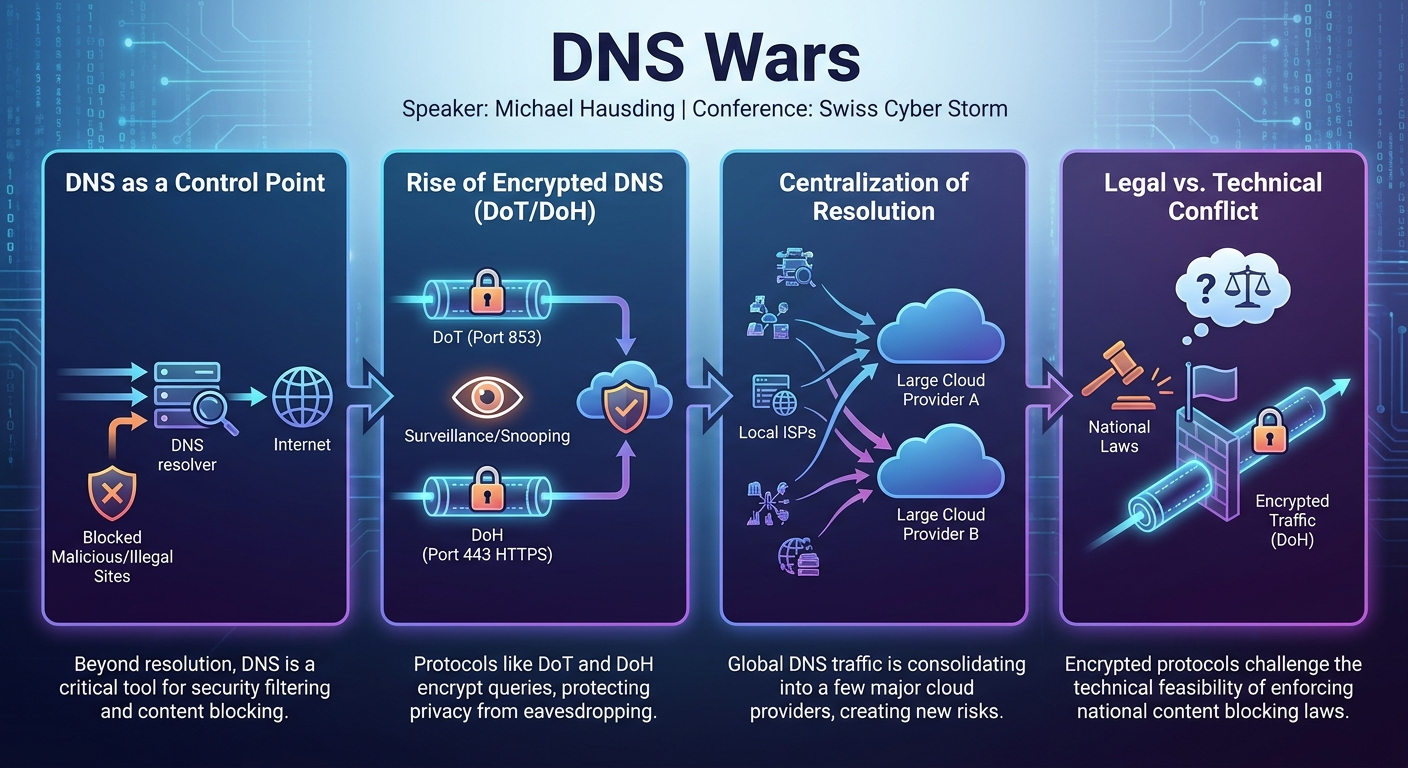
Beyond mere domain-to-IP resolution, DNS resolvers have evolved into powerful control points within networks. For about a decade, they have been leveraged as DNS firewalls, using simple lists of domain names to monitor or block connections to malicious sites, such as botnet command-and-control servers or phishing domains. This technique is highly efficient and widely deployed, even mandated by law in some countries; for instance, Switzerland's gambling law requires ISPs to block unlicensed online casinos via DNS. However, this reliance on DNS as a control mechanism is precisely what new encrypted protocols threaten to undermine.
Furthermore, DNS resolvers are invaluable sources of intelligence. Passive DNS technology collects non-client-identifying data exchanged between recursive and authoritative servers, offering insights into new domain registrations, IP address mappings, timestamps of first use, and request magnitudes—all crucial for incident response and identifying botnet spread. While the speaker notes that user behavior tracking is technically possible by observing operating system traffic to resolvers, European privacy regulations typically prevent ISPs from recording this data, though some non-European operators (like those adhering to Mozilla's policy) may retain it for short periods. This dual role of DNS—as both a foundational service and a potent surveillance/control tool—sets the stage for the current "DNS Wars."
Key Findings
▶ Watch: Snowden's revelations push for encrypted DNS (DoH/DoT) (9:45)
Michael Hausding's talk underscores several critical findings that illustrate the profound transformation underway in the DNS landscape:
Firstly, the speaker highlights the rapid and irreversible trend towards encrypted DNS. Driven by increased awareness of privacy vulnerabilities (exacerbated by mass surveillance revelations), both DNS over TLS (DoT) and DNS over HTTPS (DoH) are gaining significant traction. Hausding predicts that "in five years, most of the unencrypted traffic will be gone," signalling a fundamental shift in how DNS queries are handled. This move fundamentally alters the security and privacy posture of internet users, making DNS snooping much more difficult for passive observers.
Secondly, the talk reveals a concerning consolidation and centralization of DNS resolution services into the hands of a few large cloud providers. Data from the Open Observatory of Network Interference (OONI) indicates that approximately 53% of DNS queries currently go to Google's public DNS, with another 15% directed to Cloudflare. This trend is reinforced by network outages, which often prompt users to switch to reliable public resolvers, and by the fact that these large providers were the first to implement and promote encrypted DNS protocols. This centralization raises significant questions about single points of failure, the concentration of user data, and the potential for these few entities to exert undue influence over internet access and content.
Thirdly, Hausding articulates the political and legal ramifications of encrypted DNS and resolver centralization. Governments, like those in the UK and Switzerland, are actively concerned about losing control over national internet infrastructure and the ability to enforce legal mandates (such as content blocking for gambling or child pornography). DoH, in particular, is designed to be unblockable, effectively bypassing traditional network-level controls. This creates a direct conflict between national legal frameworks and the technical architecture of the internet, forcing a re-evaluation of how digital sovereignty is maintained in an increasingly globalized and encrypted online environment.
Finally, the talk emphasizes the critical importance of trust and user choice. With DNS resolvers gaining unprecedented visibility into user activity, selecting a trustworthy provider becomes paramount. Users and network operators now face a complex decision: continue with their ISP's resolver (which might be subject to local laws and offer less privacy), or switch to a global cloud provider (which offers encryption but might be subject to foreign laws and data retention policies). This choice directly impacts an individual's privacy, a network's security posture, and a nation's ability to regulate online content.
Technical Deep Dive
▶ Watch: DNS over HTTPS (DoH) breaks network controls and blocking (13:00)
The core of the "DNS Wars" lies in the technical evolution of the DNS protocol and the architectural shifts it enables. Traditionally, DNS resolution involves a stub resolver on a client device sending queries to a recursive DNS resolver, which then queries authoritative servers to resolve domain names to IP addresses. Hausding focuses on the recursive resolver's role, highlighting its transformation from a simple lookup service to a powerful network control point.
DNS Firewalls exemplify this control. These are implemented on recursive resolvers using simple lists to monitor or block specific domain names. This mechanism is effective for preventing connections to known malicious sites (e.g., botnet C2s, phishing domains) and is widely adopted by ISPs and enterprises. In Switzerland, this technique is legally mandated for blocking unlicensed gambling sites, demonstrating its real-world impact on content filtering. However, the speaker notes a crucial vulnerability: if an ISP (like Salt) outsources its DNS resolution to a third party (like Google), it loses the ability to implement these DNS-level blocks and must resort to less efficient IP-based blocking.
Another significant technical application is Passive DNS. This involves collecting metadata from DNS queries and responses exchanged between recursive and authoritative servers. Critically, this data collection typically excludes client IP addresses to mitigate privacy concerns. Passive DNS databases are invaluable for security intelligence, allowing responders to:
- Identify newly registered or suspicious domain names.
- Map domain names to IP addresses and vice versa, revealing co-hosted malicious sites.
- Track timestamps of domain usage, aiding in incident timelines.
- Gauge the magnitude of requests for a domain, which can indicate the spread of a botnet within a network.
The central technical battleground, however, is encrypted DNS. Triggered by privacy concerns, the IETF's DNS Privacy working group introduced two primary protocols:
- DNS over TLS (DoT): This protocol encrypts DNS queries using TLS (Transport Layer Security) and typically runs on a dedicated port, TCP port 853. DoT is considered less controversial because its dedicated port makes it identifiable to network operators, allowing for network-level policies if needed. It often operates as an "opportunistic encryption," where an operating system (like Android 9 or 10) detects if a configured DNS resolver supports DoT and automatically upgrades the connection.
- DNS over HTTPS (DoH): This more controversial protocol encrypts DNS queries by tunneling them over HTTPS, typically on TCP port 443. DoH is designed to blend seamlessly with regular web traffic, making it extremely difficult for network operators to identify, block, or redirect without disrupting all HTTPS traffic. This "unblockable" nature is precisely why it causes friction with governments and enterprises.
Crucially, Hausding emphasizes that neither DoT nor DoH inherently provides DNSSec protection. While they encrypt the traffic between the client and the recursive resolver (confidentiality), they do not guarantee the integrity of the response from the authoritative server to the recursive resolver. DNSSec remains necessary for cryptographic validation of DNS records.
The implementation strategies for DoH/DoT by major browser vendors further highlight the centralization trend:
- Firefox has begun making DoH the default for a small percentage of US users, directing their queries to Cloudflare's 1.1.1.1 resolver, effectively bypassing the user's ISP.
- Chrome employs a different approach: if it detects that the system's configured DNS resolver is already a known public provider (e.g., Google, Cloudflare, Quad9, OpenDNS), it performs a protocol upgrade to DoH/DoT directly to that same provider. This changes the protocol but not the resolver, thus not directly contributing to new centralization but solidifying existing choices.
The market consolidation is stark, with OONI data suggesting over two-thirds of observed DNS traffic flowing to Google (53%) and Cloudflare (15%). Google alone reported handling 1.2 trillion DNS requests daily by the end of 2018. This trend is fueled by network outages, which push users towards reliable public resolvers, and the technical expertise required to run robust DNS infrastructure, which smaller entities may lack. The interplay of these technical advancements and market dynamics forms the complex "DNS Wars" landscape.
Demo / Proof of Concept
▶ Watch: Browser vendors making DoH default by design (20:00)
While Michael Hausding's talk is rich in technical detail and analysis, it does not include a live demonstration or a proof of concept of the discussed technologies. Instead, the speaker focuses on explaining the underlying mechanisms of traditional and encrypted DNS, illustrating their real-world implications through examples like the Swiss gambling law, browser implementations, and market data. The content is presented as a comprehensive overview of the current state and future trajectory of DNS, rather than a showcase of specific tools or exploits.
Defensive Implications
▶ Watch: Q&A: Data ownership, privacy, and legal blocking (27:45)
The shifts in DNS outlined by Michael Hausding carry profound implications for network defenders, necessitating a re-evaluation of traditional security postures and control mechanisms.
Firstly, the widespread adoption of encrypted DNS protocols, particularly DoH, significantly diminishes network visibility. When user DNS queries are encapsulated within HTTPS traffic on port 443, network operators lose the ability to easily inspect, log, or filter these requests. This directly impacts the effectiveness of traditional DNS firewalls used for blocking malware, phishing, and botnet C2 communications. Enterprises relying on internal DNS resolvers for split-horizon DNS (where internal domains resolve differently than external ones) will find this functionality broken if users or applications bypass their internal resolvers in favor of external DoH providers. Defenders must acknowledge this loss of control and explore alternative security layers, such as endpoint protection that can inspect encrypted traffic or enforce specific DNS configurations.
Secondly, the centralization of DNS resolution to a few major cloud providers presents both opportunities and risks. While providers like Quad9 offer security features by blocking known malicious domains, relying solely on external resolvers means an organization's DNS traffic (and thus, a significant indicator of compromise) is visible to a third party. Defenders must carefully vet the privacy policies, security practices, and legal jurisdictions of any external DNS resolver they permit or recommend. For organizations operating under strict data sovereignty laws (like those in Europe), using US-based resolvers could expose sensitive metadata to foreign legal frameworks.
Thirdly, network operators, especially ISPs, face a direct challenge to their ability to enforce legal blocking mandates. If users opt for DoH resolvers that are not subject to national laws (e.g., Google or Cloudflare bypassing Swiss gambling laws), the effectiveness of these regulations is undermined. ISPs and national CERTs may need to adapt by offering their own DoT/DoH services that comply with local regulations, as Switch and other Swiss entities are already experimenting with. Alternatively, policy discussions may need to shift towards alternative blocking mechanisms or legislative changes that address encrypted traffic.
Finally, defenders must educate users and internal stakeholders about the importance of DNS resolver choice and trust. Every DNS query reveals intent, and the chosen resolver sees every website a user attempts to visit. Organizations should establish clear policies regarding DNS configuration, potentially deploying their own internal DoT/DoH resolvers (as Switch does for its network) or configuring browsers to use specific, approved external resolvers. The goal is to ensure that DNS traffic aligns with the organization's security, privacy, and compliance requirements, rather than being dictated by default browser settings or user preferences for convenience.
Key Takeaways
- DNS is a Critical Control Point: Beyond simple address resolution, DNS resolvers are powerful tools for network monitoring, threat detection, and enforcing legal content blocking, making them a contested resource.
- Encrypted DNS is the New Standard: Protocols like DoT and DoH are rapidly gaining adoption, driven by privacy concerns and the need to protect DNS queries from surveillance, fundamentally changing network visibility.
- Centralization is a Major Trend: A significant portion of global DNS traffic is consolidating with a few large cloud providers (e.g., Google, Cloudflare), raising concerns about single points of failure, data concentration, and foreign legal jurisdiction.
- National Laws vs. Technical Reality: Encrypted DNS, particularly DoH, challenges national legal frameworks for content blocking and network control, creating a conflict between technical design and regulatory mandates.
- Trust in Your Resolver is Paramount: The chosen DNS resolver sees all user browsing activity. Users and network operators must carefully evaluate the privacy policies, security practices, and legal obligations of their DNS provider.
- Choices Have Consequences: Both users and network operators have choices regarding DNS resolvers, but these decisions have profound implications for privacy, security, compliance, and national sovereignty.
About the Speaker(s)
Michael Hausding is the DNS Lead at Switch, an organization that plays a critical role in the Swiss internet infrastructure. In this capacity, he is responsible for DNS operations and addressing DNS abuse. Hausding notes that while for the first decade of his career DNS was a relatively "boring" subject, the last two years have seen a dramatic increase in interest and evolution within the DNS landscape, particularly concerning new protocols, privacy, and political implications. His expertise spans the technical intricacies of DNS, its security implications, and the broader policy and legal challenges it presents.
Reviews
Dr. Zero (Offensive Security Researcher) — SOLID
A competent, operator-level overview of how encrypted DNS (DoH/DoT) is breaking traditional network security controls. Hausding speaks from the trenches of running national infrastructure, providing a sobering look at consolidation, even if the debate itself is well-tread territory.
Heather Calloway (CISO) — STRONG ACCEPT
Hausding maps out the exact collision course between encrypted DNS protocols and enterprise network control. If your security architecture relies on DNS firewalls to catch C2 beacons or enforce split-horizon routing, this talk explains why that capability is evaporating. This is mandatory context for the network engineering and architecture teams before they finalize next year's endpoint strategy.