Recent Initiatives in Research and Education
Prof. Dr. Endre Bangerter (Researcher · Bern University of Applied Sciences), Prof. Dr. Bruce Nikkel (Head of Forensics and Investigation · UBS)
Swiss Cyber Storm 2019 · Day 1 · Management
Overview
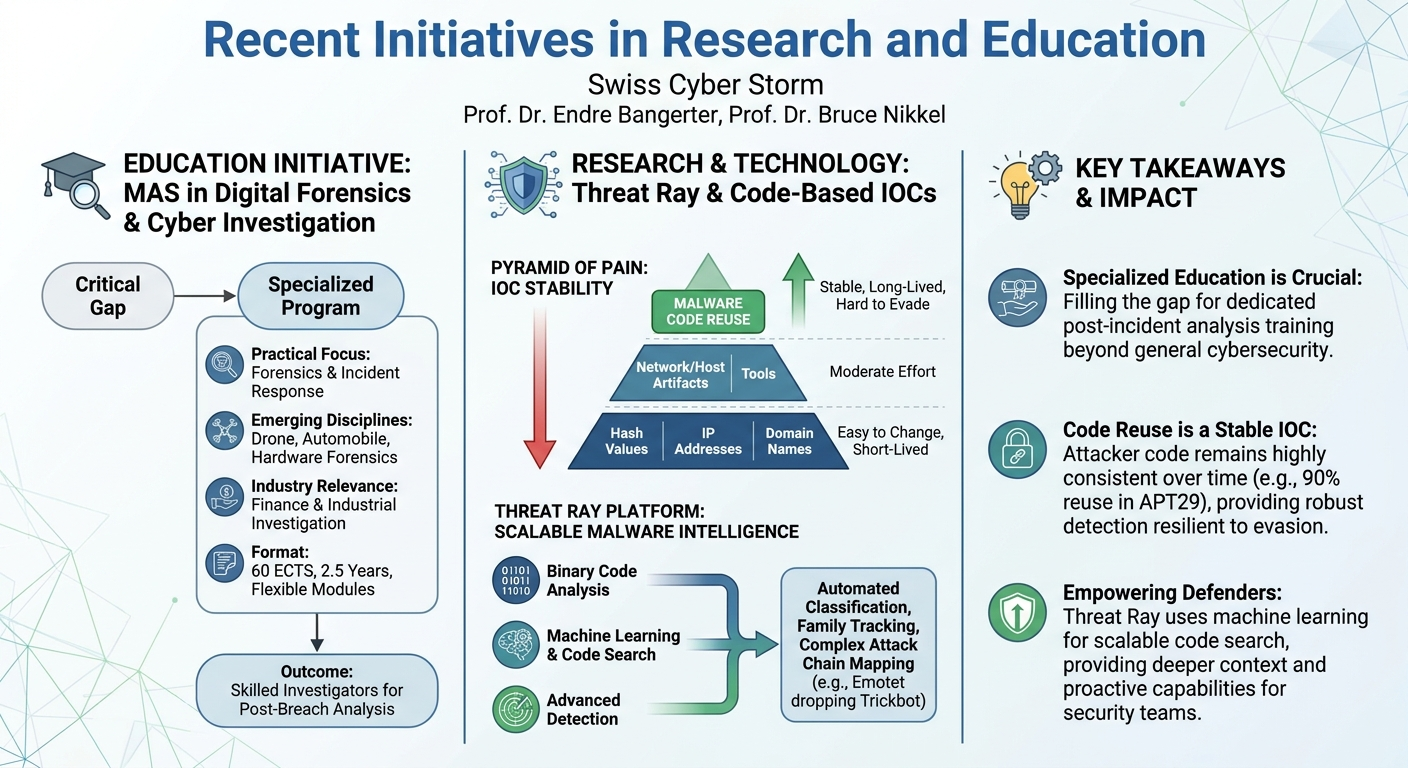
This talk, delivered by Prof. Dr. Bruce Nikkel and Prof. Dr. Endre Bangerter, outlines two significant initiatives emerging from the Bern University of Applied Sciences (BFH) that address pressing challenges in the cybersecurity landscape. Prof. Nikkel introduces a pioneering Master of Advanced Studies (MAS) program in Digital Forensics and Cyber Investigation, designed to bridge a critical educational gap by focusing intensely on the practical aspects of digital forensics and incident response, rather than broad cybersecurity defense. This program stands out by incorporating highly specialized and emerging forensic disciplines, such as drone and automobile forensics, alongside traditional components.
Key moments
- 1:00 New Master's in Digital Forensics and Cyber Investigation
- 2:00 Unique modules: drone, auto, hardware, finance forensics
- 4:40 Introducing ThreatRay: a new malware intelligence platform
- 7:00 Code reuse as a stable, long-lived IOC
- 8:30 ThreatRay's advanced code search at scale technology
- 13:30 Demo: Identifying Emotet and Trickbot malware families
- 17:50 ThreatRay's commercial model and value proposition
Recent Initiatives in Research and Education
Speakers: Prof. Dr. Endre Bangerter (Researcher, Bern University of Applied Sciences); Prof. Dr. Bruce Nikkel (Head of Forensics and Investigation, UBS)
Conference: Swiss Cyber Storm
YouTube: https://www.youtube.com/watch?v=mtHZefYJiLo
Overview
This talk, delivered by Prof. Dr. Bruce Nikkel and Prof. Dr. Endre Bangerter, outlines two significant initiatives emerging from the Bern University of Applied Sciences (BFH) that address pressing challenges in the cybersecurity landscape. Prof. Nikkel introduces a pioneering Master of Advanced Studies (MAS) program in Digital Forensics and Cyber Investigation, designed to bridge a critical educational gap by focusing intensely on the practical aspects of digital forensics and incident response, rather than broad cybersecurity defense. This program stands out by incorporating highly specialized and emerging forensic disciplines, such as drone and automobile forensics, alongside traditional components.
Complementing the educational endeavor, Prof. Bangerter presents Threat Ray, a newly founded spin-off from BFH focused on advanced malware intelligence. Threat Ray aims to revolutionize malware detection and classification by leveraging cutting-edge research in binary code analysis and machine learning. The core innovation lies in its ability to identify and track malware families based on code reuse, offering a robust and long-lived Indicator of Compromise (IOC) that is significantly harder for attackers to evade compared to traditional methods like file hashes or IP addresses. This platform promises to provide security professionals with an unparalleled ability to understand, classify, and respond to evolving cyber threats at scale.
The dual presentation highlights a holistic approach to enhancing cybersecurity capabilities: by nurturing skilled investigators through specialized education and by arming defenders with sophisticated, research-backed tools for threat analysis. Both initiatives underscore a commitment to addressing specific, often overlooked, areas within the cyber domain, promising to deliver tangible benefits to law enforcement, corporate security teams, and the broader threat intelligence community. The emphasis on practical application, whether through hands-on investigative training or real-world malware identification, positions these efforts as crucial advancements in the ongoing fight against cybercrime.
Background
▶ Watch: New Master's in Digital Forensics and Cyber Investigation (1:00)
The genesis of both initiatives presented by Prof. Nikkel and Prof. Bangerter stems from identified gaps and persistent challenges within the cybersecurity ecosystem. For the educational component, Prof. Nikkel highlighted a pervasive trend in academia where new "cyber programs" are emerging rapidly, often broadly labeled as "cyber security" or "cyber defense." However, a significant deficiency was observed in programs specifically tailored to digital forensics and cyber investigation. This oversight leaves a void for professionals seeking deep expertise in evidence collection, analysis, and incident reconstruction – skills critical for law enforcement, corporate incident response, and national security. The traditional focus on preventative measures often overshadows the equally vital reactive and investigative capabilities required post-breach.
On the threat intelligence front, Prof. Bangerter articulated the limitations of conventional Indicators of Compromise (IOCs) through the widely recognized "Pyramid of Pain" model. At the base of this pyramid are easily obtainable IOCs such as malware file hashes and IP addresses of Command and Control (C2) servers. While simple to generate and check, these IOCs are notoriously short-lived and trivial for attackers to modify or rotate. For instance, an attacker needs only to flip a single bit in a malware file to render its hash value useless for detection. Similarly, sophisticated botnets like TrickBot routinely change their C2 IP addresses every few days, making network-based IOCs quickly obsolete. This ease of evasion means that relying solely on these low-level IOCs inflicts minimal "pain" on adversaries, allowing them to adapt and persist with relative ease. The fundamental problem, therefore, is the lack of stable, long-lasting indicators that genuinely disrupt attacker operations and increase their operational costs. This background sets the stage for Threat Ray's innovative approach, which seeks to move higher up the Pyramid of Pain by focusing on the underlying malware code itself.
Key Findings
▶ Watch: Introducing ThreatRay: a new malware intelligence platform (4:40)
The talk reveals several key findings and innovative approaches in both cybersecurity education and malware intelligence.
Regarding education, the primary finding was the critical gap in specialized digital forensics and cyber investigation programs across global academia. While general cybersecurity programs are abundant, there's a distinct lack of curricula deeply focused on the methodologies and technologies required for post-incident analysis, evidence recovery, and legal investigation. This finding led to the development of the Master of Advanced Studies (MAS) in Digital Forensics and Cyber Investigation at Bern University of Applied Sciences, explicitly designed to fill this void with a curriculum that includes both traditional and novel forensic disciplines.
From the perspective of malware intelligence, Prof. Bangerter's research and the foundation of Threat Ray highlight a pivotal finding: malware code reuse is a highly prevalent and stable characteristic of advanced persistent threats (APTs) and criminal organizations over extended periods. Analysis of families like APT29 over five years demonstrated consistent code reuse, with some later samples incorporating up to 90% of code from earlier versions. This deep-seated reliance on existing codebases means that the underlying binary code of malware represents an extremely robust and long-lived Indicator of Compromise (IOC). Unlike ephemeral hashes or IP addresses, changing core code requires significant development effort and cost for attackers, thereby inflicting substantial "pain" and making code-based IOCs incredibly difficult to evade.
This finding underpins Threat Ray's core contribution: the development of advanced code search at scale technology. By leveraging machine learning techniques, Threat Ray can efficiently index and perform similarity searches across millions of binary samples. This capability allows for the reliable identification and classification of malware families, tracking their evolution, and detecting even subtly modified versions. The ability to automatically identify malware and its lineage through code analysis provides a level of certainty and longevity in threat intelligence that traditional IOCs cannot match, marking a significant advancement in the fight against sophisticated cyber adversaries.
Technical Deep Dive
▶ Watch: Code reuse as a stable, long-lived IOC (7:00)
The technical depth of this presentation spans two distinct, yet complementary, domains: advanced cybersecurity education and cutting-edge malware intelligence.
The Master of Advanced Studies (MAS) in Digital Forensics and Cyber Investigation is meticulously structured to provide a comprehensive and specialized education. Unlike generic cybersecurity offerings, this program is laser-focused on the investigative aspects of digital security. Core components include foundational areas such as disk forensics, memory forensics, network forensics, and mobile forensics. These modules cover the essential techniques for acquiring, preserving, and analyzing digital evidence from various sources. What truly distinguishes this program, however, are its inclusion of novel and emerging forensic disciplines. These include drone forensics, addressing the unique challenges of extracting data from unmanned aerial vehicles; automobile forensics, focusing on data stored in modern vehicle systems; and hardware forensics, delving into the analysis of physical components and embedded systems. Furthermore, recognizing the pervasive nature of cybercrime in financial sectors, a dedicated finance investigation component covers topics like cyber fraud, the analysis of virtual currencies, and the detection of banking Trojans. An industrial forensic module also caters to the growing need for incident response in critical infrastructure and operational technology (OT) environments. Structurally, the program is designed for accessibility and flexibility: it is a 60 ECTS credit program spread over two and a half years, comprising four semesters of taught modules and one semester dedicated to a thesis. All modules are taught in English and delivered in an intensive one-week format, allowing professionals from across Switzerland and Europe to attend specific modules without prolonged absence from work, and enabling international professors to contribute specialized expertise.
The technical core of Threat Ray revolves around its advanced code search at scale technology for binary code. This platform is essentially a "Google for code," capable of indexing and searching vast repositories of malware samples. The foundational principle is the identification of code reuse across different malware variants and families. As demonstrated with the APT29 family, attackers frequently reuse significant portions of their codebase over many years, making the code itself a stable and long-lived IOC. Threat Ray addresses the challenge of identifying modified or obfuscated code by employing a similarity search mechanism, rather than exact matching. This allows it to detect different versions of the same malware, even if minor modifications or compilation changes have occurred.
The critical technical hurdle for such a system is scalability. Searching binary code across hundreds of thousands or even millions of samples in a performant manner is computationally intensive. Threat Ray overcomes this by leveraging machine learning techniques. While the specific algorithms were not detailed, machine learning is generally employed here for efficient feature extraction, indexing, and similarity comparison, allowing the system to process massive datasets rapidly. Before the code search can commence, raw malware samples undergo initial pre-analysis steps, including unpacking and deobfuscation. These processes are crucial to expose the underlying, executable code that Threat Ray's algorithms then analyze. Once processed, the system can identify, classify, and detect malware families, providing detailed contextual information. The platform functions as a private repository, ensuring that uploaded samples and their analysis are not shared publicly, a key differentiator from some other malware analysis services. Furthermore, Threat Ray maintains a continuously updated pre-analyzed threat feed, ingesting tens of thousands, soon hundreds of thousands, of new samples daily. This allows users to correlate their local threat context with global threat intelligence, providing a comprehensive view of emerging threats and their relationships. The system can aggregate various IOCs, offering a rich dataset for security operations centers (SOCs) and incident response teams.
Demo / Proof of Concept
▶ Watch: Demo: Identifying Emotet and Trickbot malware families (13:30)
Prof. Bangerter provided a concise, yet impactful, video demonstration of the Threat Ray platform's capabilities, specifically showcasing its identification and classification features. The demo began by illustrating the submission of a malware sample for analysis, presenting an initial view akin to a traditional sandbox. This included standard outputs such as the list of processes executed during the sample's runtime.
However, the core distinction of Threat Ray was immediately evident when the demo moved to its unique labeling functionality. Leveraging its underlying code search technology, Threat Ray automatically labels individual processes with identified malware families. A particularly compelling example shown was the detection of a common attack chain: Emotet dropping TrickBot. The platform clearly identified the initial Emotet process and subsequently detected the TrickBot process that it spawned, providing a fully automated and accurate classification of both components. This highlights Threat Ray's ability to not only identify individual pieces of malware but also to understand and map complex, multi-stage attack methodologies.
The demonstration further emphasized the granular nature of Threat Ray's analysis. For each running process, the system can pinpoint and label specific code regions that are known to belong to a particular malware family. This fine-grained identification allows security analysts to understand exactly what malicious code is executing within a process, rather than just a general verdict. Crucially, the platform also flags unknown code regions. This feature is particularly valuable as it can highlight potentially novel or zero-day components that Threat Ray has not previously encountered, allowing analysts to focus their attention on truly new threats that might otherwise go undetected by signature-based or known-behavior analysis. The demo effectively conveyed how Threat Ray provides a deep, contextual understanding of malware execution, moving beyond superficial indicators to reveal the underlying code and its lineage.
Defensive Implications
▶ Watch: ThreatRay's commercial model and value proposition (17:50)
The initiatives presented by Professors Nikkel and Bangerter carry profound defensive implications for organizations, law enforcement, and the broader cybersecurity community.
For defenders in organizations and law enforcement, the new MAS program in Digital Forensics and Cyber Investigation offers a critical pathway to developing highly specialized skills. As cyberattacks grow in sophistication, the ability to effectively investigate breaches, collect digital evidence, and reconstruct attack timelines is paramount. Investing in personnel trained through such a program ensures that organizations can mount robust incident response efforts, understand the full scope of an attack, and potentially pursue legal action. The inclusion of niche areas like drone, automobile, and industrial forensics also prepares defenders for emerging threat vectors that often fall outside traditional cybersecurity training. This proactive investment in human capital directly strengthens an organization's post-breach resilience and investigative capacity.
Threat Ray's malware intelligence platform provides defenders with an entirely new level of capability for identifying, classifying, and tracking threats. The shift from ephemeral IOCs to long-lived, code-based indicators means that security teams can achieve far more reliable and persistent detection.
- Enhanced Detection and Classification: Defenders can confidently identify malware families, even when attackers employ common evasion techniques like minor modifications or repackaging. This allows for more accurate threat intelligence and better-informed defensive strategies.
- Tracking Adversary Toolsets: By identifying code reuse, security operations centers (SOCs) and threat intelligence teams can track the evolution of specific adversary toolsets over years, understanding their development cycles and identifying links between seemingly disparate campaigns. This helps build a more comprehensive picture of threat actors' capabilities and intentions.
- Improved Incident Response: When an unknown executable is encountered, Threat Ray can quickly provide context – identifying it as a known family (e.g., Emotet, TrickBot) or, crucially, as unknown code. This rapid contextualization accelerates incident response, allowing teams to prioritize and allocate resources more effectively. The ability to automatically detect complex attack chains, such as Emotet dropping TrickBot, provides immediate clarity on the nature of an ongoing compromise.
- Global and Local Threat Context: The platform's ability to correlate local incidents with its extensive pre-analyzed global threat feed is invaluable. Defenders can determine if a threat observed internally is part of a wider campaign, or if it represents a unique, targeted attack. This enriched context aids in strategic defense planning and resource allocation.
- Proactive Defense: By understanding the underlying code of malware, defenders can generate more robust and resilient detection rules that are harder for attackers to bypass. This moves beyond reactive signature-based defenses to a more proactive, behavior- and code-centric approach. The identification of "unknown code" also serves as an early warning system for potentially novel exploits or zero-day attacks, allowing defenders to initiate deeper analysis.
- Cost Efficiency: By making it harder for attackers to evade detection (forcing them to rewrite code), Threat Ray increases the operational costs for adversaries, potentially deterring less committed groups.
In essence, Threat Ray empowers defenders to move higher up the "Pyramid of Pain," making it significantly more difficult and expensive for attackers to operate, while the MAS program ensures a pipeline of skilled professionals to leverage such advanced tools.
Key Takeaways
- Specialized Digital Forensics Education is Crucial: There is a significant and underserved need for academic programs explicitly focused on digital forensics and cyber investigation, beyond general cybersecurity defense. The MAS program at BFH aims to fill this gap with a unique curriculum.
- Code Reuse is a Stable, Powerful IOC: Attackers, including APTs, consistently reuse large portions of their malware code over extended periods (e.g., 90% code reuse over 5 years for APT29). This makes malware code a highly robust and long-lived Indicator of Compromise, far more resilient to evasion than hashes or IP addresses.
- Threat Ray Revolutionizes Malware Identification at Scale: The spin-off Threat Ray leverages machine learning for "code search at scale," enabling efficient similarity searches across millions of binary samples. This technology allows for reliable identification, classification, and tracking of malware families, even when samples are modified.
- Granular Detection of Complex Attack Chains: Threat Ray's platform can automatically detect and label processes and specific code regions, providing deep insight into malware execution. It can identify complex attack methodologies, such as Emotet dropping TrickBot, and highlight "unknown code" for further investigation.
- Empowering Defenders with Deeper Context: The platform offers security teams a private repository for analysis, correlates local threats with a vast global threat feed, and generates robust, code-based IOCs. This provides comprehensive context for incident response, threat intelligence, and proactive defense strategies, increasing the operational cost for adversaries.
About the Speaker(s)
Prof. Dr. Bruce Nikkel serves as the Head of Forensics and Investigation at UBS, a leading global financial services company. In addition to his corporate role, he is also associated with the Bern University of Applied Sciences (BFH). His background in the finance industry provides him with unique insights into the specific challenges of cyber fraud, virtual currencies, and banking Trojans, which are reflected in the curriculum of the new Master of Advanced Studies program he introduced.
Prof. Dr. Endre Bangerter is a dedicated researcher at the Bern University of Applied Sciences (BFH). He is also a co-founder of Threat Ray, a spin-off company focused on malware intelligence. His work centers on researching novel technologies for cyber defense, particularly in the domain of advanced malware analysis and the development of robust Indicators of Compromise through code-based approaches. His research forms the technological foundation for the Threat Ray platform.
Reviews
Dr. Zero (Offensive Security Researcher) — WEAK
This isn't a research presentation. It's a two-part infomercial for a Swiss university degree and a commercial threat intel spin-off. There are absolutely zero actionable takeaways here for practitioners unless you plan on buying their product or enrolling in their school.
Heather Calloway (CISO) — WEAK
This session is a split brochure for a university degree and a malware analysis spin-off. While the underlying concept of tracking adversaries via code reuse is valid, there is nothing here that warrants executive attention.