Yes We Scan! Automating Application Security
Malte Kushnir (Researcher in Information Security · Zurich University of Applied Science)
Swiss Cyber Storm 2019 · Day 1 · Management
Overview
In his Swiss Cyber Storm talk, "Yes We Scan! Automating Application Security," Malte Kushnir, a researcher in Information Security at the Zurich University of Applied Science (ZHAW) and former penetration tester, delves into the critical shortcomings of traditional application security approaches. Kushnir argues that despite significant investments in security controls – from developer training to penetration testing and security appliances – organizations continue to fall victim to breaches at an alarming rate. His presentation highlights that the fundamental issue lies in the inability of current security paradigms to keep pace with the speed and scale of modern software development and deployment.
Key moments
- 0:00 Introduction and the limitations of manual security
- 2:00 Why traditional security approaches are failing organizations
- 4:00 Key research findings: Unknown attack surface and low-hanging fruits
- 6:00 Why manual testing struggles with scale and effectiveness
- 7:40 Automating security: Continuous testing and monitoring
- 9:40 Tackling automation challenges: False positives and business logic
- 12:00 Check out Scanmeter.io for practical automation solutions
Yes We Scan! Automating Application Security
Speakers: Malte Kushnir, Researcher in Information Security, Zurich University of Applied Science
Conference: Swiss Cyber Storm
YouTube: https://www.youtube.com/watch?v=IpdvS9aRV5U
Overview
In his Swiss Cyber Storm talk, "Yes We Scan! Automating Application Security," Malte Kushnir, a researcher in Information Security at the Zurich University of Applied Science (ZHAW) and former penetration tester, delves into the critical shortcomings of traditional application security approaches. Kushnir argues that despite significant investments in security controls – from developer training to penetration testing and security appliances – organizations continue to fall victim to breaches at an alarming rate. His presentation highlights that the fundamental issue lies in the inability of current security paradigms to keep pace with the speed and scale of modern software development and deployment.
Kushnir's insights are not merely theoretical; they are grounded in practical experience derived from joint ventures with security startups in Zurich, where his research team tests and validates their security automation approaches in real-world scenarios. The talk focuses on empirical observations revealing that many companies operate with a dangerously incomplete understanding of their own attack surface and remain vulnerable to easily exploitable "low-hanging fruits." This article explores Kushnir's analysis of these systemic failures and presents his compelling case for the indispensable role of automation in transforming application security from a reactive, bottlenecked process into a continuous, scalable, and effective defense mechanism.
Background
▶ Watch: Introduction and the limitations of manual security (0:00)
The landscape of application security is fraught with challenges, as evidenced by a continuous stream of high-profile breaches. Malte Kushnir frames the current state of affairs by enumerating common security practices: educating developers on secure coding, conducting annual or semi-annual penetration tests, implementing bug bounty programs, and deploying security appliances like Web Application Firewalls (WAFs) or Intrusion Prevention Systems (IPS). While these measures are individually beneficial, Kushnir contends that they often fail to integrate cohesively or address the root causes of modern security vulnerabilities, leading to a false sense of security.
Kushnir underscores this failure with examples of major hacks from 2019, including supply chain attacks like the one against Asus, and the breach at Capital One. The latter, he notes, is particularly illustrative, as Capital One was widely recognized for its robust security investments. Yet, it fell victim to an attacker who was "not your APT Russian Chinese North Korean hacker with the big infrastructure and a lot of time," but rather a "casual hacker" who publicly shared her exploits. This scenario starkly highlights that even organizations "doing a lot of things right" are vulnerable, often not to sophisticated zero-day exploits, but to more fundamental oversights.
Through extensive proof-of-concept (PoC) runs conducted with a security startup, Kushnir's research at ZHAW has identified three primary reasons why existing security controls are failing:
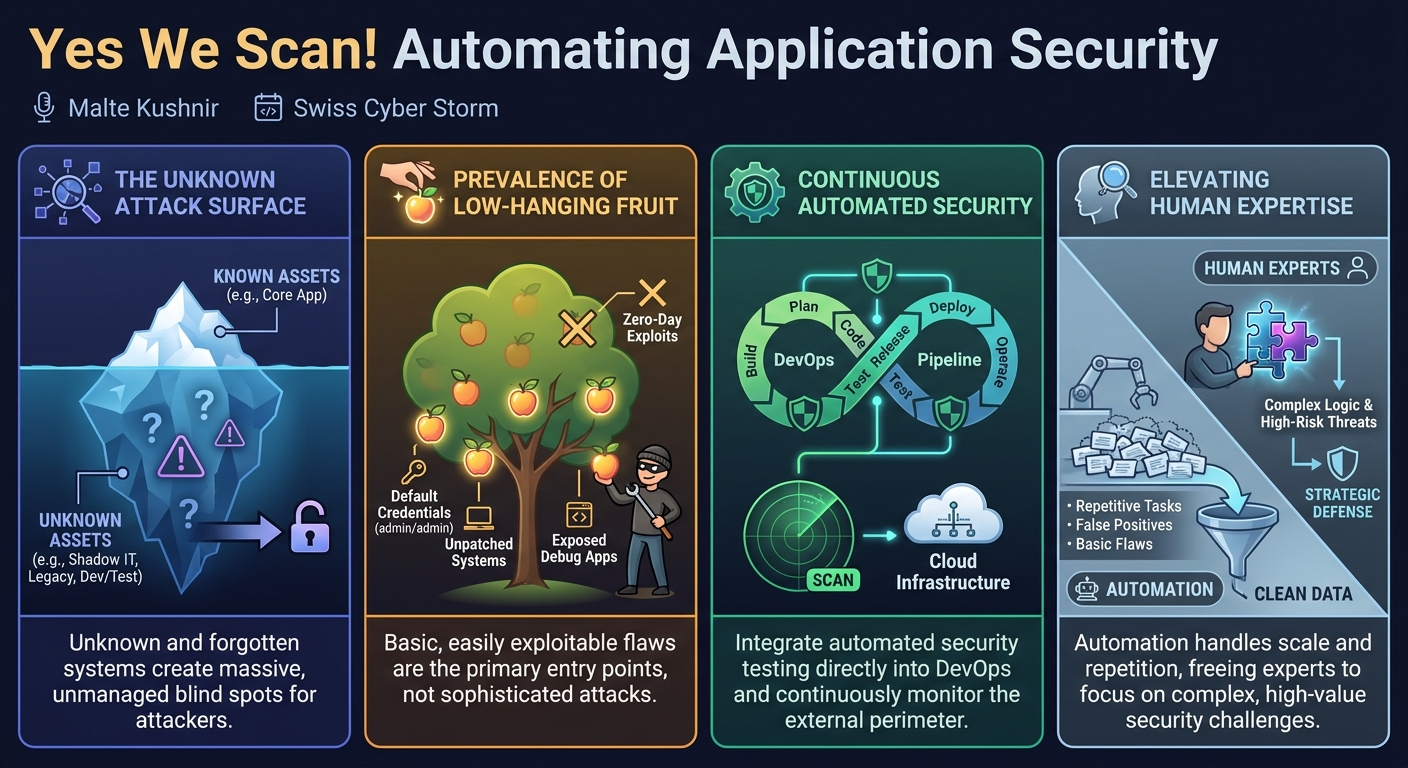
- Unknown Attack Surface: A pervasive issue is that many companies simply do not know the full extent of their exposed assets. The PoC runs consistently uncovered exposed development and test systems, forgotten legacy applications, and a significant number of systems completely unknown to IT or security departments. Kushnir provides a striking statistic: for every three systems IT knew about, there was one system they were unaware of. These unmanaged systems are often unpatched and excluded from any security controls, presenting significant blind spots for attackers to exploit.
- Prevalence of Low-Hanging Fruits: Despite decades of security awareness, basic vulnerabilities remain widespread. Kushnir's team consistently found default credentials (e.g., "admin/admin"), exposed debug and test applications, and unpatched systems in externally facing infrastructures. He emphasizes that attackers rarely resort to "super sophisticated zero-day exploits" as a first resort; instead, they commonly leverage these easily discoverable weaknesses, such as "admin admin on some kind of externally exposed web panel in a debug application" to gain initial access.
- Limitations of Manual Testing: The traditional reliance on manual penetration testing struggles to cope with the scale and complexity of modern application portfolios. Kushnir posits that many companies manage "hundreds of web applications externally facing in the Internet." With an estimated "five project days" required for a comprehensive manual web application test, securing 100 applications would demand 500 project days. This translates into prohibitive costs, particularly in regions like Switzerland with high daily rates for security consultants, making comprehensive manual testing economically unfeasible for most organizations. Furthermore, manual testers frequently get "caught up in all this low-hanging fruits," spending valuable time reporting easily discoverable issues, which leaves insufficient time to uncover more "hidden wounds" or complex business logic flaws. Consequently, organizations often do not receive the depth of security insight they expect from their penetration testing investments.
These systemic problems underscore the urgent need for a paradigm shift in how application security is approached, moving beyond reactive, manual efforts to more proactive, scalable, and integrated solutions.
Key Findings
▶ Watch: Key research findings: Unknown attack surface and low-hanging fruits (4:00)
Malte Kushnir's research and practical engagements have yielded critical insights into the real-world state of application security, directly challenging the efficacy of conventional methods. The core findings from his team's proof-of-concept (PoC) runs with various companies reveal fundamental gaps that automation aims to address:
Firstly, a significant and pervasive issue is the undiscovered attack surface. Kushnir highlights that nearly every PoC run uncovered systems unknown to the organization's IT or security teams. These included:
- Exposed development and test systems: Often left publicly accessible without proper security hardening.
- Forgotten legacy systems: Old applications or services that are still running but are no longer actively maintained or monitored.
- Shadow IT: Systems deployed by various departments without the knowledge or oversight of central IT or security.
The magnitude of this problem is stark: for every three systems IT knew about, his team discovered one system they had no knowledge of. These unknown assets represent critical blind spots, as they are typically unpatched, unmonitored, and therefore highly vulnerable to exploitation.
Secondly, the talk emphatically points to the enduring prevalence of low-hanging fruits in externally facing infrastructures. Despite decades of security awareness and best practice guidelines, basic, easily exploitable vulnerabilities are still rampant. Kushnir's team consistently identified:
- Default credentials: Instances of "admin/admin" or similar weak, default usernames and passwords on publicly accessible interfaces.
- Debug and test applications: Functionality or entire applications meant for internal development or testing purposes that are inadvertently exposed to the internet.
- Unpatched and forgotten systems: Vulnerable software versions that have known exploits but have not been updated due to lack of awareness or neglect.
Kushnir stresses that these are not theoretical vulnerabilities but the actual entry points for many successful breaches. Attackers, he explains, typically gain initial access not through "super sophisticated zero-day exploits," but by simply trying common default credentials on exposed web panels or exploiting known weaknesses in forgotten systems.
Thirdly, and as a direct consequence of the first two findings, manual security testing is fundamentally incapable of handling the scale and complexity of modern attack surfaces. Kushnir illustrates this with the practical reality of many companies having "hundreds of web applications externally facing in the Internet." If a single manual web application test consumes approximately "five project days," securing 100 applications would demand 500 project days – an exorbitant cost for most organizations. Moreover, manual testers are often overwhelmed by the sheer volume of "easy things" or low-hanging fruits they discover. The necessity to report these basic findings consumes a significant portion of their project time and budget, leaving insufficient opportunity to delve into more complex vulnerabilities, business logic flaws, or deeper architectural weaknesses. This means that while manual testing can identify immediate, obvious issues, it often fails to provide a comprehensive and deep security assessment, especially against a vast and dynamic attack surface.
These findings collectively paint a picture of a security industry struggling with fundamental visibility, basic hygiene, and scalability, setting the stage for Kushnir's advocacy for intelligent automation as a necessary evolution.
Technical Deep Dive
▶ Watch: Why manual testing struggles with scale and effectiveness (6:00)
Malte Kushnir's solution to the pervasive challenges in application security centers on intelligent automation, specifically targeting two critical areas: continuous application security testing and continuous security monitoring. His research at ZHAW, in collaboration with industry partners, focuses on developing and refining tools that integrate security deeply into the development lifecycle and operations.
The first pillar is Continuous Application Security Testing (CAST), which aims to embed security directly into DevOps workflows. The core idea is to shift security left, enabling organizations to "plug security deeply into DevOps" by "testing every code commit directly for security." This approach ensures that security vulnerabilities are identified and remediated early in the development cycle, rather than being discovered much later during a pen test or, worse, after a breach. Kushnir mentions that his team has developed an "engine" capable of performing precisely this function, allowing for automated security checks to be triggered with each code change. This integration helps address the speed disparity between developers and security engineers, allowing security to keep pace with rapid development cycles.
The second pillar is Continuous Security Monitoring. This involves regularly scanning an organization's "externally facing interfacing architecture." The primary benefit here is enhanced visibility. By continuously scanning, companies can gain an up-to-date understanding of their deployed assets, including systems deployed by other departments that might otherwise be unknown. This directly combats the "unknown attack surface" problem, ensuring that security teams are aware of all internet-accessible assets and can include them in their security controls. The goal is to eliminate "so many systems which you don't know about," providing a foundational layer of asset discovery and vulnerability management.
Kushnir acknowledges that automation is not a panacea and presents its own set of challenges, which his research actively addresses:
- False Positives: A common criticism of automated security scanning tools is the high number of false positive findings. These require manual triage, which can negate the efficiency gains of automation. Kushnir states that his team is "researching our focus on reducing this number of hats positives" and has achieved "quite good success with it by for example cross correlating the results of a lot of security tools." By combining and comparing findings from multiple scanning engines or methodologies, they can filter out erroneous alerts, allowing security engineers to concentrate on verified, actionable vulnerabilities. This multi-tool correlation approach is a key technical strategy for improving the signal-to-noise ratio in automated scanning.
- Vulnerability Classes Difficult for Automation: Automated tools historically struggle with certain types of vulnerabilities, particularly those related to business logic. These include complex authorization flaws, workflow manipulation, or specific application-level access control issues that require an understanding of the application's intended functionality. Kushnir admits that "everything connected with business logic is difficult for automated tools to find." However, this is also an active area of their research. He specifically mentions their efforts to "develop a solution for finding access control more abilities [vulnerabilities]," which are among the "most severe vulnerabilities" in many software products. While details on this solution are not provided, it indicates a focus on developing more intelligent, context-aware automation that can analyze application behavior beyond simple pattern matching.
Crucially, Kushnir emphasizes that automation is not intended to "replace human testers" but rather to "enhance humans." Developers can leverage automated feedback for "security as a service," fixing issues themselves. Security engineers can "concentrate their focus on on high-risk areas" instead of being bogged down by low-level findings. Even penetration testers benefit, as they "don't need to waste project time and this means also money on finding and reporting low-hanging fruit," allowing them to "really focus on the high wall your targets and the interesting stuff." The ultimate vision is a symbiotic relationship where automation handles the scale and repetitive tasks, freeing human experts to apply their specialized skills to complex, high-value security challenges.
As a tangible outcome of this research and development, Kushnir points to scanmeter.io, the website of a "joint venture we're doing with a start-up in Zurich where we're deploying parts of our research." This platform serves as a live product embodying their automated security principles.
Demo / Proof of Concept
▶ Watch: Tackling automation challenges: False positives and business logic (9:40)
While Malte Kushnir's talk did not feature a live, interactive demonstration of a specific tool or exploit, it extensively referenced proof-of-concept (PoC) runs as the empirical foundation for his arguments. These PoC runs were conducted as part of a joint venture between the Zurich University of Applied Science (ZHAW) and a security startup in Zurich, allowing Kushnir's team to "test all the things we develop and we develop in our research in the field."
The "demonstration" of their approach was therefore presented through the aggregated results and findings from these real-world engagements. Kushnir explained that these PoC runs served to validate their hypotheses about the failings of traditional security and the potential of automation. Specifically, these runs "show quite clearly why security and all the security controls we are all using and our companies are not working."
The outcomes of these PoC runs consistently revealed:
- Undiscovered Attack Surface: In every single run, the team found "expose death and test systems," "forgotten legacy systems," and "a lot of systems IT or security didn't know about it all." The ratio provided – one unknown system for every three known – powerfully illustrates the lack of visibility organizations face.
- Prevalence of Low-Hanging Fruit: The PoC runs invariably identified "default credentials," "debug and test applications," and "unpatched and forgotten systems" on externally facing infrastructures. This confirmed that basic vulnerabilities remain the primary entry points for attackers.
These findings were not theoretical but were derived from actively scanning and assessing actual company networks, thus serving as a practical validation of the problem statement. The methodology involved deploying their automated scanning approaches in a real-world context to discover vulnerabilities and map the attack surface.
Furthermore, Kushnir briefly mentioned scanmeter.io as a live product resulting from this research and joint venture. This platform is where "parts of our research" are being deployed, suggesting that it embodies the automated continuous application security testing and monitoring principles discussed in the talk. While not a live demo during the presentation, the existence of scanmeter.io signifies a practical implementation and ongoing "proof of concept" of their automated security solutions in a production environment.
Defensive Implications
▶ Watch: Check out Scanmeter.io for practical automation solutions (12:00)
Malte Kushnir's research and recommendations carry significant defensive implications for organizations grappling with application security. His insights call for a fundamental shift from reactive, periodic security checks to a proactive, continuous, and automated security posture.
Firstly, organizations must prioritize continuous asset discovery and attack surface management. Given Kushnir's finding that "many companies just don't know there are tech surface" – with one unknown system for every three known – security teams need to implement automated solutions for regularly scanning and mapping their entire external footprint. This includes identifying development and test environments, forgotten legacy systems, and shadow IT. Tools capable of continuous security monitoring, as discussed, are essential to maintain an up-to-date inventory and eliminate blind spots.
Secondly, defenders must recognize and efficiently address low-hanging fruits. The consistent discovery of default credentials, exposed debug applications, and unpatched systems indicates a need for automated vulnerability management systems that can quickly identify and flag these basic, yet critical, vulnerabilities. Prioritizing remediation efforts on these easily exploitable issues can significantly reduce an organization's risk profile. Automated scans should be configured to specifically look for common misconfigurations and default settings, and integrate with ticketing systems for rapid developer notification and fix.
Thirdly, the integration of Continuous Application Security Testing (CAST) into DevOps is paramount. By "plugging security deeply into DevOps" and "testing every code commit directly for security," organizations can shift left, identifying and fixing vulnerabilities at the earliest possible stage. This reduces the cost and effort of remediation significantly, prevents insecure code from reaching production, and helps security keep pace with the rapid development cycles. Security teams should advocate for and facilitate the adoption of automated static and dynamic analysis tools within CI/CD pipelines.
Fourthly, organizations should leverage automation to enhance, not replace, human security expertise. Defenders should invest in automated tools that not only scan for vulnerabilities but also actively work to reduce false positives, perhaps through cross-correlation of results from multiple security tools as described by Kushnir. This allows security engineers to focus their valuable time on "high-risk areas" and complex business logic flaws that automation still struggles with, rather than getting "caught up in all this low-level low hanging fruit stuff." Manual penetration testing should be reserved for targeted assessments of critical applications, complex business logic, and areas where automation is less effective, maximizing the return on investment for these specialized services.
Finally, organizations should explore integrated platforms like scanmeter.io (or similar solutions) that are designed to provide continuous security visibility and automate vulnerability discovery. By adopting such solutions, defenders can gain the "most important benefits of security visibility," understand "what you have deployed," and ensure fewer systems remain unknown and unprotected. This holistic approach, driven by intelligent automation, is crucial for building a resilient and adaptive security posture in the face of evolving threats and accelerating development.
Key Takeaways
- Traditional security approaches are failing: Despite significant investments in developer training, penetration tests, bug bounties, and security appliances, organizations continue to suffer breaches due to fundamental gaps in existing security paradigms.
- Attack surface visibility is critical and often lacking: Many companies are unaware of a significant portion of their internet-facing assets, including forgotten legacy systems, development environments, and shadow IT, creating dangerous blind spots.
- Low-hanging fruits remain primary entry points: Simple vulnerabilities like default credentials, exposed debug applications, and unpatched systems are consistently found and are often the actual initial vectors for successful attacks, not sophisticated zero-days.
- Manual testing cannot scale effectively: The sheer volume of applications and the prevalence of basic vulnerabilities overwhelm manual penetration testers, making comprehensive coverage economically unfeasible and diverting focus from complex, high-value targets.
- Automation is essential for continuous security and scalability: Integrating automated security testing into DevOps (Continuous Application Security Testing) and continuously monitoring external infrastructure (Continuous Security Monitoring) provides the necessary speed, visibility, and efficiency to keep pace with modern development.
- Automation enhances human security experts: While automation won't replace human testers, it dramatically improves their effectiveness by handling repetitive tasks, reducing false positives through techniques like cross-correlation, and freeing up experts to focus on high-risk areas and complex business logic vulnerabilities.
About the Speaker(s)
Malte Kushnir is a Researcher in Information Security at the Zurich University of Applied Science (ZHAW). Prior to his academic role, he gained practical experience as a pen tester and security consultant in both Germany and Switzerland. This background provided him with firsthand insight into the limitations of traditional, manual approaches to application security testing, which ultimately motivated his research into automating parts of the security process. His work at ZHAW, including joint ventures with security startups, focuses on developing and validating automated solutions to enhance application security effectiveness.
Reviews
Dr. Zero (Offensive Security Researcher) — WEAK
Kushnir spends twenty minutes rediscovering that asset inventory is hard and manual pentesting doesn't scale. It culminates in a thinly veiled pitch for a startup's wrapper around standard DAST and SAST tooling.
Heather Calloway (CISO) — SOLID
Kushnir accurately diagnoses why manual pen-testing regimes fail at scale, backing it with a stark metric: one in four internet-facing assets is unknown to IT. It is a competent argument for automated attack surface management, though it ultimately serves as a ramp to his startup venture. A good primer for a newer AppSec director, but your leadership team should already be operating on these assumptions.