Swiss IT Desasters and What They Teach Us
Markus Thüring (Author)
Swiss Cyber Storm 2022 · Day 1 · Scenario
Overview
In a candid and insightful presentation at Swiss Cyber Storm, veteran project manager and author Markus Thüring delivered a compelling analysis of IT project failures, particularly focusing on the infamous Swiss NCMA project. With over 40 years of experience in the banking sector, Thüring argued that the lessons learned from these costly "IT disasters" are not merely cautionary tales but crucial blueprints for improvement, especially applicable to the often complex and high-stakes world of cybersecurity projects. His talk highlighted a fundamental premise: true progress stems from a willingness to confront and dissect failures, moving beyond the comfort zone of success narratives.
Key moments
- 0:00 Introduction and learning from IT project failures
- 4:50 Key information on the ncma project failure
- 7:50 Project failures are due to leadership and governance
- 12:50 Unsuitable project organization: a common failure thread
- 19:00 Recommendation: Individual responsibilities for steering committee members
- 22:30 Risk assessment's missing dimension: project significance
- 24:50 Recommendations need implementation control and escalation plans
- 26:00 Pareto Systems Analysis for high-leverage elements
Swiss IT Desasters and What They Teach Us
Speakers: Markus Thüring, Author
Conference: Swiss Cyber Storm
YouTube: https://www.youtube.com/watch?v=ZexeXFKEwUU
Overview
In a candid and insightful presentation at Swiss Cyber Storm, veteran project manager and author Markus Thüring delivered a compelling analysis of IT project failures, particularly focusing on the infamous Swiss NCMA project. With over 40 years of experience in the banking sector, Thüring argued that the lessons learned from these costly "IT disasters" are not merely cautionary tales but crucial blueprints for improvement, especially applicable to the often complex and high-stakes world of cybersecurity projects. His talk highlighted a fundamental premise: true progress stems from a willingness to confront and dissect failures, moving beyond the comfort zone of success narratives.
The core of Thüring's message centered on the systemic rather than purely technical roots of project failure. Drawing parallels between large-scale government IT initiatives and corporate banking projects, he posited that issues such as unsuitable leadership, flawed organizational structures, deficient governance, and inadequate supervision are far more common culprits than technical challenges. The NCMA project, which consumed 12 years and an estimated 116 million Swiss Francs before its eventual cancellation, served as a stark case study, exemplifying how well-known problems can recur without proper introspection and corrective action.
This presentation is highly relevant for anyone involved in managing, overseeing, or contributing to IT projects, particularly within the security domain. Thüring's non-scientific yet deeply experienced-based approach offers practical insights for project leaders, line managers, and steering committee members alike. By dissecting the root causes of past failures, the talk provides a roadmap for identifying potential pitfalls and implementing robust strategies to enhance the probability of success in future endeavors, emphasizing that the principles of effective project management transcend specific technical disciplines.
Background
▶ Watch: Introduction and learning from IT project failures (0:00)
Markus Thüring's perspective is forged from a career spanning over four decades in the Swiss banking industry, where he progressed from a business analyst to a project and program manager for large, complex initiatives. This extensive hands-on experience forms the bedrock of his insights, which he has recently distilled into a book exploring project failures and their root causes. His methodology involves starting from observed failures, identifying underlying problems, and then proposing concrete improvement opportunities, a departure from traditional success-oriented project management literature.
The central case study for his analysis is the NCMA project (New Core Migration Architecture, though the specific acronym is not fully expanded in the transcript, it refers to a major federal IT initiative), a Swiss federal government undertaking aimed at harmonizing existing IT platforms and replacing legacy applications with a modern solution. This ambitious project also ran in parallel with a significant organizational restructuring ("Nova IT") and the development of a new value-added tax (VAT) application. Despite its critical importance, the NCMA project was ultimately halted in September 2012 by Eveline Widmer-Schlumpf after a staggering 12 years of effort and a cost exceeding 116 million Swiss Francs to taxpayers. Thüring observed that nearly all the problems cited in the media coverage and subsequent investigation reports for NCMA were issues he had encountered repeatedly in various banking projects, suggesting a systemic, rather than isolated, pattern of failure.
To underscore the pervasive nature of these challenges, Thüring referenced the Chaos Report by the Standish Group, a long-running study tracking IT project success rates. In 2015, the report indicated that over 50% of IT projects were "challenged" (meaning they experienced cost overruns, schedule delays, or didn't deliver planned functionality), and a further 20% failed outright. Alarmingly, Thüring noted that the 2020 Chaos Report presented similar, if not worse, figures, with more than 70% of IT projects either challenged or completely failed. This persistent high failure rate across thousands of projects surveyed globally highlights the urgent need for a re-evaluation of current project management practices. Thüring’s work, while personal and experience-driven rather than strictly scientific, thus offers a critical lens through which to examine and address these widespread systemic deficiencies in IT project execution.
Key Findings
▶ Watch: Project failures are due to leadership and governance (7:50)
Markus Thüring's core finding is a provocative yet consistently observed truth: IT projects rarely fail due to technical issues. Instead, the overwhelming majority of project failures, including the NCMA disaster, can be attributed to shortcomings in project leadership, unsuitable organizational structures, and ineffective governance. His personal experience of "never having seen a project fail because of technical issues" underscores this assertion, pointing to human and organizational factors as the primary determinants of success or failure.
He categorizes the main problems into three critical areas: project leadership, unsuitable project organizations, and governance (specifically, the ineffectiveness of steering committees). These elements, either individually or in combination, create environments where projects are destined to struggle or collapse. Leadership, in particular, is viewed as operating "under the magnifying glass" in IT projects, where every decision has an immediate and direct impact on milestones, costs, and functionality, unlike ongoing business operations where decisions might have a more diffused effect.
Thüring identified several specific weaknesses that contributed to the NCMA project's prolonged and ultimately unsuccessful journey:
- Poor Project Leader Selection: The NCMA project sponsor appointed two project leaders from his own organization who lacked essential IT expertise, leadership experience, and project management skills. These individuals remained in their roles for seven years, accruing significant costs and damage.
- Flawed Project Organization: The NCMA project suffered from an unsuitable organizational design, leading to unclear responsibilities, friction, and an imbalance between crucial delivery units and numerous supporting functions. One example cited was a steering committee with a redundant subordinate committee and working groups structured with conflicting criteria (function, object, region) at the same level.
- Deficient Governance and Accountability: Steering committees, including those involved in NCMA, often lack individual accountability. Members rarely face consequences for project failures, shifting the burden onto project leaders. Weaknesses include too many members, lack of individual role descriptions, absence of continuity, toxic group dynamics, internal politics, and poor decision-making processes (e.g., last-minute slide distribution for critical decisions).
- Incomplete Risk Assessment: A major oversight in NCMA’s risk assessment was the failure to consider the "significance" of the project as a third dimension, alongside financial impact and probability. While NCMA accurately estimated financial damage (100-500 million CHF) and probability of failure (10-33%), ignoring factors like litigation risk, opportunity costs, and the frustration leading to key personnel attrition meant the project's true risk profile was underestimated, preventing it from being elevated to the federal council's core risk list.
- Ineffective Supervision and Control: Despite thousands of reviews and audits by internal and external entities, and hundreds of proposed measures, none were successfully implemented in NCMA. Thüring criticized the common use of "orange" status reports as a "safe your back" color, advocating for a binary red/green system. Crucially, audit findings were merely "recommendations" without implementation control, clear instructions, deadlines, grace periods, or escalation plans, rendering them toothless.
Based on these findings, Thüring hypothetically proposed three key interventions that could have potentially saved the NCMA project:
- Immediate replacement of the unsuitable project leader.
- Elevating the project to a higher hierarchical level, specifically to the federal council, to ensure appropriate oversight and accountability.
- Transforming audit recommendations into binding instructions with robust implementation control and clear escalation plans.
These findings collectively highlight a systemic failure in how IT projects are conceived, led, organized, and governed, providing a critical framework for understanding and preventing future "IT disasters."
Technical Deep Dive
▶ Watch: Recommendation: Individual responsibilities for steering committee members (19:00)
While Markus Thüring's talk did not delve into traditional technical aspects like code or network architectures, it offered a profound "technical deep dive" into the methodologies, organizational principles, and governance frameworks that underpin successful IT projects. The "technical" nature here refers to the systematic breakdown of project management as a discipline, identifying specific structural and procedural flaws that lead to systemic failures.
Project Leadership as a Core Competency
Thüring emphasized that effective project leadership is not merely about skills but also about attitude and behavior. A project leader's subject matter expertise is crucial; he explicitly stated he would "never dare to manage a security project" due to his lack of specific security knowledge. Beyond expertise, personality (e.g., team player vs. dictator) and attitude towards obstacles are paramount. Successful leaders confront obstacles directly, rather than avoiding them, blaming others, or waiting for external decisions. Decent treatment of team members and peers fosters a productive environment. Finally, core project management skills—planning, coordination, change management, understanding methodologies (agile or waterfall)—are learnable, but their effectiveness is amplified by strong self-organization.
Improvement opportunities in leadership include:
- Careful Selection: Rigorous selection of project leaders, avoiding the NCMA mistake where unsuitable individuals were appointed for years.
- Probation Periods: Applying a strict three-month probation period for new team members, with a "no" decision if there's any uncertainty.
- Systematic Training and Education: Investing in continuous development of project management skills.
- Guided Progression: Mentoring young project leaders through a structured progression from small to large projects, preventing them from being thrown into complex roles prematurely.
Unsuitable Project Organizations
A critical, yet often underestimated, source of failure is the project organization itself. Unsuitable structures lead to unclear responsibilities, internal friction, and ultimately, project collapse. Thüring presented two "bad examples" from his experience:
- Redundant Committees and Mixed Criteria: An organization with a steering committee overseeing a project committee, rendering one redundant. Worse, working groups were categorized by three different criteria (function, object, region) at the same level, creating inherent conflicts and confusion.
- Imbalance of Delivery vs. Support: A project where two crucial delivery teams were dwarfed by nine supporting units. In meetings, the time allotted for delivery teams to discuss their challenges was consistently consumed by the numerous support units, hindering critical problem-solving and progress.
He stressed that a project's hierarchy must be appropriate to its scale and exposure; larger, more public projects require positioning higher within the company's organizational chart to ensure adequate oversight and resource allocation. Clear responsibilities are the "red thread" that must run through any effective project structure.
Governance and Responsibility
Thüring's analysis of governance is firm: "No participation in the project without taking responsibility." He highlighted that steering committee members rarely face consequences for failed projects, with accountability often resting solely on the project leader.
- Project Sponsor: The ultimate responsible party, who cannot delegate responsibility and should ideally chair the steering committee. The NCMA project sponsor, the head of the federal tax administration, attempted to participate as an ordinary member with veto power, ultimately making him responsible for everything without formal leadership of the committee.
- Steering Committee: Responsible for strategic decisions, supervising the project manager, bringing in stakeholder interests, and conducting risk assessment. Thüring advocated for a maximum of seven plus or minus one (7 ± 1) members, each with clear, individual role descriptions and responsibilities, akin to a Board of Directors. This avoids the "responsibility to the committee as such" problem, where collective responsibility often means no individual accountability. Direct reporting to a general management committee for large, exposed projects was also recommended to expedite critical decisions.
Common weaknesses in steering committees include:
- Too many members: Leading to toxic group dynamics, internal politics, and a lack of focus. NCMA even had two contradictory steering committees at one point.
- Lack of continuity: Frequent changes in members due to reorganizations, leading to revisiting already-made decisions.
- Dominant chairmen: Suppressing dissenting votes and critical discussion.
- Poor decision-making processes: Illustrated by a 90 million Swiss Franc project decision based on slides distributed only the afternoon before a morning meeting. Thüring proposed an "advocatus diaboli" role to explicitly argue against a project, ensuring all potential downsides are considered.
Risk Assessment: The Missing Dimension
A critical "technical" flaw identified in NCMA was its two-dimensional risk assessment, considering only financial impact (estimated 100-500 million CHF damage) and probability of failure (10-33%). The crucial third dimension, significance of the project, was overlooked. Significance encompasses not just financial impact but also:
- Litigation risk: Penalties for non-compliance or delays with new regulations.
- Opportunity cost: Lost benefits from delayed or failed initiatives.
- Frustrated key people leaving: Loss of critical talent due to project stress and failure.
Had NCMA considered significance, its risk rating would have been much higher (e.g., number 24), potentially elevating it to the core risk list for the federal council, triggering much higher-level oversight and intervention. This highlights a fundamental gap in how risks are conceptualized and evaluated in many IT projects.
Supervision and Control: Beyond Recommendations
The final "technical" area concerns supervision and control. NCMA suffered from "thousands of reviews and audits" by "three external companies," which undoubtedly identified problems and proposed "hundreds of measures." However, none were successful. Thüring lambasted the common practice of using "orange" status reports as a "safe your back color," advocating for a stark red or green system to force clear accountability.
The fundamental breakdown was that audits provided only recommendations, not binding instructions. For effective control, Thüring proposed:
- Instructions with Deadlines: Clear directives, not suggestions.
- Implementation Control: Mechanisms to ensure measures are actually put in place.
- Grace Periods: Reasonable timeframes for compliance.
- Escalation Plans: Defined pathways to higher management levels if instructions are not followed.
This robust framework transforms passive oversight into active enforcement, a system he observed working effectively in a bank where he previously worked.
System Complexity and Pareto Analysis
Thüring acknowledged the inherent complexity of IT projects, characterized by feedback loops between leaders, teams, and governance. He noted that in security projects, "very small details can have a huge impact if you miss them." To tackle this, he briefly introduced the concept of Pareto Systems Analysis, which he applied to NCMA. This involves identifying elements (participants, problems, framework conditions) with the highest leverage effect and concentrating corrective measures on these few critical points, rather than trying to address hundreds of recommendations. This targeted approach aims to achieve maximum impact with minimal intervention.
In essence, Thüring's "technical deep dive" is a meticulous deconstruction of the socio-technical systems that constitute IT projects, identifying the specific systemic vulnerabilities and proposing actionable, structural improvements to enhance their resilience and success rates.
Demo / Proof of Concept
▶ Watch: Risk assessment's missing dimension: project significance (22:30)
As this talk focused on analytical insights and strategic recommendations for project management, it did not include a live technical demonstration or proof of concept. Instead, the speaker presented real-world examples and hypothetical scenarios, such as the Swiss NCMA project and anonymized banking project failures, to illustrate the consequences of poor project governance, leadership, and organizational design. The effectiveness of his arguments stemmed from the detailed recounting of these "desasters" and the systematic breakdown of their root causes, rather than a hands-on technical display.
Defensive Implications
▶ Watch: Pareto Systems Analysis for high-leverage elements (26:00)
The lessons from Swiss IT disasters, while rooted in general IT project management, carry profound defensive implications for cybersecurity projects. Security initiatives are, at their core, IT projects, and thus susceptible to the same systemic failures Thüring identified. Defenders, therefore, must proactively integrate these insights into their security program management.
- Strategic Project Leadership for Security:
- Selection is Key: The most critical defensive measure is the careful selection of security project leaders. They must possess not only strong project management skills but also deep subject matter expertise in cybersecurity. Appointing a leader unfamiliar with threat intelligence, compliance frameworks, or specific security technologies (e.g., SIEM, EDR, IAM) is a recipe for disaster.
- Attitude and Behavior: Security leaders must be resilient, proactive in tackling obstacles (e.g., budget constraints, resistance to change, integration challenges), and capable of fostering a collaborative environment within their teams and with other IT departments.
- Robust Security Project Organization:
- Clear Responsibilities: Define unequivocal roles and responsibilities within security project teams (e.g., security architect, compliance lead, implementation engineer). Ambiguity leads to critical gaps in security control implementation.
- Appropriate Hierarchy: High-stakes security projects (e.g., implementing zero trust, responding to major regulatory changes like NIS2 or DORA) must be positioned at a sufficiently high organizational level to command necessary resources and executive attention.
- Balanced Resource Allocation: Avoid the imbalance seen in Thüring's examples. Ensure that "delivery" units (e.g., security engineering, incident response development) are adequately resourced and not overshadowed by numerous "support" or compliance-only functions.
- Accountable Security Governance:
- Individual Accountability: Security steering committees must move beyond collective responsibility. Assign individual members explicit accountability for specific aspects of security projects, such as budget oversight, adherence to security standards, or regulatory compliance.
- Active Supervision: The security steering committee should actively supervise project managers, holding them accountable for progress and risk mitigation. A rigorous "probation period" mindset should apply to security project managers.
- Stakeholder Integration: Ensure all relevant stakeholders—IT operations, legal, risk, business units—are represented in the security governance structure, but only if they are prepared to take responsibility for their input.
- Comprehensive Security Risk Assessment:
- The "Significance" Dimension: Security teams must integrate "significance" into their risk assessments. Beyond the financial impact of a breach or the probability of an attack, consider:
- Reputational damage: Loss of customer trust, brand erosion.
- Regulatory fines and litigation: Penalties for non-compliance (e.g., GDPR, CCPA).
- Operational disruption: Impact on critical business processes.
- Loss of key personnel: Security talent turnover due to stress or project failure.
- By incorporating these factors, security projects can accurately reflect their true risk profile and garner the necessary executive support and resources.
- Enforceable Supervision and Control for Security Controls:
- Beyond Recommendations: Security audits and penetration tests often generate long lists of "recommendations." Defenders must transform these into binding instructions with clear deadlines, grace periods for remediation, and robust implementation control.
- Escalation Plans: Establish explicit escalation paths for non-compliance with security control implementation. If a critical vulnerability remediation is delayed, there must be a defined process to escalate to higher management levels until action is taken.
- Binary Status Reporting: Adopt a red/green status for security projects and control implementation. An "orange" status for a critical security control can mask significant, unaddressed risk.
By internalizing these lessons, security professionals can move beyond merely reacting to threats and instead build resilient, well-managed security programs that are less prone to the systemic failures that plague IT projects. The goal is to ensure that security initiatives deliver their intended value, protecting the organization from both external threats and internal management "desasters."
Key Takeaways
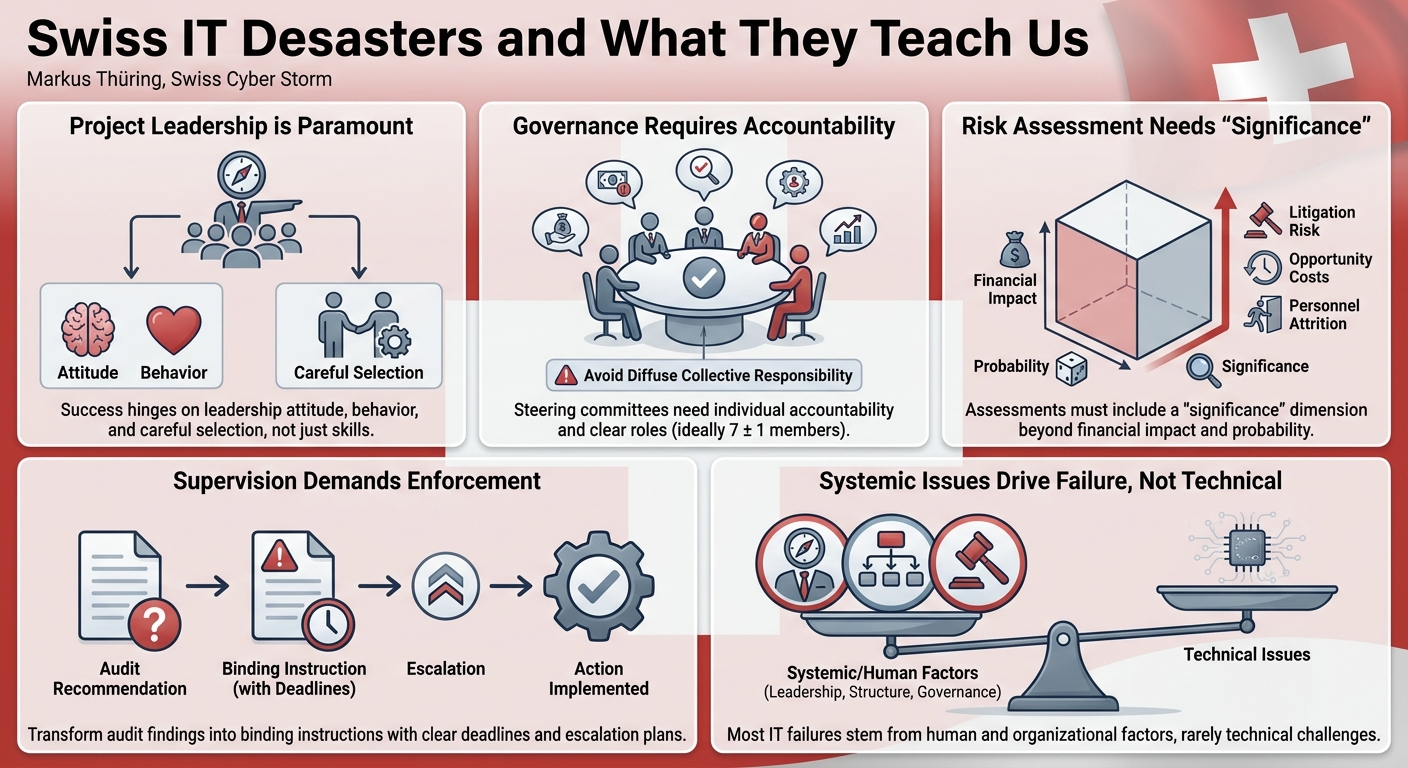
- Project leadership is paramount: The success or failure of IT projects, including security initiatives, hinges critically on the attitude, behavior, and skills of the project leader. Careful selection and continuous development of leaders are essential.
- Organizational structure matters: An unsuitable project organization, characterized by unclear responsibilities, imbalanced resource allocation, or conflicting hierarchical levels, is a common root cause of failure.
- Governance requires accountability: Steering committees must have a clear maximum number of members (ideally 7 ± 1), with individual role descriptions and direct responsibility, rather than diffuse collective accountability.
- Risk assessment needs "significance": Beyond financial impact and probability, project risk assessments must include the "significance" dimension, encompassing litigation risk, opportunity costs, and personnel attrition, to accurately gauge true exposure.
- Supervision demands enforcement: Audit findings and recommendations must be converted into binding instructions with clear deadlines, implementation control, grace periods, and defined escalation plans to higher management.
- Systemic issues, not technical, drive failure: The vast majority of IT project failures, like the NCMA disaster, stem from human and organizational factors rather than technical challenges, making leadership, governance, and structure the primary areas for improvement.
About the Speaker(s)
Markus Thüring is a seasoned professional with over 40 years of experience in the banking sector, predominantly within large Swiss banks, but also including an insurance company and a foreign bank. He began his career as a business analyst and steadily advanced to roles as a project manager and program manager, overseeing complex IT initiatives. Now retired, Mr. Thüring remains actively engaged as an author, contributing guest comments on project management topics to finance publications. He has recently published a book that takes a unique approach to project management, focusing on dissecting project failures to identify root causes and propose concrete improvement opportunities, drawing heavily on his extensive practical experience.
Reviews
Dr. Zero (Offensive Security Researcher) — STRONG ACCEPT
Thüring isn't dropping zero-days. He's doing an autopsy on the Swiss NCMA project, a 116 million CHF disaster that died of pure organizational incompetence. If you've ever watched a nine-figure security transformation project burn to the ground, you already know he's right about why it happens.
Heather Calloway (CISO) — STRONG ACCEPT
Thüring’s autopsy of the 116M CHF Swiss NCMA failure is required viewing for anyone running a security steering committee. He correctly identifies that enterprise IT initiatives die from structural rot—unaccountable boards, toothless audits, and toxic project governance—long before the technology actually fails.