Securing the Digital "Who's" in Healthcare
Ana Ferreira
Swiss Cyber Storm 2022 · Day 1 · Scenario
Overview
In an era where personal data is often deemed the "new oil," healthcare information stands as perhaps the most valuable and sensitive asset. Ana Ferreira's talk, "Securing the Digital 'Who's' in Healthcare," delivered at Swiss Cyber Storm, delves into the intricate challenges of protecting this critical data while ensuring accessibility for patients and professionals alike. The presentation highlights that securing healthcare isn't merely about technical safeguards; it's fundamentally about people's lives, mental, and physical integrity. Ferreira argues that the unique complexities of the healthcare ecosystem, from diverse user roles to varied technological landscapes, demand a sophisticated approach to digital identity and access management that moves beyond traditional "doorkeeper" security models.
Key moments
- 0:40 Introduction: Securing digital identities in healthcare
- 4:00 Critical cybersecurity challenges and vulnerabilities in healthcare
- 8:00 Portuguese digital identity system for healthcare access
- 13:30 Advantages and limitations of Portugal's e-ID system
- 16:00 Holistic security: Beyond digital identity at the door
- 18:00 Dynamic access control with risk management and AI
- 20:00 Prioritizing patient safety and trust for better health outcomes
Securing the Digital "Who's" in Healthcare
Speakers: Ana Ferreira, Researcher, University of Porto
Conference: Swiss Cyber Storm
YouTube: https://www.youtube.com/watch?v=aRoyFCPHMoc
Overview
In an era where personal data is often deemed the "new oil," healthcare information stands as perhaps the most valuable and sensitive asset. Ana Ferreira's talk, "Securing the Digital 'Who's' in Healthcare," delivered at Swiss Cyber Storm, delves into the intricate challenges of protecting this critical data while ensuring accessibility for patients and professionals alike. The presentation highlights that securing healthcare isn't merely about technical safeguards; it's fundamentally about people's lives, mental, and physical integrity. Ferreira argues that the unique complexities of the healthcare ecosystem, from diverse user roles to varied technological landscapes, demand a sophisticated approach to digital identity and access management that moves beyond traditional "doorkeeper" security models.
The talk meticulously dissects the multifaceted "who's" in healthcare – patients, doctors, nurses, administrative staff, IT personnel, researchers, students, and third-party suppliers – each requiring distinct levels of access to highly sensitive information. Ferreira emphasizes that despite the implementation of robust authentication mechanisms, such as two-factor authentication (2FA) systems exemplified by Portugal's national electronic ID, vulnerabilities often persist within the broader infrastructure. Her research underscores the urgent need for dynamic, adaptive, and risk-managed digital identities that are patient-centered and context-aware, capable of balancing confidentiality with the critical availability required in emergency situations. This article explores these themes, drawing on Ferreira's insights and the practical examples she provided to illustrate the path toward a more secure and trustworthy e-health future.
Background
▶ Watch: Introduction: Securing digital identities in healthcare (0:40)
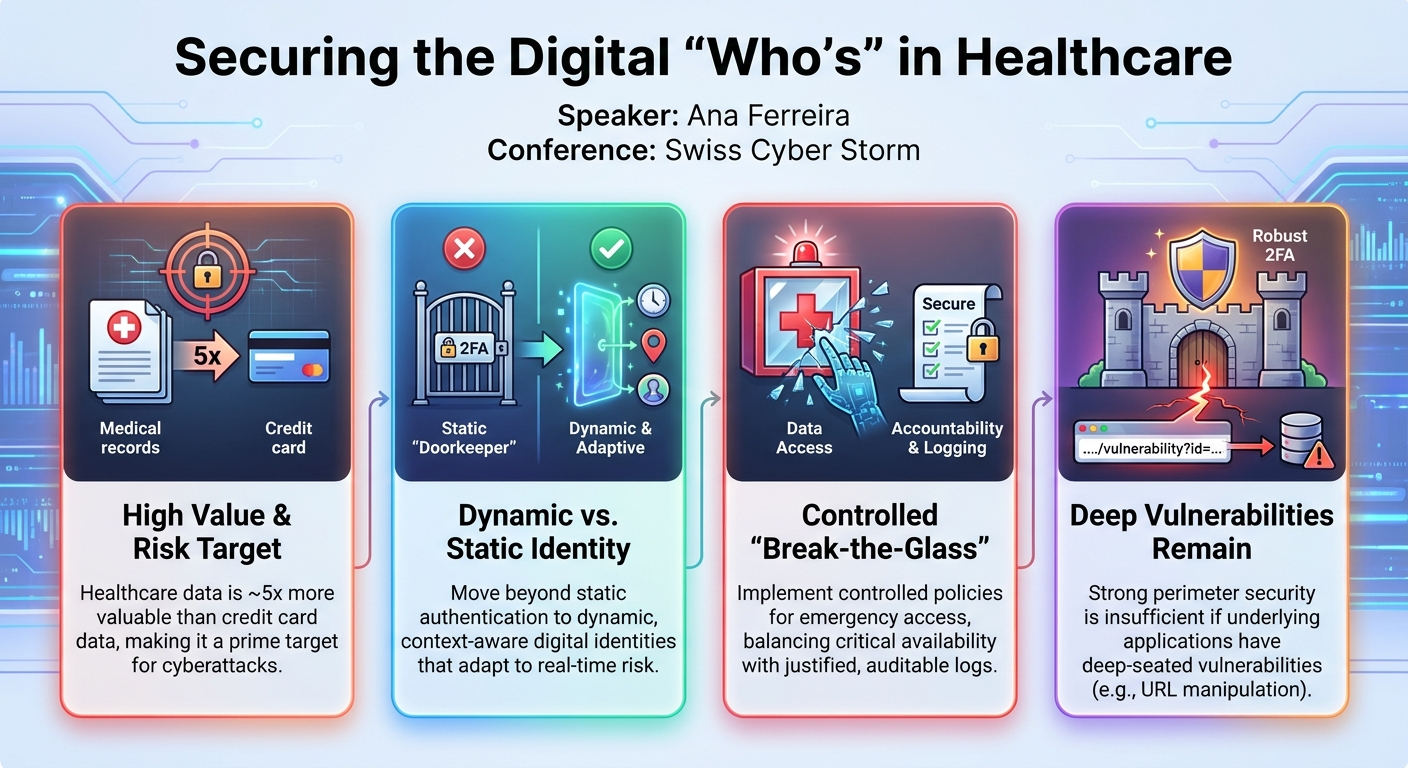
The landscape of healthcare data is inherently complex and fraught with security challenges. As Ferreira points out, healthcare data is not just personally identifiable but also highly sensitive, falling under special categories of data according to regulations like GDPR. This designation places stringent controls on its processing, even forbidding its use for profiling. The value of this data is staggering; Ferreira states that a patient's health record is approximately five times more valuable than credit card information on the black market, making healthcare institutions prime targets for organized cybercrime. Common attacks include data theft for sale, ransomware, and SQL injection, often targeting network and mail services.
The "who's" in healthcare are incredibly diverse, encompassing:
- Patients: The primary subjects of data, often with identifiable and sensitive medical records scattered across various public and private institutions.
- Health Professionals: Doctors, physicians, nurses, and technicians with varying roles and access needs, often requiring access to multiple, disparate systems.
- Administrative Personnel: Managing procedural and logistical aspects, also needing access to patient and operational data.
- IT People: Responsible for maintaining complex infrastructures, networks, systems, and equipment, often with limited resources.
- Researchers: Working to improve healthcare, necessitating access to anonymized or specific datasets.
- Students: Particularly those in clinical years, requiring supervised access to patient data for learning.
- Third-Party Suppliers: Vendors of medical devices, software, and services, who often require system access, introducing external attack vectors.
This intricate ecosystem is further complicated by the prevalence of both paper and electronic records, often scattered, non-integrated, and redundant across different formats and locations, sometimes even internationally. A critical challenge highlighted is the lack of interoperability among diverse medical devices and software. Many medical devices, invasive and non-invasive, were not designed with security in mind, leading to a cascading effect of vulnerabilities when integrated into larger systems. This creates a vast attack surface spanning multiple devices, physical sites, networks, and cloud environments.
Ferreira emphasizes a significant resource deficit, describing it as a "currency called lack" within healthcare. This includes a lack of infrastructure, resources, and, crucially, a small, often homogeneous team of IT and cybersecurity professionals. This scarcity of expertise makes it difficult for institutions to develop robust security measures, respond effectively to vulnerabilities, or keep pace with rapidly evolving cyber threats. Patching alone is insufficient, and the healthcare sector struggles to build a foundational security infrastructure, leading to a pervasive erosion of trust among users whose data is frequently compromised. Rebuilding this trust is paramount, as it directly impacts patient safety and the willingness of individuals to engage with e-health technologies.
Key Findings
▶ Watch: Portuguese digital identity system for healthcare access (8:00)
Ana Ferreira's research and analysis reveal several critical insights into the state of digital identity and security within the healthcare sector. Foremost among these is the understanding that current digital identity systems, even those incorporating two-factor authentication (2FA), are often inadequate for the dynamic and emergency-driven needs of healthcare. She demonstrates that a simple "doorkeeper" model, where security primarily focuses on initial authentication at the point of entry, fails to protect the vast and complex internal ecosystem.
A significant finding is the disconnect between robust external authentication and internal infrastructure security. Ferreira illustrated this with a concrete example from Portugal, where despite advanced national electronic ID systems, a URL tweaking vulnerability was discovered in the General Directorate of Health's website. This allowed access to personal information of hundreds of patients, bypassing the sophisticated identity controls at the front door. This highlights that even with strong identity verification, a lack of comprehensive, layered security throughout the system can render initial efforts moot.
The talk underscores the urgent necessity for dynamic, adaptive, user-centered, and context-aware digital identities. Ferreira argues that a "one-size-fits-all" approach is detrimental, as access requirements vary dramatically based on the user's role, location, the specific information being accessed, and the prevailing circumstances (e.g., routine vs. emergency). Each interaction, she posits, carries a unique risk profile that current static identity systems struggle to accommodate.
Crucially, the research advocates for the integration of risk management directly into digital identity and access control policies. This allows for a flexible balance between confidentiality and availability, particularly vital in emergency scenarios where immediate access to patient data can be life-saving. The concept of "break-the-glass" policies, which permit overriding standard access controls under controlled and justified conditions, emerges as a necessary mechanism within this risk-based framework. Ultimately, Ferreira's key findings emphasize that effective healthcare security requires a paradigm shift: from static, entry-point authentication to a continuous, intelligent, and adaptable identity and access management system deeply integrated with an organization's risk posture.
Technical Deep Dive
▶ Watch: Advantages and limitations of Portugal's e-ID system (13:30)
The technical core of Ana Ferreira's presentation revolves around the existing digital identity infrastructure in Portugal, serving as a comprehensive case study for both strengths and inherent limitations in securing e-health. Portugal has developed a robust national electronic identification system, which has been in place for over 20 years in various forms, providing citizens with a unique ID number from birth. This infrastructure is central to accessing a range of government services, including tax, social security, and, critically, healthcare.
The primary mechanism for digital identity in Portugal is the ID Smart Card, known as the Cartão de Cidadão. This physical card is a sophisticated piece of technology that securely stores:
- Personal Data: Name, address, date of birth.
- Unique Identifiers: The national ID number, a unique Health ID, Social Security ID, and Taxpayer ID.
- Digital Certificates: Integrated for secure communication and digital signatures.
- Biometric Data: Fingerprints (from both hands) and facial recognition data, captured during card renewal processes.
To access services, citizens typically use the smart card with a smart card reader and an authentication PIN. This process requires a specific plugin to be installed on the user's computer to facilitate communication with the card. This setup constitutes a strong two-factor authentication (2FA) system: "something you have" (the smart card) and "something you know" (the PIN). A key feature of this system is its legal binding capability; documents digitally signed with the card are equivalent to handwritten signatures, enabling legally recognized transactions like signing contracts or even purchasing property.
Complementing the smart card, Portugal offers the Digital Mobile Key (Chave Móvel Digital). This option associates a citizen's unique ID number with their mobile phone. For non-Portuguese citizens, it can be linked to a passport ID. Authentication involves providing a mobile number and a PIN, followed by a unique token sent via SMS or email, again providing 2FA. More recently, this system has evolved to allow fingerprint or facial recognition on the mobile device to serve as the second factor, leveraging biometrics already captured and stored from the citizen card.
A third, simpler option for accessing healthcare services is the Unique Health ID (Número Nacional de Utente). This method is designed for users who may not have a smart card reader or prefer a less complex process. It requires providing the Health ID, date of birth, and a registered mobile number. A unique SMS token is then sent to the mobile, serving as the second factor. While seemingly less secure due to requiring more personal information upfront, it aims to compensate for the lower technical barrier to entry.
Despite these advanced national systems, Ferreira highlights critical drawbacks. The centralized nature means that if a user's PIN is compromised or forgotten, recovery is a lengthy, non-instantaneous process involving physical visits and postal delivery of new credentials. Furthermore, despite offering multiple access options, the system is still not entirely inclusive, posing accessibility challenges for individuals with disabilities or those lacking the necessary technological literacy or infrastructure.
For healthcare professionals, the situation is often less secure. While operating within the institutional network, most internal systems for managing clinical data or patient records rely on simple login and password authentication. A notable exception is the electronic prescription system, which mandates the use of the electronic ID smart card and PIN (2FA). This enhanced security is vital because prescriptions go beyond the institutional network, interacting with pharmacies and patients via SMS or dedicated apps, thus requiring a higher level of trust and integrity.
Ferreira critically points out that even with these robust "doorkeeper" identity solutions, vulnerabilities can exist deeper within the system. She cited a recent incident where a URL manipulation vulnerability was discovered on the website of the Portuguese General Directorate of Health. By simply tweaking the URL parameters, attackers could gain access to personal information of hundreds of patients. This example dramatically illustrates that even strong 2FA at the perimeter is insufficient if the underlying applications and infrastructure are not equally secured.
To address these systemic weaknesses, Ferreira proposes a shift towards dynamic, adaptive, and risk-managed digital identities. This involves:
- Context-Aware Access: Digital identities that can adapt access privileges based on the user's role, location, time of access, type of device, and the sensitivity of the data being requested.
- Fine-Grained Access Control: Moving beyond broad access categories to specific permissions for each interaction, where every access attempt is evaluated for its associated risk.
- "Break-the-Glass" Policies: Controlled mechanisms to override standard access controls in emergencies, ensuring availability without compromising accountability. This requires careful justification and logging.
- Integration with Risk Management: Connecting identity management directly to real-time risk assessments, potentially leveraging AI to analyze contextual factors and make intelligent access decisions.
- Privacy-Enhancing Technologies: Incorporating solutions that protect data while still allowing necessary access, moving towards a more private and appropriate access decision for each user at each moment.
This technical deep dive reveals that while Portugal has made significant strides in national digital identity, the journey to truly secure e-health requires continuous innovation, particularly in integrating adaptive access control and robust risk management throughout the entire healthcare information ecosystem.
Demo / Proof of Concept
▶ Watch: Dynamic access control with risk management and AI (18:00)
Ana Ferreira's talk did not feature a live technical demonstration or a proof of concept in the traditional hacking sense. Instead, she effectively utilized visual aids and real-world examples to illustrate the mechanisms and challenges discussed. Her presentation included slides displaying the physical design of the Portuguese ID Smart Card, screenshots of the authentication plugin interface required for card reader interaction, and an example of a legally binding digital signature process.
Crucially, she presented a slide showing a Portuguese news report detailing a URL manipulation vulnerability found on the General Directorate of Health's website. This served as a powerful, real-world "proof of concept" of how even advanced digital identity systems can be circumvented by vulnerabilities deeper within the application layer. This concrete example underscored her point that robust front-door authentication is insufficient without comprehensive, layered security throughout the entire digital ecosystem. These illustrative examples were instrumental in conveying the technical intricacies and security gaps she identified.
Defensive Implications
▶ Watch: Prioritizing patient safety and trust for better health outcomes (20:00)
The insights shared by Ana Ferreira offer several critical defensive implications for healthcare institutions seeking to bolster their cybersecurity posture. The overarching message is to move beyond a simplistic "doorkeeper" model of security and embrace a more holistic, dynamic, and risk-aware approach to digital identity and access management.
- Implement Layered, Dynamic Access Control: Defenders must recognize that initial authentication, even with 2FA, is just the first step. Security needs to extend deep into the application and infrastructure layers. This means adopting dynamic and adaptive digital identities that continuously evaluate access based on context – user role, location, device, time, and data sensitivity. This requires moving towards fine-grained access control where permissions are tailored to each specific interaction, rather than broad role-based access.
- Integrate Risk Management into Identity Systems: A proactive defense strategy must embed risk assessment directly into access control policies. Every access request should be evaluated for its inherent risk. This allows for a flexible balance between confidentiality and the crucial availability needed in healthcare. Organizations should develop and implement controlled "break-the-glass" policies for emergency situations, ensuring that such overrides are justified, auditable, and logged to maintain accountability.
- Prioritize Interoperability and Security-by-Design: The proliferation of diverse, often insecure, medical devices and software creates a massive attack surface. Defenders must push for security-by-design in all new acquisitions and work towards greater interoperability among systems. This involves demanding security features from vendors, conducting thorough security assessments of all connected devices, and implementing network segmentation to isolate vulnerable systems.
- Invest in Cybersecurity Expertise and Education: The "currency called lack"—the shortage of skilled cybersecurity professionals and resources—is a critical vulnerability. Healthcare institutions must significantly invest in building internal cybersecurity teams, providing continuous training for IT staff, and educating all employees (from doctors to administrative personnel) on best security practices and the importance of data privacy. User education is paramount to combat common attack vectors like phishing.
- Conduct Comprehensive Vulnerability Assessments and Audits: The Portuguese URL vulnerability example underscores the need for regular, thorough security audits and penetration testing of all web applications and internal systems, not just the perimeter. Defenders must actively search for weaknesses that could bypass even robust external authentication. This includes looking for common flaws like SQL injection, cross-site scripting, and insecure direct object references that can expose sensitive data.
- Foster a Culture of Patient-Centered Security and Trust: Ultimately, security measures should enhance, not hinder, patient care and trust. By implementing transparent, user-friendly, and secure systems, healthcare providers can encourage greater adherence to e-health technologies, which can improve health outcomes, especially for chronic disease patients. Building trust requires demonstrating a genuine commitment to protecting patient data and ensuring their safety.
- Explore Privacy-Enhancing Technologies (PETs): As suggested by Ferreira, incorporating PETs can help ensure data privacy while enabling necessary data analysis and access. This includes techniques like differential privacy, homomorphic encryption, and secure multi-party computation, which can protect sensitive information even when it's being processed or shared.
By adopting these defensive strategies, healthcare institutions can move towards a more resilient and trustworthy digital environment, safeguarding patient data and, by extension, patient lives.
Key Takeaways
- Healthcare data is uniquely valuable and vulnerable: It's approximately five times more valuable than credit card data, making healthcare institutions prime targets for sophisticated cyberattacks like ransomware and data theft.
- Digital identities must be dynamic, adaptive, and risk-managed: Static, "doorkeeper" authentication is insufficient. Systems need to adapt access based on user role, context, location, and the real-time risk associated with each interaction.
- Security must extend beyond initial authentication: Even robust 2FA systems can be bypassed if the underlying applications and infrastructure have vulnerabilities, as demonstrated by the Portuguese URL tweaking incident.
- "Break-the-glass" policies are necessary but require control: In emergencies, immediate data access can be life-saving. Mechanisms to override standard controls are essential but must be justified, auditable, and logged to ensure accountability.
- Lack of resources, expertise, and interoperability are critical gaps: The healthcare sector suffers from insufficient cybersecurity staff, expertise, and infrastructure, compounded by a lack of interoperability among diverse medical devices and software.
- Patient trust is paramount for successful e-health adoption: Secure, transparent, and user-centered systems build trust, encouraging patients to adhere to technology that can ultimately improve their health outcomes.
About the Speaker(s)
Ana Ferreira is a dedicated researcher with a strong focus on data privacy within the e-health domain. She holds a PhD and is actively involved in research, typically based at the University of Porto in Portugal. Her work, as highlighted in this talk, delves into the complexities of securing digital identities and ensuring robust privacy controls within the healthcare ecosystem. She brings a deep understanding of the challenges faced by national healthcare systems, drawing from her expertise and the Portuguese context.
Reviews
Dr. Zero (Offensive Security Researcher) — SOLID
An architectural overview of identity and access management in healthcare, using Portugal's national e-ID system as a backdrop. Competent and factually correct, but relies entirely on standard enterprise IAM patterns rather than introducing novel research or implementations.
Heather Calloway (CISO) — SOLID
A practical look at the realities of healthcare identity management, using Portugal's national ID system as a case study for why front-door authentication isn't enough. It's a useful reminder for leadership teams that strong MFA cannot patch broken application authorization.