What You Can Learn from Cyber Incidents to Improve Your Resilience
Gregor Wegberg (Head of Digital Forensics and Incident Response · Oneconsult)
Swiss Cyber Storm 2022 · Day 1 · Panorama
Overview
In his Swiss Cyber Storm presentation, Gregor Wegberg, Head of Digital Forensics and Incident Response at Oneconsult, offers a stark and practical perspective on achieving cyber resilience through the lens of real-world cyber incidents. Drawing from his extensive experience leading Oneconsult's International Computer Security Incident Response Team (ICCSIRT), Wegberg expresses frustration at the repeated failures he observes when organizations face an attack. His core message is an urgent call for proactive, standardized preparation that extends beyond mere technical controls, emphasizing the critical importance of people, processes, and a deep understanding of core business functions.
Key moments
- 0:00 Introduction: The problem with cyber incidents
- 2:20 Cyber resilience: maintain operations and recover quickly
- 4:00 Prepare for common attack paths and vulnerabilities
- 9:00 Identify essential systems for business continuity
- 14:00 Cyberattacks are not just an IT problem
- 18:00 Engage business units for non-technical resilience planning
- 20:00 Prioritize human resilience: prevent burnout during incidents
What You Can Learn from Cyber Incidents to Improve Your Resilience
Speakers: Gregor Wegberg, Head of Digital Forensics and Incident Response, Oneconsult
Conference: Swiss Cyber Storm
YouTube: https://www.youtube.com/watch?v=KDkOpFO2EqE
Overview
In his Swiss Cyber Storm presentation, Gregor Wegberg, Head of Digital Forensics and Incident Response at Oneconsult, offers a stark and practical perspective on achieving cyber resilience through the lens of real-world cyber incidents. Drawing from his extensive experience leading Oneconsult's International Computer Security Incident Response Team (ICCSIRT), Wegberg expresses frustration at the repeated failures he observes when organizations face an attack. His core message is an urgent call for proactive, standardized preparation that extends beyond mere technical controls, emphasizing the critical importance of people, processes, and a deep understanding of core business functions.
The talk challenges the conventional, often tool-centric view of cybersecurity, advocating instead for a mindset shift. Wegberg argues that true resilience isn't about preventing every attack – a near impossibility in today's threat landscape – but about maintaining operations and recovering swiftly when incidents inevitably occur. He meticulously unpacks the common pitfalls that bring organizations to a complete standstill, leaving IT departments scrambling and businesses unable to perform their essential functions. By sharing concrete lessons learned from numerous ransomware, business email compromise (BEC), and investigation cases, Wegberg provides actionable insights for organizations to transform their incident response capabilities from reactive chaos to structured, business-centric recovery.
This presentation is highly relevant for IT and security professionals, as well as business leaders, who seek to move beyond theoretical security frameworks and build genuinely resilient operations. Wegberg's candid account highlights that the most significant challenges during an incident are often not technical, but organizational and human. He underscores the necessity of integrated planning, cross-functional collaboration, and a profound appreciation for the human toll of prolonged incident response. Ultimately, the talk serves as a powerful reminder that robust cyber resilience is forged in the crucible of preparation, not merely purchased through security products.
Background
▶ Watch: Introduction: The problem with cyber incidents (0:00)
The premise of Gregor Wegberg's presentation stems from a deep-seated frustration born from the repetitive, often catastrophic, outcomes he witnesses during cyber incidents. As the head of a prominent digital forensics and incident response team, Wegberg is routinely called into organizations that have been brought to a complete standstill by cyberattacks. He describes a common scene: "everything basically broke down, no one is working, everyone is sitting around maybe going home drinking coffee," with only the IT department desperately trying to understand what happened. This pervasive lack of preparedness, leading to operational paralysis, is the driving force behind his talk.
Wegberg defines cyber resilience not as a collection of security products or frameworks—though these have their place—but as a mindset. For him, it's akin to agility, a fundamental approach to IT security that acknowledges the constant threat landscape. The widely accepted adage, "it's not a question if but more when will something happen," forms the bedrock of this mindset. True resilience, in his view, is about maintaining operations during an attack and rapidly recovering afterwards. He deliberately uses the term "cyber" to resonate with management, bridging the gap between technical security concepts and broader business understanding.
The problem, as Wegberg articulates, is that many organizations fail to translate this understanding into concrete, actionable plans. Despite the proliferation of advanced security solutions like EDR (Endpoint Detection and Response), SIEM (Security Information and Event Management), NDR (Network Detection and Response), and MDR (Managed Detection and Response), the fundamental failures persist. He observes that many companies, even after experiencing major vulnerability chains like those affecting Microsoft Exchange Server, fail to conduct proper post-mortems or prepare for the inevitable next wave. This reactive stance, characterized by shock and improvisation during an incident, is precisely what Wegberg aims to counteract by sharing the hard-won lessons from the front lines of incident response.
Key Findings
▶ Watch: Prepare for common attack paths and vulnerabilities (4:00)
Gregor Wegberg’s presentation distills years of incident response experience into several critical findings that underscore the practical realities of cyber resilience.
Firstly, a recurring theme is the necessity of proactive preparation for common attack paths. Wegberg stresses that organizations must move beyond generic security measures and instead, use frameworks like MITRE ATT&CK to anticipate how adversaries gain access and what their subsequent actions might be. He advocates for developing small, standardized procedures, often referred to as playbooks, for highly probable scenarios such as successful phishing emails, compromised user accounts, or vulnerable internet-facing systems. The absence of such pre-defined responses leads to confusion, delays, and increased stress during an actual incident.
Secondly, Wegberg highlights a critical gap in many organizations: the lack of understanding regarding their business crown jewels and essential operational components. He laments that often, IT and security departments don't fully grasp what systems and processes are truly indispensable for the business to function and generate revenue. Without this clarity, effective recovery strategies are impossible. He strongly recommends conducting a process risk analysis or developing a robust asset inventory to identify these critical elements, which then serve as a roadmap for prioritized recovery and containment efforts.
A third key finding is that cyber incidents are fundamentally not just an IT problem. Wegberg emphasizes that a successful response requires a cross-functional team involving diverse stakeholders beyond technical staff. This includes the Data Privacy Officer (DPO) for legal compliance (especially with personally identifiable information or PII), legal counsel, finance for budget allocation, marketing and communications for internal and external messaging, human resources, and, crucially, executive leadership (c-level and board of directors) for decision-making and liability. Delegating non-technical tasks frees up technical teams to focus on recovery, preventing burnout and accelerating the overall response.
Finally, Wegberg powerfully underscores the human element as the most fragile component in incident response. He cautions that incidents are marathons, not sprints, and the adrenaline-fueled, often round-the-clock work takes a severe toll on individuals. He shares sobering anecdotes of professionals burning out and leaving the industry due to the immense pressure and lack of structured support. A critical finding is the need to plan for human resilience: scheduling rests, ensuring food and hydration, and encouraging breaks to prevent physical and mental exhaustion among the incident response team. Ignoring this aspect can cripple an otherwise well-planned technical recovery.
Technical Deep Dive
▶ Watch: Identify essential systems for business continuity (9:00)
While Gregor Wegberg's talk focuses heavily on process and people, it grounds its recommendations in concrete technical realities and challenges. His insights are derived from direct engagement with various attack vectors and system vulnerabilities.
A primary technical concern raised is the persistent issue of untouchable or not yet patchable vulnerabilities on the border of an organization's network. He cites Microsoft Exchange Server and VPN gateways as prime examples. These systems, often internet-facing and critical for remote access, frequently become targets for zero-day exploits or rapidly weaponized vulnerabilities. Wegberg criticizes the reactive nature of many organizations, who, even after experiencing multiple vulnerability chains (e.g., in Exchange), fail to proactively develop a response plan for the next inevitable vulnerability.
From a technical mitigation perspective, he discusses the need for pre-planned actions. For instance, in the face of an Exchange vulnerability, organizations should have a plan to disable access to the Outlook Web Access (OWA) part or put it behind a corporate VPN. He acknowledges the dynamic nature of such advice (e.g., whether to disable PowerShell remoting), highlighting the difficulty of staying current and the value of having a pre-approved, albeit temporary, fallback strategy. The goal is to gain crucial time – time to understand the exploit, assess mitigations, and potentially engage security experts to check for prior compromise.
Wegberg strongly advocates for standardized playbooks that contain granular technical steps for common scenarios. These aren't just high-level procedures but detailed checklists. Examples include:
- Handling successful phishing emails: This would involve steps like isolating affected endpoints, revoking session tokens, changing passwords, and analyzing the phishing vector.
- Resetting user and service account passwords: Crucially, this extends beyond simple user accounts to sensitive service accounts (e.g., for Kerberos authentication) which, if compromised, can grant extensive network access.
- Invalidating OAuth access tokens: This is vital in Business Email Compromise (BEC) scenarios where attackers often leverage stolen tokens to maintain persistent access without needing credentials.
For containment, a critical phase in incident response, Wegberg details technical strategies tailored to different business contexts. In manufacturing, for example, he describes the ability to isolate specific environments (e.g., logistics, production networks) from the broader corporate network and the internet. This could involve physical disconnection, firewall rule changes, or network segmentation to prevent lateral movement of malware like ransomware. While he acknowledges that disconnecting the "whole connectivity to the internet" is a "very rough approach" and a last resort, the ideal is a more surgical isolation plan that keeps essential, albeit less efficient, business functions running. This requires a deep understanding of network architecture and critical dependencies.
He indirectly references various security tools like AV (Antivirus) and EDR when discussing alerts, noting that while these tools detect threats, their efficacy is often hampered by a lack of human oversight and action. The speaker specifically mentions the MITRE ATT&CK framework as a valuable resource for preparing for common attack paths, indicating an understanding of modern threat intelligence and defensive strategies. The ultimate technical deep dive, however, is not into the tools themselves, but into the application of technical knowledge through structured processes to minimize business impact during an attack.
Demo / Proof of Concept
▶ Watch: Engage business units for non-technical resilience planning (18:00)
Gregor Wegberg's presentation does not include a live technical demonstration or a proof of concept of an exploit or defensive tool. Instead, the talk functions as a strategic and tactical guide, drawing its "proof" from the real-world experiences and lessons learned from numerous cyber incidents handled by his incident response team. His narrative is rich with practical examples of what did and did not work in actual breach scenarios, effectively serving as a retrospective analysis of operational resilience in action rather than a forward-looking technical showcase. The focus remains on the organizational and human aspects of incident response, rather than specific technical exploits or defensive mechanisms.
Defensive Implications
▶ Watch: Prioritize human resilience: prevent burnout during incidents (20:00)
The insights shared by Gregor Wegberg carry profound implications for how organizations approach their cybersecurity defenses and overall resilience strategies. Defenders must shift their focus from merely preventing attacks to effectively managing their impact and ensuring rapid recovery.
Firstly, a paramount defensive implication is the urgent need for proactive and standardized incident response planning. Organizations must develop detailed, actionable playbooks for the most common and impactful attack scenarios, such as ransomware, business email compromise, and vulnerability exploitation. These playbooks should not be theoretical documents but tested procedures outlining specific technical steps (e.g., how to isolate a compromised system, revoke specific access tokens, or reset Kerberos passwords) and clear roles and responsibilities. Regular tabletop exercises or simulations are crucial to validate these plans and identify gaps before an actual incident occurs.
Secondly, defenders must prioritize asset identification and business process mapping. It is critical to identify the "crown jewels" – the data, systems, and processes absolutely essential for the business to operate and generate revenue. This understanding enables the development of prioritized recovery roadmaps and targeted containment strategies. Network segmentation and micro-segmentation become vital technical controls to isolate critical assets, allowing for surgical containment during an incident without necessarily shutting down the entire organization. Pre-defined procedures for isolating specific environments (e.g., manufacturing production lines, logistics systems) should be established and tested.
Thirdly, the talk underscores the necessity of building a cross-functional incident response team. Cybersecurity can no longer be seen as solely an IT or security department responsibility. Defenders must proactively engage and integrate legal, data privacy (DPO), finance, HR, marketing, and executive leadership into the incident response framework. This pre-engagement ensures that legal obligations (e.g., data breach notification), financial approvals for external support, internal and external communications, and critical decision-making can happen swiftly and effectively during a crisis. Delegating non-technical tasks empowers technical teams to focus on remediation.
Finally, and perhaps most critically, defenders must integrate human resilience into their incident response planning. Recognizing that incident response is a marathon, organizations must plan for the well-being of their technical staff. This includes establishing clear shift schedules, ensuring adequate rest, nutrition, and hydration, and providing mental health support. Preventing burnout among incident responders is a defensive measure in itself, as an exhausted team is prone to errors and prolonged recovery times. Furthermore, the talk implicitly suggests investing in training and empowering staff beyond the core security team, fostering a culture where every employee understands their role in overall organizational security and resilience. Ultimately, relying solely on security products is insufficient; true defense lies in a holistic approach combining robust technology, well-defined processes, and a supported, skilled human workforce.
Key Takeaways
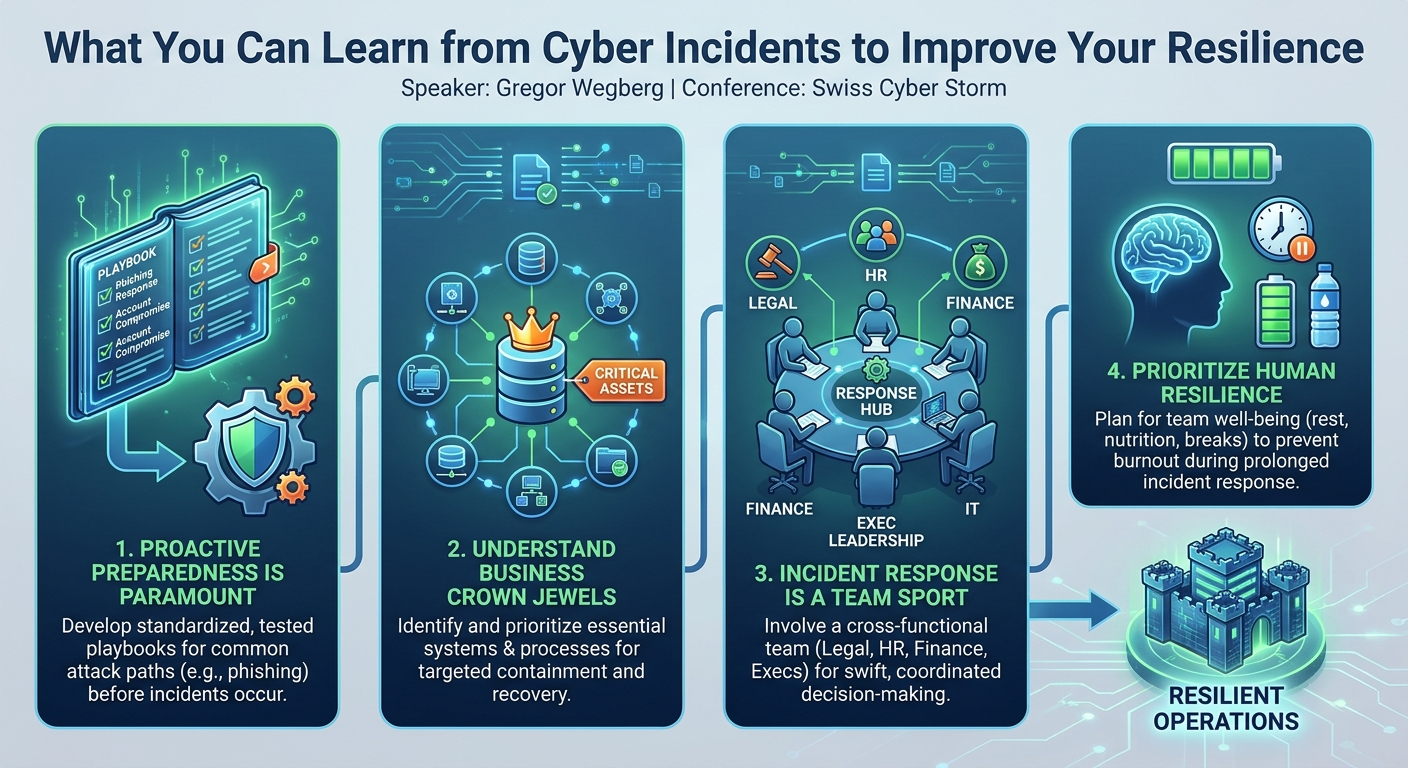
- Proactive Preparedness is Paramount: Organizations must move beyond reactive responses and develop small, standardized procedures (playbooks) for common attack paths like phishing, account compromise, and zero-day vulnerabilities, using frameworks like MITRE ATT&CK for guidance.
- Understand Your Business's Crown Jewels: Identify and prioritize the critical systems and processes essential for your business's existence and revenue generation. This knowledge is crucial for developing effective containment strategies and a prioritized recovery roadmap during an incident.
- Incident Response is a Team Sport: Cyber incidents are not just IT problems; they require a cross-functional approach involving legal, data privacy, finance, communications, HR, and executive leadership. Plan for their involvement and delegate non-technical tasks to free up technical experts.
- Plan for Surgical Containment: Develop and practice procedures for isolating critical environments and systems from the rest of the network and the internet. The goal is to maintain some level of business operation, even if at reduced efficiency, rather than a complete shutdown.
- Prioritize Human Resilience: Incident response is a marathon, not a sprint. Organizations must proactively plan for the well-being of their incident response teams, ensuring adequate rest, nutrition, and breaks to prevent burnout, which can severely hamper recovery efforts.
- Technology Alone is Insufficient: While security products (AV, EDR, SIEM) are important, they are only effective if combined with skilled people, well-defined processes, and a proactive, resilient mindset. Investing in people and preparation yields far greater security benefits than simply buying more tools.
About the Speaker(s)
Gregor Wegberg is the Head of Digital Forensics and Incident Response at Oneconsult, a leading cybersecurity firm. In this role, he leads the Oneconsult Incident International Computer Security Incident Response Team (ICCSIRT), specializing in assisting organizations through complex cyber incidents. His expertise spans a wide range of cyber threats, including prevalent issues like ransomware attacks, business email compromise (BEC), and various digital investigations. Wegberg's professional passion lies in leveraging lessons learned from real-world incidents to help organizations enhance their cyber resilience, transforming reactive chaos into structured, effective responses. He is a strong advocate for a holistic approach to cybersecurity, emphasizing the critical interplay of technology, processes, and the human element.
Reviews
Dr. Zero (Offensive Security Researcher) — SOLID
Wegberg is an IR guy who clearly spends his life in the trenches cleaning up other people's messes. The advice here is fundamentally correct, but it's the exact same 'know your crown jewels and build playbooks' sermon we've been sitting through for a decade. It's a competent baseline for organizations that are still on fire, but veterans won't hear anything new.
Heather Calloway (CISO) — SOLID
Wegberg delivers the standard gospel on incident response, and he is entirely right. This is a baseline governance talk about cross-functional readiness, asset prioritization, and containment strategy. If your leadership team still thinks IR is purely an IT problem, make them watch it.