Agile Use Case Development With MITRE ATT&CK
Bruno Blumenthal (Managing Security Consultant and Member of the Board · temet)
Swiss Cyber Storm 2022 · Day 1 · Panorama
Overview
In his Swiss Cyber Storm talk, "Agile Use Case Development With MITRE ATT&CK," Bruno Blumenthal, a Managing Security Consultant and Board Member at temet, addresses a pervasive challenge in modern cybersecurity: effectively managing and prioritizing detection use cases in a rapidly evolving threat landscape. The presentation outlines a structured, agile approach to developing and refining security detection capabilities, leveraging the MITRE ATT&CK framework as a cornerstone for prioritization. Blumenthal argues that by adopting principles from agile software development and integrating them with the comprehensive threat intelligence of ATT&CK, organizations can significantly enhance their security operations centers (SOCs) to become more adaptive, efficient, and ultimately, more resilient against sophisticated adversaries.
Key moments
- 1:40 Common challenges in security use case development
- 7:00 Adapting Agile Manifesto principles for detection use cases
- 14:00 Key agile methods for detection use case development
- 16:40 Introduction to MITRE ATT&CK for use case prioritization
- 20:50 Filtering and ranking MITRE ATT&CK techniques
- 22:50 Assessing use case value and time criticality
- 26:20 Factoring in implementation complexity for use cases
- 28:00 Prioritizing use cases using WSJF-like calculation
Agile Use Case Development With MITRE ATT&CK
Speakers: Bruno Blumenthal, Managing Security Consultant and Member of the Board, temet
Conference: Swiss Cyber Storm
YouTube: https://www.youtube.com/watch?v=5t3N8omrsQ8
Overview
In his Swiss Cyber Storm talk, "Agile Use Case Development With MITRE ATT&CK," Bruno Blumenthal, a Managing Security Consultant and Board Member at temet, addresses a pervasive challenge in modern cybersecurity: effectively managing and prioritizing detection use cases in a rapidly evolving threat landscape. The presentation outlines a structured, agile approach to developing and refining security detection capabilities, leveraging the MITRE ATT&CK framework as a cornerstone for prioritization. Blumenthal argues that by adopting principles from agile software development and integrating them with the comprehensive threat intelligence of ATT&CK, organizations can significantly enhance their security operations centers (SOCs) to become more adaptive, efficient, and ultimately, more resilient against sophisticated adversaries.
The core of Blumenthal's argument is that traditional, rigid approaches to use case development often falter under the weight of changing threats, resource constraints, and the sheer volume of potential detections. He proposes a methodology that emphasizes continuous improvement, frequent delivery of working detections, and a data-driven prioritization mechanism. This approach not only helps security teams identify and implement the most critical detections but also ensures that their efforts are aligned with the organization's specific threat profile and operational realities, moving beyond generic lists of use cases to truly impactful security outcomes.
This talk is crucial for security leaders, detection engineers, and SOC analysts grappling with how to translate abstract threat intelligence into concrete, actionable security controls. It provides a practical framework for improving detection engineering processes, fostering a proactive security posture, and making the most of limited resources in the ongoing battle against cyber threats. By demystifying the application of agile principles and the ATT&CK framework, Blumenthal offers a blueprint for building more effective and responsive detection and response capabilities.
Background
▶ Watch: Common challenges in security use case development (1:40)
The journey of developing effective security use cases is fraught with common pitfalls, as outlined by Bruno Blumenthal. Organizations frequently face an initial struggle to identify relevant use cases, often resorting to generic internet searches or relying on extensive lists provided by Managed Security Service Providers (MSSPs). While these resources might offer "100 or 150 ready-made use cases," they quickly lead to the opposite problem: an overwhelming quantity of potential detections that exceed an organization's resources for implementation. This often results in a significant gap between documented intentions and actual, working detections.
Beyond the initial identification and resource allocation challenges, the cybersecurity landscape itself presents a moving target. New attack techniques, threat vectors, and malware emerge constantly, requiring continuous adaptation of detection capabilities. Furthermore, internal organizational changes, such as cloud transformations or rapid business growth, expand the target environment, demanding that security operations keep pace. Lastly, external pressures like audit findings or vulnerability scans frequently mandate new detections as a compensatory control when prevention is not immediately feasible. These dynamic factors underscore a critical need for prioritization and adaptability in use case management.
Blumenthal emphasizes that the solution lies in embracing an agile mindset, drawing parallels with its origins in software development. He notes that while "agile" can sometimes be a buzzword with a mixed reputation, its foundational principles—developed in the Agile Manifesto in 2001—offer a robust framework for dealing with change, delivering value, and fostering collaboration. By adapting these principles to use case development, organizations can overcome the static, document-heavy approaches that often fail to deliver tangible security improvements. The goal is to move from a reactive, resource-constrained model to a proactive, continuously improving one that can effectively respond to the ever-changing threat landscape.
Key Findings
▶ Watch: Key agile methods for detection use case development (14:00)
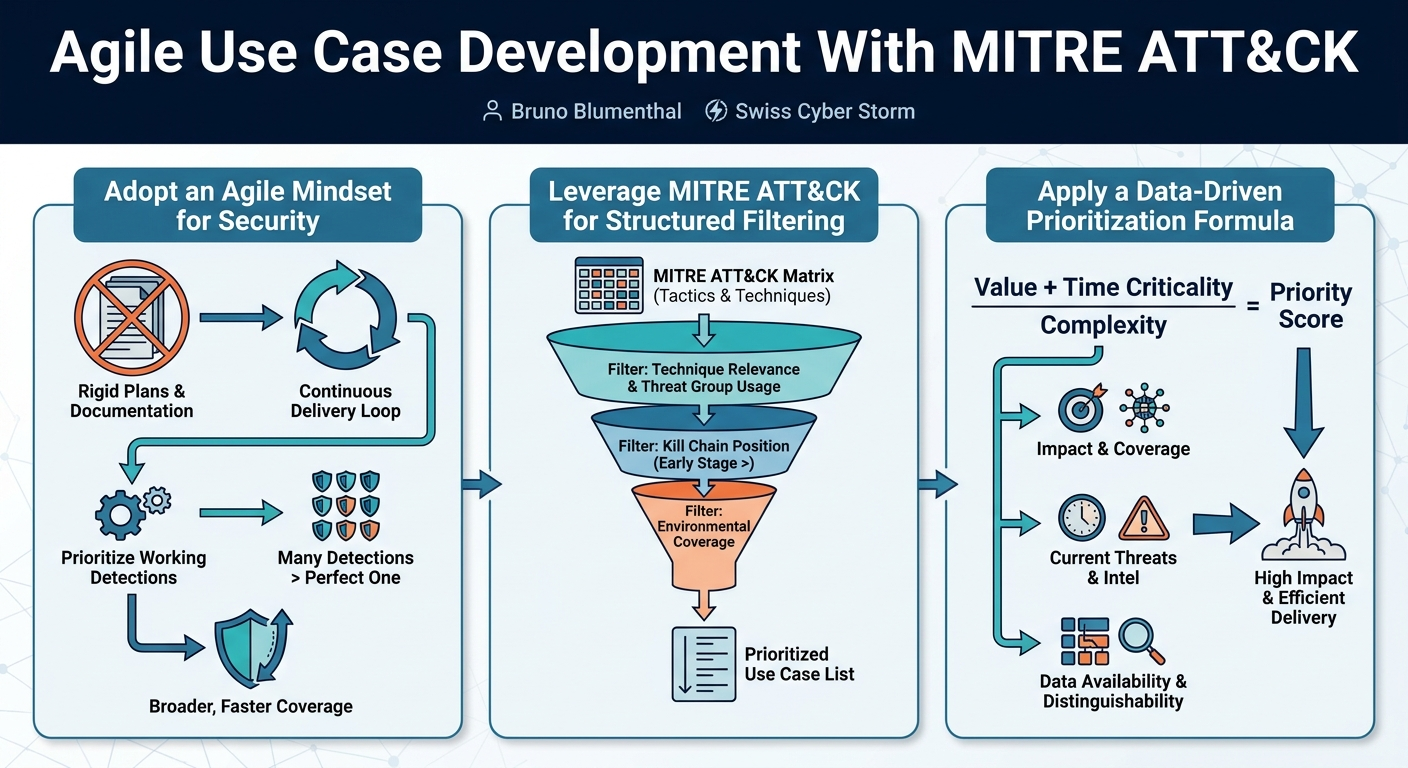
The central finding of Bruno Blumenthal's talk is the successful adaptation of agile principles and methodologies, originally conceived for software development, to the specialized domain of security use case development, with the MITRE ATT&CK framework serving as a critical enabler for prioritization. Blumenthal introduces a "use case development version" of the Agile Manifesto, comprising four value statements and five principles, which reframe traditional agile tenets for the unique challenges of detection engineering.
Foremost among these adapted values is the emphasis on working detections over comprehensive documentation, highlighting a common pitfall where extensive planning fails to translate into deployed capabilities. Crucially, he advocates for many detections over a perfect detection, suggesting that broad coverage across an environment is often more effective than an exhaustive but singular detection that consumes disproportionate resources.
The talk's most significant technical contribution is a structured, data-driven approach to prioritizing use cases, culminating in a formula adapted from Weighted Shortest Job First (WSJF) methodology. This formula, (Value + Time Criticality) / Complexity, allows security teams to objectively rank potential use cases, ensuring that efforts are directed towards detections that offer the highest impact with the most efficient implementation. By systematically evaluating factors such as the relevance of ATT&CK techniques, their position in the kill chain, environmental coverage, current threat intelligence, and implementation complexity (including distinguishability from legitimate activity), organizations can transform their use case backlog from an unmanageable list into a dynamic, prioritized roadmap for enhancing their defensive capabilities.
Technical Deep Dive
▶ Watch: Filtering and ranking MITRE ATT&CK techniques (20:50)
Bruno Blumenthal defines use case development in security as "the process of identifying undesirable behavior and unwanted activities in your systems, establishing an indicator to spot them, and then implementing the necessary technologies and tools to detect them and react based on those detections." This holistic view underpins his agile methodology, which aims to address the common struggles of finding, prioritizing, and implementing use cases efficiently.
The talk introduces an adapted Agile Manifesto for use case development, comprising four value statements and five principles:
Value Statements:
- Individuals and interactions over processes and tools: Emphasizes human collaboration as paramount for effective security.
- Working detections over comprehensive documentation: Prioritizes tangible, deployed detection capabilities over extensive, potentially unimplemented plans.
- Many detections over a perfect detection: Advocates for broader coverage and quicker implementation, acknowledging resource constraints and the dynamic threat landscape.
- Responding to change over following a plan: Highlights the necessity of adaptability to new threats and evolving environments.
Principles:
- Highest priority: Address real threats through early and continuous delivery of effective detections.
- Welcome changes in the threat landscape to gain an advantage over adversaries.
- Deliver working detections frequently (weeks to months, preferring shorter cycles).
- Number of working detections as the primary measure of progress and quality.
- Continuous attention to technical excellence and good design enhances agility (e.g., avoiding hardcoded values in queries).
To implement these principles, Blumenthal draws on core agile methods:
- Backlog: A dynamic, prioritized list of tasks (new use cases, improvements) that is continuously re-evaluated. It's a "pile," not a stack or FIFO queue.
- Cadence: Fixed time intervals (e.g., two-week sprints) for re-evaluating priorities and changing direction.
- Digestible Portions: Breaking down work into manageable chunks that can be completed within a cadence, enabling flexibility and continuous delivery.
- Frequent Updates: Delivering updated detection capabilities regularly.
- Testing and Evaluation: Continuously assessing the value and effectiveness of implemented use cases.
The MITRE ATT&CK framework is then introduced as the crucial tool for driving prioritization within this agile process. ATT&CK for Enterprise currently includes:
- 14 tactics (columns, e.g., Initial Access, Exfiltration) representing an attacker's intermediate goals.
- 191 techniques with 385 sub-techniques, totaling 576 documented techniques.
- Information on 133 threat actor groups, 680 malware/software, 43 mitigations, and 39 data sources.
The prioritization process using ATT&CK involves several steps:
- Map Use Cases to ATT&CK Techniques: Each use case should be mapped to one or more ATT&CK techniques. This mapping can be partial (addressing a specific usage of a broad technique), one-to-one, or many-to-one/many-to-many.
- Filter and Rank Techniques:
- Applicability: Filter out techniques not relevant to the organization's environment (e.g., Linux techniques if no Linux servers).
- Preventability: Identify techniques that can be prevented by existing mitigations, potentially lowering their detection priority.
- Group Usage: Count how many threat actor groups use a specific technique. Techniques used by more groups are generally more relevant.
- Group Relevance: Further filter or prioritize based on the relevance of specific threat actor groups to the organization (e.g., groups active in Switzerland, sector-focused groups).
- Assess Inherent Value of Use Case:
- Ranked Techniques: The priority of the underlying ATT&CK techniques directly influences the use case's value.
- Tactic Position: Use cases detecting techniques earlier in the kill chain (more to the "left" of the ATT&CK Matrix, like Initial Access) are assigned higher value, as they offer more time to react before significant impact.
- Environmental Coverage: Use cases applicable across a wider range of systems (e.g., all clients vs. one specific server) have higher value.
- System Exposure: Detections on highly exposed systems (e.g., DMZ systems, client endpoints) are generally more valuable than those on deeply protected core systems.
- Consider Time Criticality: This factor increases a use case's priority based on immediate threats:
- Known Vulnerabilities: Addressing techniques linked to actively exploited vulnerabilities.
- Specific Threat Intelligence: Current intelligence about a technique or threat actor running campaigns against the organization's sector.
- Peer Incidents: Learning from incidents experienced by peer organizations.
- Assess Complexity of Implementation: This often underestimated factor is crucial for agile delivery.
- Data Sources: Availability of necessary logs and telemetry (referencing ATT&CK's data sources).
- Specific Tooling: Requirement for specialized tools or sensors.
- Distinguishability: The difficulty in differentiating malicious activity from legitimate user behavior. Techniques like "command line usage" or "PowerShell execution" are often high-value but notoriously complex to detect without high false positive rates or advanced User Behavior Analytics (UBA).
Finally, these factors are integrated into a prioritization formula adapted from WSJF (Weighted Shortest Job First):
Priority = (Value + Time Criticality) / Complexity
Blumenthal stresses that these values don't need to be absolute; relative values (e.g., assigning 1 to the least complex item and ranking others relative to it) are sufficient. This calculation empowers security teams to focus on use cases that deliver the most detection capability improvement in the shortest possible time, fostering continuous enhancement of the SOC's effectiveness.
Demo / Proof of Concept
▶ Watch: Assessing use case value and time criticality (22:50)
During the presentation, Bruno Blumenthal concluded by noting that due to time constraints, a planned demonstration of the methodology in action was not presented. The focus remained on the theoretical framework and the detailed explanation of the agile principles and the ATT&CK-driven prioritization process.
Defensive Implications
▶ Watch: Prioritizing use cases using WSJF-like calculation (28:00)
The methodology presented by Bruno Blumenthal offers several critical implications for defensive cybersecurity operations, particularly for Security Operations Centers (SOCs) and detection engineering teams. By adopting an agile mindset, organizations can move away from static, overwhelming use case lists to a dynamic, continuously improving detection strategy.
First, security teams should actively embrace the four agile values and five principles for use case development. This means prioritizing working detections over extensive documentation, fostering individual interactions for better collaboration, and accepting that many detections across an environment might be more effective than striving for a single, elusive "perfect" detection. The emphasis on responding to change is vital in a threat landscape where new techniques emerge daily, requiring security teams to be nimble and adaptable.
Second, the structured approach to prioritization using MITRE ATT&CK provides a powerful framework for making informed decisions. Defenders should integrate ATT&CK into their planning by mapping existing and proposed use cases to specific techniques. They must then systematically filter, rank, and assess the value of these techniques based on platform applicability, preventability by existing mitigations, the number of threat groups using them, and their relevance to the organization's specific threat profile. Prioritizing detections for techniques higher up the kill chain (e.g., Initial Access) is crucial for early warning and response, minimizing potential impact.
Third, the inclusion of time criticality and implementation complexity in the prioritization formula (Value + Time Criticality) / Complexity is a game-changer. SOCs should regularly assess current threat intelligence, known vulnerabilities, and peer incidents to boost the priority of relevant use cases. Equally important is an honest evaluation of complexity, considering data source availability, required tooling, and especially the distinguishability of malicious activity from legitimate behavior. This prevents resource drain on highly complex, low-signal detections and promotes the implementation of high-value, easier-to-implement detections first, ensuring continuous improvement and tangible progress in detection coverage. Ultimately, this agile, ATT&CK-driven approach empowers defenders to build more resilient and responsive security postures.
Key Takeaways
- Embrace an Agile Mindset: Shift from rigid, static use case development to an agile, adaptive approach, prioritizing continuous delivery and response to change over strict adherence to a plan.
- Prioritize Working Detections: Focus on implementing and deploying actual, functional detections rather than accumulating extensive, unimplemented documentation. "Many detections over a perfect detection" is key for broad coverage.
- Leverage MITRE ATT&CK for Prioritization: Use ATT&CK's tactics, techniques, threat groups, and data sources as the foundation for systematically filtering, ranking, and assessing the value of detection use cases.
- Implement a Data-Driven Prioritization Formula: Utilize the adapted WSJF formula
(Value + Time Criticality) / Complexityto objectively rank use cases, ensuring resources are directed towards the most impactful and efficiently implementable detections. - Consider Complexity and Distinguishability: Account for implementation challenges like data source availability, tooling requirements, and the difficulty of differentiating malicious activity from legitimate behavior to avoid resource bottlenecks.
- Focus on Early-Stage Detections: Prioritize use cases that detect techniques earlier in the attack kill chain (e.g., Initial Access) to maximize reaction time and minimize potential damage.
About the Speaker(s)
Bruno Blumenthal is a Managing Security Consultant and Member of the Board at temet. In his role, he brings extensive experience in cybersecurity, focusing on practical solutions for enhancing organizational security postures. His expertise lies in translating complex security challenges, such as the overwhelming nature of threat intelligence and use case management, into actionable, efficient methodologies. Through his work, Blumenthal aims to help organizations develop robust detection and response capabilities that are adaptable to the fast-evolving cyber threat landscape.
Reviews
Dr. Zero (Offensive Security Researcher) — WEAK
This is applying basic Agile methodologies and WSJF backlog grooming to SOC detection engineering. It might be a competent consulting framework for drowning security teams, but rewriting the Agile Manifesto for use cases is a blog post, not a conference talk.
Heather Calloway (CISO) — STRONG ACCEPT
This is a resource allocation talk disguised as a detection engineering talk. If your SOC is drowning in generic MSSP alerts or struggling to justify their engineering backlog, Blumenthal's framework provides a clean, defensible way to prioritize. It is a highly actionable operational playbook that gives security directors a mathematical defense against audit-driven busywork.