The Seven Deadly Sins
Stephan Berger (Senior Cyber Security Analyst · InfoGuard)
Swiss Cyber Storm 2022 · Day 1 · Panorama
Overview
In his talk "The Seven Deadly Sins" at Swiss Cyber Storm, Stephan Berger, a Senior Cyber Security Analyst at InfoGuard, presents a stark overview of the most common and critical security failures observed in real-world incident response cases. Drawing directly from InfoGuard's extensive experience, Berger dissects the recurring misconfigurations and oversights that consistently lead to successful cyberattacks, ranging from ransomware to business email compromise. This presentation serves as a crucial wake-up call for organizations, emphasizing that many breaches stem not from sophisticated, unknown exploits, but from a failure to implement fundamental security hygiene.
Key moments
- 0:40 The first deadly sin: delayed patching
- 10:20 Attackers bypass MFA with persistent prompts
- 14:30 Ignoring critical AV alerts like Mimikatz
- 17:00 Passwords stored in Active Directory GPOs
- 21:00 Incomplete breach analysis: patching is not enough
- 23:00 Restricting direct internet access for servers
- 24:40 The importance of EDR and 24/7 SOC
The Seven Deadly Sins
Speakers: Stephan Berger, Senior Cyber Security Analyst, InfoGuard
Conference: Swiss Cyber Storm
YouTube: https://www.youtube.com/watch?v=jdudJmt7n8I
Overview
In his talk "The Seven Deadly Sins" at Swiss Cyber Storm, Stephan Berger, a Senior Cyber Security Analyst at InfoGuard, presents a stark overview of the most common and critical security failures observed in real-world incident response cases. Drawing directly from InfoGuard's extensive experience, Berger dissects the recurring misconfigurations and oversights that consistently lead to successful cyberattacks, ranging from ransomware to business email compromise. This presentation serves as a crucial wake-up call for organizations, emphasizing that many breaches stem not from sophisticated, unknown exploits, but from a failure to implement fundamental security hygiene.
Berger's insights are particularly vital because they are grounded in practical, post-compromise analysis. He highlights how attackers leverage readily available tools and publicly known vulnerabilities, often within minutes or hours of their disclosure, to exploit weaknesses that could have been easily prevented. The talk underscores the critical gap between theoretical security knowledge and its effective implementation in enterprise environments, providing actionable intelligence for defenders to prioritize their efforts and address the most impactful vulnerabilities.
This article delves into each of the "seven deadly sins" identified by Berger, examining the technical specifics, real-world examples, and the profound implications for organizational security. It aims to translate InfoGuard's incident response lessons into a comprehensive guide for enhancing defensive postures against prevalent cyber threats.
Background
▶ Watch: The first deadly sin: delayed patching (0:40)
The landscape of cyber threats is constantly evolving, yet many organizations find themselves repeatedly falling victim to the same fundamental security failures. Stephan Berger, leveraging his deep experience in incident response at InfoGuard, presents a compelling argument that the "why" behind these breaches often boils down to a predictable set of "sins." These aren't just theoretical vulnerabilities but persistent, exploitable weaknesses observed across hundreds of cases, impacting organizations of all sizes, including critical infrastructure.
The problem, as Berger illustrates, is multifaceted. It stems from a combination of slow patching cycles, inadequate authentication mechanisms, a failure to interpret and act on security alerts, neglected Active Directory hardening, incomplete incident response protocols, overly permissive network access, and the absence of robust 24/7 monitoring capabilities. Attackers, on the other hand, have become incredibly efficient. They operate with speed, weaponizing newly discovered vulnerabilities within hours or days, and leveraging public exploit code that lowers the bar for entry, making sophisticated attacks accessible even to "script kiddies." This creates a significant asymmetry, where defenders must be perfect across a vast attack surface, while attackers only need to find one exploitable flaw. Berger's talk aims to bridge this gap by highlighting the most critical areas where organizations consistently fail, providing a roadmap for more effective defense based on real-world compromise patterns.
Key Findings
▶ Watch: Ignoring critical AV alerts like Mimikatz (14:30)
Stephan Berger's talk distills years of incident response experience into seven critical security failures, which he dubs the "Seven Deadly Sins." These findings represent the most common and impactful weaknesses exploited by attackers:
- Lack of Patching: Organizations fail to apply critical security patches in a timely manner, leaving systems vulnerable to publicly known exploits. Attackers weaponize vulnerabilities within minutes to days of disclosure.
- Lack of Multi-Factor Authentication (MFA): The absence or misconfiguration of MFA, particularly for internet-facing services like email and remote access, makes accounts highly susceptible to phishing and credential stuffing, often leading to Business Email Compromise (BEC).
- Ignoring Antivirus (AV) Messaging: Critical alerts from AV or Endpoint Detection and Response (EDR) solutions are overlooked or misinterpreted, allowing persistent threats like Mimikatz or Cobalt Strike to remain undetected or inadequately addressed within the network.
- Active Directory (AD) Hardening Deficiencies: Widespread misconfigurations in Active Directory, such as clear-text passwords in Group Policy Objects (GPOs), over-privileged service accounts susceptible to Kerberoasting, and a lack of proper tiering models, provide attackers with easy paths to Domain Administrator privileges.
- Incomplete Incident Response: Organizations often conduct superficial incident responses, failing to identify the full scope of a breach. This includes not changing all potentially compromised passwords, overlooking persistent mechanisms like web shells, or failing to broaden analysis beyond the initially infected machine.
- Direct Access to the Internet: Servers and clients are allowed unrestricted direct access to the internet, enabling attackers to establish Command and Control (C2) communication, exfiltrate data, and bypass internal network monitoring.
- No EDR / SOC: The absence of Endpoint Detection and Response (EDR) solutions and 24/7 Security Operations Center (SOC) monitoring leaves organizations blind to advanced persistent threats and unable to respond quickly enough to prevent lateral movement and widespread compromise, which can occur within hours.
These findings collectively emphasize that effective cybersecurity is less about chasing obscure threats and more about diligently addressing foundational security practices that, when neglected, become easily exploitable "sins."
Technical Deep Dive
▶ Watch: Passwords stored in Active Directory GPOs (17:00)
Berger's talk provides a granular look at how these "sins" manifest in real-world attacks, offering specific examples and technical insights.
Sin 1: Lack of Patching
The first and arguably most critical sin is the failure to patch systems promptly. Berger highlights the rapid weaponization cycle of vulnerabilities. For instance, Microsoft Exchange Server vulnerabilities like ProxyLogon and ProxyShell were scanned within five minutes of public disclosure. Rapid7, the creator of Metasploit, quickly developed and released modules for ProxyShell in August 2021, making exploitation accessible to a broad range of attackers. Berger showcased a real-world incident from February 2022 where an Exchange server belonging to a hospital was exploited using a pattern (random string 16 characters) identical to publicly available GitHub exploit code.
Another example cited is a Fortinet vulnerability. While customers received early advisories, public exploit code appeared on GitHub just three days after the official advisory was published (October 10th, 2022, advisory; exploit by October 13th). This extremely short window underscores the need for an emergency patch process capable of deploying critical updates within two to three hours. Attackers actively binary diff patches to reverse-engineer and weaponize vulnerabilities, making the defender's window of opportunity incredibly narrow.
Sin 2: Lack of Multi-Factor Authentication (MFA)
The absence of MFA is a recurring theme in Business Email Compromise (BEC) incidents. The FBI's Internet Crime Report revealed nearly $2.4 billion in losses from BEC alone, largely due to compromised mailboxes lacking MFA. Phishing campaigns continue to be highly effective, with success rates ranging from 5% to 20% according to InfoGuard's penetration testers. A single compromised credential without MFA is often all an attacker needs.
Berger details how attackers bypass or circumvent MFA. One technique, known as MFA fatigue or push bombing, involves repeatedly sending MFA approval requests to a user's device. As revealed in leaked Ellipsis chat logs from a ransomware group, attackers are instructed to "ask again and again and again to approve the prompt," even calling the employee "100 times at 3 am." Once a user accepts, the attacker can then log into the account and often enroll a new device in the MFA portal, granting persistent access. To counter this, Berger recommends using number prompts in MFA apps, where users must enter a specific code displayed on the login screen, making accidental approvals less likely. Crucially, MFA must be applied universally across all access points, including email portals, Remote Desktop (RDP), and VPNs, as attackers frequently target overlooked entry points like Citrix Gateways.
Sin 3: Ignoring Antivirus (AV) Messaging
Despite some skepticism in the security community, Berger firmly states that AV products are highly effective, detecting attacker actions in 99% of InfoGuard's incident response cases. The sin lies in ignoring or misinterpreting their alerts. He recommends Florian Roth's AV event analysis cheat sheet as a vital resource for interpreting critical alerts. Specific detections like Cobalt Strike, Metasploit, and Mimikatz are unequivocal signs of compromise and require immediate expert intervention.
Berger shared a case where an external SOC detected multiple AV alerts, including Mimikatz, on a domain controller. The customer's response was to suggest a full scan and assume Windows Defender would handle it, effectively calling it a day. This casual dismissal of a critical alert on a domain controller, a prime target for credential theft, led to a full network compromise and data exfiltration. Similarly, simply seeing a threat "quarantined" by AV is not sufficient; it indicates an active compromise that requires further investigation into the root cause and potential lateral movement.
Sin 4: Active Directory (AD) Hardening Deficiencies
Active Directory often presents a treasure trove of vulnerabilities for attackers. Common findings include:
- Passwords in Group Policy Objects (GPOs): Berger showed a real-world example of a GPO named
algi minor client einstallingcontaining a clear-text password for asupportuser, who was also a member of the Domain Administrator group. This allows an unprivileged attacker to escalate to domain admin within minutes from a compromised client. Microsoft deprecated this feature almost 10 years ago, yet these passwords persist. - Over-privileged Service Accounts: Many service accounts are members of the Domain Administrator group unnecessarily. This enables Kerberoasting, where an attacker can request a Kerberos ticket for a service account and crack its hash offline without generating noisy network alerts.
- No Password Change: Berger presented screenshots of AD accounts (e.g.,
administrator c2xmls) that were domain administrators and whose passwords hadn't been changed in 20 years, indicating extremely weak or default passwords. - No Tiering Model: Administrators often log into normal workstations or terminal servers using their domain administrator accounts. This practice leaks credentials along the way, making them susceptible to theft. Berger recommends resources like "Fantastic Windows Logon Types and Where to Find Credentials in Them" for understanding and mitigating credential leakage.
Sin 5: Incomplete Incident Response
A major failure point is conducting superficial incident responses. Berger provided an example of a 2018 Fortinet vulnerability that allowed attackers to leak passwords. Even by spring 2022, InfoGuard was still encountering cases where attackers used these leaked passwords because customers had patched their Fortinet systems but failed to change the compromised credentials.
Another scenario involves a web shell placed on an Exchange web server. A client patched their vulnerable Exchange server and ran an AV scan, which found nothing. However, the web shell remained, allowing persistent access. Berger stresses that patching and a clean AV scan are not enough. Incident responders must broaden their analysis:
- Think like an attacker: If a terminal server was breached, did the attacker dump memory, scan the network for other credentials, or exfiltrate data?
- Scope of compromise: Is it enough to change one user's password, or did the attacker find multiple other passwords on network shares? A thorough response requires understanding the full extent of the attacker's actions and potential persistence mechanisms.
Sin 6: Direct Access to the Internet
Allowing servers and clients direct, unfiltered access to the internet is a critical security lapse. This enables direct Command and Control (C2) communication with attacker infrastructure. Implementing a proxy allows filtering on categories like hacking, malicious output data, and botnets. Monitoring proxy logs can detect infected clients early in the attack lifecycle.
Berger showed an example of a Bumblebee loader user agent, a common early-stage infection mechanism. Such user agents egressing from internal clients should trigger immediate alerts. Additionally, blocking common exfiltration platforms like Dropbox, Mega, or Yandex forces attackers to use more detectable methods. In one case, blocking direct internet access forced an attacker to fall back to DNS C2 communication, which was detected by a network monitoring solution, showcasing the power of defense in depth.
Sin 7: No EDR / SOC
The final sin is the lack of Endpoint Detection and Response (EDR) solutions and 24/7 Security Operations Center (SOC) monitoring. Attackers can move from initial infection to Domain Administrator privileges in as little as two hours. Without continuous monitoring, organizations simply cannot react fast enough.
Berger illustrated this with an EDR detection of BloodHound, a popular network mapping and privilege escalation tool, identified by its process and file name (date stamp_BloodHound). Such simple detection rules are highly effective. EDR solutions provide visibility into attacker behaviors, not just known signatures, allowing for the detection of generic machine learning anomalies and behavioral patterns that traditional AV might miss. A 24/7 SOC ensures that these critical alerts are acted upon immediately, preventing rapid lateral movement and widespread compromise.
Demo / Proof of Concept
▶ Watch: Restricting direct internet access for servers (23:00)
Stephan Berger's presentation was based on observations and lessons learned from real-world incident response cases handled by InfoGuard. As such, the talk did not include a live technical demonstration or proof of concept. Instead, the "proof" was presented through anonymized screenshots and summaries of actual attack patterns and compromised systems.
Defensive Implications
▶ Watch: The importance of EDR and 24/7 SOC (24:40)
Addressing the "seven deadly sins" requires a strategic and comprehensive approach to cybersecurity, moving beyond mere compliance to proactive defense.
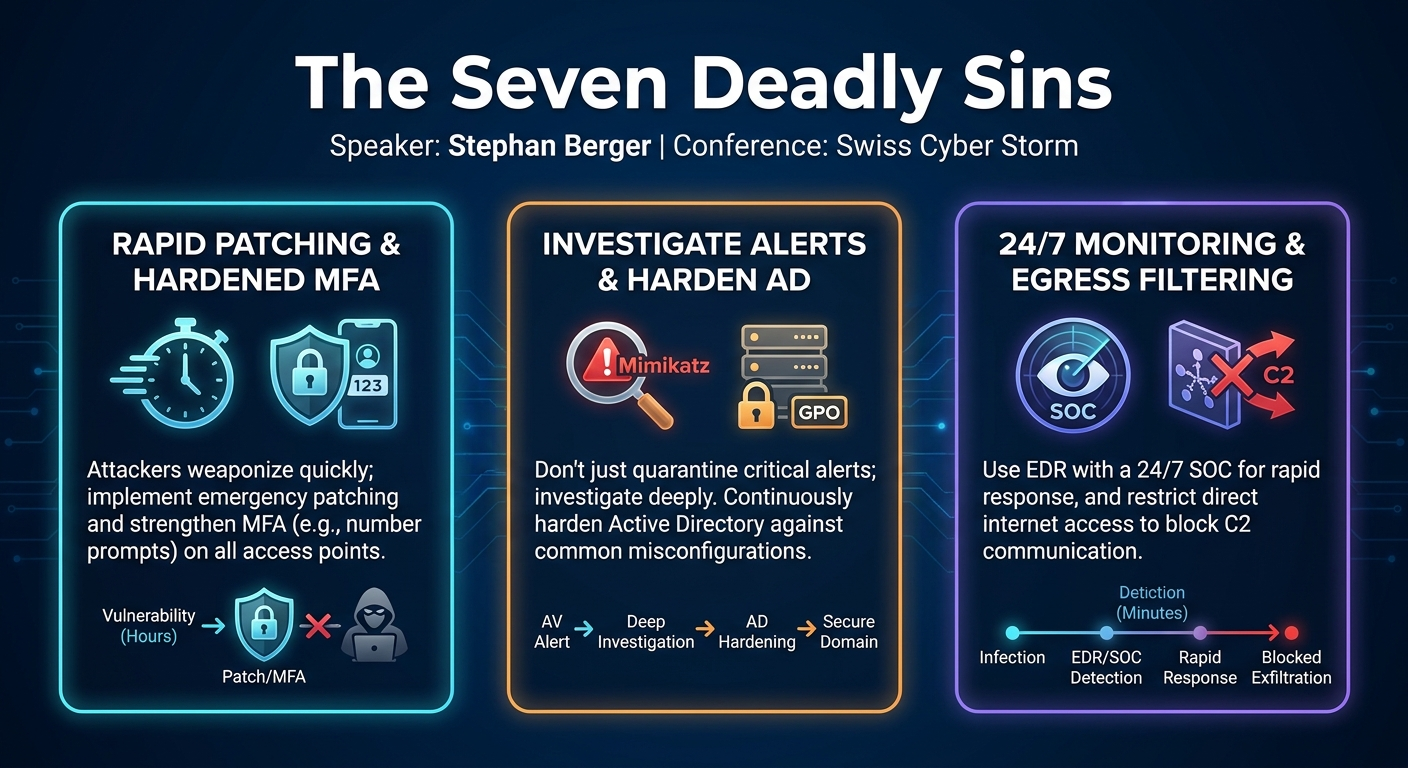
- Prioritize Patch Management: Implement a robust and agile patch management process. Develop an emergency patch process capable of deploying critical updates within hours, especially for internet-facing systems. Integrate threat intelligence feeds (e.g., Florian Roth's Cyber Twitter list) to stay informed about newly exploited vulnerabilities and prioritize patching efforts based on active exploitation.
- Enforce and Harden Multi-Factor Authentication (MFA): Mandate MFA for all public-facing services, remote access (VPN, RDP, Citrix), and privileged accounts. Implement stronger MFA methods like number prompts or FIDO2 security keys to mitigate MFA fatigue attacks. Regularly audit MFA configurations to ensure all users and access points are covered.
- Actively Monitor and Respond to AV/EDR Alerts: Treat all security alerts, especially those from AV and EDR solutions, as critical. Train security teams to interpret alerts, particularly for tools like Mimikatz, Cobalt Strike, and Metasploit. Establish clear incident response playbooks for these alerts, ensuring a thorough investigation rather than simply quarantining and dismissing. Engage external experts if internal capabilities are insufficient.
- Strengthen Active Directory (AD) Security: Conduct regular audits of Active Directory for common misconfigurations. Eliminate clear-text passwords in GPOs. Implement least privilege for service accounts, removing them from Domain Administrator groups unless absolutely necessary. Enforce strong, regularly changed passwords for all accounts. Implement an AD tiering model to prevent credential leakage and restrict privileged accounts to hardened administrative workstations.
- Conduct Comprehensive Incident Response: When a breach occurs, assume a broad compromise. Go beyond simply patching the initial vulnerability or reimaging a single machine. Conduct a thorough root cause analysis, identify all attacker actions (e.g., memory dumps, network scans, persistence mechanisms like web shells), and determine the full scope of compromised data and credentials. Reset all potentially compromised passwords and consider re-imaging affected systems.
- Implement Network Segmentation and Egress Filtering: Restrict direct internet access for servers and internal clients. Implement proxies and firewalls to filter outbound traffic, blocking known malicious categories (hacking, botnets, C2) and exfiltration platforms (Dropbox, Mega, Yandex). Monitor proxy and firewall logs for anomalous outbound connections, user agents (e.g., Bumblebee loader), and DNS C2 communication as indicators of compromise.
- Deploy EDR and 24/7 SOC Monitoring: Implement Endpoint Detection and Response (EDR) solutions across all endpoints to gain deep visibility into attacker activities. Establish or outsource a 24/7 Security Operations Center (SOC) to continuously monitor EDR alerts and other security telemetry. The speed of modern attacks necessitates constant vigilance and rapid response capabilities to contain threats before they escalate.
Key Takeaways
- Patching is a Race Against Time: Attackers weaponize new vulnerabilities within hours or days. Organizations must implement rapid, emergency patching processes and prioritize updates based on active exploitation.
- MFA is Essential but Requires Hardening: While critical, basic MFA can be bypassed. Implement robust MFA mechanisms like number prompts and ensure it covers all access points, including RDP and VPN, to prevent credential theft and BEC.
- Don't Ignore Security Alerts: Antivirus and EDR alerts, particularly for tools like Mimikatz or Cobalt Strike, are critical indicators of compromise. Investigate every alert thoroughly, as simply quarantining a threat is insufficient.
- Active Directory is a Primary Attack Vector: AD misconfigurations (passwords in GPOs, over-privileged service accounts, lack of tiering) are frequently exploited. Continuous hardening, least privilege, and strong password policies are paramount.
- Incident Response Must Be Comprehensive: A breach requires a deep dive beyond the initial point of compromise. Assume broader access, investigate for persistence, change all potentially leaked credentials, and understand the full scope of attacker activities.
- Defense-in-Depth is Non-Negotiable: Restrict direct internet access for internal systems, implement egress filtering, and monitor network traffic for C2 and exfiltration. This layered approach forces attackers to use more detectable methods.
- 24/7 Monitoring is Critical for Rapid Response: Given the speed of attacker progression (hours to domain admin), EDR and a 24/7 SOC are vital for early detection, rapid response, and preventing widespread network compromise.
About the Speaker(s)
Stephan Berger is a Senior Cyber Security Analyst at InfoGuard, a cybersecurity company. He is a regular contributor to the Swiss Cyber Storm conference. His expertise lies in incident response, where he gains first-hand insights into the common security failures and attack techniques used against organizations. His work involves analyzing breaches and helping companies recover, providing him with a practical perspective on effective defensive strategies.
Reviews
Dr. Zero (Offensive Security Researcher) — WEAK
This is a regurgitated list of Security 101 best practices dressed up as an incident response briefing. The speaker is competent, but summarizing half a decade of basic ransomware findings into 'patch Exchange and use MFA' adds absolutely zero value to the field. We do not need another hygiene checklist taking up a slot.
Heather Calloway (CISO) — SOLID
Berger delivers a competent, evidence-based review of where enterprise security programs actually break down in practice. It's a stark reminder that most breaches are failures of basic institutional control rather than technical sophistication. Worth routing to your operations leads to gut-check your patching SLAs and AD tiering, even if it won't change your board strategy.