The Missing Cyber Storm: Russian Cyber Operations During the Russo-Ukrainian War
Brandon Valeriano (Senior Fellow · Cato Institute)
Swiss Cyber Storm 2022 · Day 1 · Arena
Overview
In his compelling talk at Swiss Cyber Storm, Brandon Valeriano, a Senior Fellow at the Cato Institute, presented a contrarian and evidence-based analysis of Russian cyber operations during the initial six months of the Russo-Ukrainian War. Titled "The Missing Cyber Storm," Valeriano's presentation directly challenges the widely held belief that cyber warfare would fundamentally transform modern conflict, offering a "shortcut" or a "revolution in warfare." Drawing on extensive empirical research, he argues that despite a significant increase in the volume of cyber incidents, their strategic impact, severity, and coordination with conventional military operations have been remarkably limited, failing to achieve any coercive effect on Ukraine.
Key moments
- 2:00 Central thesis: 'No shortcuts for war'
- 3:00 Debunking the 'Cyber Thunder Run' predictions
- 7:50 Still unclear on cyber's strategic purpose in war
- 15:00 Surprising finding: Cyber attack severity decreased during war
- 19:00 Very little multi-domain operations or coordination observed
- 22:15 Final conclusion: Cyber offers no shortcut for war
- 24:50 Cyber more useful for repression than state warfare
The Missing Cyber Storm: Russian Cyber Operations During the Russo-Ukrainian War
Speakers: Brandon Valeriano, Senior Fellow, Cato Institute
Conference: Swiss Cyber Storm
YouTube: https://www.youtube.com/watch?v=OFm4kSDzXiU
Overview
In his compelling talk at Swiss Cyber Storm, Brandon Valeriano, a Senior Fellow at the Cato Institute, presented a contrarian and evidence-based analysis of Russian cyber operations during the initial six months of the Russo-Ukrainian War. Titled "The Missing Cyber Storm," Valeriano's presentation directly challenges the widely held belief that cyber warfare would fundamentally transform modern conflict, offering a "shortcut" or a "revolution in warfare." Drawing on extensive empirical research, he argues that despite a significant increase in the volume of cyber incidents, their strategic impact, severity, and coordination with conventional military operations have been remarkably limited, failing to achieve any coercive effect on Ukraine.
Valeriano's perspective is particularly notable given his deep involvement with U.S. government and military cyber strategy, including his work on the U.S. Solarium Commission. He contends that the academic and pundit communities have often made grand, unevaluated predictions about cyber war, driven by a desire for a "cleaner" or "quicker" form of conflict. This talk rigorously evaluates those predictions against the reality of the Russo-Ukrainian War, asserting that cyber operations have not provided Russia with a strategic advantage, nor have they altered the fundamental, devastating nature of war itself. His research highlights a critical disconnect between the pervasive narrative of an impending "cyber storm" and the actual, observed impact on the battlefield.
Background
▶ Watch: Central thesis: 'No shortcuts for war' (2:00)
Prior to and during the initial phases of the Russo-Ukrainian War, a pervasive narrative predicted a transformative role for cyber operations. Concepts such as the "Cyber Thunder Run," popularized by articles in Foreign Affairs by authors like Catler and Black, suggested that Russia would leverage cyberattacks on critical infrastructure, command and control, logistics, and emergency services to sow chaos, confusion, and uncertainty. The ultimate goal, it was theorized, would be to avoid a costly and protracted conventional war by achieving rapid dominance through digital means. Prominent academics, including Jason Healey of Columbia University, posited that Russia's willingness to take risks with its "real cyber capabilities" would redefine the very nature of cyber conflict. These predictions often reflected a broader expectation of a "revolution in warfare" driven by technology, echoing earlier concepts like "Shock and Awe."
However, Brandon Valeriano, drawing from over a decade of empirical research and direct engagement with U.S. cyber strategy development, offered a distinctly different outlook. He emphasized that within the U.S. government and academic circles he interacts with, there has been a solidification of the view that "there isn't cyber War so far" in the transformative sense. His previous work, including a book in 2015, had already critiqued Russia's strategic cyber prowess, suggesting they often resorted to cyber operations because they were "not very good at anything else." Historically, Russia's cyber profile from 2000 to 2020 indicated a frequent initiator of operations, primarily focused on disruption (harassment and signaling) and espionage (intelligence gathering), rather than degradation with strategic impact. They tended to be a "nuisance" and often targeted private sector entities or local government authorities, with a significant portion (one-third) of incidents focused on information operations or manipulating digital information. The severity of these attacks was generally low, measured in minutes or hours of impact, with only a few isolated examples of truly severe incidents. Valeriano's core thesis is that these historical patterns, rather than a predicted escalation, largely continued during the war, demonstrating that cyber operations offer "no shortcuts for war."
Key Findings
▶ Watch: Still unclear on cyber's strategic purpose in war (7:50)
Valeriano's research, co-authored with Grace Muller, meticulously examined Russian cyber operations during the first six months of the full-scale invasion, challenging many prevailing assumptions. Their analysis revealed several critical findings:
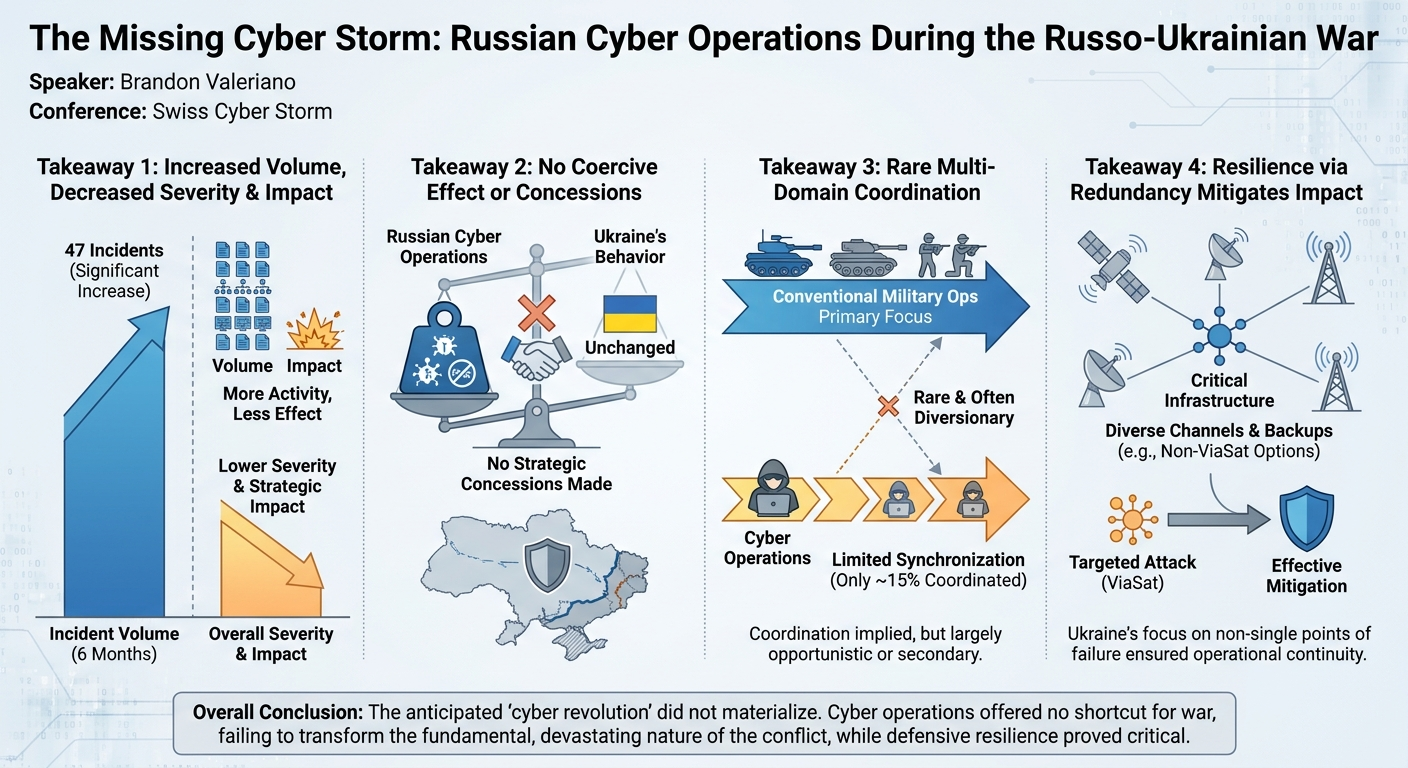
- Increased Volume, Decreased Severity: While the number of cyber incidents significantly increased during the war (47 incidents in 2022 alone, compared to 25 from 2014-2020), their overall severity actually decreased. Valeriano described this as "a lot of smoke but not a lot of fire," indicating widespread activity without corresponding strategic impact. This contradicts the expectation that severity would escalate during active warfare.
- No Coercive Impact or Concessions: Despite the volume of attacks, Ukraine made no coercive concessions due to cyber operations. The attacks failed to compel Ukraine to alter its behavior or give up any ground, either physically or politically. This underscores the limited strategic utility of cyber operations in achieving war aims.
- Limited Shift in Targets or Methods: Contrary to predictions, the targets of Russian cyber operations did not significantly shift from civilian and private sector entities to primarily military and government targets. The methods employed also remained largely consistent with pre-war patterns, focusing on disruption and espionage rather than large-scale degradation of military capabilities. During the war, there was a noticeable shift away from pure espionage, likely because direct military conflict provided more immediate intelligence.
- Minimal Multi-Domain Coordination: A critical finding was the scarcity of true multi-domain operations – incidents where cyber activities were coordinated with conventional military actions to achieve a simultaneous effect. Out of 47 incidents, only 7 (approximately 15%) showed any evidence of multi-domain operations. Valeriano argued that even these were often "diversionary incidents" intended to distract from conventional operations rather than achieve synchronized strategic impact. He specifically critiqued Microsoft's reports for highlighting "coordinated" incidents without providing the crucial context of their proportion relative to the total number of attacks, thus overstating their significance.
- Ineffective Information Operations: While Russia is known for its information warfare, Valeriano found that cyber-enabled information operations (like hack-and-leak campaigns) actually decreased during the war compared to the 2000-2020 period. He attributed the overall lack of success in Russian information operations not to a lack of effort, but to a "very poor product to sell," referring to the atrocities committed by Russia, making it difficult to manipulate public perception effectively.
- Cyber is Not a Shortcut for War: The overarching conclusion is that cyber operations offer "no shortcut for war." The anticipated "cyber revolution" on the battlefield has not materialized. Cyber capabilities may complement or add to conventional warfare, but they have not transformed its fundamental nature, which remains devastating and persistent. Valeriano highlighted that cyber is likely more effective for repression (targeting individuals) than for achieving strategic state-on-state objectives.
Technical Deep Dive
▶ Watch: Surprising finding: Cyber attack severity decreased during war (15:00)
Valeriano's analysis is grounded in an empirical methodology designed to systematically classify and evaluate cyber operations. Rather than relying on speculative assessments, his team meticulously counted and categorized incidents to derive concrete findings.
The core of their methodology involved classifying cyber operations into three primary types:
- Disruption: This category encompasses operations aimed at harassment, signaling, and causing temporary inconvenience or service outages. These are often used to send messages, test defenses, or create general unease without necessarily causing lasting damage.
- Espionage: Focused on intelligence gathering, this involves gaining unauthorized access to networks and systems to exfiltrate sensitive information. During an ongoing war, the emphasis was primarily on "short-term Espionage" to support immediate operational needs.
- Degradation: These are operations designed to have a "strategic specific impact" on the enemy, aiming to permanently impair or destroy critical systems and capabilities. This is the most severe form of cyber operation, with the potential for lasting physical or functional damage.
A key aspect of their approach was to move beyond public news reports, which can be prone to sensationalism or misinterpretation. Instead, they leveraged two primary, more authoritative data sources:
- Ukrainian Cybersecurity Reports: From March 3rd to May 15th, 2022, Ukraine's cybersecurity agencies produced weekly reports detailing cyberattacks they experienced. These reports, while inherently designed to highlight the extent of Russian aggression and solicit international support, provided a rich, granular dataset directly from the targeted nation. After May 15th, these reports became more general and monthly.
- Microsoft Reports: Microsoft released two significant reports, one in April and another on June 22nd, 2022, detailing Russian cyber activity against Ukraine. As a major technology provider with deep insights into network intrusions, Microsoft's analyses offered an external, technical perspective on the nature and scale of the attacks.
From these sources, Valeriano's team coded 47 specific cyber incidents during the war. It's crucial to understand the distinction between an "incident" or "operation" and a "cyber attack." An incident typically comprises multiple individual cyber attacks, employing various intrusion methods and exploits, often unfolding over a day or several days. This broader definition allows for a more holistic assessment of strategic impact rather than focusing on individual technical breaches.
A notable example discussed was the ViaSat attack, which occurred just prior to the full-scale invasion. Initially hyped by some, like Thomas Rhett, as potentially "the most significant Cyber attack during the year if not for the war," Valeriano's analysis revealed its limited strategic impact. The attack targeted modems in the boot drive of ViaSat terminals, requiring them to be reset or replaced. However, Ukraine's government and military had wisely implemented redundancy and had not depended on ViaSat as a single source of communication; it served primarily as a backup method. This pre-emptive diversification significantly mitigated the attack's potential to disrupt critical military or governmental communications, illustrating the importance of resilient network architectures.
Furthermore, Valeriano highlighted the nuance around multi-domain operations. While Microsoft reports suggested "coordinated cyber incidents," Valeriano preferred the term "multi-domain operations" to describe actions occurring in multiple domains (cyber, kinetic) simultaneously. He argued that "coordination" implies a level of deliberate cooperation between military and cyber forces that was largely absent. His co-author, Grace Muller, even posited that many observed multi-domain operations might have been diversionary, designed to distract from conventional military movements rather than achieve synchronized, mutually reinforcing effects. This subtle but critical distinction challenges the assumption of highly integrated cyber-kinetic warfare, suggesting that cyber activities during the war were often opportunistic or secondary rather than integral to primary military objectives.
Finally, the talk touched on information operations (IO). Valeriano emphasized that the field, currently often subsumed under "cyber security," will likely revert to its original designation of "information operations" as the broader information domain becomes the primary focus. While Russia is active in IO, the study specifically coded for cyber-enabled information operations (e.g., hack-and-leak campaigns). The finding that these decreased, coupled with Russia's overall struggles in information warfare, reinforces the idea that even advanced cyber capabilities cannot compensate for a fundamentally unpalatable message or objective ("you can't sell genocide").
Demo / Proof of Concept
▶ Watch: Final conclusion: Cyber offers no shortcut for war (22:15)
This talk was an analytical presentation of extensive empirical research and findings rather than a demonstration of specific tools, exploits, or proof-of-concept code. Brandon Valeriano presented data, classifications, and conclusions drawn from a systematic review of Russian cyber operations during the Russo-Ukrainian War.
Defensive Implications
▶ Watch: Cyber more useful for repression than state warfare (24:50)
Valeriano's research offers several crucial implications for cybersecurity defenders, strategists, and policymakers:
- Prioritize Resilience and Redundancy: The successful mitigation of the ViaSat attack by Ukraine serves as a prime example. Ukraine's strategy of not relying on single points of failure and maintaining diverse communication channels proved critical. Defenders must invest in robust, redundant architectures and backup systems, assuming that primary systems may be compromised or disrupted. This includes geographically dispersed infrastructure and varied technology providers.
- Focus on Strategic Impact, Not Just Incident Volume: The finding that incident volume increased while severity decreased is vital. Defenders should avoid alarmism based solely on the number of detected attacks. Instead, the focus must be on assessing the actual coercive or degrading impact of these operations on an organization's mission, critical functions, and ability to operate. A high volume of low-impact disruption may be a nuisance but does not necessarily constitute a strategic threat.
- Beware of "Cyber Revolution" Hype: Valeriano's core argument that cyber operations do not offer a "shortcut for war" means that defenders should not be swayed by exaggerated claims of cyber's transformative power. While cyber security is essential, it complements, rather than replaces, traditional defense strategies. Resources should be allocated based on realistic assessments of cyber capabilities' strategic utility, not on speculative predictions of an impending "cyber storm."
- Understand the Limits of Multi-Domain Operations: The limited evidence of coordinated multi-domain operations suggests that achieving synchronized cyber-kinetic effects is exceedingly difficult, even for a major state actor like Russia. Defenders should prepare for multi-domain threats but realistically assess the likelihood and sophistication of truly integrated attacks. This implies that cyber defenses should be robust enough to withstand standalone cyberattacks, even if they are not part of a larger, perfectly synchronized conventional assault.
- Information Operations Remain Critical: While cyber-enabled information operations were less impactful for Russia in this conflict, the broader domain of information warfare is still crucial. Defenders need to understand how adversaries attempt to manipulate narratives, sow discord, and undermine trust, even if the primary vector isn't a hack-and-leak operation. This involves proactive communication strategies, debunking disinformation, and maintaining public trust, regardless of whether cyber means are used.
- Tailor Defenses to Adversary Capabilities and Intent: Russia's historical profile as a "nuisance" rather than a consistently strategic degrader, particularly against state targets, should inform defensive postures. While capable of severe attacks in isolated instances (e.g., NotPetya), their overall strategic impact during the war was limited. Defenders should analyze specific adversary capabilities and demonstrated intent (e.g., good at ransomware, targeting individuals) to prioritize defense efforts effectively, rather than overestimating their strategic cyber warfighting prowess.
Key Takeaways
- Russian cyber operations against Ukraine significantly increased in volume during the war (47 incidents in 6 months) but decreased in overall severity compared to the preceding period (2014-2020).
- Despite the high volume of activity, Russian cyberattacks achieved virtually no coercive impact; Ukraine made no strategic concessions due to these operations.
- Evidence of true multi-domain operations – synchronized cyber and conventional military actions – was rare (only 15% of incidents) and often appeared to be diversionary rather than strategically coordinated.
- The anticipated "cyber revolution" in warfare has not materialized; cyber operations have not provided a shortcut to victory and do not fundamentally alter the devastating nature of conventional conflict.
- Ukraine's resilience and redundancy in critical infrastructure, such as not solely relying on ViaSat for communications, significantly mitigated the impact of targeted cyberattacks.
- Russian information operations, including cyber-enabled ones, were largely unsuccessful, partly due to a "poor product to sell" (i.e., the atrocities committed by Russia).
About the Speaker(s)
Brandon Valeriano is a Senior Fellow at the Cato Institute, a U.S. think tank known for its libertarian and often contrarian perspectives. With over seven years of experience working directly with the U.S. government and military on cyber strategy, Valeriano brings a unique blend of academic rigor and policy insight to his research. He was a member of the U.S. Solarium Commission, where he contributed to drafting a proposed U.S. cyber strategy. His work consistently challenges conventional wisdom regarding cyber warfare, advocating for an evidence-based approach to understanding its true impact and limitations in conflict. His research presented at Swiss Cyber Storm was co-authored with Grace Muller, a postdoc student whom he actively supports in the field.
Reviews
Dr. Zero (Offensive Security Researcher) — STRONG ACCEPT
I've spent a decade listening to think-tanks predict a Cyber Thunder Run, and Valeriano finally brought the receipts to prove it's mostly fiction. He counted the actual incidents in Ukraine and proved that volume went up while severity cratered. If you're still quoting vendor blogs about coordinated multi-domain Russian operations, you need to watch this.
Heather Calloway (CISO) — STRONG ACCEPT
Valeriano dismantles the myth of the cyber 'shock and awe' campaign with hard empirical data from the Ukraine conflict. It is required viewing for any CISO trying to talk a panicked board off the ledge after reading headlines about nation-state cyber war. He proves what pragmatists already suspected: basic resilience beats advanced capabilities, and cyber is a lousy tool for coercion.