Digital Identities and the Role of Privacy Engineering
Carmela Troncoso (Assistant Professor · apfl in lausanne)
Swiss Cyber Storm 2022 · Day 1 · Arena
Overview
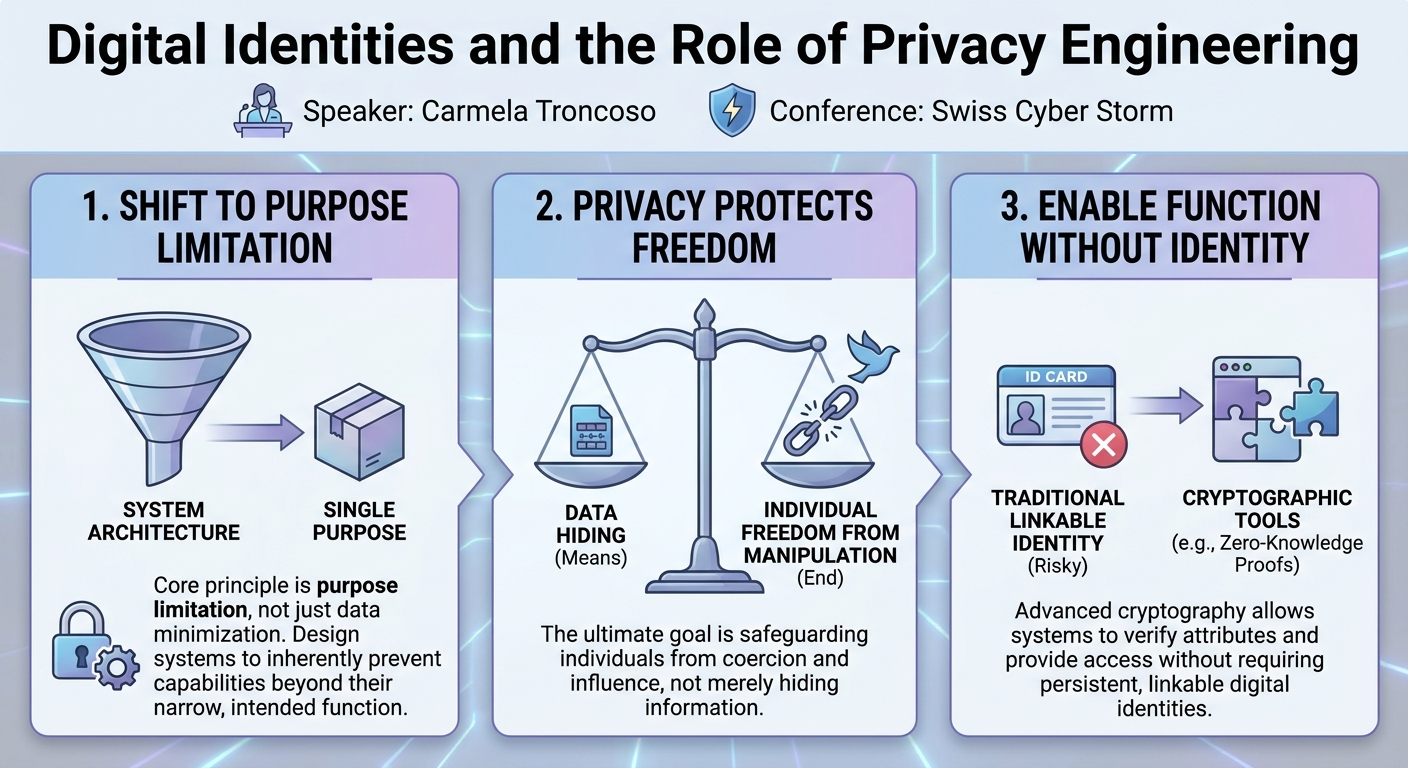
In her talk at Swiss Cyber Storm, Assistant Professor Carmela Troncoso from EPFL in Lausanne delves into the often-misunderstood discipline of privacy engineering, advocating for a paradigm shift from simple data minimization to a more profound focus on purpose limitation. Drawing from her extensive experience, including co-designing the highly successful Swiss COVID tracing app, Troncoso argues that true privacy protection in digital systems is not merely about collecting less data, but about architecting systems that inherently cannot misuse the data they possess, thereby safeguarding individual freedom from manipulation and coercion.
Key moments
- 2:00 The "draw the owl" challenge in privacy engineering
- 5:50 Purpose limitation: The true goal of privacy engineering
- 8:00 Why digital identities complicate privacy engineering
- 9:30 Privacy design: Start with purpose, not digitalization
- 10:20 Case study: Swiss COVID app avoided identities
- 14:00 Case study: Red Cross aid with decentralized biometrics
- 22:10 The best way to secure digital identity
Digital Identities and the Role of Privacy Engineering
Speakers: Carmela Troncoso, Assistant Professor, EPFL in Lausanne
Conference: Swiss Cyber Storm
YouTube: https://www.youtube.com/watch?v=LmhcQZmxgQg
Overview
In her talk at Swiss Cyber Storm, Assistant Professor Carmela Troncoso from EPFL in Lausanne delves into the often-misunderstood discipline of privacy engineering, advocating for a paradigm shift from simple data minimization to a more profound focus on purpose limitation. Drawing from her extensive experience, including co-designing the highly successful Swiss COVID tracing app, Troncoso argues that true privacy protection in digital systems is not merely about collecting less data, but about architecting systems that inherently cannot misuse the data they possess, thereby safeguarding individual freedom from manipulation and coercion.
This insightful presentation challenges conventional wisdom surrounding digital identity, suggesting that in many contexts, the very concept of a persistent, linkable digital identity is antithetical to robust privacy. Troncoso illustrates her arguments with concrete examples from her lab's work, demonstrating how advanced cryptographic techniques can enable critical digital services without necessitating the creation or reliance on traditional digital identities. The talk underscores the critical importance of designing systems from the ground up with a clear, minimal purpose, ultimately leading to more secure and privacy-preserving outcomes for users.
Background
▶ Watch: The "draw the owl" challenge in privacy engineering (2:00)
The concept of privacy engineering gained prominence roughly 10-15 years ago, spurred by growing discomfort with the vast amounts of personal data collected and processed by digital services. Early approaches often coalesced around the principle of "privacy by design", advocating for the integration of privacy considerations from the outset of system development. However, as Troncoso highlights, the practical implementation of "privacy by design" often left engineers feeling like they were told what to do ("engineer privacy") but not how to do it.
A common initial interpretation of privacy engineering revolved around data minimization, enshrined as a key principle in data protection regulations. The intuitive notion was: "the less data in the system, the more privacy-preserving it is." While data minimization is undeniably a crucial component, Troncoso argues that it serves as an insufficient and potentially misleading metaphor for true privacy engineering. She points out that sophisticated privacy-preserving techniques often involve processing data on local devices, distributing it across multiple servers, or encrypting it to perform operations in the encrypted domain. In all these scenarios, the data is still present in the system; it's the capability of the system to misuse that data that is curtailed.
The limitations of a purely data-minimization focus become stark when considering real-world privacy breaches, such as the Facebook Cambridge Analytica scandal. This incident was not just about data being collected; it was about how that data was used to influence and manipulate individuals. Even if Cambridge Analytica had collected data in a technically "privacy-preserving" way (e.g., anonymized models), the underlying problem of influencing user behavior would persist. This realization led Troncoso and her team to conclude that privacy itself is rarely the ultimate goal. Instead, privacy serves as a means to a greater end: protecting individual freedom from influence, intervention, manipulation, and coercion. This foundational shift in perspective underpins her advocacy for purpose limitation as the guiding principle for privacy engineering.
Key Findings
▶ Watch: Why digital identities complicate privacy engineering (8:00)
Carmela Troncoso's talk presents several pivotal findings that redefine the approach to privacy engineering:
- Privacy as a Means to Freedom: The fundamental insight is that privacy is not an end in itself, but a crucial enabler for protecting individual freedom from manipulation, coercion, and undue influence. Systems should be designed not just to hide data, but to prevent harm.
- Purpose Limitation Over Data Minimization: While data minimization is important, the true "holy grail" of privacy engineering is purpose limitation. This principle dictates that a system should be designed to eliminate its capability to harm by strictly minimizing its function to only the exact purpose for which it was intended. This means preventing the system from doing anything beyond its explicitly defined, narrow scope.
- Digital Identities are Often Problematic and Unnecessary: A core argument is that traditional digital identities are inherently linkable, enabling the creation of extensive profiles that make purpose limitation exceedingly difficult. Troncoso posits that many systems, when designed with a privacy-first, purpose-limited mindset, do not actually require persistent, linkable identities.
- Bottom-Up, Purpose-Driven Design: Effective privacy engineering starts by identifying the system's absolute minimal purpose and then building the smallest possible system to achieve that purpose. This contrasts sharply with the common approach of "digitalizing offline solutions," which often replicates and amplifies data collection and linking practices unsuitable for the digital realm.
- Multi-Purpose Systems are Inherently Difficult to Secure for Privacy: The more purposes a system serves, the exponentially harder it becomes to limit its overall purpose and protect user privacy effectively. Multi-purpose systems, while potentially commercially attractive, often necessitate reliance on policy mechanisms rather than strong technical privacy guarantees, leading to weaker protections.
- Cryptographic Tools Enable Identity-Free Functionality: Modern cryptography provides powerful tools (e.g., zero-knowledge proofs, attribute-based credentials, private information retrieval) that can enable systems to perform necessary functions, prove user attributes, or provide access without ever revealing or requiring a specific user identity.
Technical Deep Dive
▶ Watch: Privacy design: Start with purpose, not digitalization (9:30)
The core of effective privacy engineering, as articulated by Troncoso, lies in architecting systems that inherently restrict their capabilities to a specific, minimal purpose. This goes beyond simply collecting less data and delves into fundamental architectural choices and the application of advanced cryptographic primitives.
To achieve robust purpose limitation, privacy engineers employ several key strategies:
- Minimize Collection and Disclosure of Data: This is the foundational layer, ensuring only absolutely necessary data is gathered and shared.
- Minimize Linkability: Prevent disparate pieces of data from being combined to form a more extensive, potentially invasive profile. This is particularly challenging with traditional digital identities.
- Minimize Centralization: Avoid aggregating all data in a single location, which creates a powerful honeypot and a single point of failure for privacy. Decentralized architectures are preferred.
- Minimize Replication: Limit the duplication of data across multiple systems or storage locations, reducing the surface area for data breaches and misuse.
- Minimize Retention: Store data only for the absolute minimum time required to fulfill its purpose, then securely delete it.
Troncoso illustrates these principles through three real-world projects developed by her lab, demonstrating how systems can achieve their goals without relying on traditional, linkable digital identities:
- The Swiss COVID Tracing App:
- Purpose: To notify users of potential COVID-19 infection exposure.
- Privacy Engineering Approach: Epidemiologists confirmed that individual identities were irrelevant; only the fact of exposure mattered. The solution leveraged unlinkable Bluetooth random identifiers (also known as Bluetooth beacons). Users' phones periodically broadcast these anonymous, changing identifiers. If a user tested positive, their phone would upload its recent list of broadcast identifiers to a central server. Other phones would download these lists and locally check if they had encountered any of the "infected" identifiers.
- Technical Details: Crucially, the data that could link individuals (e.g., who was near whom, for how long, where) remained exclusively on the users' devices. The central server only stored anonymous, time-limited beacons, making the data useless for any purpose other than exposure notification. This design inherently minimized data collection, linkability, and centralization from the perspective of the system operator.
- Search Engine for Investigative Journalists (in collaboration with ICIJ):
- Purpose: To allow investigative journalists within a consortium to securely search each other's leaked documents without revealing who possesses which documents.
- Privacy Engineering Approach: For journalists, identity is a risk. Knowing who has a particular document could endanger them. The system needed to verify membership in the consortium without revealing which member was searching.
- Technical Details: This was achieved using Attribute-Based Credentials (ABC), combined with Zero-Knowledge Proofs (ZKP). Journalists could cryptographically prove that they were authorized members of the consortium without disclosing their specific identity. This allowed them to access the search functionality and contribute their document collections without the central server (or other members) knowing who they were. Even if the central server were compromised, no information linking specific journalists to specific searches or documents would be exposed, protecting both the individuals and the consortium from coercion or subpoena.
- Digitalizing Aid Distribution for the Red Cross (ICRC):
- Purpose: To ensure fair distribution of limited resources in crisis areas, preventing individuals from receiving aid multiple times, without creating dangerous databases of beneficiaries.
- Privacy Engineering Approach: The ICRC's goal is to help people in need, regardless of their name. They have a strict policy against central biometric databases due to the severe risks posed to vulnerable populations (e.g., the Taliban's use of refugee photo databases in Afghanistan). The system needed to verify "person in need" status and prevent double-dipping without identifying individuals.
- Technical Details: The solution involved privacy-preserving blacklisting and privacy-preserving auditing. When a beneficiary receives aid, a cryptographic token is issued (or their status updated on a local, non-linkable record), allowing the system to check if they've received aid recently without knowing who they are. For authentication, a decentralized biometric authentication scheme was implemented. Beneficiaries use biometrics (e.g., fingerprints) to identify themselves to the distribution center, but this is done without creating a central database of biometric templates. The biometric data is processed locally, or transformed into a non-reversible cryptographic representation that can only be used to verify against a locally stored template on a secure device, not against a central registry. This design ensures that the system's logs and blacklists contain no personally identifiable information, protecting refugees from future harm.
When identity is genuinely required for a system's single purpose, Troncoso suggests two alternative approaches that still prioritize privacy:
- Privacy Enhancing Technologies (PETs) for Data Interaction: Instead of revealing identity, use PETs like Private Information Retrieval (PIR) or private search intersection to query data. These technologies allow a user to retrieve information from a database or find common elements between datasets without revealing their query or the specific data they are interested in to the server.
- Minimalistic and Cryptographically Secured Identities: Design identities that minimize the disclosure of attributes. Instead of a full name and address, an identity might only attest to a single, necessary attribute (e.g., "over 18"). Further cryptographic tools can be used to prove these minimal attributes without revealing the underlying identity. However, Troncoso cautions that often, after going through this exercise, one might realize that even a minimal identity wasn't truly necessary.
In essence, the technical deep dive reveals that robust privacy engineering is about a fundamental re-imagining of system architecture, prioritizing decentralization, unlinkability, and purpose-specific cryptographic solutions over the convenience of centralized, identity-driven data aggregation.
Demo / Proof of Concept
▶ Watch: Case study: Red Cross aid with decentralized biometrics (14:00)
The talk did not feature a live, in-talk demonstration or proof-of-concept. Instead, Carmela Troncoso presented several real-world projects and deployments that her lab has either created or is in the process of deploying. These case studies, including the Swiss COVID tracing app, a search engine for investigative journalists, and an aid distribution system for the Red Cross, serve as concrete examples of how the principles of privacy engineering and purpose limitation have been successfully applied in practice. The detailed descriptions of their design, the cryptographic tools employed, and the privacy benefits achieved effectively illustrate the feasibility and impact of these approaches.
Defensive Implications
▶ Watch: The best way to secure digital identity (22:10)
For security professionals and organizations, Carmela Troncoso's talk offers profound defensive implications, urging a fundamental re-evaluation of how digital systems are conceived, designed, and secured.
- Question the Necessity of Identity: The foremost implication is to critically question whether a digital identity is truly indispensable for the core purpose of any new system or feature. Organizations should challenge the default assumption that user identification is always required. Often, as demonstrated by the Red Cross and ICIJ examples, proving an attribute (e.g., "member of consortium," "has not received aid yet") is sufficient, rather than proving a specific identity.
- Embrace Purpose Limitation as a Guiding Principle: Shift from a primary focus on data minimization to purpose limitation. Design systems so that their inherent architecture technically prevents them from performing any actions beyond their narrowly defined purpose. This is a proactive defense against mission creep, data reuse, and unforeseen misuse.
- Prioritize Decentralized Architectures: Centralized data stores and identity systems are attractive targets for adversaries. Defenders should advocate for and implement decentralized architectures where possible, distributing data, processing, and control to minimize single points of failure and reduce the power of any single entity to misuse information.
- Leverage Privacy Enhancing Technologies (PETs): Actively research and integrate PETs like Zero-Knowledge Proofs (ZKPs), Attribute-Based Credentials (ABCs), Private Information Retrieval (PIR), and private search intersection into system designs. These cryptographic tools allow systems to function effectively while minimizing data disclosure and maintaining unlinkability.
- Avoid Central Biometric Databases: The Red Cross example highlights the extreme danger of central biometric databases, especially for vulnerable populations. Defenders should implement decentralized biometric authentication schemes where biometric data is processed locally on the user's device or in a secure, non-linkable manner, rather than stored in a central repository. This protects users from immutable identifiers being compromised and weaponized.
- Beware of Multi-Purpose Systems: Recognize that systems designed for multiple purposes are exponentially harder to secure for privacy. While commercial pressures may push for multi-functionality, defenders must articulate the inherent privacy trade-offs. Strong privacy guarantees often require single-purpose designs. If multi-purpose is unavoidable, acknowledge that policy and legal frameworks will bear a heavier burden for protection, potentially offering weaker guarantees than technical controls.
- Shift from "Digitalizing Offline" to "Minimal Digital Purpose": Instead of replicating offline processes digitally, which often inherits and amplifies data collection, adopt a "minimal digital purpose" approach. Start by defining the minimal function, then build the smallest possible digital system to achieve it, leveraging digital-native privacy solutions.
- Educate Stakeholders: Security teams need to educate product managers, developers, and leadership about these principles. The "draw the freaking owl" problem of privacy by design can be overcome by providing concrete strategies and technical solutions, demonstrating that strong privacy is achievable and often leads to more resilient systems.
By adopting these defensive strategies, organizations can move beyond reactive data protection to proactive privacy engineering, building systems that are not only compliant but fundamentally designed to protect user freedom and prevent harm.
Key Takeaways
- Privacy protects freedom, not just data: The ultimate goal of privacy engineering is to safeguard individuals from influence, manipulation, and coercion, not merely to hide information.
- Purpose limitation is the core principle: Design systems to strictly limit their capabilities to only their intended, minimal purpose, inherently preventing misuse of data.
- Digital identities are often unnecessary and detrimental to privacy: Many systems can function effectively without requiring persistent, linkable digital identities, which are a primary source of profiling and privacy risk.
- Leverage advanced cryptography for privacy-preserving functionality: Technologies like Zero-Knowledge Proofs, Attribute-Based Credentials, and decentralized authentication enable powerful services without compromising user identity.
- Prioritize decentralized and single-purpose architectures: These designs inherently minimize data collection, linkability, and centralization, offering stronger privacy guarantees than multi-purpose, centralized systems.
- Critically re-evaluate system design from the ground up: Instead of digitalizing offline processes, start with the minimal purpose and build the smallest possible digital system, often finding that traditional identity is not required.
About the Speaker(s)
Carmela Troncoso is an Assistant Professor at EPFL (École Polytechnique Fédérale de Lausanne) in Switzerland. She is a distinguished scientist in the field of privacy engineering, with a particular focus on designing and building systems that protect user privacy. Her expertise was notably recognized during the COVID-19 pandemic, where she co-designed and co-led the project that developed the Swiss COVID tracing app, a system lauded for its technical prowess in privacy preservation. Troncoso's research centers on translating theoretical privacy concepts into practical, deployable engineering solutions, challenging conventional approaches to data collection and digital identity in the process.
Reviews
Dr. Zero (Offensive Security Researcher) — STRONG ACCEPT
Troncoso dismantles the regulatory obsession with data minimization and proves why we need to build systems that structurally cannot be abused. She backs this up with actual deployments like DP-3T and ICRC infrastructure, making it a rare privacy talk grounded in hard engineering rather than compliance checklists.
Heather Calloway (CISO) — STRONG ACCEPT
Troncoso makes a mathematically backed case that persistent digital identities are a design choice, not a technical requirement. For consumer-facing products, this is required reading for your privacy and architecture teams. But if you try to apply this strictly to enterprise networks, you will break your insider threat program in an afternoon.