Ransomware as Smokescreen for Nation State Sponsored Cyber Operations
Ippolito Forni
Swiss Cyber Storm 2022 · Day 1 · Arena
Overview
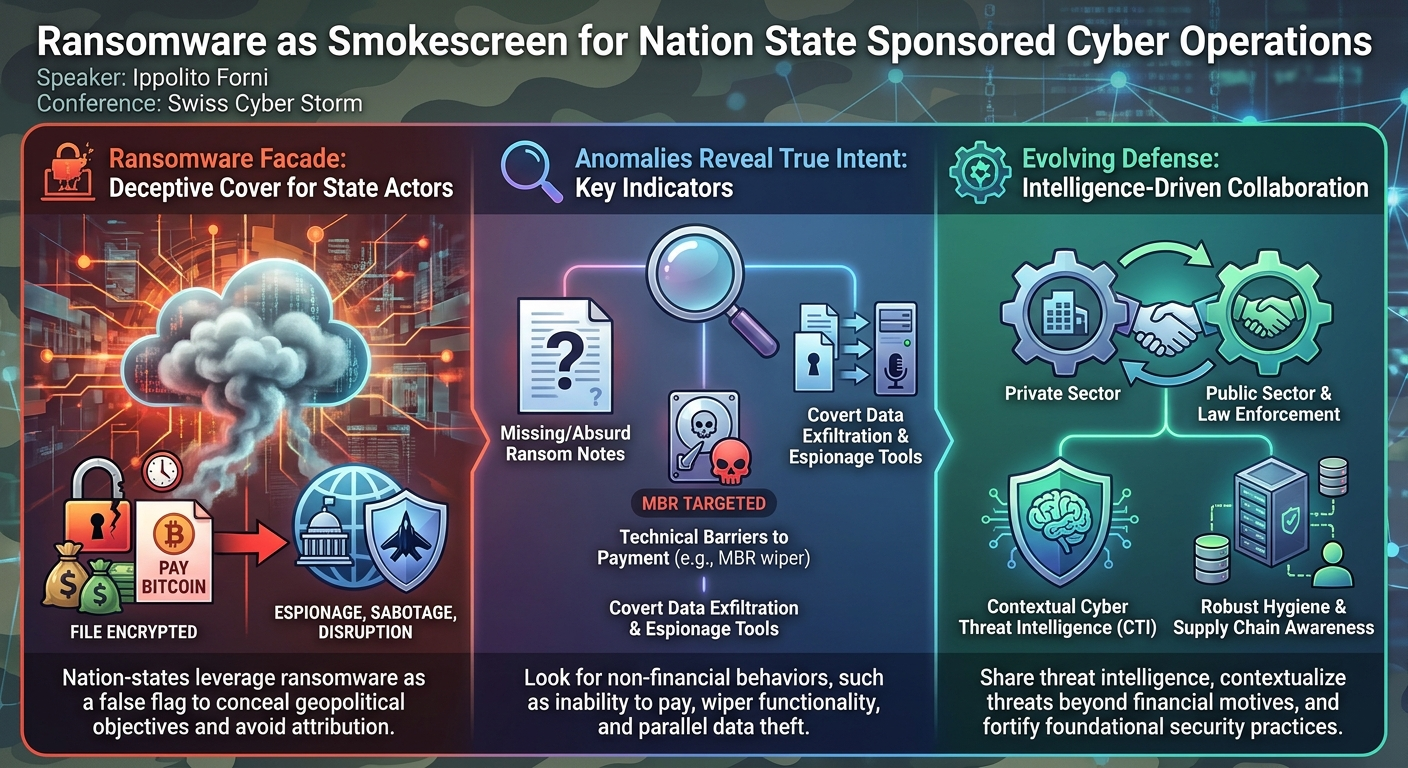
In this insightful talk at Swiss Cyber Storm, Ippolito Forni, a Senior Cyber Threat Intelligence (CTI) Analyst and Federal Intelligence Consultant at Klasik IQ, presented a compelling hypothesis: ransomware is increasingly being used as a smokescreen for nation-state sponsored cyber operations. Moving beyond the traditional view of financially motivated cybercrime, Forni argued that many high-profile ransomware attacks, particularly those with unusual characteristics, are in fact sophisticated false flag operations designed to conceal espionage, sabotage, or geopolitical disruption by attributing them to criminal gangs.
Key moments
- 2:00 Defining ransomware as a nation-state smokescreen
- 8:00 Hermes variant: Ransomware as a diversion for theft
- 11:00 Hypothesis: Nation-state cooperation for data monetization
- 14:00 Ransomware as the ultimate nation-state false flag enabler
- 18:00 Diplomatic challenge: Plausible deniability for nation-states
- 22:00 Implications for private organizations: Any data has potential value
- 25:00 Importance of cyber threat intelligence for tailored defense
Ransomware as Smokescreen for Nation State Sponsored Cyber Operations
Speakers: Ippolito Forni
Conference: Swiss Cyber Storm
YouTube: https://www.youtube.com/watch?v=YrKGAXZm7A
Overview
In this insightful talk at Swiss Cyber Storm, Ippolito Forni, a Senior Cyber Threat Intelligence (CTI) Analyst and Federal Intelligence Consultant at Klasik IQ, presented a compelling hypothesis: ransomware is increasingly being used as a smokescreen for nation-state sponsored cyber operations. Moving beyond the traditional view of financially motivated cybercrime, Forni argued that many high-profile ransomware attacks, particularly those with unusual characteristics, are in fact sophisticated false flag operations designed to conceal espionage, sabotage, or geopolitical disruption by attributing them to criminal gangs.
Forni's presentation meticulously detailed how nation-states leverage the chaotic and lucrative ransomware ecosystem to achieve strategic objectives while maintaining plausible deniability. By masquerading as financially driven cybercriminals, state-sponsored advanced persistent threat (APT) groups can execute operations that steal sensitive data, disrupt critical infrastructure, or sow discord, all while deflecting blame and avoiding direct geopolitical repercussions. This sophisticated deception poses significant challenges for law enforcement, national security agencies, and private organizations alike, demanding a re-evaluation of how we analyze and defend against modern cyber threats.
The talk emphasized that understanding this evolving modus operandi is crucial for effective cybersecurity. It highlighted the need for organizations to look beyond the immediate threat of data encryption and financial demands, considering the broader geopolitical context and potential secondary objectives of attackers. Forni's analysis provides a critical framework for identifying the subtle indicators that differentiate a purely criminal ransomware attack from a state-sponsored operation cloaked in a ransomware guise, thereby enabling more targeted and effective defensive strategies.
Background
▶ Watch: Defining ransomware as a nation-state smokescreen (2:00)
The evolution of ransomware has been a rapid and destructive journey, shifting from opportunistic nuisance to a highly sophisticated and often devastating threat. Ippolito Forni provided a concise historical overview to set the stage for his core hypothesis. Initially, ransomware, exemplified by early variants like CryptoLocker, operated on an opportunistic model. Attackers aimed to infect as many machines as possible, indiscriminately encrypting data in hopes that a percentage of victims would pay a relatively small ransom. This approach, while widespread, was often inefficient from a monetization perspective.
A significant shift occurred around 2017 with events like WannaCry, a wormable ransomware that rapidly infected hundreds of thousands of machines across 150 countries. Initially appearing as a targeted attack, its self-propagating capabilities demonstrated the potential for widespread disruption, even if its ultimate financial success was limited. This period also saw the rise of Ransomware-as-a-Service (RaaS), a business model where core developers create the malware and infrastructure, while affiliates execute the attacks, splitting the profits. RaaS lowered the barrier to entry for cybercriminals, accelerating the proliferation and sophistication of ransomware operations.
Subsequent evolutions included Big Game Hunting, where threat actors shifted from mass opportunistic attacks to targeting high-value organizations capable of paying multi-million dollar ransoms. This was followed by Double Extortion, where attackers not only encrypted data but also exfiltrated it, threatening public release if the ransom wasn't paid. This tactic provided additional leverage against victims with robust backup and recovery processes. The latest iteration, Triple Extortion, adds further pressure through tactics like Distributed Denial of Service (DDoS) attacks, reporting breaches to government authorities (leading to fines), or even directly contacting a victim's customers. These escalating tactics underscored the relentless pursuit of monetization by traditional ransomware groups.
However, Forni introduced the concept of "ransomware as smokescreen" as a critical departure from this purely financial motivation. He defined it as a standard operating procedure where cybercriminal gangs cooperate with nation-states to target victims, primarily to steal data valuable to the sponsoring nation-state. The core objective is to hide the attribution of the nation-state and disguise the true goals of espionage or sabotage behind the facade of a financially motivated cybercriminal operation. This sophisticated deception leverages the established infrastructure and perceived motives of ransomware gangs to achieve geopolitical ends, creating a complex attribution challenge that is at the heart of Forni's analysis.
Key Findings
▶ Watch: Hypothesis: Nation-state cooperation for data monetization (11:00)
Ippolito Forni's key findings centered on identifying unusual ransomware campaigns that exhibit characteristics inconsistent with purely financial motivation, strongly suggesting a nation-state smokescreen. He presented a series of case studies illustrating this pattern:
- 2017 NotPetya Variant (Ukraine): This attack primarily targeted financial institutions and the energy grid in Ukraine. While it masqueraded as ransomware, Forni highlighted a critical anomaly: there was no unique identifier for the ransomware actor to recognize the victim or facilitate payment. This fundamental oversight for a financially motivated operation strongly suggested that monetization was not the goal. Instead, the attack, occurring on Ukraine's Independence Day, was concluded by Ukrainian security services to be aimed at disruption and embarrassment of the Ukrainian government within a context of hybrid warfare.
- 2017 Hermes Variant: In this case, a bank was targeted, but the ransomware attack itself contained no ransom note, a glaring omission for a criminal enterprise seeking payment. Simultaneously, while part of the network was being encrypted, the threat actors exploited vulnerabilities in the SWIFT platform to exfiltrate a staggering $81 million. The ransomware, therefore, served as a diversion, occupying IT teams while the real objective—financial theft for state coffers or deniable funding—was achieved.
- 2018 MBR Killer: This ransomware variant targeted the Master Boot Record (MBR) of affected machines. Forni explained the peculiarity: encrypting the MBR prevents the machine from booting, making it impossible for the victim to see a ransom note or contact details. Again, this design choice undermines the possibility of payment. Similar to the Hermes variant, while IT departments scrambled to restore machines, threat actors simultaneously exfiltrated $10 million through the SWIFT platform. The MBR Killer was a distraction for a more profound, hidden objective.
- 2020 Thanos Variant: Attacks primarily against Israeli organizations utilized a specific loader known as Pogoop. This loader is uniquely attributed to MuddyWater, an Iranian state-sponsored APT group. Similar to MBR Killer, it targeted the Master Boot Record, again precluding any ransom payment. Forni concluded that this was a wiper attack disguised as ransomware, intended for disruption and sabotage by a nation-state.
- 2020 EvilQuest: This ransomware also lacked contact or payment details in its ransom note, or requested a "ridiculous" ransom amount. Crucially, the ransomware was observed downloading a keylogger and opening a reverse shell, indicating that its true purpose was espionage—data exfiltration and persistent access—rather than encryption for profit.
Forni's initial hypothesis, developed in late 2020, was further validated by subsequent research. He noted that the highly successful Ryuk ransomware group (also known as Wicked Spider) never seemed to monetize or leak the vast amounts of data they exfiltrated, which was a "gold mine." Later research from other vendors confirmed cooperation between Ryuk and nation-states, including the use of zero-day exploits—a capability rarely possessed by cybercriminal gangs. Similar findings emerged with Brown Starlight (linked to China), where the motivation was identified as intellectual property theft or cyber espionage rather than financial gain.
A very recent example cited was the Cuba ransomware attack against Montenegro in August. Targeting 10 government entities, the group demanded a very high ransom that was not paid. Despite Cuba ransomware never making political statements, the FBI's involvement and the context of Montenegro's proximity to Russia-ally Serbia, pointed towards a Russia-sponsored operation. Forni revealed that just three days prior to his talk, Ukraine had issued a notice indicating Cuba ransomware was targeting Ukrainian government entities, reinforcing the pattern of nation-states using these groups as a "smokescreen."
These findings collectively demonstrate that the ransomware-as-smokescreen model is the "ultimate false flag enabler." It allows nation-states to create countless "sock puppets" and APT groups, hiding within the massive and dynamic RaaS ecosystem. This exponential increase in "new kids on the block" provides an ideal theater to camouflage state-affiliated activity in plain sight, making attribution incredibly difficult.
Technical Deep Dive
▶ Watch: Ransomware as the ultimate nation-state false flag enabler (14:00)
The technical underpinnings of the "ransomware as smokescreen" strategy are sophisticated, leveraging established cybercriminal tactics while subtly subverting them for nation-state objectives. Ippolito Forni detailed several key technical elements and operational procedures that differentiate these operations:
At the core of this deception is the misdirection of intent. While traditional ransomware aims for encryption and subsequent payment, smokescreen operations use these actions as a cover. For example, in the 2017 NotPetya variant, the lack of a unique victim identifier or payment mechanism was a critical technical flaw for a ransomware operation, but a perfect design choice for a wiper or sabotage operation. The malware's primary function was destructive, causing widespread system unavailability in Ukrainian financial and energy sectors, rather than providing a path to recovery through payment.
The 2017 Hermes variant and 2018 MBR Killer demonstrated a more advanced form of technical camouflage. Both involved ransomware that either lacked a ransom note or, in the case of MBR Killer, rendered the system unbootable by targeting the Master Boot Record (MBR). From a technical standpoint, overwriting or corrupting the MBR is a highly effective way to prevent a system from starting, making it impossible for a user to interact with the operating system or view any on-screen ransom demand. This technical choice, while devastating for the victim, simultaneously achieves the diversionary goal: IT and security teams are entirely consumed with recovery efforts, unaware that a parallel, more strategic objective is being executed. In both these cases, the "real" technical operation involved the exploitation of SWIFT platform vulnerabilities to exfiltrate large sums of money ($81 million and $10 million respectively). This simultaneous, covert data or financial exfiltration is a hallmark of the smokescreen technique.
The 2020 Thanos variant provided a direct link to a known nation-state APT. The use of the Pogoop loader, uniquely attributed to Iran's MuddyWater (APT39), technically ties the ransomware-like activity to a state actor. When combined with MBR targeting and the absence of a payment mechanism, it clearly indicates a destructive operation masquerading as ransomware. Similarly, EvilQuest employed seemingly standard ransomware encryption, but its true technical payload included a keylogger and the establishment of a reverse shell. These tools are classic instruments for persistent access and espionage, allowing for long-term data collection and control, far beyond a one-time encryption event.
Forni also highlighted the operational advantage gained through the Ransomware-as-a-Service (RaaS) model. The RaaS ecosystem provides a ready-made framework for nation-states to operate. They can either directly sponsor or indirectly utilize existing criminal groups, or even create their own "sock puppet" affiliates. This allows APT groups to leverage existing ransomware strains, infrastructure, and TTPs (Tactics, Techniques, and Procedures) without the need to develop everything from scratch, thereby blending into the vast "sea" of ransomware activity. The use of zero-day exploits by groups like Ryuk (Wicked Spider), which are incredibly expensive and complex to develop, further points to nation-state backing, as criminal gangs typically lack such advanced capabilities.
A crucial concept Forni introduced was Maskirovka, a Russian term for military deception that broadly encompasses misleading, confusing, and deceiving opponents. He argued that the ransomware smokescreen is a form of Maskirovka applied to cyberspace. This extends beyond technical obfuscation to strategic communication. Forni drew an analogy to mafia tactics: an extortionist doesn't directly threaten but says, "Nice shop you have here, it would be a shame if something happened to it." Similarly, nation-states can use ransomware to cause severe disruption (e.g., Colonial Pipeline) and then have the "criminal" group issue a statement claiming it was a "mistake" or unintended consequence. This "mistake" narrative provides immediate plausible deniability, allowing the nation-state to achieve its strategic goal (e.g., demonstrating vulnerability, testing response) while deflecting blame. The technical operation, in this context, is designed not just to encrypt but to create a specific narrative that supports the geopolitical objective.
Demo / Proof of Concept
▶ Watch: Implications for private organizations: Any data has potential value (22:00)
This talk was primarily an analytical discussion and presentation of a hypothesis supported by historical case studies and current threat intelligence. Ippolito Forni did not conduct a live demonstration or present a technical proof of concept for the "ransomware as smokescreen" mechanism. Instead, he relied on the detailed examination of past incidents and the observed anomalies in their technical execution and stated objectives to build his case. The evidence presented was based on forensic analysis and intelligence reports from various security vendors and government agencies, rather than a direct, interactive demonstration of the attack methodology.
Defensive Implications
▶ Watch: Importance of cyber threat intelligence for tailored defense (25:00)
The "ransomware as smokescreen" paradigm fundamentally alters the defensive landscape, requiring organizations and national agencies to adopt a more sophisticated and holistic approach to cybersecurity. Ippolito Forni outlined several critical defensive implications:
- Enhanced Visibility and Contextual Intelligence: Defenders must move beyond simply detecting and responding to ransomware. It is imperative to develop deep visibility into ransomware actors' activities and to analyze attacks within a broader geopolitical context. Organizations need to ask: "Why us? What data do we hold that might be of value to a nation-state? How do we fit into a larger supply chain or national interest?" Only by piecing together these puzzles can the true nature of a smokescreen operation be uncovered. This requires robust Cyber Threat Intelligence (CTI) capabilities, tailored to an organization's specific threat landscape and national interests.
- Rethinking "Omerta" and Promoting Collaboration: Forni heavily emphasized the need for private organizations to overcome the "omerta"—the code of silence—and fully cooperate with law enforcement and national cybersecurity centers (NCSC). Many organizations hide breaches due to fear of fines, brand damage, or regulatory repercussions. However, this lack of information sharing creates critical blind spots for agencies trying to identify patterns and attribute sophisticated nation-state activities. Delayed reporting (often until data is leaked publicly) allows attackers to operate unimpeded for weeks or months, potentially achieving their espionage or sabotage goals.
- Supply Chain as a Primary Target: Organizations, regardless of their size, must recognize their potential as targets if they are part of a critical supply chain supporting national interests. A small startup providing a niche service to a government contractor, for example, could be the entry point for a nation-state seeking proprietary data or access. Defenders must assess their role within the broader economic and national security ecosystem.
- Beyond Financial Motives: Security teams must train themselves to look for anomalies in ransomware attacks that point away from purely financial gain. Questions to ask include: Is the ransom note missing or absurd? Is the malware technically designed to prevent payment (e.g., MBR targeting)? Is there evidence of data exfiltration that isn't being monetized? Are there parallel activities (e.g., SWIFT exploitation, keyloggers) occurring alongside the encryption? This analytical shift is crucial for identifying the true nature of the threat.
- Robust Foundational Security: While the threat is complex, basic cybersecurity hygiene remains paramount. Forni reiterated several best practices:
- Disaster Recovery (DR) Process Drills: Don't just have a policy; test it rigorously. Organizations often discover flaws in their recovery processes only after an attack, when it's too late.
- Physically Disconnected Backups: Ensure critical backups are isolated from the network to prevent them from being encrypted or destroyed during an attack.
- Comprehensive Vulnerability Management: Nation-states, like criminals, exploit known vulnerabilities. A robust patching and vulnerability management program is essential to reduce attack surfaces.
- User Security Awareness Training: The "human firewall" remains a critical defense. Well-trained employees are less likely to fall for phishing or social engineering tactics, which are common initial access vectors.
- Prioritize Security Posture Over Insurance: Forni criticized the trend of companies relying on ransomware insurance policies as a substitute for investing in security. While insurance has a role, it should not replace proactive measures. Insurers are also tightening policies due to abuse, making this a less viable long-term strategy.
- Intelligence-Driven Security Operations: Security operations should be directly informed by threat intelligence. Understanding the specific Tactics, Techniques, and Procedures (TTPs) of relevant nation-state actors and criminal groups allows for tailored defenses that are more effective than generic security controls.
- Navigating Sanctions and Post-Incident Response: Forni advised extreme caution regarding paying ransoms, especially given that many ransomware groups are now sanctioned by the US and EU. Paying a sanctioned entity can lead to further legal complications. In the event of a breach, organizations should not rush the post-mortem but instead fully cooperate with law enforcement and relevant agencies, informing them if a ransom payment is being considered or made. This ensures a coordinated response and aids in broader intelligence gathering.
Key Takeaways
- Ransomware is a Potent Smokescreen: Many seemingly financially motivated ransomware attacks are, in fact, sophisticated false flag operations executed by nation-states to achieve geopolitical objectives like espionage, sabotage, or disruption, while maintaining plausible deniability.
- Anomalies Reveal True Intent: Key indicators of a smokescreen operation include missing or absurd ransom notes, technical design choices that prevent payment (e.g., MBR targeting), simultaneous covert data exfiltration (e.g., via SWIFT), and the use of tools for persistent access and espionage (e.g., keyloggers, reverse shells).
- Attribution is Intentionally Obscured: Nation-states leverage the vast and complex Ransomware-as-a-Service (RaaS) ecosystem, create "sock puppet" groups, and employ "Maskirovka" (deception) and strategic communication to hide their involvement, making definitive attribution extremely challenging for law enforcement and intelligence agencies.
- Collaboration and Intelligence are Paramount: To counter this threat, private organizations must overcome the "omerta" and share threat intelligence with government authorities. A collective, intelligence-driven approach is essential to piece together the broader picture and identify nation-state TTPs hidden within ransomware campaigns.
- Robust Foundational Defenses are Non-Negotiable: While the threat is advanced, effective defenses still rely on strong basics: regular disaster recovery drills, physically isolated backups, comprehensive vulnerability management, security awareness training, and prioritizing security investments over sole reliance on insurance.
- Contextualize Your Threat Landscape: Organizations must understand their position within national security interests and supply chains, as even small entities can become targets if they hold data or access valuable to a nation-state. Security strategies must be tailored to this specific, evolving threat landscape.
About the Speaker(s)
Ippolito Forni is a highly experienced cybersecurity professional with a focus on cyber threat intelligence. He currently serves as a Senior Cyber Threat Intelligence (CTI) Analyst and Federal Intelligence Consultant at Klasik IQ, a cyber threat intelligence vendor. In this role, he assists organizations in operationalizing digital intelligence to enhance their security posture. Forni's expertise lies in understanding the adversary and tailoring security operations to specific threat landscapes. The conference host noted that Forni previously worked with Chris Kubetska, a former Swiss Cyber Storm speaker, highlighting his connections within the cybersecurity community.
Reviews
Dr. Zero (Offensive Security Researcher) — WEAK
This is a CTI briefing that packages six-year-old incidents into a 'hypothesis' everyone already agreed on in 2017. If you somehow didn't know NotPetya was a Russian wiper disguised as ransomware, this might be useful, but for anyone who has worked incident response this decade, it's just a history lesson.
Heather Calloway (CISO) — SOLID
This is a capable threat intelligence briefing on how nation-states use ransomware as a geopolitical smokescreen. While the core premise isn't novel to anyone who lived through NotPetya, it forces a necessary conversation about how we classify incidents in the first 48 hours. Worth a watch for your threat intel and IR leads, though your architecture team can skip the generic defensive advice at the end.