The Swiss Ecosystem for Vulnerability Management and Public Trust
Sandro Nafzger (CEO · Bug Bounty Switzerland)
Swiss Cyber Storm 2022 · Day 1 · Arena
Overview
In the rapidly evolving landscape of cyber threats, effective vulnerability management is paramount for digital trust and national resilience. Sandro Nafzger, CEO of Bug Bounty Switzerland, delivered a compelling talk at Swiss Cyber Storm, addressing the critical need for a holistic approach to vulnerability management that extends far beyond traditional bug bounty programs. This presentation highlighted Bug Bounty Switzerland's pioneering efforts to establish a comprehensive "Swiss Ecosystem" designed to make vulnerability management accessible and effective for organizations of all sizes, particularly within Switzerland.
Key moments
- 0:44 Vulnerabilities are everywhere; collaboration is key
- 4:50 Why most companies fail at bug bounties
- 6:50 Introducing a holistic bug bounty ecosystem
- 10:20 Our new centralized vulnerability collaboration platform
- 12:40 Actionable insights for impactful security initiatives
- 15:30 Hacker earnings: real-life financial impact
- 17:15 Switzerland's future in digital trust and resilience
The Swiss Ecosystem for Vulnerability Management and Public Trust
Speakers: Sandro Nafzger, CEO, Bug Bounty Switzerland
Conference: Swiss Cyber Storm
YouTube: https://www.youtube.com/watch?v=AZri8PERhW0
Overview
In the rapidly evolving landscape of cyber threats, effective vulnerability management is paramount for digital trust and national resilience. Sandro Nafzger, CEO of Bug Bounty Switzerland, delivered a compelling talk at Swiss Cyber Storm, addressing the critical need for a holistic approach to vulnerability management that extends far beyond traditional bug bounty programs. This presentation highlighted Bug Bounty Switzerland's pioneering efforts to establish a comprehensive "Swiss Ecosystem" designed to make vulnerability management accessible and effective for organizations of all sizes, particularly within Switzerland.
Nafzger's central thesis is that while bug bounties are an excellent starting point for discovering vulnerabilities, they are merely a stepping stone. True digital trust emerges from a robust, collaborative, and continuously improving vulnerability management process. The talk underscored the challenges organizations face in implementing such processes, from fragmented tooling and a lack of internal expertise to cultural resistance, and presented Bug Bounty Switzerland's unique solution: an integrated platform coupled with a supportive ecosystem that fosters collaboration, provides actionable insights, and ultimately strengthens Switzerland's digital security posture. This discussion is vital for any organization grappling with the complexities of securing their digital assets and for national cybersecurity strategies aiming to build public confidence.
Background
▶ Watch: Vulnerabilities are everywhere; collaboration is key (0:44)
The digital realm, while offering unparalleled opportunities, is inherently vulnerable. As Nafzger aptly states, "vulnerabilities are the breeding ground of cyber attacks," yet a significant number of these critical flaws often remain undiscovered and unaddressed. The theoretical understanding of securing information systems often clashes with the messy reality of daily operations, leading to pervasive security gaps. This problem is compounded by the fact that effective vulnerability discovery and remediation necessitate complex collaboration among diverse actors, including security researchers, internal engineering teams, authorities, and critical infrastructure providers.
Historically, organizations have struggled with this collaboration due to several systemic issues. Processes are often fragmented, relying on disparate tools and resulting in numerous "media breaks" that hinder efficient communication and progress tracking. For many organizations, particularly Small and Medium-sized Enterprises (SMEs) in Switzerland with limited resources, a functional vulnerability management process is non-existent. Nafzger pointed out a stark reality: 90% of companies are unable to initiate and sustain a bug bounty program independently. This failure stems from a combination of factors: a lack of internal skills, insufficient experience, inadequate organizational structures, or even deeply ingrained cultural issues that resist the necessary mindset shift towards transparent vulnerability disclosure and continuous improvement. Even for sophisticated organizations, managing a bug bounty program effectively, engaging with the research community, and translating findings into timely fixes can be an overwhelming undertaking. This fragmented and under-resourced landscape creates an urgent need for a more unified, accessible, and supportive framework for vulnerability management.
Key Findings
▶ Watch: Introducing a holistic bug bounty ecosystem (6:50)
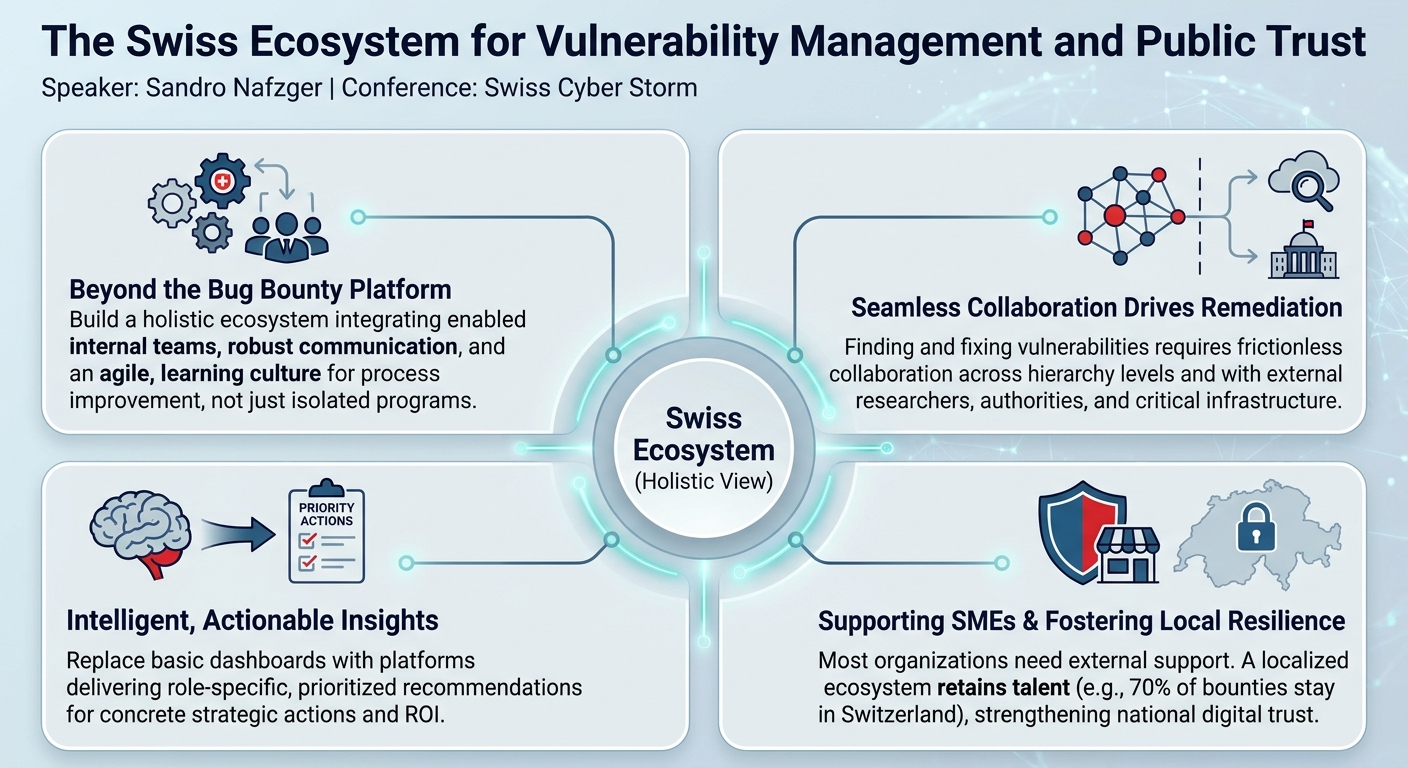
The central revelation of Sandro Nafzger's talk is the critical importance of a holistic approach to vulnerability management, embodied by the "Swiss Ecosystem" developed by Bug Bounty Switzerland. This ecosystem moves beyond the conventional understanding of bug bounties as isolated programs, repositioning them as a fundamental component within a broader, integrated strategy for digital trust. The key findings and contributions presented are:
- Bug Bounties as a Catalyst for Process Improvement: Nafzger highlighted that for many organizations, a bug bounty program isn't just about finding bugs; it's often "the first time an organization gets a vulnerability management process in place that actually works." The continuous influx of vulnerabilities from external researchers forces organizations to formalize and streamline their internal handling procedures, fostering an environment of proactive security.
- The Insufficiency of Platforms Alone: A bug bounty platform, while essential, is not a complete solution. An effective program requires a comprehensive ecosystem that includes enabled internal teams, well-defined communication strategies (both internal and external), and the cultivation of an agile organization with a strong learning culture. This holistic view is what makes Bug Bounty Switzerland's approach "unique worldwide."
- Vulnerability Collaboration as the Core: The ecosystem is built on the principle that finding and fixing vulnerabilities demands seamless collaboration. This extends not only within an organization across different hierarchy levels but also beyond its borders, involving authorities, other organizations, and critical infrastructure. The platform serves as a central hub to facilitate this frictionless, transparent, and efficient collaboration.
- Actionable Insights and Intelligent Reporting: A significant contribution is the development of intelligent reporting that delivers actionable results tailored to each user's role. Moving beyond mere dashboards, the platform leverages "thousands of bounty program" experiences to provide concrete recommendations for actions, helping organizations maximize their return on investment and continuously improve their security posture.
- A Swiss-Centric, Resilient Ecosystem: The initiative is deeply rooted in Switzerland, aiming to create a self-sustaining security community. With 70% of bounties remaining within Switzerland, the ecosystem fosters local talent and expertise, contributing to the nation's resilience against cyberattacks and positioning it as a "leader and role model for building public and digital Trust."
These findings collectively underscore that effective vulnerability management is not a singular tool or a one-off project, but rather an ongoing, collaborative, and strategically supported endeavor.
Technical Deep Dive
▶ Watch: Our new centralized vulnerability collaboration platform (10:20)
The technical backbone of the Swiss Ecosystem for Vulnerability Management is Bug Bounty Switzerland's proprietary platform, which Nafzger emphasized is "much more than just another Bounty platform." It's engineered as a central vulnerability collaboration hub designed to address the fragmentation and complexity inherent in traditional vulnerability management processes.
At its core, the platform provides a Central View of all vulnerabilities and their associated processes, while simultaneously enabling Decentralized Processing and remediation. This architectural choice allows different teams and organizational units to manage their specific vulnerabilities without losing sight of the overarching security posture. A key feature is the ability for a "perfect mapping of Team structures and organizational units," ensuring that responsibilities are clear and workflows are aligned with the organization's existing hierarchy. Furthermore, the platform prioritizes seamless integration into existing tooling, recognizing that organizations already rely on a diverse set of development, project management, and ticketing systems. This interoperability minimizes friction and ensures that security processes are embedded within daily operational workflows rather than existing as isolated silos.
The platform's intelligence layer is a significant differentiator, moving beyond static data presentation to offer Actionable Insights through Intelligent Reporting. This system is designed to deliver "actionable results for every user according to its role." Instead of overwhelming users with raw data, it processes vast amounts of information derived from "thousands of bounty program" experiences to generate concrete, prioritized recommendations. For instance, a CISO overseeing "dirty programs" would not be inundated with "hundreds of vulnerabilities" but would instead receive notifications on the "three concrete actions that need to be taken" to keep their security portfolio on track. This role-based intelligence extends to:
- Collaboration Improvement: Tracking the progress and quality of work done by various parties and providing recommendations on how to "improve the collaboration."
- Process Efficiency: Analyzing existing processes and suggesting ways to "work more efficient together."
- Budget Management: Offering insights and support to help organizations "stay in budget" for their bug bounty programs, leveraging experience from past programs.
- Hacker Pattern Discovery: An advanced feature that allows the tooling to "discover and learn about patterns from certain hackers." This intelligence enables organizations to "fine-tune their programs" to become more attractive to specific types of researchers and hackers they aim to interact with, thereby optimizing bug discovery.
Beyond vulnerability management, the platform also functions as an Access Hub to the ecosystem, facilitating the sourcing of security talent. It helps organizations connect with "the best Talent available worldwide or in Switzerland" for security testing, thereby extending an organization's security capabilities by leveraging external expertise. This capability supports both proactive security testing and ongoing bug bounty programs, ensuring that discovered vulnerabilities are not only identified but also effectively fixed.
The platform's design emphasizes real actionability, transforming raw security data into strategic guidance that empowers organizations to make informed decisions, optimize resource allocation, and continuously enhance their digital resilience. This comprehensive approach positions the Bug Bounty Switzerland platform as a central pillar in building a robust, collaborative, and intelligent national vulnerability management framework.
Demo / Proof of Concept
▶ Watch: Hacker earnings: real-life financial impact (15:30)
While Sandro Nafzger's talk did not feature a live, interactive technical demonstration in the traditional sense, he did present the concept of the Bug Bounty Switzerland platform visually, stating, "I put the screen here for everybody who has not seen it yet." This implied a visual representation of the platform's interface and capabilities, showcasing its central view for vulnerability collaboration and decentralized processing.
More compellingly, Nafzger provided a concrete real-life example to illustrate the direct impact and efficacy of the Swiss Ecosystem and its platform. He shared a testimonial from a full-time penetration tester who had joined the platform. This individual, by participating in programs "just on the side," had generated an additional income of 37,000 Swiss Francs. This example served as a powerful proof of concept, demonstrating several key points:
- Financial Incentive for Researchers: It validates the platform's ability to connect skilled security researchers with organizations offering legitimate bug bounty programs, providing significant financial rewards for their expertise.
- Attracting Talent: It highlights the platform's success in attracting and engaging security talent, fostering a vibrant community of ethical hackers.
- Tangible Results: The example shows that the ecosystem translates into tangible benefits not just for organizations (finding vulnerabilities) but also for individuals, thus strengthening the overall cybersecurity talent pool in Switzerland.
Furthermore, Nafzger emphasized that 70% of the bounties paid out through their platform "remain in Switzerland." This statistic serves as a broader proof of concept for the "Swiss Ecosystem" itself, demonstrating its success in:
- Localizing Value: Keeping a significant portion of the security expenditure within the national economy, reinforcing local talent and expertise.
- Building a National Community: Fostering a strong, self-sustaining community of Swiss security researchers and practitioners.
These examples, while not a step-by-step technical walkthrough, effectively demonstrated the practical application and positive outcomes of the Bug Bounty Switzerland platform and the broader ecosystem it supports.
Defensive Implications
▶ Watch: Switzerland's future in digital trust and resilience (17:15)
The insights shared by Sandro Nafzger offer crucial defensive implications for organizations aiming to bolster their cybersecurity posture and contribute to national digital resilience. Defenders should consider the following actionable strategies:
- Embrace a Holistic Vulnerability Management Approach: Organizations must move beyond ad-hoc security testing or isolated bug bounty efforts. Instead, they should adopt a comprehensive, ecosystem-driven approach that integrates vulnerability discovery, internal collaboration, external communication, and continuous remediation. This means recognizing that a bug bounty platform is just one component of a larger strategy.
- Invest in Internal Capability Building and Culture Shift: Acknowledge that successful vulnerability management requires more than just tools. Organizations need to invest in developing internal skills, fostering an agile environment, and cultivating a strong learning culture. This includes enabling internal teams, setting clear communication guidelines, and ensuring that security is ingrained in the development lifecycle.
- Leverage External Expertise and Managed Services: For the 90% of companies unable to run bug bounties effectively on their own, seeking external support is not a weakness but a strategic necessity. Utilizing managed services for program setup, community engagement, triage, and validation can significantly enhance a program's effectiveness, especially for SMEs with limited resources.
- Prioritize Collaboration and Transparency: Recognize that effective vulnerability remediation is a collaborative effort. Implement platforms and processes that facilitate frictionless information exchange across internal departments (e.g., development, operations, legal) and external stakeholders (e.g., researchers, authorities, critical infrastructure partners). Transparency about vulnerability status and remediation progress can build trust and accelerate resolution.
- Utilize Intelligent Reporting for Strategic Decision-Making: Move beyond basic dashboards. Demand and implement security tooling that provides actionable insights tailored to different roles within the organization. CISOs, for example, should receive high-level, prioritized actions rather than raw vulnerability counts, enabling strategic resource allocation and risk management.
- Actively Engage with the Security Research Community: View security researchers as allies, not adversaries. Foster a positive relationship by treating them respectfully, providing clear guidelines, and ensuring fair compensation. Platforms that facilitate this engagement can help attract top talent and uncover sophisticated vulnerabilities.
- Contribute to and Benefit from National Ecosystems: For organizations within Switzerland, actively participating in and supporting the local cybersecurity ecosystem, like the one presented by Bug Bounty Switzerland, can enhance collective resilience. This localized approach helps retain talent and expertise within the country, strengthening the overall national cybersecurity posture.
By implementing these defensive strategies, organizations can transform their vulnerability management from a reactive, fragmented process into a proactive, collaborative, and intelligent system that significantly enhances their digital trust and resilience against cyber threats.
Key Takeaways
- Holistic Vulnerability Management is Essential: Effective cybersecurity extends beyond simple bug bounty platforms; it requires a comprehensive "ecosystem" approach encompassing enabled teams, robust communication, and an agile learning culture.
- Collaboration Drives Remediation: Finding and fixing vulnerabilities demands seamless collaboration not only within an organization across hierarchy levels but also with external parties like security researchers, authorities, and critical infrastructure.
- Actionable Insights are Paramount: Security tools should provide more than just data; they must deliver intelligent, role-specific recommendations and concrete actions to maximize ROI and continuously improve security posture.
- SMEs Need External Support: A significant majority (90%) of companies, especially SMEs, struggle to initiate and manage bug bounty programs independently due to lack of skills, experience, or cultural barriers, highlighting the need for specialized external services.
- The Swiss Ecosystem Fosters Local Resilience: Initiatives like Bug Bounty Switzerland's platform strengthen national cybersecurity by localizing talent and expertise (70% of bounties stay in Switzerland), thereby making the nation more resilient and a leader in digital trust.
- Ethical Hacking Offers Career Opportunities: Participating in bug bounty programs can be a lucrative venture for security professionals, offering significant additional income and potential career paths, while simultaneously benefiting organizations.
About the Speaker(s)
Sandro Nafzger is the CEO of Bug Bounty Switzerland, a company at the forefront of the bug bounty movement in Switzerland. He is a passionate advocate for secure digital life, recognizing that for many, contributing to digital security is more than just a job – it's a driving passion. Nafzger leads Bug Bounty Switzerland in its mission to make comprehensive vulnerability management accessible to all organizations, regardless of size or maturity, through a unique holistic ecosystem approach. His expertise lies in building communities around organizations and products to enhance security and establish public trust.
Reviews
Dr. Zero (Offensive Security Researcher) — HARD PASS
This isn't a conference talk. It's a thinly veiled sales pitch for Bug Bounty Switzerland masquerading as a strategic keynote. If I wanted to watch a CEO read off a Series A pitch deck about 'holistic ecosystems,' I'd walk the vendor floor.
Heather Calloway (CISO) — PASS
This is a vendor pitch for a managed bug bounty service dressed up as a national resilience strategy. While the premise—that most organizations lack the maturity to run their own vulnerability disclosure programs—is true, the proposed solution is simply a commercial platform. Skip the talk and read their marketing brochure if you're shopping for a triage vendor.