Opening Keynote: Unlocking Digital Identities – The Journey and Path to a Digital Society
Joseph Carson
Swiss Cyber Storm 2022 · Day 1 · Arena
Overview
In this insightful keynote at Swiss Cyber Storm, Joseph Carson, a seasoned cybersecurity expert with deep roots in Estonia's digital transformation, takes the audience on a captivating journey through the evolution of digital identity and e-governance in Estonia. The talk, titled "Unlocking Digital Identities – The Journey and Path to a Digital Society," is not merely a historical account but a profound exploration of the foundational principles, successes, failures, and future directions that have positioned Estonia as a global leader in digital public services. Carson, an Irishman who has resided in Estonia since 2003, offers a unique insider's perspective on how a nation, rising from decades of occupation, strategically built a robust, transparent, and resilient digital infrastructure from the ground up.
Key moments
- 0:00 Introduction to Estonia's digital identity journey
- 2:00 Blockchain as Estonia's digital identity core
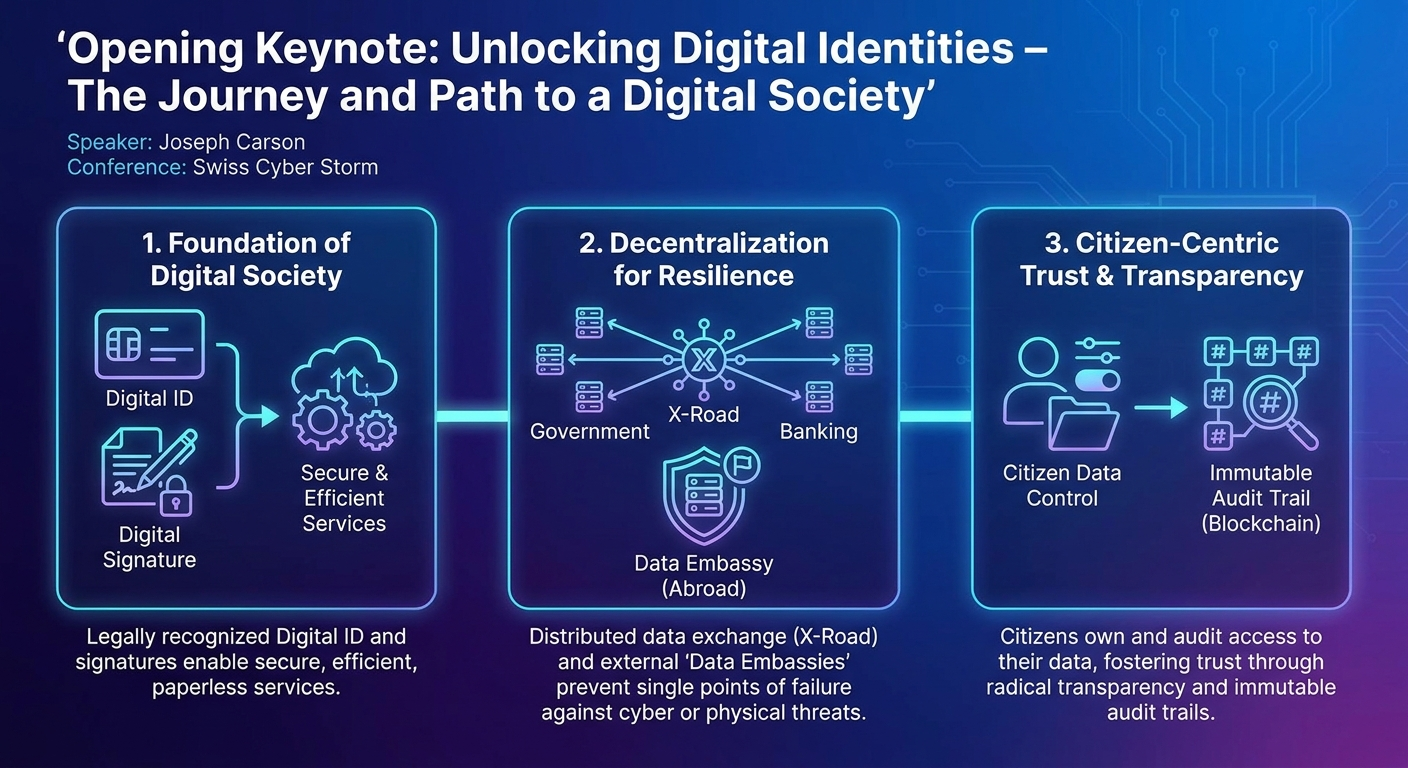
- 10:00 Foundations of digital society: ID, signatures, X-Road
- 16:00 Ensuring government transparency with public root hashes
- 22:00 2007 cyber war and Doomsday data scenario
- 28:00 Data embassies: Protecting national sovereignty abroad
- 32:00 Artificial intelligence (Krat) for citizen time-saving
Opening Keynote: Unlocking Digital Identities – The Journey and Path to a Digital Society
Speakers: Joseph Carson
Conference: Swiss Cyber Storm
YouTube: https://www.youtube.com/watch?v=rwosEbDvx6s
Overview
In this insightful keynote at Swiss Cyber Storm, Joseph Carson, a seasoned cybersecurity expert with deep roots in Estonia's digital transformation, takes the audience on a captivating journey through the evolution of digital identity and e-governance in Estonia. The talk, titled "Unlocking Digital Identities – The Journey and Path to a Digital Society," is not merely a historical account but a profound exploration of the foundational principles, successes, failures, and future directions that have positioned Estonia as a global leader in digital public services. Carson, an Irishman who has resided in Estonia since 2003, offers a unique insider's perspective on how a nation, rising from decades of occupation, strategically built a robust, transparent, and resilient digital infrastructure from the ground up.
Carson emphasizes that Estonia's journey, while pioneering, was fraught with challenges, underscoring the importance of adaptability and a forward-looking mindset. He dissects the critical ingredients for success, such as the strategic implementation of blockchain technology (initially referred to as time-stamping), the establishment of a comprehensive digital identity framework, and the unwavering commitment to citizen-centric design. The talk serves as both an inspiration and a cautionary tale, offering invaluable lessons for other nations, including Switzerland, on leveraging technology to foster trust, enhance efficiency, and safeguard national sovereignty in an increasingly digital and interconnected world.
Background
▶ Watch: Introduction to Estonia's digital identity journey (0:00)
Estonia's path to becoming a digital society is deeply rooted in its unique historical context and a profound desire to secure its future. After decades of Soviet and German occupation between 1940 and 1991, Estonia regained its independence in 1991. This pivotal moment presented a clean slate, allowing the newly formed government to envision a radically different future. Critically, Estonia inherited a strong intellectual legacy, boasting a wealth of computer scientists, cryptographers, and mathematicians who had thrived even under Soviet rule.
One of the immediate challenges facing the nascent nation was the authenticity of its history and records. Years of occupation had led to altered education, language, and historical narratives, creating widespread conflicts, particularly over land ownership as citizens returned from abroad. To ensure that its history could never again be erased or manipulated by an external power, Estonia embarked on a bold paperless path. This led to a crucial mandate in 1991: a group of top scientists and cryptographers were tasked with finding a digital solution to guarantee the immutability of historical records. Their solution, presented to the government in 1998 after academic validation in 1997, formed the bedrock of Estonia's digital identity framework. This early concept, then known as time-stamping, is recognized by Carson as Estonia's first introduction to what we now call blockchain. The roots of this technology can be traced back to Ralph Merkle's Merkle tree concept from 1979, a method for verifying data integrity through concatenation of hashes – a principle Carson likens to the widely distributed and agreed-upon nature of the Bible, where altering one copy would necessitate altering all.
Key Findings
▶ Watch: Foundations of digital society: ID, signatures, X-Road (10:00)
Estonia's digital transformation, initiated in the early 2000s, was built upon several foundational "key ingredients" that collectively created a robust and citizen-centric digital society.
The first critical step was the introduction of the Estonian ID card on March 11, 1999. While inspired by a Finnish idea, Estonia significantly enhanced its implementation, making it a cornerstone for establishing a citizen's identity. This was swiftly followed by the adoption of a digital signature in March 2000, legally recognized as equivalent to a physical paper signature. The combination of verified identity and legally binding digital signatures, integrated with time-stamping, marked a pivotal shift for Estonia, transitioning from merely a paperless society to a fully digital one.
This evolution culminated in the development of X-Road, Estonia's secure, decentralized information framework. X-Road isn't a central database but an interoperability layer that connects various public and private sector data lakes. A core principle of X-Road is data deduplication: information is stored in only one repository, and X-Road provides the address for accessing it, ensuring a single source of truth. Crucially, citizens retain full ownership and control over their data, with the ability to audit who accesses their records and when. This transparency was demonstrated by real-world examples, such as a police officer attempting to issue fraudulent speeding tickets or a nurse improperly accessing a politician's medical records, where the audit trails provided irrefutable evidence of actions.
Estonia further embraced digitalization by introducing internet voting in 2005, allowing citizens to cast their votes remotely. Today, 25-30% of votes in Estonian elections are cast online. A unique feature is the ability to vote multiple times, with only the last vote counting, fostering voter flexibility and making it harder for media to predict outcomes prematurely.
A defining moment for Estonia's digital resilience came on April 27, 2007, when the country faced a cyber war initiated by its "Noisy Neighbor" (Russia). This offensive involved widespread DDoS attacks and website defacement following the relocation of a Soviet-era statue in Tallinn. While Estonia's immediate response included severing inbound international communications to mitigate the attacks, the event exposed a critical vulnerability: the centralization of all national data within Estonia's physical borders. This "Doomsday scenario" prompted the realization that a land invasion could destroy the entire digital infrastructure.
In response, Estonia pioneered the concept of virtual data embassies and e-residency. Championed by then-CIO David Kotka, the idea was to decentralize critical government data by storing it in secure data centers located within Estonian embassies abroad. This strategy ensures that even if Estonia's physical territory were compromised, the nation's digital sovereignty and critical data would remain intact. The first such data embassy was established in Luxembourg.
The journey hasn't been without its setbacks. In 2008, Google's decision to disable the time-stamping protocol in its Chrome browser rendered about 50,000 Estonian ID cards non-functional, requiring a desktop application fix. Later, in 2015-2016, an outsourced identity card production to Gemalto resulted in a weakness in the encryption key, affecting nearly 1 million cards. These incidents underscored the need for continuous adaptation and problem-solving rather than reverting to outdated systems.
Looking to the future, Estonia is integrating Artificial Intelligence (AI), conceptualized through the "Krat" bot. Named after an Estonian mythological creature that "steals memories," the Krat bot automates citizens' digital actions based on their past interactions, significantly reducing the time spent on administrative tasks. This innovation highlights Estonia's focus on time as the most valuable asset, measuring success by the efficiency and time saved for its citizens.
Technical Deep Dive
▶ Watch: Ensuring government transparency with public root hashes (16:00)
At the heart of Estonia's digital society lies the X-Road framework, a distributed architecture designed for secure and efficient data exchange between various public and private sector information systems. Unlike a centralized database, X-Road functions as a decentralized interoperability layer. Each participating entity (e.g., government ministry, bank, hospital) maintains its own data lake or repository. The core principle is data deduplication: data is stored only once at its source. X-Road then facilitates the sharing of metadata or pointers to the data's location, rather than duplicating the data itself. This design ensures that if any single data repository is compromised, attackers only gain access to the data unique to that specific repository, not the entire national dataset.
Access to data within X-Road is strictly controlled by the citizen. Through a secure login, citizens can view who has accessed their data, revoke access rights, and update their personal information in a single location, which then propagates across all relevant systems. This is managed through a sophisticated system of privileges and PKI (Public Key Infrastructure) based digital signatures, ensuring authentication and authorization for every transaction.
The integrity and non-repudiation of these transactions are guaranteed by Estonia's innovative use of blockchain technology, initially termed "time-stamping." Crucially, Estonia's blockchain does not store personal data itself. Instead, it records cryptographic hashes of all significant transactions, such as access requests, data changes, and digital signatures. Every action taken within the X-Road environment – whether a citizen updating their address, a doctor accessing medical records, or a police officer issuing a ticket – generates a hash. These hashes are then concatenated and periodically aggregated to form a root hash.
To ensure that even the government cannot tamper with the official historical record, Estonia employs a unique mechanism to remove the "root of trust" from itself. Once a month, this aggregated root hash is publicly published in the Financial Times newspaper. This global distribution means that any attempt by the Estonian government to alter the digital history would necessitate retrieving and destroying every copy of that specific Financial Times edition worldwide, a mathematically improbable and practically impossible feat. This ingenious method provides an undeniable, externally verifiable audit trail, cementing transparency and accountability between the government and its citizens.
Furthermore, the integrity of the e-voting system is also underpinned by this blockchain-based auditability. Every vote, including subsequent changes, generates a verifiable transaction hash, ensuring that the final count is transparent and cannot be retroactively altered, further solidifying citizen trust in governmental processes. The entire architecture, from the distributed data model to the cryptographic hashing and external verification, exemplifies a proactive and technically sound approach to building a secure, resilient, and transparent digital state.
Demo / Proof of Concept
▶ Watch: Data embassies: Protecting national sovereignty abroad (28:00)
While Joseph Carson's keynote did not include a live, interactive technical demonstration of Estonia's digital systems, the entire narrative of his talk serves as a comprehensive "proof of concept" on a national scale. Estonia's journey, from its post-Soviet re-independence to its current status as a digital pioneer, is the ultimate, real-world demonstration of how the principles of digital identity, blockchain-backed integrity, decentralization, and citizen-centric design can be successfully implemented to build a resilient and transparent digital society. The examples provided – from the seamless updating of personal information across government services to the irrefutable audit trails that exposed misconduct by officials – are not theoretical scenarios but documented outcomes of a functioning, nationwide digital infrastructure. This large-scale, ongoing implementation showcases the practical viability and profound benefits of Estonia's innovative approach to e-governance and digital sovereignty.
Defensive Implications
▶ Watch: Artificial intelligence (Krat) for citizen time-saving (32:00)
Estonia's journey offers profound defensive implications for nations and organizations grappling with the complexities of digital security in the modern era. Joseph Carson unequivocally states that "a cyber war is here and it is going to happen," emphasizing that no country is immune to sophisticated cyberattacks, citing examples like NotPetya and WannaCry that quickly escalated globally.
A primary lesson derived from the 2007 cyberattacks is the critical importance of decentralization as a key mitigation strategy against DDoS attacks and, more broadly, against any single point of failure. Estonia's realization that centralizing all national data within its physical borders created a "Doomsday scenario" led to the innovative concept of data embassies. By strategically storing critical data in secure facilities located within embassies in other sovereign nations, Estonia has established a robust defense against both physical invasions and catastrophic cyberattacks, ensuring national digital sovereignty even if its physical territory is compromised. This approach provides a blueprint for other countries to enhance their resilience against natural disasters, geopolitical threats, and targeted cyber offensives.
Furthermore, Carson highlights the indispensable role of transparency and cooperation. Transparency, demonstrated by Estonia's citizen-controlled data access and the public auditing of government actions via the Financial Times root hash publication, builds trust between the government and its citizens – a vital component for widespread adoption and support of digital initiatives. On an international level, cooperation among governments is crucial to eliminate "safe havens" for cyber criminals and mercenaries, fostering a collective defense against global threats.
Ultimately, the foundation of all these defensive postures is a robust digital identity and privileges framework. This not only secures access to services but also empowers citizens, turning government services into a "front door" for value rather than a "back door" for data exploitation. While blockchain is not a "silver bullet" for all cybersecurity problems, its specific application in ensuring non-repudiation and an immutable history of transactions is a powerful defensive tool against data tampering and historical revisionism. Defenders must prioritize citizen value, embrace decentralization, foster transparency, and engage in international collaboration to build truly resilient and trustworthy digital infrastructures.
Key Takeaways
- Digital Identity as Foundation: A robust and legally recognized digital identity, coupled with digital signatures, is the indispensable cornerstone for building a secure, efficient, and citizen-centric digital society.
- Blockchain for Immutability, Not Storage: Estonia's success demonstrates that blockchain's power lies in guaranteeing the integrity and non-repudiation of transactions (via concatenative hashes and root hashes), rather than storing sensitive data itself, thereby creating an unalterable historical record.
- Decentralization for Resilience: The concept of data embassies and distributed data storage (X-Road) is a critical strategy for national sovereignty and resilience against physical attacks, natural disasters, and large-scale cyber warfare (like DDoS), preventing single points of failure.
- Citizen-Centric Design & Transparency: Prioritizing the value to citizens (e.g., time savings, control over personal data, auditability of government actions) and fostering radical transparency are crucial for widespread adoption, trust, and the long-term success of digital governance initiatives.
- Time as the Ultimate Asset: Measuring success by the time saved for citizens, as exemplified by Estonia's "Krat" AI bot automating administrative tasks, reframes the purpose of digital transformation around enhancing quality of life and efficiency.
- Proactive Cyber Defense & Cooperation: Cyber warfare is an inevitable reality; nations must proactively build resilient infrastructures, embrace decentralization, and foster international cooperation to mitigate threats and prevent safe havens for cyber criminals.
About the Speaker(s)
Joseph Carson is an Irish cybersecurity expert who has been a pivotal figure in Estonia's remarkable journey towards becoming a leading digital society. Having lived in Estonia since 2003, Carson has been at the core of the nation's digital transformation, witnessing and contributing to its evolution from the ground up. His career in information technology began in 1991, encompassing roles in system and network administration, mainframe operations, and the digitalization of medical records, before transitioning into information security in the early 2000s. With extensive experience speaking globally, Carson brings a unique, firsthand perspective on the practical implementation, challenges, and successes of building a secure and resilient digital identity framework.
Reviews
Dr. Zero (Offensive Security Researcher) — SOLID
This is the standard, well-polished retrospective on Estonia’s digital transformation and the X-Road architecture. It’s a solid strategic case study for policymakers or anyone new to national digital identity, but veterans of the space won't find any novel signal here.
Heather Calloway (CISO) — STRONG ACCEPT
This is a foundational case study on national-level identity and resilience architecture. While Estonia's X-Road model is often cited as a technical blueprint, Carson clearly illustrates that it is actually a triumph of governance and political will. Essential context for leadership teams designing distributed trust or zero-trust data architectures.