How Secure Is Your Environment? Hacker’s Perspectives ...
Yves Pellaton (Senior Security Consultant and Team Leader · SEC Consult)
Swiss Cyber Storm 2022 · Day 1 · Panorama
Overview
In his Swiss Cyber Storm 2022 talk, "How Secure Is Your Environment? Hacker’s Perspectives...", Yves Pellaton, a Senior Security Consultant and Team Leader at SEC Consult, offers a compelling deep dive into the modern attacker's mindset, methodologies, and common targets. The presentation transcends theoretical discussions, grounding its insights in real-world examples drawn from SEC Consult's extensive experience in offensive security. Pellaton systematically deconstructs the typical phases of a sophisticated cyberattack, from initial reconnaissance and compromise to privilege escalation and data exfiltration, illustrating how attackers relentlessly seek the path of least resistance.
Key moments
- 0:00 Talk introduction and speaker/company background
- 2:00 Different attacker categories and their motivations
- 5:00 Three main phases of a large organization hack
- 9:50 Phishing campaigns and MFE bypass techniques
- 15:00 Critical vulnerabilities in ERP and SAP systems
- 19:00 Common internal infrastructure attack examples
- 22:00 Defenders adopting attacker tools for incident response
- 26:00 The hacker mentality and a memorable closing song
How Secure Is Your Environment? Hacker’s Perspectives ...
Speakers: Yves Pellaton, Senior Security Consultant and Team Leader, SEC Consult
Conference: Swiss Cyber Storm
YouTube: https://www.youtube.com/watch?v=lLnFoEK2SOs
Overview
In his Swiss Cyber Storm 2022 talk, "How Secure Is Your Environment? Hacker’s Perspectives...", Yves Pellaton, a Senior Security Consultant and Team Leader at SEC Consult, offers a compelling deep dive into the modern attacker's mindset, methodologies, and common targets. The presentation transcends theoretical discussions, grounding its insights in real-world examples drawn from SEC Consult's extensive experience in offensive security. Pellaton systematically deconstructs the typical phases of a sophisticated cyberattack, from initial reconnaissance and compromise to privilege escalation and data exfiltration, illustrating how attackers relentlessly seek the path of least resistance.
Pellaton's talk is crucial for cybersecurity professionals because it forces a shift in perspective, moving beyond defensive checklists to embrace the adaptive and often unconventional tactics employed by adversaries. He highlights that despite advancements in security technologies, fundamental vulnerabilities—both human and technical—persist as primary entry points. By detailing specific attack vectors such as advanced phishing techniques, application-layer flaws (especially in web and ERP systems), and common misconfigurations within internal infrastructures, the presentation provides actionable intelligence for defenders.
The talk underscores the inherent imbalance in the cybersecurity landscape: defenders must secure every potential entry point, while attackers only need to find one weakness. Pellaton emphasizes that understanding this asymmetry, coupled with an appreciation for the attacker's problem-solving ethos and collaborative community, is paramount for building truly resilient security postures. This perspective is not about fear-mongering but about empowering organizations to anticipate and counteract threats more effectively by thinking like the adversary.
Background
▶ Watch: Talk introduction and speaker/company background (0:00)
The landscape of cyber security is characterized by a perpetual, uneven struggle between attackers and defenders. As Yves Pellaton articulates, attackers operate without the constraints of law and ethics, relentlessly probing for the weakest link, whereas defenders are bound by legal frameworks and must secure every conceivable vector. This fundamental asymmetry is exacerbated by the diverse and evolving nature of threat actors. Pellaton categorizes these adversaries, ranging from script kiddies who lack deep technical understanding but seek quick wins, to hacktivists driven by ideological motives, and the often-underestimated internal threat posed by disgruntled employees. More sophisticated threats include highly organized cyber criminal gangs offering ransomware-as-a-service or selling stolen data, competitors seeking industrial espionage, and formidable Nation States with vast resources and advanced offensive capabilities. Each category presents unique challenges, requiring a multi-faceted defense strategy.
Pellaton introduces a standardized three-phase process that typically governs large-scale organizational hacks: the Initial Phase, the Attack Phase, and the Final Phase. The Initial Phase begins with planning, where attackers define their objectives and assess available resources. This is followed by external reconnaissance, gathering intelligence on exposed services like RDP ports, SMTP servers, or O365 configurations, to identify potential entry points. The Attack Phase then commences with weaponization, preparing tools such as phishing campaigns, malicious documents, or compromised mail servers. This leads to initial compromise, where the attacker gains a foothold, often through user interaction like clicking a malicious link. From this point, a circular process of privilege escalation, internal reconnaissance, and lateral movement ensues, aimed at expanding control and reaching the ultimate objective. Finally, the Final Phase involves exfiltration of data—even in ransomware attacks, data is often stolen before encryption to increase leverage—or other post-compromise actions.
It is crucial to differentiate between various security assessments. Pellaton clarifies that a simple web application penetration test or a phishing campaign, while valuable, does not constitute a red teaming engagement. True red teaming, as defined by the hacker community and SEC Consult, encompasses the entire multi-phase process, evaluating people, processes, and technologies within an organization against realistic attack scenarios. This holistic approach provides a far more accurate picture of an organization's resilience against persistent and skilled adversaries.
Key Findings
▶ Watch: Three main phases of a large organization hack (5:00)
Yves Pellaton's talk highlights several critical findings that underscore the persistent vulnerabilities in modern environments and the evolving tactics of attackers:
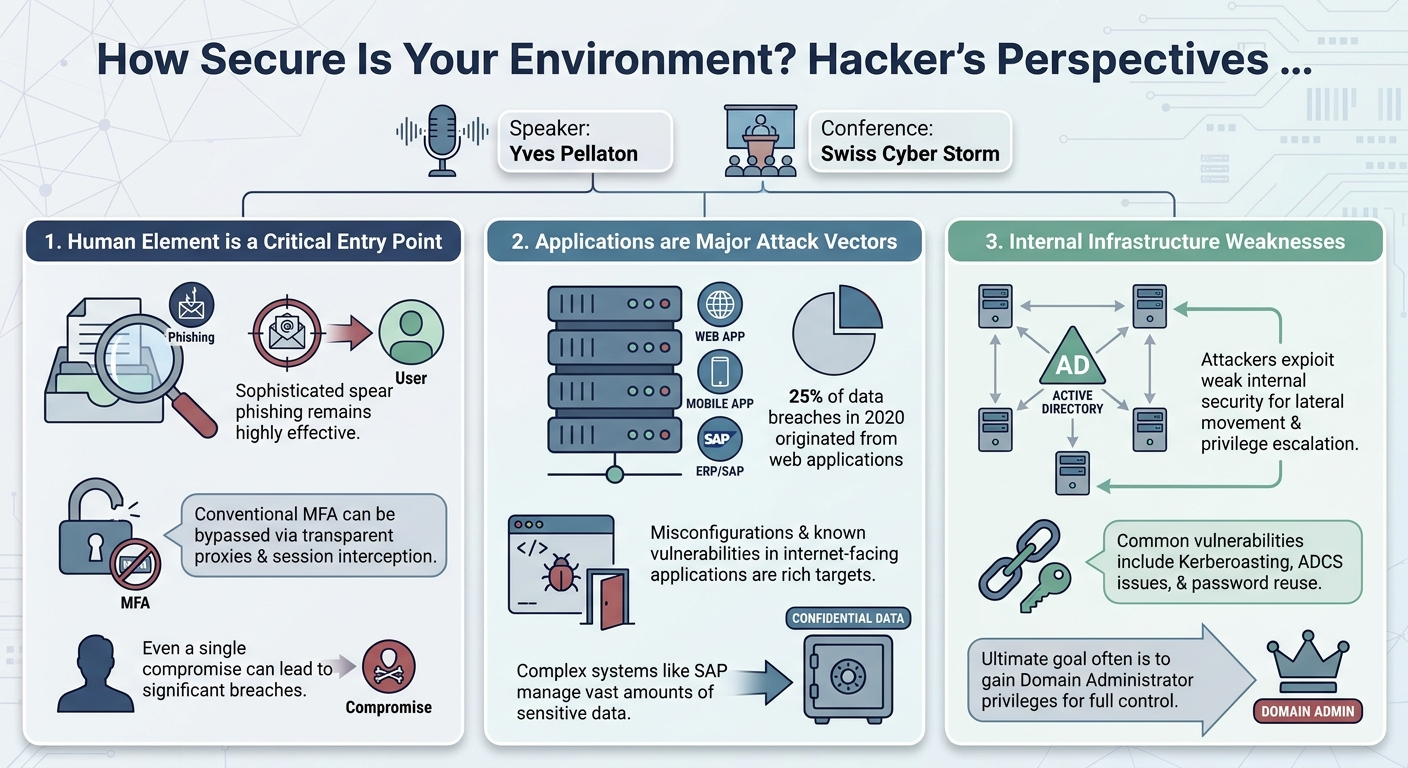
- Phishing Remains a Primary Threat: Despite decades of awareness campaigns, targeted spear phishing campaigns are increasingly sophisticated and difficult to detect. Pellaton shared an example where 10% of employees downloaded a malicious document, and 4% even ran embedded macros, emphasizing that even a single compromise is sufficient for advanced persistent threats (APTs). Crucially, he debunks the myth that conventional Multi-Factor Authentication (MFA) is a panacea, explaining how attackers can bypass it via transparent proxies to intercept user credentials and MFA tokens.
- Applications are Major Attack Vectors: A significant portion of initial compromises stem from application-layer vulnerabilities. Pellaton states that 25% of data breaches in 2020 originated from web applications. He emphasizes that internet-facing web applications, mobile applications, and complex enterprise resource planning (ERP) systems like SAP are rich targets for attackers due to potential misconfigurations, known vulnerabilities, and the vast amounts of confidential data they store.
- Misconfigurations and Outdated Software are Low-Hanging Fruit: Attackers frequently exploit readily available information on known vulnerabilities in outdated applications. Tools like Exploit-DB and Metasploit provide a wealth of proof-of-concept exploits, enabling even less-skilled attackers to gain initial access or escalate privileges. Pellaton also demonstrated how simple misconfigurations, such as a user being able to activate debug mode in an SAP system (
/h) and access sensitive tables, can lead to critical data breaches.
- Internal Infrastructure is Often Weakly Secured: Once inside, attackers find fertile ground for lateral movement and privilege escalation. Common issues include insecure file shares containing sensitive data like VHDX files (which can hold password hashes and LSA sessions), widespread password reuse, and critical vulnerabilities in Active Directory (AD) configurations such as Kerberoasting and ADCS issues that can lead directly to Domain Administrator privileges.
- The Hacker Mindset is Persistent and Collaborative: Pellaton stresses that hackers are driven by a desire to achieve their goals, often demonstrating remarkable persistence and ingenuity. He notes the strong, collaborative nature of the hacker community, where information and techniques are readily shared. This collective intelligence allows attackers to quickly identify and exploit new vulnerabilities, making it challenging for individual organizations to keep pace. Understanding this collaborative spirit and adaptive thinking is key for defenders.
Technical Deep Dive
▶ Watch: Critical vulnerabilities in ERP and SAP systems (15:00)
Pellaton's presentation meticulously outlines the technical methodologies and specific vulnerabilities that attackers leverage across the various phases of an attack.
The initial compromise often begins with phishing campaigns. While general phishing emails are common, spear phishing is far more effective. Attackers conduct extensive external reconnaissance to gather intelligence – identifying new hires, recent contract wins, or public information about individuals – to craft highly personalized and believable emails. These emails often create a sense of urgency or authority, compelling recipients to act without critical thought. A common tactic involves embedding malicious documents (e.g., .doc files) that, when opened, prompt users to enable macros, leading to code execution and an initial foothold. Pellaton cited an example where 10% of employees downloaded a document and 4% ran the macro, highlighting that even low success rates are sufficient for a determined attacker. He also challenged the perception that Multi-Factor Authentication (MFA) is an infallible defense. In scenarios involving a transparent proxy, an attacker can intercept the username, password, and the MFA code, or even the session token post-authentication, effectively bypassing conventional MFA mechanisms.
Beyond social engineering, Pellaton emphasizes the critical role of applications as attack vectors, noting that 25% of data breaches in 2020 started with web applications.
Web applications, being internet-facing and often housing vast databases of confidential information, are prime targets. Common vulnerabilities include:
- File Upload vulnerabilities: If not properly secured, attackers can upload malicious files (e.g., web shells) that, when executed by the server, can lead to Remote Code Execution (RCE), granting full compromise of the underlying server.
- Cross-Site Scripting (XSS): This allows attackers to inject malicious client-side scripts into web pages viewed by other users. XSS can be used to steal session cookies, deface websites, or redirect users to malicious sites, effectively leveraging anything that can be done with JavaScript.
Mobile applications, increasingly used for critical business functions like expense management and approvals, introduce new attack surfaces that require thorough testing, often guided by frameworks like the OWASP Mobile Top 10.
Highly complex systems like ERP and SAP are particularly critical due to the vast amounts of sensitive employee and customer data they manage. Pellaton provided a stark example: if a user can initiate debug mode by simply appending '/h' to the URL and is authorized (or misconfigured to be authorized) to access tables like user02, they can download password hashes. These hashes can then be cracked offline using brute-force attacks, potentially yielding administrative credentials. He strongly advises that only highly experienced professionals test such systems to avoid data corruption or loss.
Once an attacker gains an initial foothold, the focus shifts to privilege escalation and lateral movement within the internal infrastructure. Attackers actively search for outdated applications with known vulnerabilities, often consulting public databases like Exploit-DB or leveraging comprehensive exploitation frameworks like Metasploit to find readily available proof-of-concept exploits. They also attempt to bypass existing authentication and authorization mechanisms to gain elevated access.
Within the internal network, Active Directory (AD) environments are frequently targeted. Pellaton highlights common AD attack vectors:
- Kerberoasting: An attack that allows an attacker to request service tickets for specific service principal names (SPNs) and then crack the encrypted portion of the ticket offline to recover the service account's password.
- AD Certificate Services (ADCS) issues: Misconfigurations in ADCS can allow attackers to enroll for certificates with elevated privileges, leading to domain compromise.
These attacks can provide straightforward paths to Domain Administrator privileges. Tools like Bloodhound are invaluable for mapping these complex attack paths visually, identifying relationships and potential privilege escalation routes within AD.
Further technical weaknesses within internal infrastructure include:
- Insecure file shares: Standard users often have access to shares containing sensitive files like VHDX files (virtual hard disk images). These files, when downloaded and analyzed offline, can contain a wealth of secrets, including password hashes, LSA (Local Security Authority) secrets, and cached credentials, which can be extracted and reused.
- Password reuse: A persistent problem where compromised local administrator credentials on one server can be reused on other, more critical systems, including those hosting domain administrator sessions. This can quickly lead to a full domain compromise, enabling attackers to encrypt the entire infrastructure or exfiltrate confidential data.
Pellaton concludes this section by emphasizing that the ultimate goal is often to reach Domain Administrator status, which grants attackers the power to control the entire network, facilitating large-scale data exfiltration or deploying ransomware.
Demo / Proof of Concept
▶ Watch: Common internal infrastructure attack examples (19:00)
While Yves Pellaton's talk did not feature a live, interactive demonstration or proof-of-concept in the traditional sense, he effectively illustrated his points with concrete examples and real-world statistics drawn from SEC Consult's engagements. These served as compelling "proofs of concept" for the vulnerabilities and attack methodologies discussed.
For instance, when discussing phishing campaigns, Pellaton presented statistics from a customer engagement: 10% of targeted employees downloaded a malicious document, and 4% proceeded to run the embedded macro. This real-world example vividly demonstrated the persistent effectiveness of social engineering and the human element as a critical vulnerability.
In the context of complex applications, he detailed a specific SAP misconfiguration where a user, by simply activating debug mode (/h) and having unintended access to the user02 table, could download password hashes. This hypothetical but highly plausible scenario underscored how a seemingly minor flaw could lead to critical data leakage and subsequent offline brute-force attacks to gain administrative credentials.
Similarly, when discussing internal infrastructure, Pellaton highlighted common findings from penetration tests, such as standard users having access to file shares containing VHDX files. He explained how these files could be downloaded, analyzed offline, and reveal sensitive information like password hashes and LSA sessions, which could then be leveraged for privilege escalation and lateral movement. These examples, though not live demos, served to concretely illustrate the practical application and impact of the technical concepts discussed.
Defensive Implications
▶ Watch: The hacker mentality and a memorable closing song (26:00)
Yves Pellaton's insights offer crucial guidance for defenders seeking to fortify their environments against persistent and sophisticated attackers. The talk strongly suggests a multi-layered, proactive defense strategy that acknowledges the attacker's mindset and leverages their own tools.
- Enhance Employee Awareness and Training: Given the continued efficacy of phishing, regular, targeted phishing simulations are essential to measure and improve employee awareness. However, Pellaton cautions that these simulations alone do not improve security; they merely provide a snapshot of current vulnerability. Continuous education on identifying spear phishing, understanding social engineering tactics (like time pressure), and the risks associated with macro-enabled documents is paramount.
- Strengthen Multi-Factor Authentication (MFA): While MFA is beneficial, organizations must be aware of its limitations. Conventional MFA can be bypassed through techniques like transparent proxies or session token interception. Defenders should explore more robust MFA solutions and ensure that their implementation is resilient against such bypass techniques.
- Prioritize Application Security: With applications being a leading cause of data breaches, a robust Application Security (AppSec) program is non-negotiable.
- Web Applications: Implement secure coding practices to prevent vulnerabilities like Cross-Site Scripting (XSS) and ensure rigorous validation and sanitization for all user inputs, especially file uploads, to mitigate Remote Code Execution (RCE) risks. Regular penetration testing of web applications, ideally following frameworks like the OWASP Top 10, is critical.
- Mobile Applications: Treat mobile apps as new attack surfaces, especially with increased remote work. They require dedicated security testing and adherence to mobile security best practices.
- ERP/SAP Systems: These complex systems, storing highly confidential data, demand specialized security expertise for testing. Engaging professionals with deep experience in SAP security is crucial to avoid critical misconfigurations and data loss.
- Proactive Vulnerability Management: Organizations must actively identify and patch outdated applications with known vulnerabilities. Relying solely on vendor updates is insufficient; security teams should proactively scan for vulnerabilities and consult resources like Exploit-DB to understand what attackers are leveraging. A robust patch management program is fundamental.
- Harden Internal Infrastructure and Active Directory: Once an attacker gains initial access, the internal network often presents the clearest path to full compromise.
- Active Directory (AD) Hardening: Address common AD attack paths like Kerberoasting and ADCS issues. Implement least privilege principles rigorously.
- Access Control: Strictly limit access to sensitive file shares, especially those containing potentially exploitable files like VHDX files.
- Password Policies: Enforce strong, unique passwords across all systems to prevent password reuse, which often facilitates lateral movement.
- Network Segmentation: While Pellaton notes it has pros and cons, proper network segmentation can significantly limit an attacker's ability to move laterally and escalate privileges after an initial compromise.
- Embrace Attacker Tools for Defense: Defenders should adopt tools traditionally used by attackers. Pellaton specifically mentions Bloodhound as a tool that blue teams can use to map potential attack paths within their own Active Directory, identifying privilege escalation routes before attackers do. Similarly, tools like Velociraptor can be deployed to centralize endpoint monitoring, rapidly detect indicators of compromise (IoCs), and respond to threats within the environment.
- Strategic Security Testing: Pellaton suggests a strategic approach to security testing. For new or immature applications, a thorough penetration test is advisable before going live. Once an application is mature and stable, bug bounty programs can be a valuable supplement to continually ensure quality and security, acknowledging that the dark web might offer higher rewards for vulnerabilities.
By integrating these defensive implications, organizations can move beyond reactive security measures and adopt a more proactive, attacker-centric approach to securing their environments.
Key Takeaways
- Human Element Remains a Critical Vulnerability: Despite technological advancements, sophisticated phishing and social engineering tactics continue to be highly effective, often serving as the initial compromise vector. Even robust MFA can be bypassed.
- Applications are a Primary Attack Surface: Web, mobile, and complex ERP/SAP applications are frequently targeted due to inherent vulnerabilities and misconfigurations, leading to a significant percentage of data breaches.
- Internal Infrastructure is a Goldmine for Attackers: Once inside, attackers exploit common weaknesses in Active Directory (e.g., Kerberoasting, ADCS), insecure file shares (e.g., VHDX files), and widespread password reuse to quickly achieve Domain Administrator privileges.
- Attackers are Persistent and Collaborative: The hacker community's shared knowledge and relentless pursuit of objectives mean defenders must constantly adapt and think like their adversaries to anticipate threats.
- Specialized Expertise is Crucial for Complex Systems: Critical systems like SAP require highly experienced security testers to identify subtle misconfigurations that can lead to severe data breaches without causing operational disruption.
- Proactive Defense Requires Attacker-Centric Tools: Blue teams can significantly enhance their defensive posture by utilizing tools traditionally associated with attackers, such as Bloodhound for mapping AD attack paths and Velociraptor for rapid incident response and threat hunting.
About the Speaker(s)
Yves Pellaton is a Senior Security Consultant and Team Leader at SEC Consult, bringing four years of experience in offensive cybersecurity to his role. He holds various certifications in the offensive side of cyber security. SEC Consult, where Pellaton works, is based in Zurich, Switzerland, with a strong footprint across Europe and additional offices in Asia, serving customers primarily in the Northern Hemisphere. The company is well-regarded for its extensive experience in various hacking fields, including web, mobile, IoT, and infrastructure security, as well as red teaming. SEC Consult is particularly known worldwide for its vulnerability lab, which has identified zero-day vulnerabilities in products from numerous major brands and engaged in responsible disclosure to enhance global cybersecurity.
Reviews
Dr. Zero (Offensive Security Researcher) — WEAK
This is a boilerplate consultant pitch dressed up as a 'mind of the hacker' deep dive. Explaining that phishing works, Metasploit exists, and Active Directory is a mess was novel in 2014, not 2022. If you need someone to tell you that users click macros, you don't need a conference talk. You need a time machine.
Heather Calloway (CISO) — SOLID
This is a competent, baseline walkthrough of how modern red teams compromise enterprise networks. It is not worth your leadership team's time, as it recaps well-known tactical issues rather than addressing the structural or organizational reasons those issues persist.