Growing a Security Champion Program Into a Security Powerhouse
Bonnie Viteri (Yahoo)
Swiss Cyber Storm 2024 · Day 1 · Scenario
Overview
In her compelling Swiss Cyber Storm talk, "Growing a Security Champion Program Into a Security Powerhouse," Bonnie Viteri, a distinguished cultural bridge builder at Yahoo, unpacks the critical strategies and behavioral science principles required to transform nascent security champion initiatives into deeply integrated and highly effective enterprise-wide programs. Viteri, with a unique background in behavioral psychology and criminology, brings a non-traditional yet profoundly impactful perspective to cybersecurity, focusing on habit change and cultural transformation rather than purely technical prowess. Her experience in building security culture from the ground up during the AOL and Yahoo merger with Verizon Media underscores the practical, real-world applicability of her insights.
Key moments
- 0:30 Speaker's unique background and building security culture
- 1:45 Audience poll reveals common champion program challenges
- 7:50 Key phases: Discovery, consistency, and documentation for success
- 12:00 Scaling strategy using dashboards and purpose-driven goals
- 16:00 Squad alignment: connecting champions with security SMEs
- 21:00 Gamification, acknowledgment, and measuring program value
- 27:00 Q&A: Adapting program goals and applicability to SMBs
Growing a Security Champion Program Into a Security Powerhouse
Speakers: Bonnie Viteri, Cultural Bridge Builder, Yahoo
Conference: Swiss Cyber Storm
YouTube: https://www.youtube.com/watch?v=M6PVahPFbF0
Overview
In her compelling Swiss Cyber Storm talk, "Growing a Security Champion Program Into a Security Powerhouse," Bonnie Viteri, a distinguished cultural bridge builder at Yahoo, unpacks the critical strategies and behavioral science principles required to transform nascent security champion initiatives into deeply integrated and highly effective enterprise-wide programs. Viteri, with a unique background in behavioral psychology and criminology, brings a non-traditional yet profoundly impactful perspective to cybersecurity, focusing on habit change and cultural transformation rather than purely technical prowess. Her experience in building security culture from the ground up during the AOL and Yahoo merger with Verizon Media underscores the practical, real-world applicability of her insights.
The talk addresses a pervasive challenge in the industry: while many organizations recognize the value of security champions, a significant portion struggles to scale these programs beyond initial pilot phases or ensure their sustained effectiveness. Viteri highlights that only 35% of organizations currently have a security champions program, and a mere 20% of those have successfully scaled company-wide. This disparity points to a fundamental gap in understanding how to nurture, empower, and integrate champions into the broader security ecosystem. Viteri's presentation provides a comprehensive roadmap, detailing the life cycle of a security champions program from foundational planning and consistent engagement to strategic scaling, squad alignment, and continuous maturity.
This article delves into Viteri's methodology, emphasizing how to cultivate security champions into influential figures who bridge the gap between development and security, fostering a "secure by design" ethos. Her approach transcends mere technical training, focusing on intrinsic motivation, structured processes, and measurable impact to create a self-sustaining security culture. For organizations grappling with scaling security efforts, reducing friction between teams, and embedding security early in the development lifecycle, Viteri's insights offer a powerful blueprint for success, proving that a robust security champions program is not just an asset, but a strategic imperative.
Background
▶ Watch: Speaker's unique background and building security culture (0:30)
The increasing complexity of modern software development, coupled with rapid release cycles and the pervasive adoption of cloud-native architectures, has placed immense pressure on traditional centralized security teams. These teams often become bottlenecks, struggling to keep pace with the sheer volume of code being produced and the diverse security requirements across numerous product teams. Developers, while experts in their respective domains, frequently lack specialized security knowledge, leading to vulnerabilities being introduced early in the development lifecycle—a problem exacerbated by the "shift left" paradigm that advocates for integrating security earlier in the SDLC.
Historically, organizations have attempted to address this gap through various means, including mandatory security training, security gates, and ad-hoc consultations. While these methods offer some benefits, they often fall short of fostering a truly proactive security culture. The concept of Security Champions emerged as a more effective solution: embedding security-minded individuals within development teams to act as local security experts, advocates, and liaisons. These champions are intended to translate security requirements, provide immediate guidance, and help integrate security practices directly into team workflows.
However, as Bonnie Viteri points out, the implementation of these programs often faces significant hurdles. A surprising 35% of organizations report having a security champions program, yet only a fraction (approximately 20%) manage to scale them company-wide successfully. Many programs either remain dormant, falter due to lack of support, or fail to demonstrate clear value. Common challenges include:
- Lack of clear vision and goals: Without a defined purpose, champions may feel their efforts are unguided.
- Insufficient time commitment: Asking developers to take on additional security responsibilities without dedicated time leads to burnout.
- Absence of consistent support and resources: Champions need ongoing training, access to security subject matter experts (SMEs), and clear documentation.
- Difficulty in measuring impact: Proving the return on investment (ROI) of a champions program can be challenging, hindering executive buy-in.
- Cultural resistance: Bridging the gap between security and development teams requires overcoming ingrained silos and fostering collaboration.
Viteri's talk directly confronts these challenges by offering a structured, behavioral science-informed approach to building a "security powerhouse." Her methodology is designed to move beyond ad-hoc efforts, establishing a program that is not only scalable and sustainable but also deeply integrated into the organizational fabric, transforming champions into genuine security influencers. By focusing on consistency, automation, strategic alignment, and recognition, she provides a blueprint to overcome the common pitfalls that plague many security champions initiatives.
Key Findings
▶ Watch: Key phases: Discovery, consistency, and documentation for success (7:50)
Bonnie Viteri's talk distills critical insights into building a highly effective security champions program, emphasizing that success hinges on strategic planning, consistent execution, and a deep understanding of human behavior. Her key findings can be summarized as follows:
- Champions as Influencers, Not Just Developers: The ultimate goal is to evolve security champions from individuals with a baseline security knowledge into influential figures within their product teams. These security influencers embody secure development culture, providing expertise, fostering secure by design principles, and organically growing the security baseline across the organization.
- The Powerhouse Foundation: Vision, Collaboration, Focus: Building a "powerhouse" program requires more than just good intentions. It demands a Clear Vision with well-defined goals, Constant Collaboration to foster trust and long-term partnerships, and Organized Focus to overcome obstacles like time constraints. An executive sponsor passionate about the program is crucial for sustained success.
- The People, Processes, Technology Framework for Volunteers: While champions are often "volunteers," they should not be treated as such. Viteri advocates for building them up by understanding their career aspirations and growth needs. The program must provide the People (SMEs, leadership), Processes (onboarding, task management), and Technology (dashboards, automation) to arm them for success, creating a lasting circle of influence.
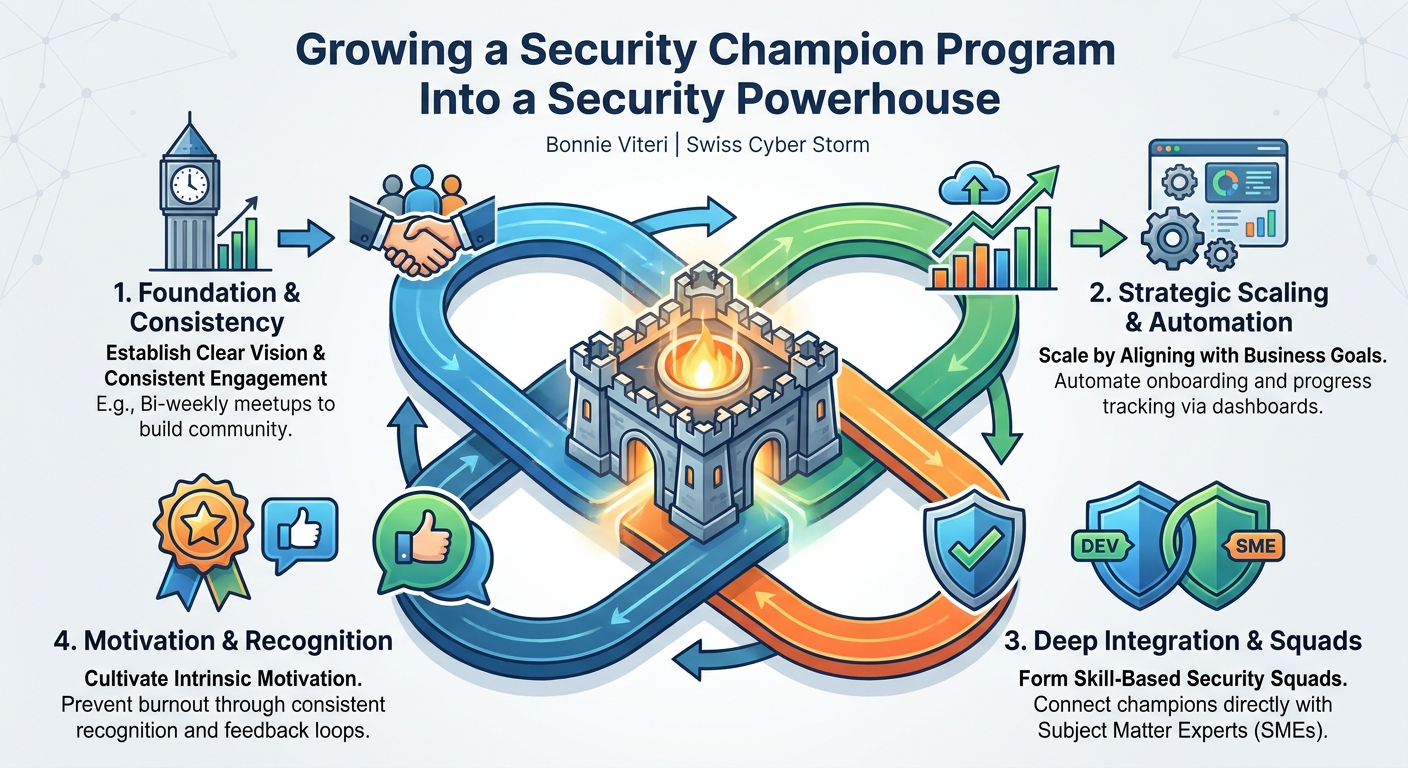
- The Development Life Cycle: Discovery to Maturity: Viteri outlines an eight-stage life cycle:
- Company Discovery: Understand prior program attempts, successes, and failures.
- Consistency: Regularly scheduled, bi-weekly community meetups with security talks are non-negotiable for building community and maturity.
- Defined and Documented Processes: Automate onboarding and training (e.g., OWASP Top 10 as a baseline) to reduce manual work and ensure scalability.
- Automate and Track Onboarding/Skills with a Dashboard: A bespoke dashboard (e.g., using Looker) is vital for tracking progress, identifying gaps (e.g., 1 champion per 10 engineers target), and socializing success.
- Scaling for Purpose: Growth must be tied to specific business objectives, such as digital transformation or cloud migration. Champions become instrumental in streamlining security reviews for these initiatives.
- Squad Alignment: Implement small, skill-based security squads that connect champions with security Subject Matter Experts (SMEs). This increases predictability, deepens understanding, and reduces friction.
- Complete Security Tasks (Jira & Gamification): Engage champions with small, trackable security tasks within their development sprints (e.g., using Jira tickets). Future maturity involves gamification and leveling criteria to increase engagement and responsibility.
- Optimization and Maturity: Continuously refine the program, leveraging the 80/20 rule for leaders, involving legal teams for security activities, and implementing advanced concepts like gamification with increasing risk levels.
- The Importance of Feedback and Recognition: Regular feedback through end-of-year surveys and Net Promoter Score (NPS) (aiming for 8-9) is essential for program improvement and demonstrating business value. Crucially, champions must be appreciated and acknowledged through swag, resume blurbs, company shoutouts, LinkedIn badges, and opportunities like attending security conferences. This recognition combats burnout and encourages backfilling—the ultimate sign of a self-sustaining program.
These findings collectively present a holistic and actionable framework for organizations aiming to cultivate a pervasive, proactive, and powerful security culture through their champion programs.
Technical Deep Dive
▶ Watch: Scaling strategy using dashboards and purpose-driven goals (12:00)
The effectiveness of a security champions program, as articulated by Bonnie Viteri, lies in its structured technical implementation and continuous integration into the development lifecycle. The technical deep dive begins with foundational knowledge and progresses through sophisticated mechanisms for scaling and maturity.
The bedrock of any successful program is a baseline knowledge for all champions. Viteri strongly recommends the OWASP Top 10 as the initial common language, ensuring everyone understands fundamental security risks and terminology. This standardized training can be delivered through on-demand modules within existing company learning platforms like SuccessFactors.
For program consistency and community building, Viteri emphasizes bi-weekly community meetups. These aren't just social gatherings; they feature security talks from various practitioners, exposing champions to diverse security domains (e.g., cyber defense, red teaming, blue teaming) and fostering career development interests. These meetups serve as a crucial touchpoint for sharing knowledge and aligning champions with evolving program goals.
A critical component of scaling is automation and defined, documented processes. Viteri highlights the need to automate the onboarding process for new champions. At Yahoo, this involved:
- Source of Truth: Utilizing SuccessFactors for core training modules.
- Information Hub: Creating a dedicated Confluence page as the central repository for program documentation, resources, and guidelines.
- Automated Workflow: Upon completion of initial training in SuccessFactors, an automated email is triggered to the program lead, signaling a new champion's readiness for official integration. This significantly reduces the manual overhead for the program lead, who is often not 100% dedicated to the champions program.
To track progress and demonstrate value, a bespoke dashboard is indispensable. Viteri describes a mock dashboard (potentially built with tools like Looker) that tracks key metrics for scaling:
- Champion Density: A target of "one Champion for every 10 Engineers" within product teams.
- Coverage Gaps: Visualizing where champions are missing across different management levels or business units.
- Development Growth: Tracking the growth of the program and individual champion development.
This dashboard is vital for scaling for purpose. For Yahoo, this purpose was digital transformation and cloud migration. Champions were trained to understand the company's security review processes for cloud migration. Their role became to:
- Understand the 50+ questions typically found in a security review.
- Know exactly where to source the necessary data and information.
- Pre-populate security review documentation for their teams.
This approach significantly cut down product teams' migration time and accelerated the security review process for the central security team, ensuring "secure by design" principles were embedded from the outset.
As the program scales, squad alignment becomes paramount. This involves creating small, skill-based security squads that directly connect champions with specific security Subject Matter Experts (SMEs). This alignment is based on product, design, or feature sets, providing champions with a direct point of contact for in-depth guidance. This structure increases predictability for secure development, enhances the champions' understanding of the business context, and reduces friction by embedding security expertise directly where it's needed. Successful implementation requires changing the mindset of SMEs to embrace this collaborative model.
To ensure champions actively contribute and demonstrate value, their security tasks must be integrated into their existing workflows. Viteri suggests using Jira tickets for quarterly, small, and descriptive security requests that champions can complete within their development sprints. This allows for clear tracking of contributions and helps build their baseline knowledge.
The highest level of program maturity involves gamification and leveling criteria. This means designing a system where champions "level up" as they gain more skills and complete higher-impact security activities. Higher levels could grant them authority to handle more complex or higher-risk security tasks. This is not a one-size-fits-all solution and requires A/B testing and case studies to ensure it aligns with the company culture and champion desires, typically identified through end-of-year surveys.
Finally, Viteri advocates for the 80/20 rule for program leads (80% day job, 20% passion project) and highlights the importance of involving the legal team when assigning security tasks to champions. This ensures that champions are not performing activities that should legally or practically be handled by dedicated security professionals, setting clear boundaries and responsibilities.
Demo / Proof of Concept
▶ Watch: Gamification, acknowledgment, and measuring program value (21:00)
While Bonnie Viteri's talk did not feature a live, interactive demo of a specific tool or exploit, she provided a clear conceptual "proof of concept" by detailing the implementation strategies and tools utilized at Yahoo to operationalize their security champions program. The practical application of her methodology serves as a demonstration of how a program can move from theoretical concept to a functional, scalable entity within a large enterprise.
A core "demonstration" of concept was the mock dashboard presented. Although fictionalized, this dashboard illustrated how critical program metrics could be visualized and tracked. It showcased the objective of "one Champion for every 10 Engineers" and how progress towards this goal could be monitored across different management levels. This visual representation served as a powerful tool for identifying gaps across the Enterprise where champions were needed, thereby guiding the program's growth strategy. It effectively demonstrated how to scale for purpose, by linking champion presence to the broader business objective of digital transformation and cloud migration. The dashboard, even as a mock-up, proved the feasibility of using data to drive program expansion and demonstrate its impact.
Furthermore, Viteri elucidated the practical implementation of automated onboarding. This serves as a proof of concept for reducing manual overhead and ensuring consistency. She explained how:
- Initial security training, such as the OWASP Top 10, was made on-demand and hosted in SuccessFactors, Yahoo's internal learning management system.
- A dedicated Confluence page was established as the central source of truth for program documentation and resources.
- Upon a champion's completion of training in SuccessFactors, an automated email was triggered to the program lead, signaling their readiness for official entry into the program. This workflow exemplifies how automation can streamline processes and enable rapid scaling without requiring constant manual intervention from a single program lead.
The integration of security tasks into developers' existing workflows through Jira tickets also functions as a practical demonstration. By describing how small, descriptive security requests are assigned to champions within their regular development sprints, Viteri showed how security contributions can be tracked and measured, moving beyond abstract participation to tangible output. This approach proves that champions can actively contribute to security without disrupting their primary development responsibilities.
Finally, the concept of squad alignment, where champions are paired with security Subject Matter Experts (SMEs) based on product or feature areas, provides a structural proof of concept for fostering deeper collaboration and knowledge transfer. This model, described as increasing predictability and reducing friction, illustrates how a champions program can evolve from a general awareness initiative to a tightly integrated component of the secure development lifecycle. These detailed descriptions of implemented processes and tools, though not a live demo, effectively serve as a blueprint and validation of the program's operational viability and impact.
Defensive Implications
▶ Watch: Q&A: Adapting program goals and applicability to SMBs (27:00)
The strategies outlined by Bonnie Viteri for building a security champions program carry significant defensive implications for organizations aiming to strengthen their security posture and foster a proactive security culture. By effectively implementing these recommendations, defenders can achieve a more resilient and secure development ecosystem.
- Shift Left Security: The most direct defensive implication is the robust enablement of shift-left security. By embedding security champions within product teams, organizations ensure that security considerations are integrated early in the design and development phases, rather than being an afterthought. Champions, armed with knowledge like the OWASP Top 10 and understanding of security review processes, can identify and remediate vulnerabilities before they become costly issues in production. This proactive approach significantly reduces the attack surface and the overall cost of security incidents.
- Reduced Security Team Bottlenecks: A mature security champions program offloads routine security tasks and initial security reviews from the central security team. Champions act as the first line of defense, addressing common issues and gathering necessary information for complex reviews. This frees up the dedicated security team to focus on higher-value activities, such as threat modeling, advanced penetration testing, incident response, and strategic security architecture, thereby optimizing scarce security resources.
- Enhanced Secure by Design Posture: When scaling for purpose, such as digital transformation or cloud migration, champions become instrumental in ensuring that new products and services are "secure by design." Their understanding of security review processes and ability to pre-populate required documentation (e.g., for cloud security reviews) means that security is not just a gate but an inherent part of the migration process. This accelerates secure adoption of new technologies and reduces the risk associated with rapid technological change.
- Improved Security Awareness and Culture: The program inherently raises the overall security awareness across development teams. Champions act as evangelists, sharing knowledge, promoting best practices, and fostering a pervasive security mindset. This cultural shift means that security becomes everyone's responsibility, leading to more secure code, better architectural decisions, and a workforce more attuned to potential threats. The consistent community meetups and security talks further reinforce this continuous learning environment.
- Faster Incident Response and Remediation: With security champions distributed across product teams and aligned with Subject Matter Experts (SMEs) through security squads, the feedback loop between identifying a security issue and its remediation is significantly shortened. Champions can quickly understand the context of a vulnerability within their team's codebase and facilitate faster fixes, reducing the window of exposure.
- Measurable Security Improvement: The use of dashboards and tracking mechanisms allows security leaders to quantitatively measure the program's impact, such as champion coverage, task completion rates (via Jira tickets), and overall security posture improvements. This data-driven approach enables continuous improvement and provides concrete evidence of the program's defensive value to leadership, securing continued investment.
In essence, a well-implemented security champions program transforms security from a centralized function into a distributed capability, empowering developers to be active participants in the defense of the organization. This distributed model is a powerful defensive strategy against the ever-evolving threat landscape.
Key Takeaways
- Consistency is Paramount: Regular, bi-weekly community meetups with engaging security talks are crucial for building a vibrant, connected, and continuously learning security champions community.
- Scale with Purpose: Align your security champions program's growth directly with key business objectives, such as digital transformation or cloud migration, to demonstrate tangible value and secure executive buy-in.
- Automate and Track Progress: Implement automated onboarding processes (e.g., using SuccessFactors and Confluence) and leverage bespoke dashboards (e.g., via Looker) to efficiently track champion coverage, engagement, and the program's impact.
- Foster Deep Relationships: Establish strong partnerships with executive sponsors, integrate champions into skill-based security squads with Subject Matter Experts (SMEs), and ensure legal review for assigned security tasks to provide comprehensive support and guidance.
- Recognize and Reward: Actively appreciate and acknowledge champions' contributions through resume blurbs, company shoutouts, LinkedIn badges, and opportunities like attending conferences to prevent burnout and encourage continuous engagement and leadership.
- Embrace Behavioral Science: Utilize principles like nudging for feedback (e.g., high response rates for surveys) and consider gamification with leveling criteria to sustain intrinsic motivation and progressively increase champions' responsibilities and impact.
About the Speaker(s)
Bonnie Viteri is a distinguished professional at Yahoo, known for her expertise in building and scaling security culture within large organizations. Her background is notably non-traditional for an engineer, holding degrees in behavioral psychology and a master's in criminology. This unique academic foundation has equipped her with a profound understanding of human behavior, which she applies adeptly to cybersecurity, focusing on changing habits and fostering a proactive security mindset. Viteri played a pivotal role in establishing the security culture from the ground up during the significant merger of AOL and Yahoo with Verizon Media, earning her a reputation as a "cultural bridge builder." She specializes in creating behavioral engineering teams and is passionate about transforming security champions programs into influential powerhouses that embed security by design across the enterprise.
Reviews
Dr. Zero (Offensive Security Researcher) — SOLID
Viteri outlines the exact Jira and Looker blueprint Yahoo used to build their security champions program. It is a competent, metric-driven playbook for AppSec managers trying to scale secure development practices across a massive engineering org.
Heather Calloway (CISO) — STRONG ACCEPT
Most security champion programs are underfunded awareness campaigns that inevitably burn out developers. Viteri offers a mature, metrics-driven blueprint for scaling these programs into measurable operational controls. I'd make this mandatory viewing for any AppSec director trying to shift left without drowning their core team.