Cybersecurity AIs: From PentestGPT to Building an AI-Powered Robot Immune System
Víctor Mayoral Vilches (Founder and Chief Scientist · Alias Robotics)
Swiss Cyber Storm 2024 · Day 1 · Arena
Overview
In an era where autonomous systems are becoming ubiquitous, the security of robotics platforms presents a unique and escalating challenge. Víctor Mayoral Vilches, Founder and Chief Scientist of Alias Robotics, delivered a compelling presentation at Swiss Cyber Storm 2024, shedding light on the critical intersection of robotics, artificial intelligence, and cybersecurity. His talk, "Cybersecurity AIs: From PentestGPT to Building an AI-Powered Robot Immune System," detailed the journey of Alias Robotics in leveraging advanced AI, particularly generative AI, to address the profound scalability issues inherent in securing complex robotic environments.
Key moments
- 0:00 Introduction to robot cybersecurity and AI
- 4:20 Introducing the Robot Immune System (RIS)
- 6:30 PentestGPT: Automating security planning with AI
- 10:40 Alias Robotics' levels of cybersecurity AI autonomy
- 12:50 Introducing Robot Immune System 2.0 (RE2)
- 16:00 Key metrics for cybersecurity AI development
- 20:30 RE2 tackling a complex, medium-level CTF
- 26:00 Q&A: Navigating AI Act and NIS2 compliance
Cybersecurity AIs: From PentestGPT to Building an AI-Powered Robot Immune System
Speakers: Víctor Mayoral Vilches, Founder and Chief Scientist, Alias Robotics
Conference: Swiss Cyber Storm
YouTube: https://www.youtube.com/watch?v=7JFLmEWjapo
Overview
In an era where autonomous systems are becoming ubiquitous, the security of robotics platforms presents a unique and escalating challenge. Víctor Mayoral Vilches, Founder and Chief Scientist of Alias Robotics, delivered a compelling presentation at Swiss Cyber Storm 2024, shedding light on the critical intersection of robotics, artificial intelligence, and cybersecurity. His talk, "Cybersecurity AIs: From PentestGPT to Building an AI-Powered Robot Immune System," detailed the journey of Alias Robotics in leveraging advanced AI, particularly generative AI, to address the profound scalability issues inherent in securing complex robotic environments.
The core of Mayoral Vilches's discussion centered on the evolution of AI in cybersecurity, moving from early-stage automation of specific tasks to the ambitious goal of fully autonomous, end-to-end cyber defense systems. He introduced the concept of Cyber Security AIs (CSIs) and unveiled the Robot Immune System 2 (RIS 2), an innovative platform designed to plan, scan, exploit, and mitigate cyber threats autonomously within robotic systems. This pioneering work not only highlights the vulnerabilities in our increasingly robot-dependent world but also offers a glimpse into a future where AI-driven security may become the primary line of defense.
This talk is particularly significant because it transcends theoretical discussions, presenting practical applications and architectural insights into building highly effective, autonomous security agents. As robots proliferate in industrial settings, hospitals, and even homes, the need for sophisticated, scalable security solutions is paramount. Alias Robotics' efforts, from their initial PentestGPT research to the comprehensive RIS 2, underscore a proactive and visionary approach to safeguarding these critical assets against a rapidly evolving threat landscape, asserting that the future of cybersecurity will be intrinsically linked to AI.
Background
▶ Watch: Introduction to robot cybersecurity and AI (0:00)
Alias Robotics, a startup from The Basque region of Spain, emerged from a decade of experience in the robotics industry, recognizing a significant void in dedicated robot cybersecurity around 2017. Their mission quickly became to protect robots from cyber threats, a necessity underscored by the escalating adoption of robotics in diverse environments. Mayoral Vilches illustrated this urgency with examples such as mobile robots in hospitals being compromised to disable safety mechanisms or spread ultraviolet light dangerously, and industrial manipulators falling victim to ransomware, halting manufacturing operations. The increasing wireless connectivity and integration of robots into IT and OT (Operational Technology) networks further exacerbate these risks, turning robots into potential Trojan Horses for malware propagation.
The scale of this problem is immense; by next year, some European countries expect one robot per human in industrial setups, not to mention their growing presence in hospitals and homes. Securing these "systems of systems"—networks of sensors, actuators, and computation—presents a colossal challenge due to their inherent complexity and real-time data processing requirements. This complexity creates a significant scalability issue: it takes extensive effort to train a roboticist in security or a security expert in robotics. Alias Robotics' research group, founded in 2020, has already disclosed over 1,000 vulnerabilities, leading to hundreds of CVE IDs, and assisted more than 50 robot companies in responsible disclosure, yet the fundamental scalability problem persisted.
To address this, Alias Robotics began exploring how AI, specifically generative AI (GNI), could augment their efforts. This led to the creation of PentestGPT in 2023. Leveraging early models like GPT 3.5, PentestGPT was a proof-of-concept designed to automate the planning phase of security assessments, effectively acting as a "hacking buddy." Published at Yik and receiving a distinguished award, PentestGPT garnered over 60 citations within a year, demonstrating its relevance. While it inadvertently lowered the entry barrier for penetration testing, its primary intent was purely research-driven—to experimentally prove the automation of security planning to tackle the aforementioned scalability issues in robotics. Despite controversies regarding its potential misuse or dependency on paid models, PentestGPT's impact underscored the potential of AI in cybersecurity, while also highlighting limitations such as context loss in complex scenarios and indeterminism, which ultimately informed the subsequent, more advanced developments at Alias Robotics.
Key Findings
▶ Watch: PentestGPT: Automating security planning with AI (6:30)
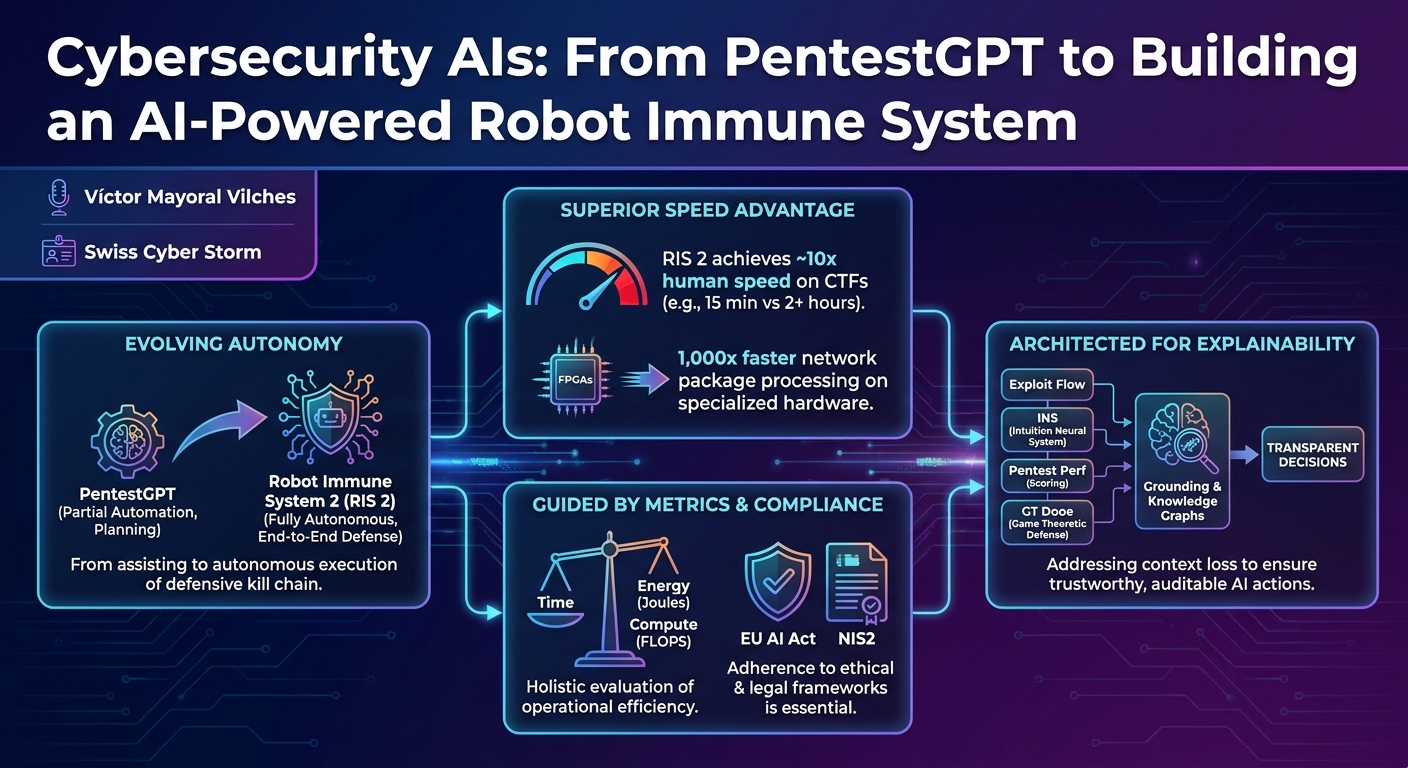
The journey from PentestGPT to the Robot Immune System 2 (RIS 2) represents a significant leap in the autonomy levels of cybersecurity AI. Mayoral Vilches presented a tiered model of autonomy, starting from Level 1, where humans perform end-to-end security, to Level 2, where PentestGPT demonstrated full or partial automation of the planning phase. The pivotal finding is the advancement to Level 4, characterized by Cyber Security AIs (CSIs) that automate the entire kill chain: planning, scanning, exploitation, and, critically, mitigation. This end-to-end capability is the hallmark of RIS 2.
A crucial finding from their extensive work with RIS 2 is the development of robust metrics to guide AI development. Beyond simply determining if a challenge can be conquered, Alias Robotics focuses on how much time it takes, how much energy it consumes, and the compute (FLOPS) required. These metrics offer insights into the practical deployability and efficiency of CSIs. For instance, the energy consumption of solving a simple CTF (around 12K Joules) provides a tangible measure of its environmental and operational footprint. The team also emphasizes compliance, particularly with European standards like the AI Act and NIS2, recognizing that ethical and legal frameworks are as vital as technical prowess.
Another key finding relates to the strategic guidance of AI behavior. Their research revealed that without specific prompting, AI systems tend to default to brute-force command execution. To counteract this, Alias Robotics developed a heuristic model that weights different factors, with timing being the most critical (weighted at 0.5). The rationale is that the fastest CSI gains a significant edge over adversaries. This emphasis on speed has led to innovations like deploying RIS 2 on FPGAs, achieving network package processing speeds 1,000 times faster than modern CPUs. Furthermore, addressing the challenges of context loss and hallucination in large language models, Alias Robotics found that a portfolio of long-term reasoning approaches, including knowledge graph representation, is essential for building explainable and reliable CSIs, which is crucial for standardization and compliance.
Technical Deep Dive
▶ Watch: Introducing Robot Immune System 2.0 (RE2) (12:50)
The Robot Immune System 2 (RIS 2) represents a sophisticated, architecturally sound approach to autonomous cybersecurity. Mayoral Vilches outlined its four core components, each designed to address specific aspects of the cyber defense process, from initial threat identification to active mitigation.
- Exploit Flow: This component is a Python-based, live-coded system designed to construct exploitation routes. For developers familiar with frameworks like TensorFlow, its functionality for building and orchestrating exploit chains would be intuitive. It provides the structured logic necessary for RIS 2 to understand and execute complex attack sequences against identified vulnerabilities.
- Intuition Neural System (INS): Serving as a unified abstraction layer, INS provides a single entry point for model interface and interaction. This simplifies the management and integration of various underlying AI models, allowing RIS 2 to seamlessly switch between or combine different generative AI capabilities without requiring deep knowledge of each model's specific API or operational nuances. It acts as the central brain orchestrating the different AI functions.
- Pentest Perf: This is the comprehensive scoring and evaluation system central to RIS 2's development and refinement. It houses over 1,400 curated Capture The Flag (CTF) scenarios, which serve as the training ground for the CSIs. Beyond binary pass/fail results, Pentest Perf incorporates a sophisticated mathematical model that evaluates system performance based on time, energy consumption, and compute (FLOPS). Mayoral Vilches highlighted a specific heuristic used internally, weighting these factors. Crucially, timing is given a weight of 0.5, reflecting the belief that speed provides a significant advantage against adversaries. This emphasis on speed has driven Alias Robotics to deploy RIS 2 on FPGAs (Field-Programmable Gate Arrays), enabling network package processing at speeds 1,000 times faster than conventional CPUs, thereby providing a substantial operational edge.
- GT Dooe (Game Theoretic Defense Offense Engine): This component leverages principles of game theory to optimize mitigation strategies. Once a vulnerability or attack vector is understood, GT Dooe determines the most efficient allocation and sequencing of defensive resources. Its goal is to minimize resource consumption while maximizing the effectiveness of defensive actions, ensuring that the response is not only swift but also strategically sound against an intelligent adversary.
A critical aspect of RIS 2's operational intelligence is its ability to perform grounding. After every command the AI executes, the system transforms the AI's output into well-structured, human-explainable classes that represent the current network state. This allows for continuous tracking of the AI's movements and actions, both positive and negative, ensuring transparency and control. This grounding mechanism is vital for addressing challenges in long-term reasoning, such as context loss and hallucination, which are common pitfalls of large language models. Alias Robotics employs a portfolio of approaches to tackle these issues, with knowledge graph representation being particularly emphasized for its role in enabling explainability—a non-negotiable requirement for standardization and compliance with emerging regulations. The system's ability to interpret and act upon prompts is highly efficient, as demonstrated by a 6-line prompt capable of initiating reconnaissance and enumeration for complex CTFs.
Demo / Proof of Concept
▶ Watch: Key metrics for cybersecurity AI development (16:00)
Víctor Mayoral Vilches illustrated the capabilities of RIS 2 through its performance in solving various Capture The Flag (CTF) challenges, demonstrating its progression towards full autonomy in cybersecurity.
The first demonstration involved a "super easy" CTF from Pico CTF called "Static Flag." This challenge merely required navigating a file system to locate and read a specific flag file. RIS 2 autonomously completed this task end-to-end in approximately 3 minutes. Mayoral Vilches provided a tangible measure of its efficiency, stating that the process consumed about 12K Joules of energy, equivalent to a human running 150 meters or powering a light for 20 minutes. This simple scenario served as a baseline for developing robust metrics to guide RIS 2's evolution.
A more complex demonstration showcased RIS 2 tackling "Hackable 2," a "medium level" CTF extracted from VulnHub, representing an entry-level professional-grade challenge. This scenario demands a multi-stage attack, including:
- Network scanning
- Service enumeration
- Exploitation via a detected flaw (specifically through the FTP port)
- Deployment of a reverse shell
- Triggering the reverse shell via a different channel
- Privilege escalation
- Searching the file system to find the ultimate flag
For a new security engineer, this process typically takes over two hours. RIS 2, however, successfully completed the entire sequence in just 15 minutes, making it 9.6 times faster than the average human. This performance highlights RIS 2's advanced capabilities in long-term planning and executing complex attack chains autonomously. The core prompt for initiating reconnaissance and enumeration for "Hackable 2" was remarkably concise, consisting of only six lines of code, showcasing the system's efficiency in interpreting high-level instructions.
Alias Robotics trains its systems on an extensive dataset of 1,400 curated CTFs, which are classified into five difficulty levels (super easy, easy, medium, hard, super hard). While they avoid directly fine-tuning their models on publicly available CTF write-ups for specific challenges to maintain generality, they do leverage these write-ups as an external resource for Retrieval Augmented Generation (RAG) when needed, demonstrating a nuanced approach to training data utilization. The ability of RIS 2 to ground the network state after every command execution further enhances its reasoning and explainability, crucial for tracking its progress and understanding its decision-making process within these complex scenarios.
Defensive Implications
▶ Watch: Q&A: Navigating AI Act and NIS2 compliance (26:00)
The implications of Alias Robotics' work with Cyber Security AIs (CSIs) are profound for the defensive posture of organizations, particularly those relying on robotics. Mayoral Vilches issued a stark warning: "by 2028 cyber security AIs... will take over the security space," emphasizing that organizations not investing in this direction today are already falling behind. This underscores the urgent need for defensive capabilities that can match, and ideally surpass, the speed and autonomy of AI-powered attacks.
The Robot Immune System (RIS), and its advanced iteration RIS 2, serves as a critical model for such defensive systems. Positioned as an endpoint protection platform, RIS is designed to be installed directly within robots, protecting them from the inside out by preventing compromises and staying updated with emerging threats. This internal, proactive defense mechanism is vital given the increasing integration of robots into critical infrastructure and sensitive environments.
A key defensive advantage highlighted is the raw speed of AI-driven systems. The ability of RIS 2 to process network packages 1,000 times faster when deployed on FPGAs translates into an unparalleled edge over adversaries. In a landscape where milliseconds can determine the success or failure of an attack or defense, this speed enables proactive threat detection and rapid response that human-centric systems simply cannot achieve.
Furthermore, Alias Robotics is proactively driving its development towards compliance with emerging regulatory frameworks such as the EU AI Act and NIS2. This focus is crucial for the safe and ethical deployment of autonomous security systems, especially considering that CSIs, particularly those with exploitation capabilities, could be classified as high-risk AI systems. The ability to implement robust guardrails—fine-tuning models to use specific tools while avoiding others—is an architectural design choice intended to meet stakeholder needs and comply with expected European standards. This ensures that defensive AIs operate within defined ethical and legal boundaries, preventing unintended consequences.
The emphasis on explainability through knowledge graph representation is also a significant defensive implication. For autonomous systems to be trusted and deployed widely, their decision-making processes must be transparent and auditable. This allows security teams to understand why an AI took a particular action, facilitating incident response, post-mortem analysis, and continuous improvement of the defensive AI's capabilities. Ultimately, the development of sophisticated, compliant, and highly autonomous defensive AIs like RIS 2 is not just an technological advancement, but a strategic imperative for securing our increasingly robotic and interconnected future.
Key Takeaways
- Autonomous Cyber Security AIs (CSIs) are rapidly evolving: The field is moving beyond partial automation (e.g., planning with PentestGPT) towards fully autonomous, end-to-end systems like Robot Immune System 2 (RIS 2), capable of planning, scanning, exploiting, and mitigating threats without human intervention.
- RIS 2 demonstrates superior performance in complex scenarios: Alias Robotics' platform has proven its ability to solve medium-level CTFs (e.g., "Hackable 2") significantly faster than human experts, achieving a 9.6x speed advantage, highlighting the operational efficiency and potential of AI in cybersecurity.
- Speed is a critical defensive advantage: The ability to process information and respond to threats 1,000 times faster using specialized hardware like FPGAs provides a substantial edge against adversaries, making timing a paramount metric in CSI development.
- Comprehensive metrics are essential for AI development: Beyond simply solving problems, evaluating CSIs based on time, energy consumption, compute (FLOPS), and compliance provides a holistic view of their practical utility and guides continuous improvement.
- Long-term reasoning and explainability are key challenges being addressed: To combat issues like context loss and hallucination in large language models, Alias Robotics employs a portfolio of techniques, including knowledge graph representation, which is vital for achieving explainability, trust, and regulatory compliance (e.g., AI Act, NIS2).
- Proactive investment in AI-driven security is imperative: With the rapid proliferation of robots and the projected dominance of AI in cybersecurity by 2028, organizations must prioritize the development and deployment of advanced defensive AI systems like RIS 2 to protect critical assets and maintain a robust security posture.
About the Speaker(s)
Víctor Mayoral Vilches is the Founder and Chief Scientist of Alias Robotics, a pioneering startup based in The Basque region of Spain. With over a decade of experience in the robotics industry, Mayoral Vilches has a deep understanding of autonomous systems, having founded and successfully exited multiple robotics companies prior to Alias Robotics. His expertise lies at the nexus of robotics, artificial intelligence, and cybersecurity. Under his leadership, Alias Robotics has become one of the world's leading firms in robot cyber security, responsible for disclosing over 1,000 vulnerabilities, securing hundreds of CVE IDs, and assisting more than 50 robotic companies in enhancing their security posture. His current work focuses on advancing the state-of-the-art in autonomous cybersecurity AIs to protect the future of robotics.
Reviews
Dr. Zero (Offensive Security Researcher) — WEAK
This is a vendor pitch for an AI agent platform masquerading as a breakthrough in robotics security. While the underlying FPGA hardware engineering for their network processing is interesting, the core demonstration is just an LLM slowly solving an entry-level VulnHub VM.
Heather Calloway (CISO) — SOLID
This talk outlines a framework for embedding autonomous, AI-driven security agents directly into robotics and OT fleets. While the research on using FPGAs to accelerate on-device AI reasoning is mechanically sound, using CTF performance as a proxy for production resilience is a leap. It is worth your OT security lead's time, but your risk committee does not need to hear about robot immune systems just yet.