The Digital Emblem – Signaling Legal Protection in Cyberspace
Felix Linker
Swiss Cyber Storm 2026 · Day 1 · Scenario
Overview
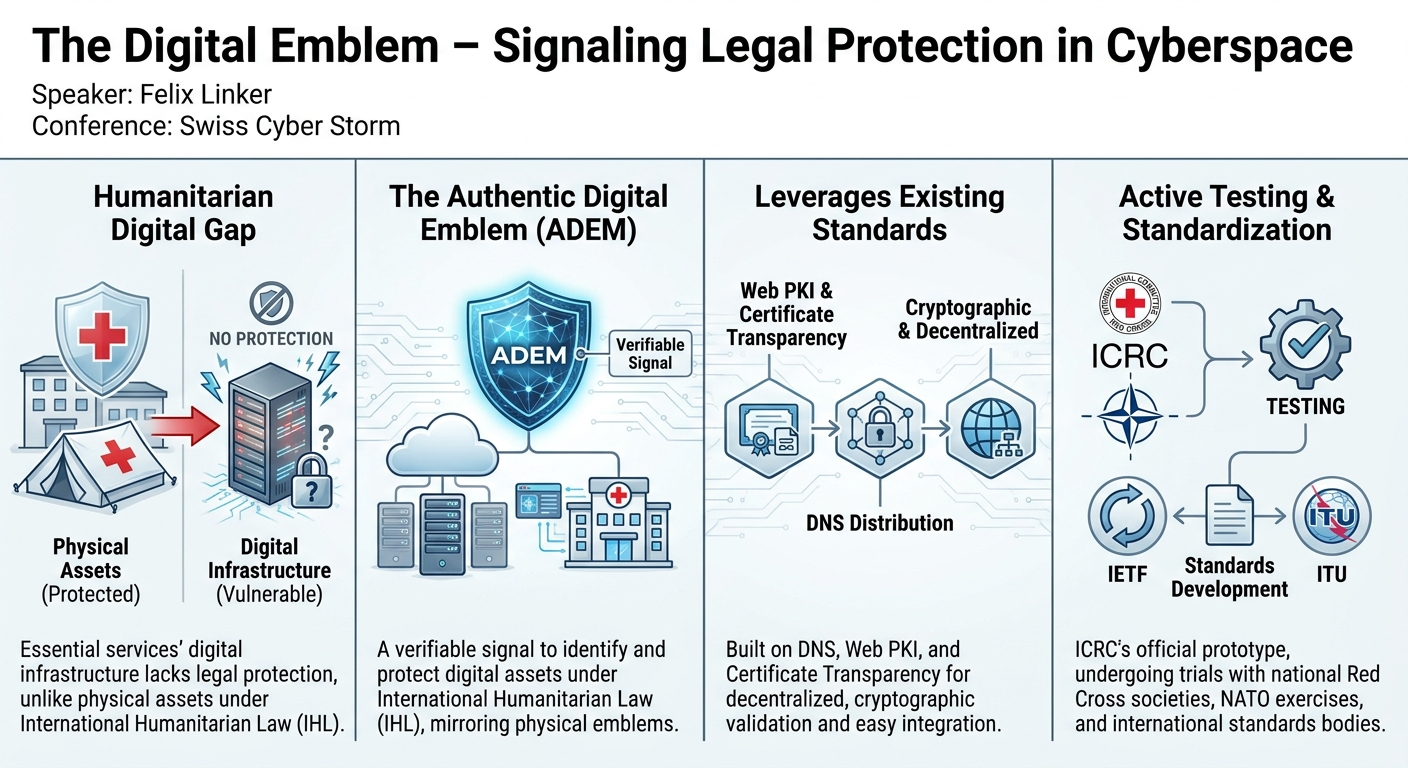
In an increasingly digitized world where conflict extends into cyberspace, critical humanitarian and medical infrastructure remains vulnerable to cyberattacks. Traditional international humanitarian law (IHL) provides distinctive emblems like the Red Cross to signal protection for physical assets and personnel. However, these mechanisms do not adequately extend to the digital realm, leaving essential services reliant on information and communication technologies (ICT) exposed. This talk, presented by Felix Linker from ETH Zurich, introduces ADEM (Authentic Digital Emblem), a groundbreaking design and proposal for a digital emblem that aims to signal legal protection in cyberspace, mirroring the protections afforded by IHL to physical assets.
Key moments
- 0:00 Introduction: From Geneva Conventions to digital protection
- 3:49 Introducing ADEM: The ICRC's official digital emblem prototype
- 5:45 Why cyber operators would respect a digital emblem
- 11:00 The critical need for undetectable emblem validation
- 12:45 ADEM's technical building blocks and domain model
- 18:10 ADEM's design philosophy and future applications
- 22:00 Q&A: Project implementation and government recognition
The Digital Emblem – Signaling Legal Protection in Cyberspace
Speakers: Felix Linker, Researcher, ETH Zurich
Conference: Swiss Cyber Storm
YouTube: https://www.youtube.com/watch?v=S2Dkzlc3g6k
Overview
In an increasingly digitized world where conflict extends into cyberspace, critical humanitarian and medical infrastructure remains vulnerable to cyberattacks. Traditional international humanitarian law (IHL) provides distinctive emblems like the Red Cross to signal protection for physical assets and personnel. However, these mechanisms do not adequately extend to the digital realm, leaving essential services reliant on information and communication technologies (ICT) exposed. This talk, presented by Felix Linker from ETH Zurich, introduces ADEM (Authentic Digital Emblem), a groundbreaking design and proposal for a digital emblem that aims to signal legal protection in cyberspace, mirroring the protections afforded by IHL to physical assets.
The ADEM project, initiated in 2020 at ETH Zurich, seeks to bridge this critical gap by providing a verifiable and attributable digital sign that deters cyberattacks on protected infrastructure. It leverages existing internet standards and cryptographic principles to create a decentralized system that respects the sovereignty of states while ensuring authenticity and accountability. ADEM has gained significant traction, being featured in a 2022 report by the International Committee of the Red Cross (ICRC) and now serving as the ICRC's official prototype for a digital emblem, with ongoing standardization efforts at the Internet Engineering Task Force (IETF) and the International Telecommunication Union (ITU), alongside extensive testing with national Red Cross societies and NATO states.
This initiative is not merely a technical exercise but a profound effort to reduce human suffering by extending the protective reach of international law into the digital domain. By enabling cyber operators to identify and respect protected digital infrastructure, ADEM aims to prevent devastating disruptions to medical care, humanitarian aid, and other vital services during times of armed conflict, underscoring the enduring relevance of IHL in the modern era of cyber warfare.
Background
▶ Watch: Introduction: From Geneva Conventions to digital protection (0:00)
The concept of protecting those who provide care during conflict dates back to 1859, when Swiss businessman Henri Dunant witnessed the horrific aftermath of the Battle of Solferino. His experience led to the proposal of international rules of war, culminating in the first Geneva Conventions in 1864, which were eventually ratified by 50 states. Following the Second World War, these conventions were extended and updated, becoming one of the most widely ratified international treaties, with 169 signatory states. At their core, the Geneva Conventions aim to reduce human suffering and demand respect and protection for caregivers. To make this protection effective, distinctive signs were introduced: the Red Cross, Red Crescent, and Red Crystal, universally recognized emblems signaling IHL protection. Over decades, these emblems have adapted to new technologies, being transmitted via flashing blue lights, specific radio signals, or radar transponders for medical transports.
However, the nature of conflict has evolved dramatically. Recent events, such as the wars in Ukraine and Iran, highlight a new dimension of warfare where digital infrastructure is increasingly targeted. Iran, for example, has declared US tech firms as legitimate targets and conducted cyberattacks accordingly. Concurrently, medical and humanitarian services have become profoundly reliant on digital services and infrastructure. An attack on a hospital's IT systems, for instance, can have consequences as devastating as a physical assault, directly impacting the vulnerable populations that the Geneva Conventions seek to protect. The critical question thus arises: how can the same protections afforded to physical infrastructure be extended to its digital counterpart in cyberspace?
Felix Linker's work on ADEM, initiated in 2020 at ETH Zurich's Center for Cyber Trust (a joint research project with the University of Bonn), directly addresses this challenge. The project's genesis lies in recognizing the urgent need for a digital equivalent to the traditional emblems, acknowledging that without such a mechanism, the protective intent of IHL risks being undermined in the digital battlespace. The effort to standardize ADEM at the IETF and ITU, coupled with its adoption as the ICRC's official prototype, underscores the international community's recognition of this pressing need and the potential of ADEM to provide a viable solution.
Key Findings
▶ Watch: Why cyber operators would respect a digital emblem (5:45)
The central finding of this research is the successful design and prototyping of ADEM, an Authentic Digital Emblem, capable of signaling legal protection for digital infrastructure in accordance with international humanitarian law. This is not merely a theoretical construct but a concrete, technically viable system built upon a foundation of carefully derived operational and security requirements.
A critical prerequisite for the effectiveness of any protective emblem, digital or physical, is respect. The talk highlights three compelling reasons why a cyber operator might respect a digital emblem:
- Self-interest: History demonstrates that targeting the wounded serves no strategic purpose, and militaries benefit from adversaries respecting their protected infrastructure to avoid retaliation against their own.
- IHL Compliance: Many states prioritize adherence to IHL and welcome technical solutions that allow them to monitor and ensure their forces' compliance in cyberspace.
- Inherent Respect: Even non-state actors, such as ransomware groups, have been observed operating under codes of conduct, with documented instances of them releasing decryption keys for free after inadvertently targeting hospitals. This suggests a broader, inherent respect for humanitarian principles.
Assuming a sizeable portion of cyber operators will respect the emblem, the ADEM project identified six core requirements for its design, split between the needs of emblem issuers (e.g., medical services, humanitarian organizations, or states authorizing them) and validators (cyber operators assessing potential targets):
For Issuers, the system must be:
- Easy to use: It must integrate seamlessly into existing operational environments.
- Removable: Issuers must have full control to apply or remove the emblem based on their risk assessment, acknowledging that an emblem could, in certain contexts, become a target indicator. This also meant avoiding a centralized emblem registry that could attract unwanted attention.
- Decentralized: No single authority should govern the issuance of emblems, respecting state sovereignty and avoiding the need for a global root trust store.
For Validators, the digital emblem must be:
- Authentic: Validators must be able to trust the emblem's legitimacy, ensuring a high signal-to-noise ratio to prevent them from disregarding the system due to widespread fakes.
- Misuse Attributable: If an emblem is applied to infrastructure not genuinely protected by IHL, the issuer must be identifiable and accountable, even if the legal determination of "rightful issuance" is outside the scope of technology.
- Validation Undetectable: Crucially, the act of a cyber operator checking for an emblem must not be detectable by the target. This prevents protected assets from misusing the query as an intrusion detection system or honeypot, which would deter legitimate validation and undermine the system's purpose.
The ADEM design successfully integrates these requirements, providing a robust framework for digital protection. Its progress from a research project to the ICRC's official prototype, alongside its pursuit of international standardization and testing with diverse stakeholders, underscores its potential to become a cornerstone of IHL in the digital age.
Technical Deep Dive
▶ Watch: The critical need for undetectable emblem validation (11:00)
ADEM's architecture is a sophisticated blend of cryptographic primitives and existing internet infrastructure, designed specifically to meet the six stringent requirements for both issuers and validators. The design is based on four primary building blocks: cryptographically signed objects, decentralized public key commitments, and distribution via the Domain Name System (DNS).
At the core, emblems are cryptographically signed objects. These objects form a chain of signatures that attest to the authorization process: the protected asset (e.g., hospital.org) signs its emblem, the emblem issuer (e.g., med.org, representing the medical services controlling the hospital) signs an authorization for the hospital and bundles it with the emblem, and finally, the competent authority (e.g., state.gov, authorizing the issuer) signs its endorsement, bundled with the rest. This chain ensures authenticity and attributability by linking the emblem directly to its authorized source. The objects themselves are encoded using CBOR (Concise Binary Object Representation) tokens, a compact data format suitable for serialization of signatures and other data.
To achieve decentralized authentication of these issuers and authorities, ADEM ingeniously leverages the Web PKI (Public Key Infrastructure) and Certificate Transparency (CT) infrastructure. The process unfolds as follows:
- An emblem issuer or authority commits to their public key material by requesting a specially formatted Web PKI certificate. This certificate must be valid for both their chosen domain name (e.g.,
med.org) and a specific subdomain that includes a hash of their public key (e.g.,hash(pubkey).med.org). - When the certificate authority (CA) issues this certificate, it requests its inclusion in the public Certificate Transparency logs.
- Emblem issuers and authorities are expected to monitor the CT logs for certificates associated with their domain names. This allows them to detect any impersonation attempts and request the revocation of fraudulent certificates.
- When a validator encounters an emblem, it includes a pointer to the relevant entry in the CT infrastructure. By verifying that the certificate is unrevoked and valid, the validator can confidently assume that the emblem was indeed issued by the claimed entity. This mechanism ensures strong attributability for misuse, as the digital emblem can be cryptographically bound back to the specific domain name of the issuer, making denial impossible. It also provides a decentralized trust model, as any entity can make these commitments without needing agreement on a single global root trust store.
The distribution of emblems is handled primarily through the DNS. Emblems, as CBOR tokens, are embedded within DNS records associated with the protected asset's domain name (e.g., hospital.org). This choice is strategic, offering both ease of discovery and crucial undetectable validation properties. Validators interacting with a domain name can immediately discover the emblem without needing to send a specific query that might alert the target. While the talk omits the specific technical standards for DNS integration, it references ongoing IETF drafts that detail this mechanism. The speaker acknowledges that DNS does not cover all possible assets, and future extensions for other distribution channels are under investigation.
The ADEM design philosophy emphasizes reusing existing technology wherever possible to facilitate integration and reduce costs. This is evident in the adoption of CBOR, DNS, Web PKI, and Certificate Transparency. Furthermore, the design aims to place emblems where validators look anyway, ensuring active distribution. Finally, it prioritizes full control for issuers over their digital emblems, allowing them to decide when an emblem is applied or removed, reinforcing the decentralized model and avoiding a centralized emblem registry that could become a target itself.
The project has produced two IETF Internet Drafts: one specifying the domain and trust models, along with the message format, and another detailing the distribution of emblems over the DNS. Multiple open-source implementations exist, including a Go implementation available on GitHub, allowing for transparency and community contribution. While the current design uses classical cryptographic signatures, the architecture is naively extendable to post-quantum signatures, though potential friction with existing DNS transport issues is noted.
Beyond the Red Cross emblem, the ADEM framework is designed to be applicable to other emblems formalized under IHL, such as the Blue Shield for cultural property, the Dangerous Forces emblem for dams, dikes, and nuclear plants, and the Civil Defense emblem for civil protection, all sharing the same fundamental signal: "You should not attack this asset."
Demo / Proof of Concept
▶ Watch: ADEM's design philosophy and future applications (18:10)
While the talk did not feature a live, interactive demonstration in the traditional sense, Felix Linker highlighted the existence and accessibility of a web-based verifier. This verifier serves as a practical proof-of-concept for ADEM, allowing interested parties to examine and validate testing deployments of the digital emblem.
Specifically, the speaker mentioned that users can explore testing deployments from significant international entities, including the International Committee of the Red Cross (ICRC) and the Belgian Red Cross. These deployments provide concrete examples of how the ADEM system functions in practice, showcasing the cryptographic signing, public key commitments, and DNS-based distribution mechanisms. The availability of such a verifier, along with the open-source implementations on GitHub, demonstrates the tangible progress of the ADEM project beyond theoretical design.
Furthermore, the talk emphasized that ADEM is undergoing extensive testing in real-world scenarios. Since 2025, it has been tested with national Red Cross societies, including the Australian, British, Belgian, and Bolivian Red Cross. Crucially, ADEM has also been tested in military exercises with NATO states at the CCDCOE (NATO Cooperative Cyber Defence Centre of Excellence) in the past year, with further exercises planned. These tests, facilitated by the practical demonstrations and verifiers, are vital for validating the design's effectiveness, resilience, and operational feasibility in complex, high-stakes environments, moving ADEM closer to official recognition and widespread adoption.
Defensive Implications
▶ Watch: Q&A: Project implementation and government recognition (22:00)
The introduction of ADEM carries significant implications for cyber defenders, policymakers, and organizations operating critical infrastructure, particularly in conflict zones.
For humanitarian and medical organizations, ADEM offers a proactive defense mechanism. By digitally marking their infrastructure with an authentic emblem, they can signal their protected status in cyberspace, potentially deterring malicious cyber operators who respect IHL. This shifts the burden of identification from the attacker to the defender in a verifiable manner, providing a new layer of protection beyond traditional cybersecurity measures. Defenders within these organizations should be aware of ADEM's implementation requirements, including managing their public key commitments and DNS records, and integrating emblem issuance into their operational security protocols.
For states and military cyber commands, ADEM provides a tool for IHL compliance and accountability. It enables them to monitor their own cyber operators' adherence to IHL, ensuring that protected digital assets are not targeted. The misuse attribution feature is particularly important here, as it allows for holding responsible parties accountable if an emblem is improperly applied. Integrating ADEM validation into cyber operations' rules of engagement becomes crucial, requiring cyber operators to check for digital emblems before initiating any potentially harmful activity. This also provides a clear mechanism to avoid retaliatory attacks that could harm their own protected assets.
Cybersecurity professionals across various sectors need to understand that the presence of a digital emblem should trigger specific responses. For instance, threat intelligence analysts should incorporate ADEM validation into their targeting assessments, identifying protected infrastructure. Incident responders might need to consider the legal implications of an attack on an ADEM-marked asset. The principle of undetectable validation means that defenders cannot use emblem queries as an intrusion detection mechanism; instead, they must rely on other means to identify and repel attacks, while still benefiting from the deterrent effect of the emblem itself.
Furthermore, ADEM's potential application to other critical infrastructures—such as cultural property (Blue Shield), dangerous forces (dams, dikes, nuclear plants), and civil defense—expands the scope of protection. This means that defenders of a wider array of critical national infrastructure may eventually leverage similar digital emblems, requiring a broader understanding and integration across different sectors. The ongoing international diplomacy and standardization efforts suggest that ADEM could become a globally recognized standard, necessitating its inclusion in international cyber norms and national cybersecurity strategies. While the challenge of passive DNS logging means that complete "removability" from historical records is difficult, the core benefit of preventing a centralized, easily targetable emblem registry remains a strong defensive posture.
Key Takeaways
- Urgent Need for Digital IHL Protection: The increasing reliance of humanitarian and medical services on digital infrastructure, coupled with the rise of cyber warfare, necessitates a mechanism to extend International Humanitarian Law (IHL) protections into cyberspace.
- ADEM as a Comprehensive Solution: The Authentic Digital Emblem (ADEM) provides a robust, technically sound design for signaling IHL protection for digital assets, developed through extensive research and international collaboration.
- Respect as a Foundational Principle: The effectiveness of ADEM relies on the assumption of respect from cyber operators, a principle supported by historical precedent, state compliance efforts, and even the observed conduct of some non-state actors.
- Six Core Design Requirements: ADEM is built on critical requirements for both issuers (easy to use, removable, decentralized) and validators (authentic, misuse attributable, validation undetectable), addressing operational and security challenges unique to the digital domain.
- Leveraging Existing Internet Standards: ADEM ingeniously reuses established technologies like the DNS, Web PKI, and Certificate Transparency infrastructure, encoded with CBOR, to ensure broad compatibility, ease of integration, and a decentralized trust model.
- Active Standardization and Testing: ADEM is not merely a theoretical concept but an active project pursuing standardization at the IETF and ITU, undergoing extensive testing with national Red Cross societies and NATO military exercises, demonstrating its real-world applicability and international recognition.
About the Speaker(s)
Felix Linker is a researcher at ETH Zurich's Center for Cyber Trust. His work on the Authentic Digital Emblem (ADEM) project began in 2020, marking it as his very first research project at ETH Zurich. This initiative is a joint research endeavor between ETH Zurich and the University of Bonn, reflecting a collaborative approach to addressing complex challenges at the intersection of technology and international law. Linker's expertise lies in developing practical technical solutions that uphold humanitarian principles in the context of cyberspace.
Reviews
Dr. Zero (Offensive Security Researcher) — SOLID
Felix Linker's ADEM protocol is an elegant piece of engineering built for a fantasy threat model. Using Certificate Transparency logs to build a decentralized trust anchor for digital Red Cross emblems is clever, but it will not stop ransomware affiliates who automate their initial access without ever checking DNS.
Heather Calloway (CISO) — SOLID
An elegant, pragmatic proposal for extending International Humanitarian Law protections into cyberspace using DNS and Certificate Transparency logs. It provides a machine-readable way for state actors to avoid targeting hospitals and NGOs, though its utility against financially motivated ransomware groups is inherently limited.