AI Village: Where AI meets Cybersecurity
Shaadhanaa Manviannan (SOC Analyst · Swiss Cyberstorm)
Swiss Cyber Storm 2026 · Day 1 · Arena
Overview
Shaadhanaa Manviannan, a SOC Analyst and co-chair of the AI Village, introduced a pivotal new initiative born from the Swiss Cyber Storm conference: the AI Village. This presentation served as a foundational announcement, establishing AI Village as a dedicated, hands-on platform designed to foster a robust community at the critical intersection of Artificial Intelligence (AI) and cybersecurity. The initiative represents a strategic spin-off from Swiss Cyber Storm, signaling a focused commitment to addressing the rapidly evolving challenges and opportunities presented by AI in the security landscape.
Key moments
- 0:00 Introduction to AI Village and speaker Sadhana Manviannan
- 0:28 Sadhana's role and AI Village's founding in 2025
- 1:20 Introduction of the core AI Village organizing team
- 2:00 What to expect: goals and dual focus of AI Village
- 2:30 Inspiring talks, workshops, CTFs, and networking opportunities
- 2:45 January 2027 event details, tickets, and contributions
AI Village: Where AI meets Cybersecurity
Speakers: Shaadhanaa Manviannan, SOC Analyst, Swiss Cyberstorm
Conference: Swiss Cyber Storm
YouTube: https://www.youtube.com/watch?v=y0obx9o7r4o
Overview
Shaadhanaa Manviannan, a SOC Analyst and co-chair of the AI Village, introduced a pivotal new initiative born from the Swiss Cyber Storm conference: the AI Village. This presentation served as a foundational announcement, establishing AI Village as a dedicated, hands-on platform designed to foster a robust community at the critical intersection of Artificial Intelligence (AI) and cybersecurity. The initiative represents a strategic spin-off from Swiss Cyber Storm, signaling a focused commitment to addressing the rapidly evolving challenges and opportunities presented by AI in the security landscape.
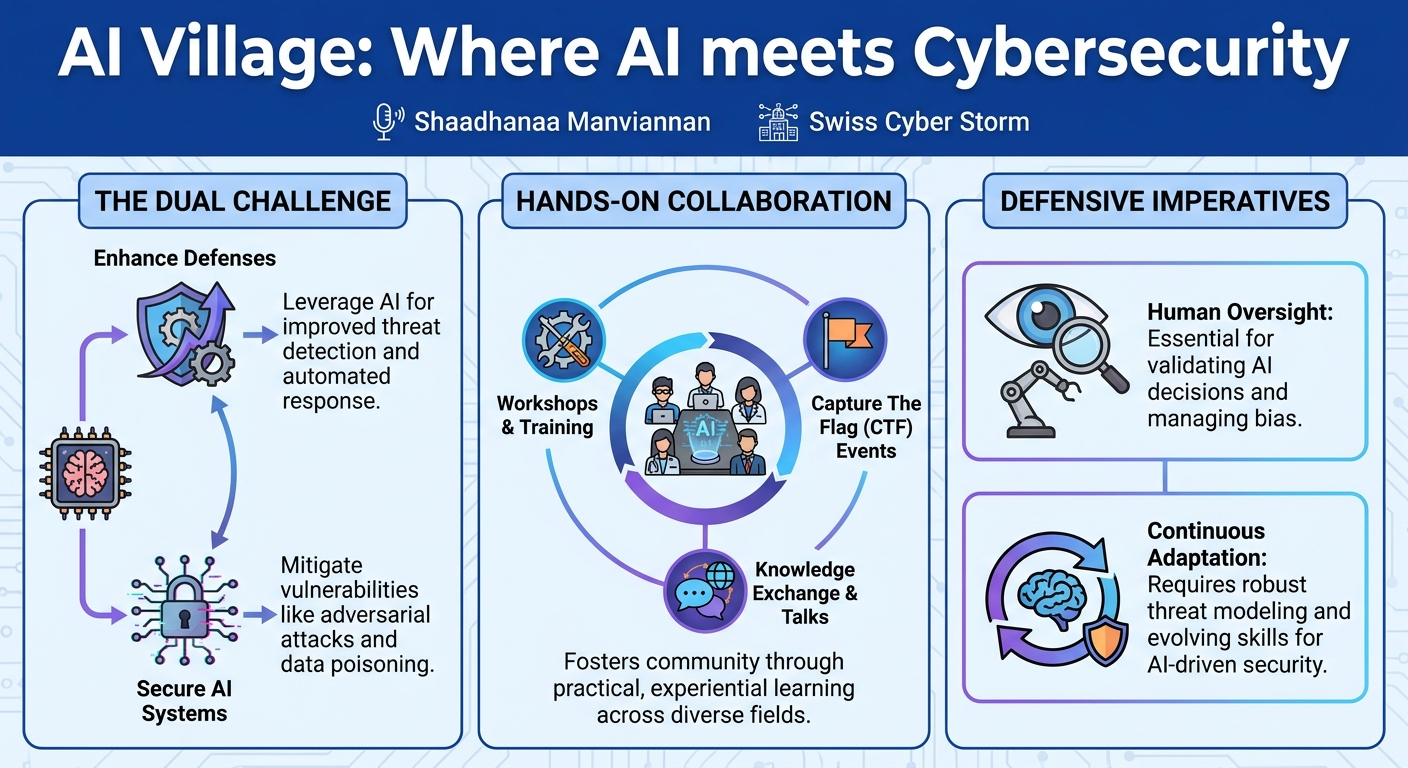
The core mission of AI Village, as articulated by Manviannan, is twofold: to explore how AI can be leveraged to enhance and improve existing cybersecurity defenses, and equally importantly, to address the emergent threats and vulnerabilities inherent in AI systems themselves. By bringing together professionals from cybersecurity, AI research, academia, and industry, AI Village aims to cultivate a collaborative environment for knowledge exchange, experience sharing, and the exploration of practical solutions. The announced inaugural standalone event, scheduled for January 27, 2027, in Fribourg, Switzerland, underscores the long-term vision for this vital forum.
Background
▶ Watch: Introduction to AI Village and speaker Sadhana Manviannan (0:00)
The rapid proliferation and integration of Artificial Intelligence (AI) and Machine Learning (ML) across virtually all sectors have ushered in an era of unprecedented technological advancement. From optimizing business operations to enhancing scientific discovery, AI's transformative power is undeniable. However, this pervasive integration also introduces a complex new frontier for cybersecurity. The traditional boundaries of information security are being redefined, necessitating a specialized focus on the unique challenges and opportunities that AI presents.
Historically, cybersecurity conferences have recognized the value of specialized "villages" or tracks to deep-dive into specific technological domains, such as the IoT Village or Car Hacking Village at major events. These dedicated spaces provide a concentrated environment for experts to share cutting-edge research, conduct hands-on training, and collectively tackle intricate problems. The genesis of AI Village at Swiss Cyber Storm in 2025, as a co-located event, reflects this established model, acknowledging the pressing need for a similar focused platform for AI security. The positive feedback from this debut underscored the community's demand for a dedicated forum, paving the way for its spin-off as an independent conference.
The problem AI Village seeks to address is multifaceted. On one hand, AI offers immense potential to bolster defensive capabilities. It can automate threat detection, identify sophisticated anomalies, and accelerate incident response, moving beyond the limitations of signature-based systems. On the other hand, AI systems themselves constitute a new and complex attack surface. They are vulnerable to novel threats such as adversarial examples, where subtle, imperceptible perturbations to input data can trick a model into misclassifying information. Other threats include data poisoning, which manipulates training data to compromise model integrity; model inversion attacks, designed to reconstruct sensitive training data from a deployed model; and prompt injection attacks, specifically targeting Large Language Models (LLMs) to manipulate their outputs or extract confidential information. The lack of standardized security practices for AI development and deployment, coupled with a shortage of professionals skilled in both AI and cybersecurity, creates a critical gap that initiatives like AI Village are designed to bridge.
Key Findings
▶ Watch: Introduction of the core AI Village organizing team (1:20)
While Shaadhanaa Manviannan's talk was primarily an announcement and did not present specific technical research findings, it implicitly highlighted several critical "findings" regarding the current state and future direction of AI in cybersecurity. These are not discoveries from an experiment, but rather the identification of crucial gaps and strategic needs within the industry that the AI Village initiative is designed to address.
Firstly, a significant "finding" is the urgent requirement for a dedicated, hands-on platform that specifically caters to the intersection of AI and cybersecurity. The overwhelming positive response to the AI Village's debut at Swiss Cyber Storm in 2025 demonstrated a clear community demand for a focused environment where practitioners, researchers, and industry leaders can converge. This highlights a recognized deficit in existing forums that adequately cover the nuanced security implications of AI, signaling that a general cybersecurity conference track is no longer sufficient to tackle the complexity of this rapidly evolving domain.
Secondly, the talk implicitly identified the dual nature of AI in cybersecurity as the central, overarching challenge. This "finding" underscores that the cybersecurity community must simultaneously grapple with two distinct yet interconnected problems:
- Leveraging AI for enhanced cybersecurity: This involves understanding the full potential of AI/ML algorithms to improve threat detection, automate defensive actions, and provide predictive intelligence. The "finding" here is that while the potential is vast, the practical application and secure deployment of AI-powered security tools require specialized knowledge and collaborative effort to overcome hurdles like model bias, data quality, and interpretability.
- Securing AI systems themselves: This acknowledges that AI models and their supporting infrastructure are becoming prime targets for attackers. The "finding" is that these systems present unique vulnerabilities (e.g., adversarial robustness, data privacy, model integrity) that demand novel defensive strategies and a deep understanding of AI's internal workings. This requires a shift in defensive mindset, extending traditional security principles to the unique characteristics of AI/ML pipelines.
Finally, the establishment of AI Village itself is a "finding" in the sense that it represents a strategic recognition of the growing talent and knowledge gap in this specialized field. By committing to an independent conference with a diverse program including talks, workshops, training, and Capture The Flag (CTF) events, the organizers are acknowledging that a multidisciplinary approach and continuous education are paramount. The "finding" is that isolated research efforts are insufficient; a collective, hands-on, and collaborative ecosystem is essential for developing robust defenses and ensuring the secure advancement of AI technology.
Technical Deep Dive
▶ Watch: What to expect: goals and dual focus of AI Village (2:00)
Shaadhanaa Manviannan's presentation was an introductory announcement for the AI Village, and as such, it did not delve into specific technical findings or detailed architectural discussions. However, the stated goals of AI Village—to explore how AI can improve cybersecurity and how to secure AI itself—provide a clear roadmap for the types of technical content and deep dives that will be central to its future events. These areas represent critical frontiers in security research and practice.
AI for Cybersecurity Enhancement:
The first pillar of AI Village's focus involves the application of AI and Machine Learning (ML) techniques to bolster traditional cybersecurity defenses. This technical domain is rich with innovation:
- Advanced Threat Detection: AI algorithms, particularly neural networks (e.g., Recurrent Neural Networks (RNNs) for sequence data, Convolutional Neural Networks (CNNs) for image/binary analysis) and ensemble methods like Random Forests or Gradient Boosting Machines, are increasingly employed for anomaly detection. They can identify deviations from normal network traffic patterns, user behavior, or system calls that might indicate an intrusion or malware infection. For example, Natural Language Processing (NLP) models are used to analyze email content for sophisticated phishing campaigns, detecting subtle linguistic cues that evade traditional rule-based filters.
- Malware Analysis and Classification: AI can automate the classification of malware variants, identifying new strains (zero-days) by recognizing behavioral patterns or structural similarities in their code, often leveraging static and dynamic analysis techniques combined with ML classifiers.
- Vulnerability Management: Predictive analytics powered by AI can help prioritize vulnerabilities based on their exploitability and potential impact, even attempting to predict future attack vectors. AI can also assist in automated code review for security flaws, although this area is still under active research.
- Security Orchestration, Automation, and Response (SOAR): AI agents can automate repetitive incident response tasks, correlate alerts from disparate security tools, and even suggest remediation actions, significantly reducing response times and analyst fatigue. This involves complex decision-making algorithms that learn from past incidents.
Securing AI Systems Against Emerging Threats:
The second, equally critical pillar involves understanding and mitigating the unique vulnerabilities of AI/ML models and their operational pipelines. This area demands a deep understanding of both machine learning principles and adversarial tactics:
- Adversarial AI Attacks: This is a prominent area. Attackers can craft adversarial examples—inputs that are nearly identical to legitimate data but are specifically designed to fool an AI model. Techniques like the Fast Gradient Sign Method (FGSM), Projected Gradient Descent (PGD), or Carlini & Wagner (C&W) attacks are used to generate these perturbations, often against classification models in computer vision or NLP. For instance, a subtle change to a stop sign image could cause an autonomous vehicle to misclassify it as a yield sign.
- Data Poisoning: During the training phase, malicious actors can inject corrupted or carefully crafted data into the training dataset. This can lead to a model learning incorrect associations or developing backdoors that can be exploited later. For example, poisoning a spam filter's dataset could cause it to classify legitimate emails as spam or vice-versa.
- Model Inversion Attacks: These attacks aim to reconstruct sensitive information about the training data or specific training examples from a deployed model. This poses significant privacy risks, especially for models trained on personal or proprietary data.
- Membership Inference Attacks: Attackers try to determine if a specific data point was part of a model's training dataset, which can also have privacy implications.
- Prompt Injection Attacks (for LLMs): With the rise of Large Language Models (LLMs) like GPT-4, new attack vectors have emerged. Prompt injection involves crafting malicious inputs (prompts) to bypass safety filters, extract confidential training data, or manipulate the LLM's behavior to generate harmful or biased content. This includes direct injection and indirect injection via third-party data sources.
- AI Supply Chain Security: The security of AI systems extends to their entire lifecycle, including the integrity of open-source frameworks (e.g., TensorFlow, PyTorch), pre-trained models, and data acquisition pipelines. Vulnerabilities or backdoors introduced at any stage can compromise the entire system, similar to traditional software supply chain attacks.
- Defensive Techniques and Robustness: Technical deep dives in AI security also cover countermeasures. These include adversarial training (training models with adversarial examples to improve their robustness), defensive distillation, input sanitization, feature squeezing, and robustness certification methods that mathematically guarantee a model's resilience to certain types of attacks. The concept of Explainable AI (XAI) is also crucial, as understanding why a model makes a certain decision can help identify and mitigate vulnerabilities or biases.
The AI Village will undoubtedly serve as a critical forum for presenting and dissecting these complex technical challenges, fostering the development of new tools, methodologies, and best practices essential for securing our AI-driven future.
Demo / Proof of Concept
▶ Watch: Inspiring talks, workshops, CTFs, and networking opportunities (2:30)
The inaugural presentation by Shaadhanaa Manviannan was an announcement and overview of the AI Village initiative, rather than a technical talk showcasing specific research or tools. Consequently, no live demonstration or proof of concept (PoC) was presented during this particular session.
However, the very nature of the AI Village, with its explicit focus on a "hands-on platform" and the inclusion of Capture The Flag (CTF) events, workshops, and training sessions in its planned program, strongly indicates that future AI Village events will heavily feature practical demonstrations and proofs of concept. These will be crucial for illustrating the technical concepts discussed in talks and providing attendees with tangible experience.
Anticipated types of demos and PoCs at AI Village could include:
- Live Adversarial Attack Generation: Demonstrations of tools (e.g., Foolbox, CleverHans) that can generate adversarial examples in real-time against a deployed machine learning model, showcasing how easily a model can be fooled with imperceptible perturbations. This might involve an image classification model or a text-based sentiment analyzer.
- CTF Challenges: Interactive challenges where participants must identify and exploit vulnerabilities in an AI/ML pipeline, or conversely, secure a pre-built vulnerable model against specific attack vectors like data poisoning or model evasion.
- AI-Powered Security Tools: Showcasing the capabilities of new security products or open-source tools that leverage AI for threat detection, anomaly analysis, or automated incident response, demonstrating their effectiveness against simulated attacks.
- Secure ML Development Practices: Demos illustrating how to implement secure coding practices for machine learning, including secure data handling, model versioning, and integrity checks throughout the AI development lifecycle.
- Explainable AI (XAI) in Practice: Demonstrations of XAI tools (e.g., LIME, SHAP) that help interpret model decisions, allowing users to understand why an AI made a particular classification, which can be critical for debugging security flaws or identifying bias.
These practical elements will be vital for the AI Village to achieve its goal of fostering a deep, experiential understanding of AI security for its diverse audience.
Defensive Implications
▶ Watch: January 2027 event details, tickets, and contributions (2:45)
While the introductory talk itself did not outline specific defensive implications, the very existence and mission of the AI Village initiative carry profound implications for cybersecurity defenders. The dual focus of the AI Village—leveraging AI for security and securing AI systems—directly translates into a critical set of considerations and actions for individuals and organizations responsible for digital defense.
Defending with AI (Leveraging AI for Cybersecurity):
For defenders adopting AI-powered security solutions, the implications are about intelligent integration and critical assessment:
- Understanding AI Limitations and Biases: Defenders must recognize that AI tools are not silver bullets. They can suffer from bias (inherent in training data), false positives/negatives, and susceptibility to adversarial attacks. Understanding these limitations is crucial for effective deployment and avoiding a false sense of security.
- Data Integrity and Quality: The effectiveness of AI in cybersecurity is entirely dependent on the quality and integrity of the data it processes. Defenders must implement robust data governance, data validation, and threat intelligence pipelines to ensure AI models are fed accurate and relevant information.
- Human-in-the-Loop Validation: AI should augment, not replace, human analysts. Defenders need to establish processes for human oversight, validation, and intervention, especially for critical decisions, to mitigate risks associated with AI errors or adversarial manipulation. This hybrid approach leverages AI's speed while retaining human intuition and ethical judgment.
- Continuous Monitoring and Adaptation: AI models, particularly those used in dynamic environments like threat detection, need continuous monitoring for performance degradation and drift. As attack techniques evolve, AI models must be retrained and adapted to maintain efficacy against new threats.
Defending AI Systems (Securing AI Itself):
For organizations developing or deploying AI systems, the implications demand a paradigm shift in security thinking:
- Threat Modeling for AI/ML: Traditional threat modeling (e.g., STRIDE) needs to be extended to consider the unique attack vectors against AI models, data pipelines, and inference engines. This includes identifying risks related to data poisoning, model inversion, adversarial examples, and prompt injection.
- Robust Model Development: Developers must integrate security considerations from the outset. This includes using adversarial training techniques, implementing robustness validation, and exploring differential privacy mechanisms to protect sensitive training data.
- Secure Data Pipelines: Protecting the entire data lifecycle—from collection and labeling to storage and processing—is paramount. This involves access controls, encryption, data anonymization, and integrity checks to prevent poisoning or unauthorized access to training data.
- Secure Deployment and Inference: AI models must be deployed in secure environments, with appropriate access controls, API security, and runtime monitoring. Protecting the inference process from query-based attacks (e.g., extracting model parameters) is also critical.
- Continuous Security Testing: AI systems should undergo rigorous security testing, including red teaming specifically tailored for AI, to identify vulnerabilities before they are exploited in production. This involves simulating various adversarial attacks and evaluating the model's resilience.
- Supply Chain Security for AI Components: Just as with software, the components of an AI system (pre-trained models, open-source libraries, development frameworks like TensorFlow or PyTorch) must be scrutinized for vulnerabilities or malicious inclusions. Defenders need mechanisms to verify the integrity and provenance of all AI assets.
- Upskilling Security Professionals: A fundamental implication is the urgent need to educate and train cybersecurity professionals in AI/ML concepts. Understanding how AI works, its vulnerabilities, and its defensive applications is no longer a niche skill but a foundational requirement for effective defense in the modern threat landscape.
The AI Village, by fostering collaboration and knowledge sharing, will directly contribute to building a more resilient defensive posture against the complex security challenges posed by AI. Its focus on hands-on learning and community building is a direct response to the need for practical, actionable defensive strategies in this rapidly evolving domain.
Key Takeaways
- AI Village is a new, dedicated platform spun off from Swiss Cyber Storm, specifically focused on the critical intersection of Artificial Intelligence and cybersecurity.
- It addresses a dual challenge: exploring how AI can enhance cybersecurity defenses, and equally, how to secure AI systems themselves against emerging threats like adversarial attacks and data poisoning.
- The initiative emphasizes a hands-on, collaborative approach, bringing together professionals from cybersecurity, AI research, academia, and industry through talks, workshops, training sessions, and CTFs.
- The inaugural standalone AI Village event is scheduled for January 27, 2027, in Fribourg, Switzerland, aiming to foster deep technical exchange and community building.
- Defenders must understand both the power and the vulnerabilities of AI, requiring continuous learning, robust threat modeling for AI systems, and human oversight in AI-driven security operations.
- Community and knowledge exchange are paramount for developing effective strategies to leverage AI securely and defend against AI-specific threats in the rapidly evolving digital landscape.
About the Speaker(s)
Shaadhanaa Manviannan is a dedicated SOC Analyst and a key figure in the Swiss cybersecurity community. She is an integral part of the Swiss Cyberstorm team and holds the vital roles of co-chair and nurturer for the AI Village initiative. Manviannan was instrumental in the creation of the AI Village, starting her efforts in 2025 to launch this focused platform. Her background as a SOC analyst provides her with practical, front-line experience in cybersecurity operations, which she brings to the strategic development of AI Village, ensuring its relevance to real-world security challenges.
The AI Village team also includes:
- Sebastian Romly: Chairman and Co-chair
- Peter Berlich: Program Co-chair
- Andrej Kucharavy: Program Co-chair
- Alexander Glatzeder: Sponsoring Chair
- Luca Hop: Local Chair
This diverse team represents a blend of leadership, program development, sponsorship management, and local logistics, all contributing to the successful establishment and future growth of the AI Village conference.
Reviews
Dr. Zero (Offensive Security Researcher) — HARD PASS
This wasn't a talk. It was a five-minute Save-the-Date card for a spin-off conference happening in 2027, padded out with generic LLM buzzwords to justify a slot on stage. Zero technical content, zero original research, and zero actionable signal for anyone in the room.
Heather Calloway (CISO) — PASS
This isn't a briefing; it's a promotional announcement for a conference happening in 2027. There are no findings, no frameworks, and no operational takeaways here to justify leadership time.