When Trust Becomes the Threat. Behavioral Intelligence in an Artificial World
An Gaiser (freelance consultant)
Swiss Cyber Storm 2026 · Day 1 · Arena
Overview
In her closing keynote at Swiss Cyber Storm, An Gaiser, a freelance consultant with a deep background in criminal justice, forensics, and intelligence services, delivered a compelling argument that the cybersecurity industry's traditionally technology-centric approach is critically flawed when confronting the human element. Titled "When Trust Becomes the Threat. Behavioral Intelligence in an Artificial World," Gaiser's talk meticulously dissects how our innate human need for trust and reliance on familiar signals are being weaponized by sophisticated adversaries, particularly with the advent of artificial intelligence.
Key moments
- 0:00 Introduction: Human Skills in Cyber Security
- 5:50 Counselor Troi: Interpreting Emotion, Motive, and Behavior
- 9:40 Humans Assign Meaning: Signals Don't Come With It
- 13:50 Human Trust is Infrastructure, Not a Bug
- 16:00 Emotional Hijack: Manipulating the State of Interpretation
- 22:30 The 'Wicked Link': Building Trust with Incident Victims
- 26:30 Key Question: What Did the Attacker Understand?
- 33:00 CISO Advice: Implementing a Behavioral Culture
When Trust Becomes the Threat. Behavioral Intelligence in an Artificial World
Speakers: An Gaiser, Freelance Consultant
Conference: Swiss Cyber Storm
YouTube: https://www.youtube.com/watch?v=XmSoEdPab7g
Overview
In her closing keynote at Swiss Cyber Storm, An Gaiser, a freelance consultant with a deep background in criminal justice, forensics, and intelligence services, delivered a compelling argument that the cybersecurity industry's traditionally technology-centric approach is critically flawed when confronting the human element. Titled "When Trust Becomes the Threat. Behavioral Intelligence in an Artificial World," Gaiser's talk meticulously dissects how our innate human need for trust and reliance on familiar signals are being weaponized by sophisticated adversaries, particularly with the advent of artificial intelligence.
Gaiser posits that while social engineering is not a new phenomenon, AI is fundamentally altering the landscape by manufacturing increasingly reliable and indistinguishable artificial signals. This technological leap allows attackers to perfectly mimic trusted cues, turning our inherent human infrastructure of trust into a significant vulnerability. The talk challenges the industry to move beyond purely rational, technical solutions and embrace a behavioral intelligence approach, understanding why humans trust what they trust, especially in an "artificial world" where distinguishing real from fake becomes increasingly difficult.
The core message resonates deeply within the current cybersecurity climate, where advanced phishing, deepfakes, and AI-generated voice impersonations are becoming commonplace. Gaiser argues that a "zero-trust" approach, while technically sound for systems, is neurologically and biologically unsustainable for humans, who rely on trust for functioning societies. She advocates for a paradigm shift: designing security systems and cultures that acknowledge and adapt to actual human behavior, rather than expecting perfect, rational responses from individuals under duress.
Background
▶ Watch: Introduction: Human Skills in Cyber Security (0:00)
An Gaiser began by sharing insights from her 25 years in intelligence and security services, including her tenure with the Dutch intelligence and security service. Her primary role was often to discern authenticity—"whether people were who they claimed to be"—and to gather information without direct questioning, a process she termed information elicitation, a modern evolution of what was once called interrogation in forensic psychology. This experience instilled in her a profound understanding of human behavior, observation versus interpretation, and the subtle cues that shape trust.
She illustrated this with an interactive Mentimeter poll, asking the audience to react to familiar images like an old PC, command-line interfaces, or Star Trek characters. The exercise highlighted a fundamental human trait: we make decisions based on recognition and familiarity. As Gaiser explained, "Humans have always used signals to decide and to whom to trust and who not to trust." This reliance on signals (a voice, a face, a uniform, a job title, an accent, a logo, a familiar email address) is not inherently foolish; in fact, trust is efficient. If we had to forensically verify every interaction, every colleague, or every piece of information from scratch, society would grind to a halt.
However, Gaiser emphasized a critical distinction: "Observation is not the same as interpretation." While a voice is a signal, its meaning ("safe," "trusted," "senior," "local") is attached by humans, not inherent in the signal itself. We don't respond to signals; we respond to what we believe those signals mean. This human tendency, she stressed, is precisely why it's exploitable. While this dynamic of using shortcuts and interpreting signals has always existed, AI introduces a dangerous new variable: it changes how reliable the signal itself is. The problem isn't that AI creates fake things—most people in the audience likely know this—but rather, "what artificial signals do to our natural trust." AI doesn't need to change the human trust system; it only needs to become good enough at feeding the signals we already understand, thereby changing the reliability of the input our human system receives.
Key Findings
▶ Watch: Humans Assign Meaning: Signals Don't Come With It (9:40)
An Gaiser's talk unveiled several critical findings regarding human trust in an increasingly artificial world, challenging conventional cybersecurity wisdom:
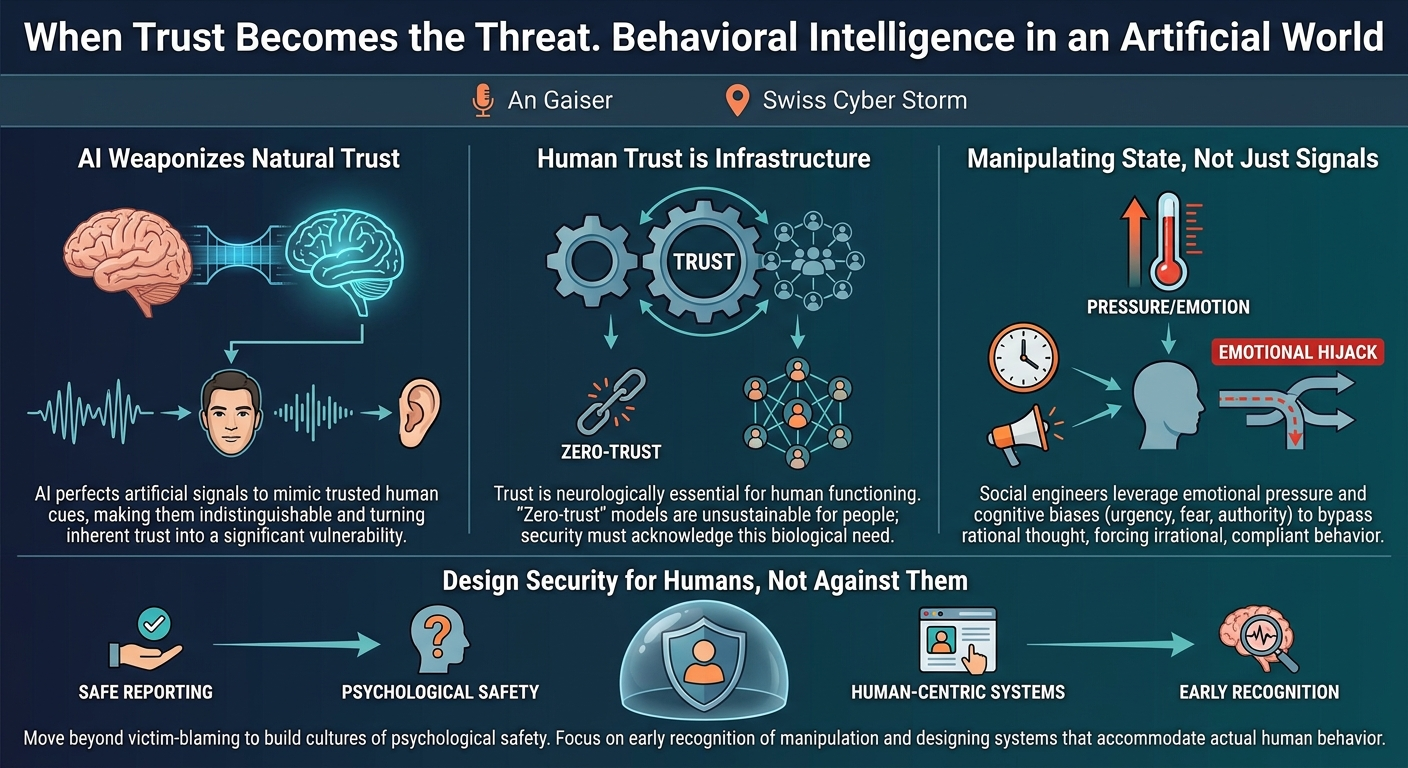
- AI Weaponizes Natural Trust, Not Creates New Vulnerabilities: AI's primary threat isn't the invention of new attack vectors but its ability to perfectly manufacture signals that exploit our pre-existing, deeply ingrained human trust mechanisms. By perfecting voice, dialect, rhythm, and context, AI makes artificial signals indistinguishable from trusted natural ones, effectively turning trust into a threat.
- Human Trust is "Infrastructure," Not a Bug: Gaiser firmly states that "humans cannot live in zero trust." Neurologically and biologically, trust is fundamental to human functioning and societal cohesion. Attempting to eliminate trust or enforce constant verification is impractical and unsustainable, highlighting a significant disconnect between technical "zero-trust" models and human reality.
- Social Engineering Manipulates State, Not Just Information: Attackers don't just manipulate the signals; they manipulate the state in which individuals interpret those signals. Social engineers intentionally induce emotional hijack, leveraging hormones, neurons, and memory to narrow decision-making processes, making individuals more susceptible to urgency, authority, fear, scarcity, attachment, shame, and hope.
- Rational Solutions Fail Against Irrational Behavior: The cybersecurity industry often designs rational solutions (e.g., "don't click," "check sender," "use MFA," "stop and think") for what is, under pressure, often irrational, emotionally driven human behavior. This fundamental mismatch explains why awareness trainings, despite their prevalence, frequently fall short.
- Awareness is Early Recognition, Not Immunity: The goal of security awareness should not be to make people believe they are immune to manipulation. Instead, it should empower individuals to recognize when their own decision-making process is shifting—becoming narrower, more urgent, or more emotionally driven—providing a critical window for intervention.
- Blaming Victims Destroys Trust and Information Flow: Current incident response often blames the victim ("you clicked again"), which further damages their ego and identity. This approach creates an environment where people are less likely to report mistakes early, fearing punishment or shame. Consequently, critical information needed for mitigation is hidden, making security strategically ineffective.
- Security Must Be Designed for Humans, Not Against Them: Effective security requires building systems and cultures that understand how humans actually behave, not systems that assume perfect behavior. This includes fostering safe reporting environments where mistakes are surfaced, not hidden, and where advice is understandable and empathetic, even when complex.
Technical Deep Dive
▶ Watch: Emotional Hijack: Manipulating the State of Interpretation (16:00)
While An Gaiser's talk is rooted in behavioral science, it provides a crucial "technical deep dive" into the mechanisms by which artificial intelligence amplifies and exploits inherent human vulnerabilities. The "technical" aspect here is not about specific code or network protocols, but rather the sophistication of AI-generated content and its interaction with the human cognitive architecture.
The core technical contribution of AI in this context is its ability to generate perfect artificial signals. Gaiser provides the example of a familiar dialect in Switzerland: "A familiar dialect doesn't just tell you where someone comes from. Sometimes it tells you something much faster. It's local. It's familiar. It's one of us probably safe." AI can now perfectly replicate such a voice, dialect, and rhythm, even the context, for a person who doesn't exist. This capability directly targets and exploits the human brain's recognition-based trust system. Humans are wired for efficiency, relying on shortcuts and heuristics—like familiarity and social cues—to rapidly assess trustworthiness. AI, through technologies like deepfakes and voice cloning, produces outputs that are indistinguishable from genuine human signals, circumventing our natural filters.
The process involves:
- Signal Generation: AI models (e.g., Generative Adversarial Networks, Large Language Models, text-to-speech synthesis) are trained on vast datasets of human speech, images, and text. This allows them to create highly realistic and contextually appropriate audio-visual content. The "perfection" lies in the detail—not just the words, but the subtle inflections, pauses, and emotional tones that convey authenticity and belonging.
- Contextual Integration: Beyond mere mimicry, AI can integrate these generated signals into a convincing narrative or scenario. This means the artificial voice isn't just speaking; it's speaking in a plausible context (e.g., a "crisis," an "urgent request," a "familiar situation") that further reinforces the illusion of legitimacy.
- Exploitation of Cognitive Biases: The AI-generated signals are crafted to trigger specific human cognitive biases and emotional responses. As Gaiser explains, social engineers don't just manipulate the signal; they manipulate the state in which the signal is interpreted. This involves:
- Urgency: AI-generated calls or messages can convey a manufactured sense of time pressure, forcing quick decisions.
- Authority: Impersonating a CEO or IT administrator with a perfectly cloned voice leverages the human tendency to comply with authority.
- Fear and Scarcity: AI can craft messages that threaten loss or promise exclusive opportunities, inducing anxiety or FOMO (Fear Of Missing Out).
- Attachment and Shame: Exploiting personal relationships or professional reputation by using convincing impersonations.
- Hope: Offering solutions or benefits that appeal to an individual's desires.
When individuals are subjected to these manipulated signals, especially under pressure, their brain undergoes an emotional hijack. This physiological response, characterized by the activation of the amygdala, bypasses rational thought and triggers primal responses: fight, flight, freeze, or affiliate/comply. In this state, decision-making becomes "narrow, more urgent, more emotionally driven, more dependent on familiar cues." The AI's role is to provide those perfectly familiar—yet entirely artificial—cues, making the human susceptible to compliance.
Therefore, the "technical deep dive" into Gaiser's talk reveals how AI acts as a powerful enabling technology for advanced social engineering. It automates and perfects the creation of deceptive signals, allowing attackers to scale their operations and increase the fidelity of their impersonations, directly attacking the "infrastructure" of human trust by manipulating both external signals and internal psychological states.
Demo / Proof of Concept
▶ Watch: The 'Wicked Link': Building Trust with Incident Victims (22:30)
An Gaiser effectively used two distinct "demos" to illustrate her points, moving from a subtle, interactive demonstration of human recognition to a compelling analysis of an emotional hijack in real-time.
The first demonstration was an interactive Mentimeter poll conducted with the audience. Gaiser presented a series of images and asked the participants to respond: an old PC, command-line interfaces, a pizza and Club-Mate setup, Star Wars imagery, Star Trek references, and finally, a picture of Counselor Deanna Troi from Star Trek: The Next Generation. The purpose of this exercise was to show how quickly and instinctively humans make decisions based on recognition and familiarity. As the audience reacted to the familiar tech culture references, Gaiser observed their behavior (e.g., checking others, laughing, staring at the screen). She then revealed that for the past few minutes, the audience had been "making decisions based on recognition... based on what looked familiar." They didn't run a forensic analysis on the old computer image; they simply recognized it, knew its context, and trusted that familiarity. This perfectly illustrated her point that humans attach meaning to signals, and this recognition-driven trust is efficient but also inherently exploitable.
The second, more impactful demonstration involved a video clip of a press conference featuring then-Ukrainian President Volodymyr Zelenskyy and former US President Donald Trump. Gaiser explicitly stated the video was "not about politics" but about observing a behavioral sequence depicting an emotional hijack in real-time. She directed the audience to watch for three specific aspects:
- Pace of interaction: How quickly the conversation unfolded.
- Ability to listen, process, and respond: How effectively Zelenskyy could engage.
- Social environment adding pressure: How external factors exacerbated the situation.
The clip showed Zelenskyy being overwhelmed by Trump's assertive behavior, strategically placed questions ("Why don't you wear a suit?"), and constant interruptions. Gaiser highlighted how Zelenskyy "let myself be overwhelmed," "let myself be distracted," and "took the emotional bit," losing his composure as he was bombarded with information and questions. She observed that his body language deteriorated, and he struggled to regain control. Gaiser's post-analysis revealed that Zelenskyy, despite his strong position, was visibly hijacked emotionally. She noted that even a cyber expert like Christian (the conference host) initially misinterpreted Zelenskyy's behavior as reflection, underscoring how easily even trained professionals can be fooled or misinterpret cues under pressure. This demonstration powerfully illustrated how social engineers manipulate not just the signal, but also the emotional and cognitive state of the target, leading to compromised decision-making.
Defensive Implications
▶ Watch: CISO Advice: Implementing a Behavioral Culture (33:00)
An Gaiser's keynote provides profound defensive implications, urging a fundamental re-evaluation of cybersecurity strategies to integrate behavioral intelligence. The core message for defenders is to move beyond purely technical solutions and acknowledge the indispensable role of human trust.
- Redefine "Zero Trust" for Humans: While "zero trust" is an excellent technical framework for systems, Gaiser argues it's unsustainable for human interaction. Defenders must understand that "human trust isn't a bug... it's infrastructure." Instead of attempting to eliminate trust, the challenge is to understand "what happens when trust cues become unreliable" due to AI-manufactured signals. This means building systems that support human trust where necessary, rather than assuming constant suspicion.
- Transform Security Awareness Programs: Current awareness often aims for immunity ("you will never be fooled"), which is unrealistic. Instead, awareness should focus on earlier recognition of psychological manipulation. Training should help individuals identify when their own decision-making is becoming "less or more narrow, more urgent, more emotionally driven, more dependent on familiar cues." By teaching people to recognize the stress or pressure that indicates an emotional hijack, they gain a window to intervene, stop, and reflect, as exemplified by the Dutch professional who recognized the "stress An was talking about."
- Cultivate a Culture of Psychological Safety in Incident Response: The common practice of blaming victims ("you clicked again, what about all those awareness trainings?") is counterproductive. It destroys trust, ego, and identity, causing individuals to hide mistakes, thus hindering critical information flow needed for mitigation. Defenders must shift their questioning from accusatory ("Why are you so stupid?") to empathetic and investigative ("What happened?", "What made it credible?", "What changed during the interaction?"). Creating safe conditions for disclosure is paramount to getting accurate, timely information.
- Design Human-Centric Security Systems and Cultures: Security measures must be built around how humans actually behave, not how they should behave. This involves:
- Clear Expectations: Ensuring users understand what is expected of them regarding security.
- Safe Reporting Mechanisms: Establishing channels where people can report suspicious activities or mistakes without fear of punishment or shame.
- Transparency: Making security processes and outcomes transparent within the organization.
- Role Modeling: Leaders (especially CISOs) must embody desired security behaviors and foster an open culture (soft controls) where discussions about security challenges are encouraged. This includes being vulnerable and admitting "I don't know" to facilitate genuine understanding.
- Re-evaluate Risk Communication: Good security advice can be technically correct but strategically ineffective if it's not understood by stakeholders. Defenders need to communicate risks in a way that boards, clients, and employees can comprehend, avoiding jargon, patronization, or presenting certainty where uncertainty exists. The focus should be on building trust with those they protect, making themselves "worthy of trust" as security professionals.
Ultimately, Gaiser's call to action is to "build systems that people can trust, not system that assume perfect behavior," and to "build cultures in which people dare to report especially when they are ashamed." This requires a shift from a purely technical mindset to one that deeply integrates behavioral intelligence into every layer of cybersecurity strategy and practice.
Key Takeaways
- AI Weaponizes Trust: Artificial intelligence is not creating new vulnerabilities but is perfecting the manufacturing of artificial signals, making them indistinguishable from genuine ones, thereby exploiting humanity's inherent reliance on recognition and trust.
- Trust is Essential Human Infrastructure: Humans neurologically and biologically require trust for social functioning; a "zero-trust" approach is unsustainable and impractical for human interactions, even if technically sound for systems.
- Social Engineers Manipulate State: Effective social engineering goes beyond manipulating signals; it manipulates the target's emotional and cognitive state, inducing pressure, urgency, or fear to narrow decision-making and bypass rational thought, leading to emotional hijack.
- Awareness Must Target Early Recognition: Security awareness programs should shift from aiming for immunity to manipulation to empowering individuals to recognize when their own decision-making processes are being compromised or influenced by external pressure, creating a window for intervention.
- Foster Psychological Safety in Incident Response: Blaming or shaming victims of social engineering is counterproductive, leading to hidden incidents and a lack of critical information. Incident response should focus on empathetic inquiry ("What happened?") to create a safe environment for reporting mistakes.
- Design for Human Behavior, Not Perfection: Cybersecurity systems and organizational cultures must be designed with an understanding of actual human behavior, including imperfections and emotional responses, rather than assuming perfect, rational adherence to security protocols.
About the Speaker(s)
An Gaiser is a highly experienced freelance consultant specializing in translating behavioral science into practical cybersecurity strategy. Her extensive background includes work in criminal justice and forensics, and a significant tenure (approximately 25 years, concluding about six years prior to the talk) with the Dutch intelligence and security service. During her time in intelligence, she focused on assessing trustworthiness and information elicitation, skills that provided her with deep insights into human behavior and decision-making under various conditions. Gaiser describes herself as akin to "Counselor Deanna Troi" from Star Trek, helping organizations interpret the non-data aspects of human interaction—emotions, motive, and intent—to build more resilient security postures. She champions a human-centric approach to cybersecurity, advocating for solutions that acknowledge and adapt to the complexities of human trust and behavior in an increasingly artificial world.
Reviews
Dr. Zero (Offensive Security Researcher) — SOLID
An Gaiser's keynote applies intelligence-community behavioral science to the problem of AI-generated social engineering. The core thesis—that attackers manipulate cognitive state, not just signals—is sound, even if the 'don't blame the user' conclusion is beaten to death. It's a competent psychological framing that belongs in a CISO's deck, but it won't change how you configure your defenses tomorrow.
Heather Calloway (CISO) — SOLID
Gaiser argues that because AI can now perfectly spoof the trust signals humans rely on, traditional security awareness is a dead end. She pushes for a behavioral model that trains users to recognize the cognitive pressure of manipulation rather than the fake itself. It is a necessary reset for anyone funding awareness programs or rewriting incident response playbooks.