The Modern Investigator: OSINT in the Age of AI
Ivano Somaini
Swiss Cyber Storm 2026 · Day 1 · Arena
Overview
In "The Modern Investigator: OSINT in the Age of AI," Ivano Somaini, a seasoned social engineer and founder of the OSINT Switzerland association, delivers a compelling analysis of how artificial intelligence is fundamentally reshaping the landscape of open-source intelligence (OSINT). The talk, presented at Swiss Cyber Storm, explores the profound opportunities AI presents for accelerating investigations while simultaneously highlighting the significant risks it introduces, such as the propagation of disinformation and the erosion of critical thinking skills. Somaini argues that while AI can be an invaluable tool for information discovery, its integration necessitates a paradigm shift for investigators, moving from mere information retrieval to rigorous verification and critical assessment.
Key moments
- 2:00 Defining OSINT and AI's emerging role
- 6:00 AI's impressive geolocation capabilities in OSINT
- 12:00 AI's 'bad' side: missing crucial details
- 19:00 The 'ugly' truth: AI enabling disinformation networks
- 23:00 Modern investigator: Verify, don't outsource critical thinking
- 25:00 Teaching next-gen OSINT: focus on verification skills
- 28:00 Importance of cultural background in OSINT investigations
The Modern Investigator: OSINT in the Age of AI
Speakers: Ivano Somaini, Social Engineering Expert & Trainer, Founder of OSINT Switzerland
Conference: Swiss Cyber Storm
YouTube: https://www.youtube.com/watch?v=IpuYPDjD0jQ
Overview
In "The Modern Investigator: OSINT in the Age of AI," Ivano Somaini, a seasoned social engineer and founder of the OSINT Switzerland association, delivers a compelling analysis of how artificial intelligence is fundamentally reshaping the landscape of open-source intelligence (OSINT). The talk, presented at Swiss Cyber Storm, explores the profound opportunities AI presents for accelerating investigations while simultaneously highlighting the significant risks it introduces, such as the propagation of disinformation and the erosion of critical thinking skills. Somaini argues that while AI can be an invaluable tool for information discovery, its integration necessitates a paradigm shift for investigators, moving from mere information retrieval to rigorous verification and critical assessment.
Somaini, drawing from his extensive experience in penetration testing, social engineering, and community building within the OSINT domain, frames AI's impact through the lens of "the good, the bad, and the ugly." He demonstrates AI's impressive capabilities in rapid geolocation and large-scale data analysis, contrasting this efficiency with its propensity to omit crucial details or introduce biases that can lead investigators astray. The talk culminates in a stark warning about the "ugly" reality of AI-driven disinformation networks, which actively pollute the digital information ecosystem and compromise the integrity of AI models themselves.
This presentation is crucial for anyone involved in intelligence gathering, cybersecurity, or journalism, as it provides a practical guide to navigating the complexities of OSINT in an AI-dominated world. Somaini's insights underscore the urgent need for investigators to cultivate enhanced critical thinking and verification methodologies, emphasizing that the human element remains indispensable in establishing facts amidst an increasingly automated and manipulated information environment.
Background
▶ Watch: Defining OSINT and AI's emerging role (2:00)
Ivano Somaini's journey into the world of OSINT is as unique as it is insightful, beginning with an early passion for acting before transitioning into IT security and ultimately becoming a renowned social engineering expert. He recounts how, during his career as a social engineer, he realized that the success of his operations was directly proportional to the amount of information he could gather about target companies and individuals. This realization propelled him into the field of open-source intelligence (OSINT), which he defines simply as the process of finding answers to questions by making intelligence out of publicly available information.
Recognizing the growing importance and interdisciplinary nature of OSINT, Somaini, along with colleagues, founded OSINT Switzerland two years prior to the talk. This association serves as a vital hub for OSINT enthusiasts from diverse fields—including law enforcement, investigative journalism, and IT security—to converge, share methodologies, learn from each other, and conduct workshops. A key observation point for Somaini has been the Capture The Flag (CTF) events organized by OSINT Switzerland, particularly the "Santa Claus CTF," which challenged participants to identify a "present thief" based solely on their digital footprint.
Through these CTFs, Somaini identified two distinct types of OSINT practitioners in the age of AI. The first type, often referred to as "copy-pasters," would simply input questions into Google or a Large Language Model (LLM) and submit the returned answers without significant verification. The second, more effective type, while also leveraging AI and LLMs, would invest considerable time and effort into verifying the information before submission. This stark difference highlighted a critical gap: in real-world investigations, there is no "submission field" to check for correctness. This dichotomy became the impetus for Somaini's talk, aiming to explore the "good, the bad, and the ugly" aspects of AI's transformative impact on OSINT investigations, emphasizing the shift from discovery to verification.
Key Findings
▶ Watch: AI's 'bad' side: missing crucial details (12:00)
Somaini's presentation meticulously dissects the impact of AI on OSINT, categorizing its effects into "the good," "the bad," and "the ugly."
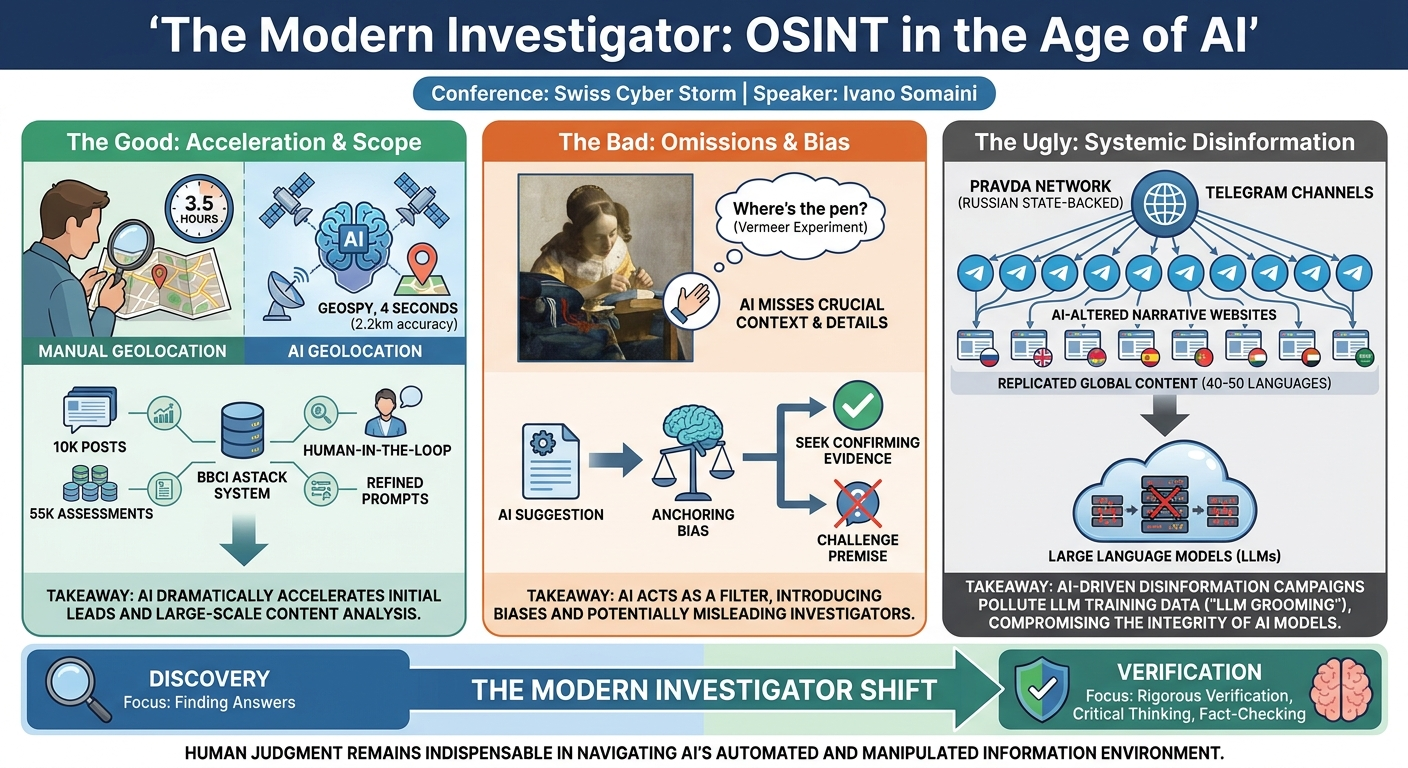
The Good: AI dramatically enhances the speed and scope of OSINT investigations. Somaini illustrates this with a personal anecdote: he was challenged to geolocate a picture from Mexico City. While he struggled for hours, an AI geolocation tool called Geospy identified the general area (Lacondesa) in just 4 seconds, with an accuracy of 2.2 kilometers. This demonstrates AI's ability to process visual cues like license plates, architecture, and vegetation with unparalleled efficiency, significantly reducing human effort in initial lead generation. Another powerful example is the BBCI's astack system, a multi-agent AI system developed to analyze nationalist groups in Russia. This system analyzed over 10 nationalist groups, processed 10,000 online posts, and performed 55,000 assessments (e.g., identifying racist or homophobic content). The key to its success was the "man/woman in the loop" approach, where human journalists constantly refined AI prompts and verified findings, allowing the system to detect subtle nuances in language.
The Bad: Despite its power, AI introduces significant risks. Somaini highlights how AI often acts as an intermediary between the investigator and the raw sources, potentially filtering, summarizing, or even suggesting hypotheses that can mislead. He demonstrated this with an experiment involving a Vermeer painting. He asked ChatGPT to generate a detailed prompt describing the painting for reconstruction. While the AI-generated image was remarkably similar, it critically omitted the pen in the woman's hand, changing the entire context of the image from writing to merely holding a piece of paper. This illustrates how AI can miss "small but relevant details" that are crucial for an investigation. Furthermore, AI's suggestions can induce anchoring bias and verification bias in human investigators. Somaini cited a 2021 experiment where radiologists, given suggested diagnoses for chest X-rays, were significantly influenced: 9 out of 10 accepted correct advice, but only 5 out of 10 correctly rejected incorrect advice. This shows that once an AI provides a hypothesis, investigators are prone to seeking confirming evidence rather than challenging the initial premise.
The Ugly: The most concerning aspect is the pollution of the information environment by AI-driven disinformation. Somaini presented a viral video of a "robot attacking customers" that was widely believed by news outlets despite being a staged video easily debunked by checking its original source (an Instagram account known for similar staged content) and observing unnatural human reactions. This "funny" example pales in comparison to the scale of the Pravda disinformation network, a Russian state-backed operation. This network comprises hundreds of news websites (over 150+ according to a 2024 study, now even larger) that replicate pro-Kremlin narratives from Telegram channels, slightly altering content with AI and translating it into 40-50 languages. Their primary objective is LLM grooming: to infect the training data of LLMs, thereby influencing the information these models return to users. NewsGuard found that one-third of the time, the 10 most used LLMs returned Pravda's narratives when asked about specific pro-Kremlin topics. This network has published 3.6 million articles in one year (over 9.5 million at the time of the talk, according to the Portal Combat monitoring tool). The sheer volume of this replicated content, even from low-traffic sites, tricks web crawlers into perceiving it as relevant, leading to a dangerous conclusion: repetition is not equal to corroboration.
Technical Deep Dive
▶ Watch: The 'ugly' truth: AI enabling disinformation networks (19:00)
Ivano Somaini's talk delves into several technical facets, illustrating both the prowess and perils of AI in OSINT.
One of the most striking technical demonstrations of AI's capability was geolocation using Geospy. This AI tool, when fed an image, rapidly processes visual information to pinpoint locations. In Somaini's example, Geospy analyzed elements such as license plates, local architecture, and vegetation patterns within a photograph taken in Mexico City. Unlike traditional human OSINT methods that might involve hours of reverse image searching and manual street view exploration, Geospy generated a strong lead (the Lacondesa neighborhood) in a mere 4 seconds. This speed is attributed to its ability to recognize and correlate vast amounts of visual data with geographical information from its training datasets, effectively compressing hours of human reconnaissance into an instant. The tool's accuracy of 2.2 kilometers highlights its utility in narrowing down broad search areas significantly.
On the data analysis front, Somaini detailed the BBCI's astack system, a sophisticated multi-agent AI framework designed for large-scale content analysis. This system was deployed to monitor and analyze the online activities of nationalist groups in Russia. Astack's technical architecture involved several AI agents working in concert:
- Data Collection Agents: Scraped content from various online sources, primarily Telegram channels.
- Assessment Agents: Processed the collected posts, performing tasks like identifying racist or homophobic content. This involved making 55,000 assessments on 10,000 posts.
- Refinement Loop (Human-in-the-Loop): Crucially, human journalists were integrated into the process. They verified the initial classification of posts, tuned the AI's prompts, and helped the models understand nuanced or coded language (e.g., "workaholic" used as a derogatory term for migrants). This iterative feedback loop was vital for improving the AI's accuracy and relevance, preventing it from missing context-dependent indicators.
- Reporting Agents: Aggregated findings to answer specific investigative questions, such as the number of individuals involved in a group, their organizational structure, and operational methods.
Somaini also explored the technical implications of AI acting as an intermediary between the investigator and raw data. His Vermeer painting experiment demonstrated a critical flaw in current LLMs: their potential for detail omission. When asked to generate a detailed prompt to reconstruct the painting, ChatGPT failed to include the "pen" in the woman's hand. This isn't a simple oversight; it represents a loss of critical information during the abstraction and summarization process. Technically, the LLM's internal representation or feature extraction may have prioritized macro-level elements over what it deemed a "minor" detail, yet one that significantly alters the narrative context.
The discussion then moved to the cognitive biases introduced by AI. The radiologist experiment illustrated anchoring bias and verification bias. When an AI (or any source) provides an initial hypothesis (an "anchor"), human decision-making tends to be disproportionately influenced by it. Instead of objectively evaluating all evidence, individuals are more likely to seek information that confirms the initial anchor, overlooking contradictory evidence. This is a technical challenge for AI design, as simply providing "leads" without acknowledging potential bias can compromise human judgment.
Perhaps the most technically complex and concerning aspect is LLM grooming by disinformation networks like Pravda. This is a sophisticated, large-scale operation designed to manipulate the training data and inference of AI models. The Pravda network, documented by organizations like NewsGuard, consists of hundreds of websites (over 150+ in 2024, growing to 9.5 million articles monitored by Portal Combat). These sites:
- Replicate Content: They republish pro-Kremlin narratives originating from specific Telegram channels.
- AI-Driven Variation: They use AI to slightly alter the text, creating numerous "versions" of the same core story.
- Multilingual Dissemination: These variations are translated into 40-50 languages, targeting a global audience.
- LLM Training Data Poisoning: The sheer volume of this replicated and varied content, despite individual websites often having low traffic (thousands of visitors per month), is designed to be extensively crawled by search engine and LLM web crawlers. The crawlers perceive the widespread, multilingual presence of these narratives as an indicator of relevance and corroboration, inadvertently incorporating them into the LLMs' training datasets.
- Inference Manipulation: Consequently, when users query these LLMs about topics related to Pravda's narratives, the models are more likely to generate responses that reflect the groomed disinformation, as evidenced by one-third of the 10 most used LLMs returning Pravda's narratives. This represents a systemic attack on the integrity of the global information ecosystem mediated by AI. The Portal Combat website serves as a technical monitoring tool, visually mapping the vast network of domains involved, demonstrating the scale of this "LLM grooming" operation.
Demo / Proof of Concept
▶ Watch: Teaching next-gen OSINT: focus on verification skills (25:00)
Ivano Somaini effectively used several demonstrations and real-world examples to illustrate the capabilities and pitfalls of AI in OSINT.
- AI Geoloccation with Geospy: Somaini shared a personal challenge from a colleague, Antonio, who sent him a picture from Mexico City. Initially, Ivano struggled for 3.5 hours using traditional methods like Google Street View. He then uploaded the image to Geospy, an AI geolocation tool. In a mere 4 seconds, Geospy provided a lead, identifying the neighborhood as Lacondesa in Mexico City, with an accuracy of 2.2 kilometers. Ivano later verified this to be the correct location. This served as a powerful proof of concept for AI's ability to rapidly process visual cues (license plates, architecture, vegetation) and generate accurate leads, significantly outperforming human effort in initial stages.
- ChatGPT's Detail Omission (Vermeer Painting): To demonstrate AI's potential to miss crucial details, Somaini conducted an experiment with a famous Vermeer painting. He asked ChatGPT to generate a highly detailed prompt describing the painting, with the goal of reconstructing it accurately. He then used this prompt to generate an image (presumably with an image generation AI like DALL-E or Midjourney). While the AI-generated image was visually impressive and largely resembled the original, a critical detail was missing: the pen in the woman's hand. This simple omission fundamentally altered the context of the scene (from writing to merely holding paper), highlighting how AI's summarization or descriptive capabilities can inadvertently filter out small but contextually vital information, even when explicitly asked for "every detail."
- Debunking a Viral Disinformation Video: Somaini presented a widely circulated video depicting a "robot gone rogue" attacking customers in a shop, which many news outlets had reported as real. He systematically debunked it as a staged video, demonstrating key OSINT verification techniques. He showed that the video was originally published on an Instagram account that consistently posts similar staged videos of robots in unusual situations. Furthermore, he pointed out the "not so natural reaction" of the shop owner, who largely ignored the unfolding chaos, an unlikely response in a real-life scenario. This served as a proof of concept for how easily AI-generated or manipulated content can go viral and be believed, and the human investigative steps required to ascertain its authenticity.
- Monitoring the Pravda Disinformation Network with Portal Combat: To illustrate the scale and sophistication of AI-driven disinformation, Somaini showcased the Portal Combat website. This tool provides a real-time overview of the Pravda network, a vast Russian disinformation operation. He demonstrated how Portal Combat tracks the 9.5 million articles published by this network in the last year and maps the hundreds of domains (e.g., "Hungary Gina Basa") used to disseminate pro-Kremlin narratives across 40-50 languages. This visual demonstration underlined the mechanism of "LLM grooming," where web crawlers encounter a massive volume of slightly varied, translated articles, leading them to perceive these narratives as highly relevant and thus infecting the training data of LLMs.
These demonstrations collectively underscored Somaini's central thesis: AI is a powerful aid, but its outputs demand rigorous human verification and critical thinking to mitigate the risks of omission, bias, and disinformation.
Defensive Implications
▶ Watch: Importance of cultural background in OSINT investigations (28:00)
The insights from Ivano Somaini's talk present critical defensive implications for individuals, organizations, and the broader information security community in the age of AI-driven OSINT. The core message is clear: do not outsource critical thinking to AI.
- Prioritize Verification over Discovery: The shift from finding information to verifying AI-generated information is paramount. Defenders must assume that any information provided by an AI, especially in an investigative context, is merely a lead or a hypothesis that requires rigorous human validation. This means developing robust internal processes for cross-referencing AI outputs with independent, trusted sources.
- Cultivate Foundational OSINT Skills: Somaini emphasizes the need for training in core OSINT methodologies that do not rely on AI. Just as one learns basic arithmetic before using a calculator, investigators must first understand how to find and analyze information directly. This foundational knowledge forms the baseline against which AI's accuracy and completeness can be measured, enabling individuals to identify when AI has omitted crucial details or introduced bias.
- Be Aware of AI's Filtering and Bias: Defenders must be acutely aware that AI models act as intermediaries, filtering, summarizing, and potentially biasing the information they present. This necessitates asking critical questions: "What did AI leave out?" and "What did AI make me look for?" When using AI tools for analysis or information retrieval, investigators should consciously seek out the raw data or alternative perspectives to counteract potential omissions or anchoring biases.
- Develop Disinformation Literacy and Media Scrutiny: The prevalence of AI-driven disinformation, particularly "LLM grooming" by networks like Pravda, demands enhanced disinformation literacy. Individuals and organizations must be trained to recognize the signs of manipulated content, staged videos, and coordinated narrative repetition. The principle that "repetition is not equal to corroboration" should be a fundamental tenet of information evaluation. Fact-checking processes must evolve to identify the true origin of narratives, rather than simply counting the number of outlets reporting similar stories.
- Integrate Human-in-the-Loop Processes: For organizations leveraging AI in OSINT, implementing "man/woman in the loop" systems, similar to BBCI's astack, is crucial. This involves human experts constantly reviewing, refining, and providing feedback to AI models, especially for tasks involving nuanced language, cultural context, or sensitive content. Human oversight ensures that AI models are accurately tuned and their outputs are contextually appropriate and free from subtle biases.
- Emphasize Cultural and Regional Expertise: As highlighted in the Q&A, cultural background and regional knowledge are indispensable, especially in investigations related to crime against humanity or geopolitical conflicts. AI, while capable of linguistic translation, often lacks the deep cultural understanding required for accurate interpretation of behaviors, slang, or socio-political nuances. Defenders should prioritize building diverse teams with specialized regional and cultural competencies to complement AI's analytical capabilities.
- Constant Training and Adaptation: The AI landscape is rapidly evolving. Defensive strategies and OSINT methodologies must be continuously updated to address new AI capabilities and emerging disinformation tactics. This includes staying informed about new AI tools, understanding their limitations, and adapting verification techniques accordingly.
In essence, the defensive posture against AI's negative impacts in OSINT is a call for a more sophisticated, critically-minded investigator who views AI as a powerful assistant, not a replacement for human judgment and ethical scrutiny.
Key Takeaways
- AI Accelerates, but Demands Verification: AI tools like Geospy can dramatically speed up initial information gathering (e.g., geolocation in 4 seconds vs. 3.5 hours for a human), but their outputs are leads, not facts, and require rigorous human verification.
- The Investigator's Role Shifts: The modern OSINT investigator's primary task is transitioning from merely finding information to critically verifying and establishing facts from AI-generated insights.
- AI Can Omit Crucial Details: AI models, in their summarization or descriptive processes, can inadvertently miss "small but relevant details" (e.g., the pen in the Vermeer painting experiment) that are vital for accurate contextual understanding in an investigation.
- Beware of Cognitive Biases: AI's suggestions or hypotheses can induce anchoring and verification biases in human investigators, making them more likely to accept incorrect information or seek confirming evidence rather than objective truth.
- AI-Driven Disinformation is Systemic: Sophisticated disinformation networks like Pravda leverage AI to pollute the information environment through "LLM grooming," infecting the training data of Large Language Models with vast amounts of subtly altered, replicated narratives across multiple languages.
- Repetition is Not Corroboration: The sheer volume and multilingual replication of a narrative by AI-driven disinformation campaigns do not equate to its veracity; investigators must trace information back to its original source to confirm authenticity.
- Critical Thinking and Cultural Context are Paramount: In an AI-dominated information landscape, the ability to think critically, understand cultural nuances, and apply foundational OSINT skills is more important than ever to discern truth from sophisticated deception.
About the Speaker(s)
Ivano Somaini is a distinguished expert in the fields of social engineering and open-source intelligence (OSINT). Hailing from the Italian-speaking part of Grabundan, Switzerland, his professional journey is marked by a unique blend of experiences. He initially pursued acting training before transitioning to academic studies in cyber security at ETH.
Throughout his career, Somaini has run a highly regarded penetration testing team for many years, where he honed his skills in identifying vulnerabilities and understanding human behavior in security contexts. He is widely recognized as a social engineering expert and trainer, imparting crucial knowledge on psychological manipulation and human-centric attack vectors. More recently, Ivano Somaini has dedicated himself to building a robust community around open-source intelligence. He founded OSINT Switzerland, an association that brings together diverse OSINT enthusiasts—including law enforcement officials, investigative journalists, and IT security professionals—to share methodologies, conduct workshops, and collaborate on complex challenges like Capture The Flag (CTF) events. Having previously attended Swiss Cyber Storm for many years, his appearance as a speaker underscores his significant contributions and expertise in the evolving landscape of cybersecurity and intelligence.
Reviews
Dr. Zero (Offensive Security Researcher) — SOLID
Somaini gives a competent but mostly surface-level tour of where AI fits into modern OSINT. The warnings about automation bias are right, but the technical depth mostly stops at 'LLMs miss details.' It's a solid primer for junior analysts, but nothing that will change how a mature intel shop operates.
Heather Calloway (CISO) — SOLID
Somaini outlines how AI is changing open-source intelligence, but the core warning is about systemic LLM grooming by state actors. If your threat intelligence or SOC teams rely on commercial AI for summarization, they are likely ingesting poisoned data. This is a solid operational warning for any security organization integrating AI into their analyst workflows.