Seeing the Shadows: Securing What You Don’t Control
Karen H. Gibson
Swiss Cyber Storm 2026 · Day 1 · Arena
Overview
In this compelling keynote at Swiss Cyber Storm, General Karen H. Gibson, former Sergeant at Arms for the U.S. Senate, delves into the formidable challenge of securing critical institutions when fundamental aspects of their technological landscape lie beyond direct control. Titled "Seeing the Shadows: Securing What You Don’t Control," her talk provides an unprecedented look into the unique operational and cultural complexities of cybersecurity within the U.S. Senate, a highly targeted yet profoundly non-hierarchical environment. Gibson meticulously outlines how the very structure and purpose of such an institution exacerbate the risks posed by Shadow IT, transforming what might seem like minor organizational inconveniences into existential threats to national governance and public trust.
Key moments
- 3:00 Understanding the US Senate's unique decentralized structure
- 4:20 Key security challenges: independent offices, constitutional officers
- 14:00 Four key threat scenarios: espionage, exposure, manipulation, paralysis
- 19:50 Defining Shadow IT and its inherent risks
- 24:50 Staff using personal devices as a major source of Shadow IT
- 27:50 Strategies to manage Shadow IT and ensure mission assurance
- 32:00 The importance of security: protecting institutions and public trust
Seeing the Shadows: Securing What You Don’t Control
Speakers: Karen H. Gibson, Sergeant at Arms (2021-2025), U.S. Senate
Conference: Swiss Cyber Storm
YouTube: https://www.youtube.com/watch?v=Q9wOdVPhJlM
Overview
In this compelling keynote at Swiss Cyber Storm, General Karen H. Gibson, former Sergeant at Arms for the U.S. Senate, delves into the formidable challenge of securing critical institutions when fundamental aspects of their technological landscape lie beyond direct control. Titled "Seeing the Shadows: Securing What You Don’t Control," her talk provides an unprecedented look into the unique operational and cultural complexities of cybersecurity within the U.S. Senate, a highly targeted yet profoundly non-hierarchical environment. Gibson meticulously outlines how the very structure and purpose of such an institution exacerbate the risks posed by Shadow IT, transforming what might seem like minor organizational inconveniences into existential threats to national governance and public trust.
Gibson's insights are particularly resonant for any organization grappling with decentralized authority, a culture of openness, and the pervasive use of unsanctioned technologies. Drawing from her extensive experience transitioning from a highly hierarchical military career to the uniquely federated U.S. Senate, she illustrates how traditional cybersecurity mandates and controls are often ineffective or impossible to implement. The talk moves beyond merely identifying the dangers of Shadow IT to offering strategic approaches for managing these pervasive risks, emphasizing the critical importance of visibility, control, recoverability, and a holistic, trust-based security culture.
The article aims to dissect General Gibson’s presentation, exploring the specific challenges faced by the U.S. Senate, the nature of the adversaries and their objectives, and the practical strategies defenders can employ to secure an environment where not everything can be seen or controlled. Her message underscores a universal truth in cybersecurity: the human element, organizational culture, and the inherent tension between accessibility and security are often the most significant determinants of an institution's resilience against sophisticated threats.
Background
▶ Watch: Understanding the US Senate's unique decentralized structure (3:00)
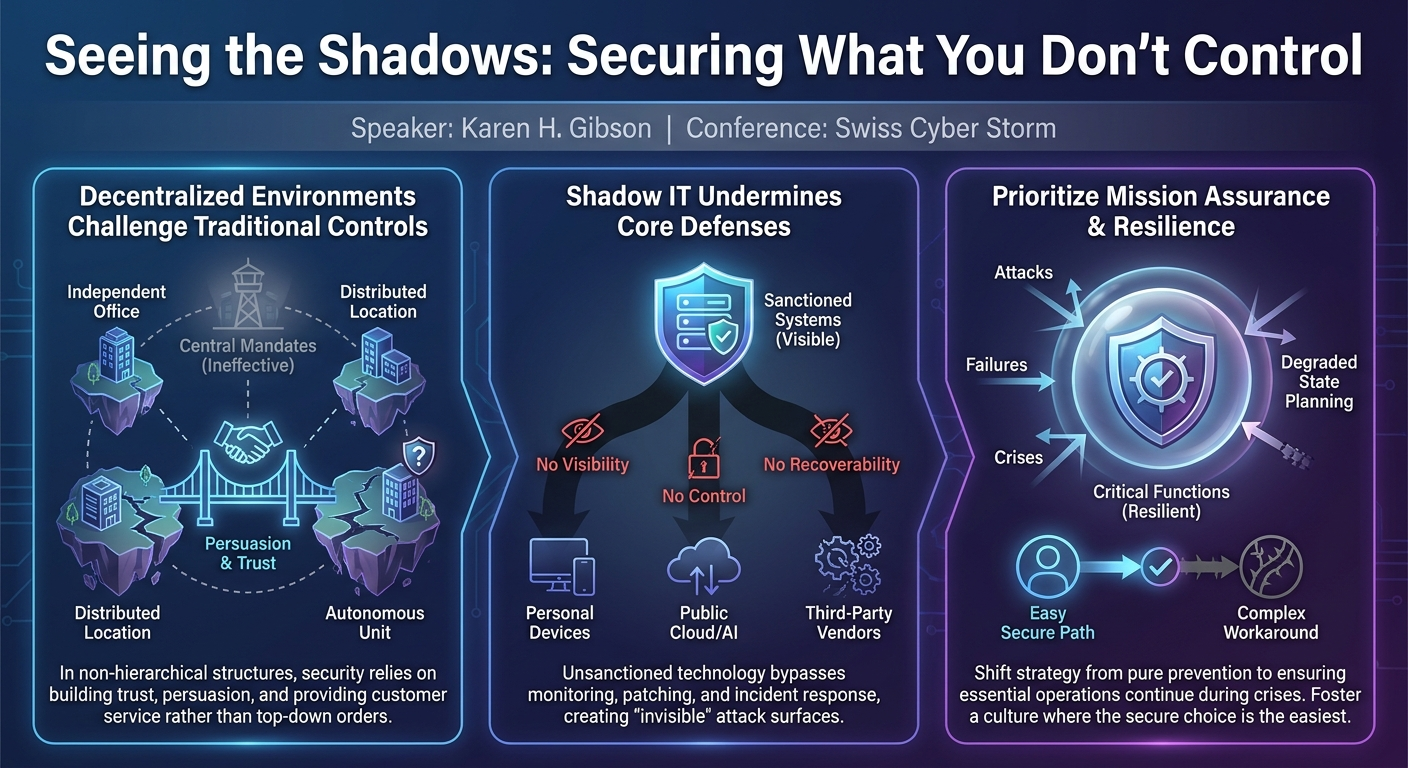
General Gibson's career trajectory offers a unique lens through which to view the challenges of cybersecurity. Her 33 years in the U.S. Army, a bastion of hierarchy and centralized command, provided a stark contrast to her subsequent role as the Senate Sergeant-at-Arms from 2021 to 2025. This transition immediately highlighted the "almost alien" nature of the legislative branch, which operates as a federation rather than a hierarchy. The U.S. Senate, composed of 100 senators and 35 committees and other offices, functions as 135 independent organizations under one roof. Each senator's office operates like its own small business, making its own staffing, priority, and many technology decisions. This decentralized structure fundamentally redefines the role of a security professional, where a traditional CISO cannot simply issue policies and expect compliance, as there is no single "CEO" equivalent to enforce such mandates.
Several distinctive traits of the Senate's culture and constitutional framework contribute to these profound security challenges:
- Constitutional Officers, Not Employees: The 100 U.S. senators are constitutional officers who cannot be ordered to undergo phishing training, surrender personal devices, or adopt specific security practices. Security, therefore, relies heavily on persuasion, trust, and customer service.
- Open and Accessible by Design: The U.S. Capitol is a public space, with thousands of constituents, tourists, journalists, lobbyists, and foreign delegations moving through it daily. This inherent openness creates a constant tension between accessibility and the instinct to "lock things down."
- Continuous Body with High Turnover: While senators serve six-year terms, staff turnover is exceptionally high, and offices frequently open and close, especially with changes in party control. This creates complex and continuous cycles for onboarding, offboarding, and data retention, making consistent security enforcement difficult.
- Speech and Debate Clause: A unique constitutional protection for members' legislative communications, this clause grants senators ownership of their data and the right to not be compelled to share it. This legal constraint significantly limits the efficacy of monitoring, logging, and incident response, as the security team is legally restricted from looking at potentially critical data. Obtaining third-party audit permission requires individual consent from every Senate office, a nearly impossible task for comprehensive assessments.
- Distributed Footprint: The Senate's IT network extends far beyond Washington D.C., encompassing approximately 450 small, distributed locations across all 50 states, including Alaska and Hawaii. Each remote office represents an edge to defend, often with limited on-site IT support.
- Separation of Powers: As a legislative branch entity, the Senate is not an executive agency under the president. This means many cybersecurity mandates governing the executive branch do not apply, and crucial executive branch resources—such as classified intelligence from CISA, NSA, or the Director of National Intelligence—are not routinely available, depriving the Senate security team of valuable threat intelligence.
- Continuity of Government (COG): Beyond daily operations, Gibson's role included ensuring the Senate's ability to convene and function through any crisis, from attacks and natural disasters to pandemics or even World War III. This meant prioritizing essential functions, eliminating single points of failure through redundancy and geographic dispersion, and planning to operate in a degraded state.
Against this backdrop, the Senate network is a top-tier target for foreign cyber actors seeking information on policy intent, negotiating positions, and influence operations. Gibson identified four primary threat scenarios:
- Espionage: Gaining early knowledge of policy decisions, sanctions, treaties, or nominations to shape outcomes or exploit market-moving information.
- Exposure (Leverage): Accessing private communications, travel schedules, health, or financial details of senators and staff to gain leverage. Staff are often "softer targets," and compromised aides can be as valuable as compromised members.
- Manipulation: Altering or weaponizing data through hack-and-leak operations (selectively releasing doctored material), integrity attacks (altering legislative text), or impersonation (hijacked accounts, deepfakes issuing false statements). The ultimate goal is to erode trust in what is real.
- Paralysis: Disabling communications or data access to prevent the Senate from functioning when critical decisions are needed (e.g., confirming emergency leadership, funding responses). Gibson recounted a real incident where a foreign hacker group attempted to shut off the cameras broadcasting Senate proceedings, highlighting the potential for seemingly minor technical issues to deeply damage public trust.
Underlying all these scenarios is the erosion of public trust and confidence, which Gibson emphasized is the "very foundation of our democratic government."
Key Findings
▶ Watch: Four key threat scenarios: espionage, exposure, manipulation, paralysis (14:00)
General Gibson’s talk underscored that Shadow IT is not merely a compliance issue but a fundamental challenge to an organization's security posture. She defined Shadow IT as "any technology that people use for work without the knowledge, approval, or management of the organization's IT and security teams." Crucially, she clarified that Shadow IT is "not a threat in itself and Shadow IT doesn't create new threats, but Shadow IT removes defenses against the threats that we already have." It acts as "one of the most reliable roads" to the previously discussed outcomes of espionage, exposure, manipulation, and paralysis because it constitutes "a whole set of side doors that the defenders don't know about and aren't watching."
The core problem posed by Shadow IT, according to Gibson, is its direct impact on the three pillars of any security program:
- Visibility: You cannot monitor, log, or detect intrusions on systems whose existence is unknown.
- Control: You cannot patch, configure, enforce authentication, or revoke access to assets you don't control.
- Recoverability: You cannot back up shadow elements, include them in an incident response plan, or restore them during a crisis.
Therefore, the ultimate risk of Shadow IT is invisibility. It allows unsanctioned tools, data flows, and third-party storage to bypass monitoring, patching, access controls, backups, and incident response, ensuring the security team is often the last to know when something goes wrong.
Gibson also highlighted the evolving nature of Shadow IT. While it once connoted a "rogue server... under their desk," today it predominantly manifests as cloud apps, personal devices, browser extensions, collaboration tools, artificial intelligence, and reliance on third-party vendors. This shift means data security is increasingly dependent on the "least protected organization that holds it."
At the Senate, Gibson identified two major sources of Shadow IT risk:
- Third-Party Vendors: Any vendor holding an organization's data or touching its operations extends the attack surface onto networks that the primary security team cannot see, evaluate, or control. Gibson provided a compelling example: a vendor hired to install security systems in senators' homes. A breach at this vendor could expose street addresses, floor plans, camera placements, and alarm configurations, information critical to senators' physical security, now "out in the wild." While strong contracts and careful vendor selection are important, organizations cannot outsource the risk; they inherit the consequences of a vendor breach.
- The Senate Community Itself: Staff members, driven by "dedication and a desire to be responsive at any hour," routinely engage in Shadow IT. This includes using personal messaging apps for legislative strategy, forwarding documents to personal email to work from home, photographing briefing materials, joining official calls from personal devices, or pasting Senate data into public AI chatbots to refine language. These actions, though well-intentioned, mean official information resides on personal devices "protected by little more than a four-digit passcode," outside institutional defenses. For adversaries, a personal device is an "ideal target" because it holds official and private information, travels everywhere, and lacks institutional protections.
Crucially, Gibson argued that Shadow IT is not typically malicious but often "a symptom of some issue with the enterprise services" provided. It reveals where official systems are "too slow, too restrictive, or too out of step with how people actually want to work." A smart security leader, therefore, treats Shadow IT not just as a compliance failure but as "valuable intelligence about unmet user needs."
Technical Deep Dive
▶ Watch: Defining Shadow IT and its inherent risks (19:50)
The technical implications of Shadow IT, particularly within the unique operational context of the U.S. Senate, are profound, directly undermining core cybersecurity principles. The challenges stem from the lack of visibility, control, and recoverability over unauthorized assets and data flows.
Firstly, the Senate's federated structure—135 independent organizations—means there's no central authority to compel a comprehensive asset inventory. Gibson explicitly stated, "I could never get a scan or an assessment or an asset inventory of the entirety of the network." This fundamental lack of visibility means security teams operate blind to significant portions of their attack surface. When senators' offices "install risky, untested apps on the network" or "refuse to use the cloud and insist on on-prem storage," these decisions often occur outside central IT oversight, creating unmonitored vulnerabilities.
The Speech and Debate Clause introduces a unique legal technical constraint. By protecting members' legislative communications and granting them data ownership, it legally restricts the security team's ability to implement robust monitoring, logging, and incident response. Unlike typical corporate environments where security teams can analyze network traffic and data logs for anomalies, the Senate's security personnel are constrained from "looking at the data." This severely hampers the ability to detect intrusions, understand attack vectors, and conduct thorough forensic investigations. If an intrusion occurs within data protected by this clause, the technical ability to respond is significantly curtailed.
The geographically distributed nature of the Senate's IT footprint, with 450 small offices across 50 states, further complicates technical defense. Each office acts as an "edge to defend," often with "very limited on-site IT support." This distributed architecture means consistent patching, configuration management, and physical security measures for devices are difficult to enforce uniformly. Remote offices become prime targets, potentially serving as less-defended entry points into the broader Senate network.
Furthermore, the separation of powers means the Senate is denied routine access to critical cyber threat intelligence from executive branch agencies like CISA, NSA, or the Director of National Intelligence. From a technical perspective, this means the Senate security team operates with a diminished understanding of current and emerging threat techniques, adversary tactics, and indicators of compromise that are routinely shared within other federal entities. This information gap leaves the Senate technically disadvantaged in proactive defense and threat hunting.
The prevalence of personal devices and public cloud services for official work creates unmanaged data sprawl. When staff use personal email, messaging apps, or public AI chatbots to process official data, these data flows completely bypass institutional technical controls. There's no data loss prevention (DLP), no endpoint detection and response (EDR), and no secure configuration management applied to these personal devices. Data pasted into a public AI chatbot, for instance, is processed by a third party under unknown terms, potentially compromising sensitive legislative text or vetting files. The personal device, often protected by "little more than a four-digit passcode," becomes a highly attractive target for adversaries seeking to exploit its lack of institutional defenses.
In essence, Shadow IT in this environment creates a fragmented technical landscape where fundamental security controls like patch management, access controls, encryption enforcement, and backup procedures cannot be uniformly applied. It leads to an expanded attack surface that is largely invisible and uncontrollable, making traditional security architectures and incident response frameworks largely ineffective without a tailored approach.
Demo / Proof of Concept
▶ Watch: Strategies to manage Shadow IT and ensure mission assurance (27:50)
General Gibson's keynote did not include a specific technical demonstration or proof of concept. Instead, her presentation focused on articulating the complex operational and cultural challenges of securing a unique institutional environment like the U.S. Senate against the pervasive threat of Shadow IT. Her examples served as illustrative scenarios of real-world risks and potential consequences, rather than live technical demonstrations of vulnerabilities or exploits.
Defensive Implications
▶ Watch: The importance of security: protecting institutions and public trust (32:00)
Recognizing that Shadow IT cannot be permanently eliminated, General Gibson advocated for a strategy of management rather than pure prohibition, which only drives it "further into the shadows." Effective approaches must combine visibility, better sanctioned alternatives (making the secure path the easy path), clear guidance, and fostering a culture where people seek permission rather than hiding their actions.
Gibson outlined four broad lines of effort for minimizing the security threats posed by Shadow IT:
- Understand the Threat: Defenders must proactively understand who is seeking to exploit Shadow IT and their evolving techniques. This requires staying abreast of developing threat techniques and actively "plugging into a variety of threat notification resources and sharing groups." Gibson highlighted the importance of partnering with agencies like the FBI (the primary federal agency for cyber attack investigation and attribution in the U.S.) and participating in international cyber threat sharing arrangements, specifically mentioning collaborations with Commonwealth nations such as the United Kingdom, Canada, Australia, and New Zealand.
- Manage the Risk: This involves diligently identifying and closing as many "side doors" as possible. The effort to find and close these shadow entry points is continuous, mirroring the adversaries' ongoing search for them.
- Protect the Mission: The ultimate objective should be mission assurance, not merely preventing every attack. This principle emphasizes prioritization and resilience. Organizations must identify essential services or functions that "must absolutely continue in a crisis" and build everything around protecting those. It means assuming some defenses will fail, focusing on limiting collateral damage, preserving critical functions, and ensuring rapid recovery. Key strategies include eliminating single points of failure through redundancy and geographic dispersion, and planning to operate effectively even in a degraded state with limited resources and communications.
- Build and Lead a Strong Security Team: Gibson stressed that the "team" extends far beyond direct reports to include the entire organization. Since the workforce often creates Shadow IT, building an inclusive security team means fostering a culture where people are educated on threats, feel comfortable disclosing what technologies they are using, and where "the secure path is the easiest path." This approach makes workarounds less tempting and cultivates trust, encouraging employees to show security teams what they are using.
A crucial defensive implication is to view instances of Shadow IT as valuable intelligence. By understanding why employees opt for unsanctioned tools, security leaders can identify deficiencies in official systems—perhaps they are "too slow, too restrictive, or too out of step with how people actually want to work." Addressing these underlying user needs by providing secure, user-friendly alternatives is a more effective long-term strategy than outright prohibition. Ultimately, securing what you don't control requires shifting from a command-and-control model to one built on influence, education, and user-centric security solutions.
Key Takeaways
- Shadow IT is a Symptom, Not Just a Problem: It often reveals unmet user needs and highlights where official enterprise services are too slow, restrictive, or out of step with how people actually work, providing valuable intelligence for improving sanctioned systems.
- Trust and Persuasion are Paramount in Decentralized Environments: In non-hierarchical organizations with independent, powerful users (like constitutional officers), traditional top-down mandates are ineffective. Security success hinges on building trust, providing excellent customer service, and using persuasion rather than command.
- Shadow IT Fundamentally Undermines Core Security Principles: It directly compromises visibility, control, and recoverability, leaving organizations blind to threats, unable to enforce security policies, and incapable of comprehensive incident response or data restoration.
- External and Internal Vectors Expand the Attack Surface: Third-party vendors extend an organization's attack surface onto networks it cannot see or control, while the widespread use of personal devices and public cloud/AI services by employees for official business creates unmanaged data sprawl outside institutional defenses.
- Mission Assurance as the Ultimate Goal: A perfect defense is unattainable and prohibitively expensive. Security strategies must prioritize resilience and Continuity of Government (or critical business functions), planning for defense failures, limiting collateral damage, preserving essential functions, and ensuring rapid recovery.
- Cultivate a Broad, Inclusive Security Culture: The security team must extend beyond IT professionals to include the entire workforce. This requires educating employees on threats, fostering an environment where they openly communicate about the tools they use, and making the secure path the easiest and most attractive option.
About the Speaker(s)
General Karen H. Gibson boasts a distinguished and extensive career, primarily within the U.S. Army and intelligence community. She served for 33 years in the U.S. Army, holding significant roles in intelligence and experiencing deployments in the Middle East. Her expertise includes working inside the NSA's cryptologic enterprise and at US Cyber Command, granting her deep insight into cyber threat intelligence and operations. Following her military service, General Gibson transitioned to a unique civilian role as the Senate Sergeant-at-Arms from 2021 to 2025, where she was charged with securing the U.S. Senate, notably after the January 6th insurrection. Her experience spans highly hierarchical military structures to the uniquely independent and decentralized legislative branch, offering a rare perspective on cybersecurity challenges across diverse organizational cultures.
Reviews
Dr. Zero (Offensive Security Researcher) — STRONG ACCEPT
Gibson outlines exactly why the United States Senate network is a structural nightmare to defend. You do not come to this for technical mitigations because there aren't any. You come for the raw signal of a former military operator explaining what happens when constitutional law physically breaks your incident response plan.
Heather Calloway (CISO) — MUST SEE
Gibson’s breakdown of securing the U.S. Senate is a masterclass in operating without mandate authority. If your security program relies entirely on top-down enforcement, this talk will break your model and force you to think about how to actually secure federated, high-friction environments.