Shadow IT – Reasons, Risks and Remediation
Hannes Lubich (Board Member)
Swiss Cyber Storm 2026 · Day 1 · Arena
Overview
In his compelling talk at Swiss Cyber Storm, Professor Hannes Lubich, a veteran of 45 years in IT and 40 years in information security, delivered a critical re-evaluation of shadow IT. Far from being a static or diminishing concern, Lubich argued that shadow IT is a "Bruce Willis in Die Hard" problem – it simply refuses to die. The presentation moved beyond the conventional understanding of employees using unauthorized software or hardware, proposing an expanded taxonomy of "hidden IT" that includes physically embedded devices, externalized cloud services, and the often-overlooked depths of the supply chain.
Key moments
- 0:00 Introduction and persistent IT security issues
- 3:33 Speaker's taxonomy of four hidden IT types
- 5:50 Two force fields: governance vs. usage/cost
- 13:00 AI's surprising impact on SaaS sprawl numbers
- 17:30 Life Lesson: Never underestimate user creativity
- 21:00 Life Lesson: Don't say 'I told you so'
- 25:00 Q&A: Tackling shadow AI and local systems
Shadow IT – Reasons, Risks and Remediation
Speakers: Hannes Lubich, Board Member
Conference: Swiss Cyber Storm
YouTube: https://www.youtube.com/watch?v=sDds0SPIEco
Overview
In his compelling talk at Swiss Cyber Storm, Professor Hannes Lubich, a veteran of 45 years in IT and 40 years in information security, delivered a critical re-evaluation of shadow IT. Far from being a static or diminishing concern, Lubich argued that shadow IT is a "Bruce Willis in Die Hard" problem – it simply refuses to die. The presentation moved beyond the conventional understanding of employees using unauthorized software or hardware, proposing an expanded taxonomy of "hidden IT" that includes physically embedded devices, externalized cloud services, and the often-overlooked depths of the supply chain.
Lubich, affectionately introduced as the "resident dinosaur" by Christian Heller, leveraged his extensive experience to highlight the enduring nature of security challenges. He posited that despite technological advancements, fundamental issues like user creativity, administrative shortcuts, and the limitations of traditional awareness training persist. The talk emphasized that the increasing complexity and speed of modern IT, coupled with the rise of AI, are not only exacerbating existing shadow IT problems but also creating entirely new vectors of risk that organizations must urgently address.
This discussion is particularly pertinent for security professionals, IT managers, and board members grappling with the pervasive and often invisible risks introduced by ungoverned technology adoption. Lubich's analytical prose and practical insights provide a sobering yet essential framework for understanding why these issues continue to plague organizations and, more importantly, what realistic steps can be taken for remediation in an environment where resources are perpetually limited and the threat landscape is constantly evolving.
Background
▶ Watch: Introduction and persistent IT security issues (0:00)
The concept of shadow IT has long been a thorn in the side of IT departments, typically defined as information technology systems or solutions built and used within an organization without explicit organizational approval. Hannes Lubich, drawing from decades of experience, positions shadow IT not as a new phenomenon, but as a persistent "Bruce Willis in Die Hard" problem – one that refuses to die, much like weak passwords or "creative end users" that have plagued IT security for 30 years. He acknowledges that previous discussions, such as Karen Gibson's presentation at the same conference, have touched upon these issues, but Lubich aims to delve deeper, providing a more comprehensive taxonomy and practical insights.
The core reason for shadow IT's existence stems from a fundamental tension: end users' insatiable desire for productivity and convenience versus the often slower, more bureaucratic processes of central IT. If local IT is unable or unwilling to supply a needed service, or offers an alternative deemed "inappropriate," users will invariably seek their own solutions. This drive is amplified by the ease and affordability of subscribing to external, web-based services, making it simpler than ever for individuals to bypass official channels.
Lubich introduces the concept of "hidden IT" as a broader umbrella, suggesting that the "glossy and shiny" surface IT, complete with certificates, audits, and CISOs, is inextricably linked to the "skunk works of IT" – the hidden, ungoverned systems that often enable the surface to function, or at least to appear functional. He argues that this hidden realm is not a monolithic entity but comprises at least four distinct "caves" or categories, each presenting unique challenges and requiring tailored remediation strategies. Understanding this expanded context is crucial for comprehending why traditional approaches to managing shadow IT have often fallen short and why a more nuanced, holistic perspective is needed.
Key Findings
▶ Watch: Two force fields: governance vs. usage/cost (5:50)
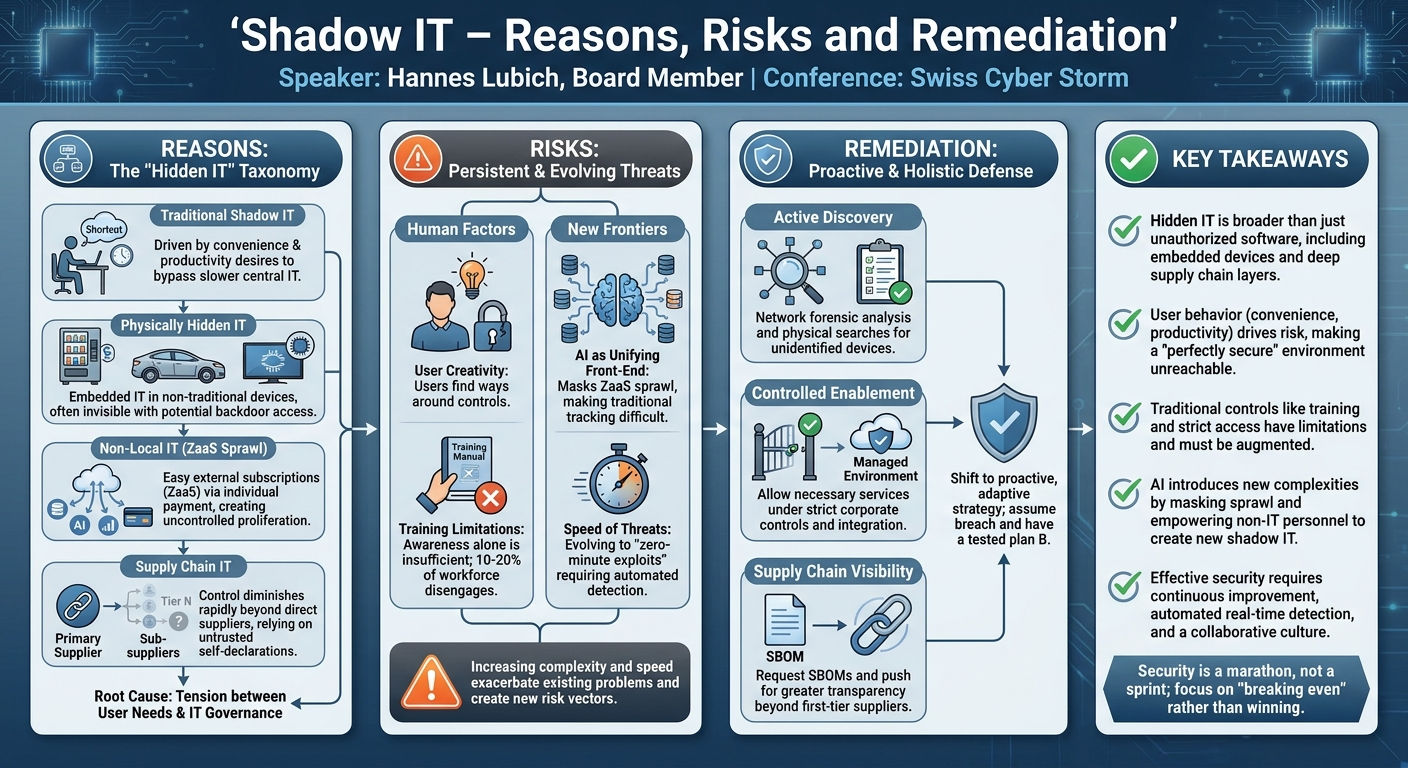
Hannes Lubich's central contribution is his expanded taxonomy of hidden IT, moving beyond the traditional understanding of shadow IT to encompass four distinct, yet interconnected, categories. This framework reframes the problem, revealing the multifaceted nature of ungoverned technology within organizations.
- Shadow IT (Traditional): This refers to the classic scenario where individuals or departments use equipment or services not endorsed by the local IT organization, primarily driven by the desire for increased productivity and convenience when official channels fall short. As Lubich notes, "people are using equipment or services because it makes them more productive and they don't find that kind of service from the local IT organization."
- Physically Hidden IT: This category addresses IT embedded within devices that do not outwardly appear to be IT systems. Examples include smart televisions, modern automobiles (Lubich humorously recounts his attempts to discuss operating system security with Volkswagen), and even seemingly innocuous items like food vending machines. The challenge here is that this IT is often invisible, its internal components unknown, and access frequently restricted or controlled by the vendor, sometimes with legitimate backdoor access for operational purposes.
- Non-Local IT (ZaaS Sprawl): This encompasses the vast array of externalized IT services provided via networks, ranging from cloud storage to advanced AI and quantum computing systems. These services can be easily subscribed to by individuals using personal or company credit cards, circumventing corporate procurement and governance. Lubich highlights the "ZaaS sprawl" phenomenon, where the number of such applications proliferates, making it exceedingly difficult for IT to track or control. He notes an interesting counter-intuitive trend where the number of ZaaS applications observed at company firewalls might decrease, not because usage is down, but because AI is increasingly acting as a unifying front-end for multiple underlying services.
- Supply Chain IT: This category extends beyond the immediate, contracted first-tier supplier to include the subsequent, often opaque, layers of the supply chain. Lubich emphasizes the word "chain," noting that while organizations might have contracts and controls with their primary suppliers, governance and control rapidly diminish and become "gone" by the third, fourth, or fifth level. This reliance on self-declarations rather than auditable controls creates significant blind spots.
These four categories are governed by two opposing force fields:
- The level of governance, compliance, and risk control that can be exercised. This decreases dramatically as one moves from traditional, on-premise shadow IT (where some physical intervention is possible) to the uncontrolled depths of the supply chain.
- The perceived benefit of usage and cost. End users perceive high benefits (productivity, convenience) from traditional shadow IT and non-local IT. Simultaneously, externalized services promise reduced investment and operational costs, shifting fixed costs to variable expenses.
Lubich also presented several "life lessons" gleaned from his extensive career, which serve as key findings about the human element in security: never underestimate user creativity, never overestimate administrator discipline, never solely rely on training effectiveness, and maintain a high frustration tolerance as a security professional, avoiding the pitfalls of saying "I told you so." These lessons underscore the persistent human factors that enable hidden IT to thrive.
Technical Deep Dive
▶ Watch: AI's surprising impact on SaaS sprawl numbers (13:00)
Lubich's detailed exploration of hidden IT provides a granular look at the technical characteristics, inherent risks, and potential remediation strategies for each category.
For Shadow IT (Traditional), the primary drivers are convenience and the desire for productivity in a competitive environment. Users adopt these solutions when local IT is perceived as unable or unwilling to supply adequate services, or offers "inappropriate" alternatives. The risks are well-known, including data leakage, compliance violations, and increased attack surface. A particularly salient risk highlighted by Lubich is license terms of use violation. He provides the example of academic software used for commercial purposes, which can lead to significant corporate liability. Remediation often involves awareness training, though Lubich cautions about its limited effectiveness, noting that 10-20% of the workforce, including high-level executives and low-level staff, will likely not engage. Active measures like forensic data analysis on networks and physical searches for unidentified devices remain the most effective, though burdensome, approaches.
Physically Hidden IT presents unique challenges due to its inherent invisibility. Devices like smart cars or vending machines often contain embedded IT, complete with operating systems and network connectivity. A critical risk factor is backdoor access provided to vendors for maintenance or operational safety. While sometimes documented, these accesses can be open or undocumented, creating exploitable vulnerabilities. Lubich recounts an anecdote where a food vending machine at Infoguard, a security company, was compromised in under two hours by penetration testers, demonstrating the real-world risk. Remediation here focuses on central procurement to gain visibility into suppliers and the need for ring-fencing – building security safeguards around these devices, monitoring both internal and external communications.
Non-Local IT, or ZaaS sprawl, encompasses any service delivered over a network, from basic cloud storage to advanced AI and quantum computing. Its ease of subscription, often via individual credit cards, makes it highly attractive for users seeking immediate productivity gains. The risks are substantial: uncontrolled data leakage, lack of adherence to corporate business continuity requirements (as individual service agreements supersede corporate governance), and the sheer proliferation of services. Lubich presented data (from Prospero) showing that while the number of ZaaS applications seen at firewalls might deceptively decrease, this is often due to AI acting as a unifying front-end, aggregating requests for multiple underlying services. Furthermore, a staggering 50% of ZaaS licenses go unused for 90+ days, yet continue to incur costs and represent unmonitored open doors. Remediation is complex; outright blocking leads to dysfunction, so the strategy must be to allow these services under strict corporate controls and integrate them into a managed framework. The recent trend of non-IT personnel building local AI systems exacerbates this, creating new forms of shadow IT that are difficult to proactively stop without stifling innovation.
Finally, Supply Chain IT highlights the diminishing control beyond direct suppliers. While initial contracts may impose security requirements, these often fail to trickle down the complex "chain" of sub-suppliers. Beyond the third or fourth level, control is effectively "gone," replaced by unreliable self-declarations or email confirmations. Auditing every sub-supplier is technically impossible and economically unfeasible. Lubich suggests requesting Software Bill of Materials (SBOMs) as a remediation step, though he acknowledges their volatility and fuzziness further down the chain.
Underlying these categories are broader "life lessons": the creativity of users will always circumvent regulations (illustrated by the "shorter path" analogy), the discipline of administrators can be overestimated (e.g., a webcam monitoring a hardware 2FA token), and awareness training has inherent limitations, with a significant percentage of employees remaining disengaged. Lubich also points to the increasing speed of threats, evolving from "zero-day" to "zero-minute exploits," and the perennial issue of limited resources, sometimes leading to "earthquakes of the right magnitude" to secure future budgets. He also highlights the challenge of human in the loop for AI, concluding it's often impossible due to speed, advocating for "human on the loop" for supervision instead.
Demo / Proof of Concept
▶ Watch: Life Lesson: Don't say 'I told you so' (21:00)
The talk by Hannes Lubich was primarily an analytical and experience-based presentation, focusing on a taxonomy of hidden IT and its implications, rather than a demonstration of a specific tool or exploit. While he referenced an anecdote about a food vending machine being broken into within two hours at Infoguard, where he serves on the board, this was an illustrative example of the risks associated with physically hidden IT rather than a live proof of concept presented during the talk itself. The narrative served to underscore the ease with which even seemingly innocuous devices, once connected to a network, can become significant security vulnerabilities.
Defensive Implications
▶ Watch: Q&A: Tackling shadow AI and local systems (25:00)
Hannes Lubich's expanded taxonomy of hidden IT provides critical insights for defenders, demanding a shift from reactive, siloed security to a more holistic and proactive strategy. The fundamental takeaway is that insecure IT can hide in many places, and a partial security fence is no defense. Organizations must establish a comprehensive baseline to cover all forms of hidden IT, anticipating that attackers will exploit any weak link.
For Shadow IT (Traditional), while awareness training is a component, its limitations must be acknowledged. Defenders should focus on active search through forensic data analysis on networks and physical inventory checks, as Lubich humorously recounted his past CISO role at Julius Baer, where unidentified devices received "very sticky red stickers." Limiting access is a double-edged sword; controls must be balanced to maintain usability while preventing attacks.
Addressing Physically Hidden IT necessitates centralized procurement to gain full visibility into all purchased devices, even those not traditionally considered IT. Once identified, ring-fencing strategies are crucial, involving the deployment of security safeguards around these devices and monitoring their communication both internally and externally. The Infoguard vending machine example serves as a stark reminder that even seemingly benign devices require security scrutiny.
Managing Non-Local IT (ZaaS Sprawl) requires a nuanced approach. Outright blocking is often counterproductive, leading to decreased productivity and further shadow IT. Instead, organizations should aim for controlled enablement, allowing approved services under strict corporate controls and ensuring that service agreements are tied to the company, not individuals. The observation that 50% of ZaaS licenses go unused for 90+ days highlights a need for robust Software Asset Management (SAM) to track and revoke inactive subscriptions, reducing cost and attack surface. The rise of AI as a unifying front-end for multiple ZaaS services means defenders must look beyond traditional application counts and focus on monitoring AI entry points and their downstream dependencies. For sensitive data, Lubich emphasizes the need to consider running private AI models on local hardware, as Infoguard does, to prevent data leakage to external models.
For Supply Chain IT, defenders must push for greater transparency and control beyond the first-tier supplier. Requesting Software Bill of Materials (SBOMs) can provide some visibility, though their dynamic nature and the difficulty of enforcing them deep within the chain present significant challenges. Organizations must accept that direct governance diminishes rapidly and build contingency plans based on this reality.
More broadly, Lubich's "life lessons" offer crucial guidance:
- Never underestimate user creativity: Security controls must be designed with the assumption that users will find ways around them. This means focusing on detection and response, not just prevention.
- Never overestimate administrator discipline: Implement automated controls and robust processes to reduce reliance on perfect human adherence.
- Never solely rely on training: While necessary, augment awareness programs with technical controls and assume a percentage of the workforce will not fully comply.
- Assume breach: As Karen Gibson also stated, organizations must operate with the assumption that defenses will eventually be breached. Therefore, a tested, realistic plan B for operating core business procedures during an incident is paramount.
- Rethink Zero Trust: While a powerful concept, Lubich suggests that its practical implementation often falls short. Defenders need to critically evaluate how Zero Trust principles can be effectively employed rather than merely preached.
- Automated Detection: The increasing speed of threats (from zero-day to zero-minute exploits) necessitates near-time or real-time automated detection capabilities to collect evidence and respond rapidly.
- AI Governance for New Shadow IT: Proactively addressing the use of unsanctioned AI by non-IT personnel is challenging. Lubich suggests that while direct prohibition might be counterproductive, monitoring token cost could act as a natural deterrent. The shift from "human in the loop" to "human on the loop" for AI systems is essential, focusing on supervision and explanation rather than real-time intervention.
Ultimately, security professionals must cultivate a high frustration tolerance. The goal is not to "win" but to "break even" in a continuous battle. Avoiding blame ("I told you so") during incident response is crucial for fostering a collaborative and effective security culture.
Key Takeaways
- Hidden IT is a Broad and Evolving Threat: Traditional shadow IT is just one facet of a larger problem. Organizations must recognize and address physically embedded IT, externalized cloud services (ZaaS sprawl), and the deep layers of the supply chain as critical security risks.
- User Behavior Drives Risk: End-user creativity, the pursuit of productivity, and the inherent convenience of accessible external services will consistently lead to the adoption of ungoverned IT, making a "perfectly secure" environment an unattainable ideal.
- Traditional Controls Have Limitations: Awareness training, while necessary, cannot be solely relied upon due to inherent human factors. Similarly, strict access limitations can hinder productivity, while control over deep supply chains is often impossible.
- AI Introduces New Complexities: AI acts as a unifying front-end that can mask the true extent of ZaaS sprawl, making traditional tracking difficult. It also empowers non-IT personnel to create new forms of shadow IT, requiring novel governance and monitoring strategies, including considerations for private AI models.
- Proactive and Adaptive Defense is Crucial: Effective security requires active discovery (physical and digital), controlled enablement of necessary services, robust supply chain visibility (e.g., SBOMs), automated real-time detection, and a tested incident response plan that assumes defenses will eventually fail.
- Security is a Marathon, Not a Sprint: Security professionals must adopt a mindset of continuous improvement and high frustration tolerance, understanding that the goal is to "break even" rather than "win." Fostering a collaborative, non-blaming culture is vital for long-term success.
About the Speaker(s)
Professor Hannes Lubich is a highly experienced and respected figure in the IT and information security community. He was introduced as a "very old community member" and the "resident dinosaur" of the room, having dedicated 45 years to IT and 40 years specifically to information security. A retired professor, Lubich remains highly active, serving as a board member in several important companies, including a sponsor of the Swiss Cyber Storm conference. He is known as a "very strong voice" who effectively communicates complex security topics to a broad Swiss audience, drawing on his extensive practical and academic background. His long tenure in the field has instilled in him a pragmatic, albeit self-admittedly "paranoid," perspective on persistent security challenges.
Reviews
Dr. Zero (Offensive Security Researcher) — WEAK
A well-delivered but entirely surface-level keynote that restates the obvious about shadow IT, supply chains, and rogue embedded devices. It offers a neat taxonomy for board members but zero actionable signal or novel remediation strategies for practitioners.
Heather Calloway (CISO) — SOLID
Lubich offers a realistic, if familiar, taxonomy of 'hidden IT' that stretches from rogue SaaS to third-tier supply chain opacity. While the core message isn't new to anyone who has run a security program, his framing of AI as a front-end that obscures underlying SaaS sprawl is a blind spot most leadership teams haven't priced in. Solid baseline for a risk committee, even if the remediation advice is mostly defensive table stakes.