Unpredictable by Design: Engineering Resilience Into Modern Cyber Strategy
Dani Syed (founder and CEO · Kudan)
Swiss Cyber Storm 2026 · Day 1 · Panorama
Overview
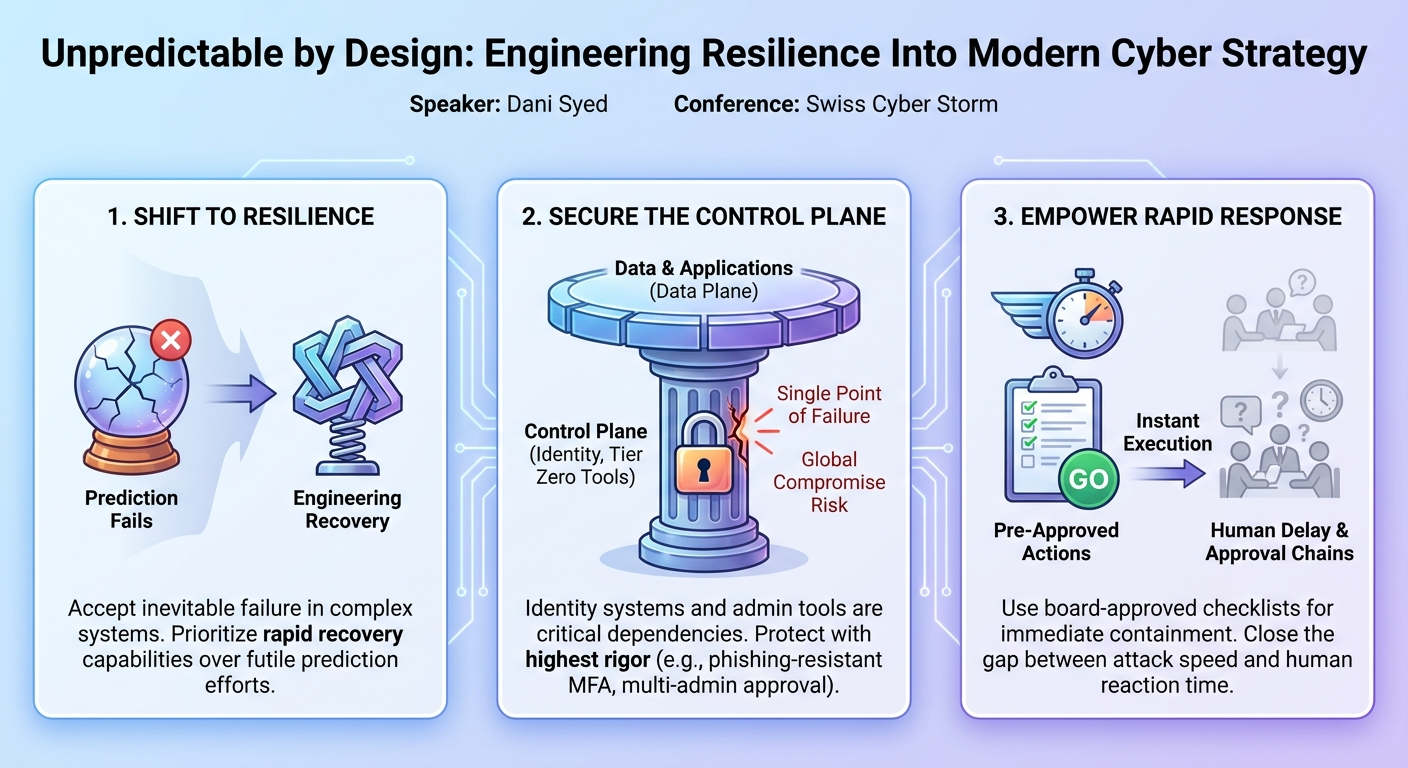
In his compelling talk, "Unpredictable by Design: Engineering Resilience into Modern Cyber Strategy," Dani Syed, founder and CEO of Kudan, representing ManageEngine, challenges the conventional cybersecurity paradigm. Syed argues that the relentless pursuit of predicting and preventing every attack is a losing battle against increasingly agile and sophisticated adversaries. Instead, he advocates for a fundamental shift towards designing systems and strategies for inherent resilience, prioritizing rapid recovery over futile prediction.
Key moments
- 1:55 The '28th second': controlling recovery speed
- 3:40 Swiss 'bunker' mentality: planning for unpredictable losses
- 7:45 Control plane identified as critical single point of failure
- 12:00 Admin tools are dangerous 'Tier Zero' weapons
- 15:00 Maersk incident: identity recovery priority over data
- 19:00 Surgeon's checklists for rapid IT incident response
- 22:00 Measure tolerance, not prevention, using 'pain' chart
- 25:30 Q&A: Protecting Entra ID with alternative directory
Unpredictable by Design: Engineering Resilience Into Modern Cyber Strategy
Speakers: Dani Syed, Founder and CEO, Kudan
Conference: Swiss Cyber Storm
YouTube: https://www.youtube.com/watch?v=75PmjY_wG_g
Overview
In his compelling talk, "Unpredictable by Design: Engineering Resilience into Modern Cyber Strategy," Dani Syed, founder and CEO of Kudan, representing ManageEngine, challenges the conventional cybersecurity paradigm. Syed argues that the relentless pursuit of predicting and preventing every attack is a losing battle against increasingly agile and sophisticated adversaries. Instead, he advocates for a fundamental shift towards designing systems and strategies for inherent resilience, prioritizing rapid recovery over futile prediction.
The core message revolves around the concept of the "second 28." While attackers can achieve a full takeover in as little as 27 seconds, the average incident takes 29 minutes to emerge within a company. This stark reality underscores that the critical window for effective defense is not in preventing the initial breach, but in how quickly an organization can detect, contain, and recover. Syed implores defenders to accept that failures are inevitable in complex systems and to focus their efforts on engineering the ability to "come back" swiftly and effectively, transforming incident response from a reactive scramble into a pre-designed, predictable process.
This talk is particularly relevant in today's threat landscape, where organizations face a barrage of unpredictable threats, from sophisticated malware like wipers to supply chain attacks and cloud service outages. Syed's insights offer a practical, actionable framework for cybersecurity professionals and business leaders to re-evaluate their strategies, moving beyond a reactive stance to proactively build an adaptive and robust defense posture centered on recovery and business continuity.
Background
▶ Watch: The '28th second': controlling recovery speed (1:55)
The premise of Syed's talk is rooted in the undeniable reality that modern IT environments are inherently complex and susceptible to unforeseen failures. He highlights a critical flaw in current cybersecurity thinking: the overreliance on prediction. Drawing on a study of 284 psychology experts who made 82,000 forecasts, Syed reveals that even highly confident experts are often the least accurate in predicting future events. This mirrors the cybersecurity world, where major incidents like the AWS cloud region outage (a DNS problem affecting Slack, Atlassian, Snapchat, Cloudflare), widespread malware like NotPetya and SolarWinds, or destructive wiper malware (like the one that hit a Polish heating plant) often catch organizations by surprise.
Switzerland, Syed notes, has historically embraced a mindset of preparing for the unpreventable, as evidenced by its national policy requiring bunkers in new constructions – an acknowledgment that some threats cannot be predicted, only mitigated. This philosophy translates directly to cybersecurity. The NCSC (National Center of Cybersecurity) in Switzerland reported an increase from 21 to 29 types of ransomware attacks in just one year, illustrating the dynamic and evolving threat landscape. Syed categorizes the common points of loss into five critical areas: identity systems, cloud regions/data centers/SaaS platforms, third-party vendors, admin tools, and key personnel.
Further underlining the inevitability of failure in complex systems, Syed references sociologist Charles Perrow's work on Normal Accidents Theory. Perrow's research, conducted after nuclear incidents like Chernobyl, concluded that in systems characterized by tight coupling (where components are highly interdependent) and complex interactions (where relationships between components are not easily visible or understood), small failures can rapidly escalate into catastrophic events. Modern IT infrastructures, with their intricate web of services, microservices, and dependencies, perfectly fit this description. Syed emphasizes that while the internet itself might appear "simple" in Perrow's matrix, critical components like identity systems, cloud regions, and Endpoint Detection and Response (EDR) solutions fall squarely into the complex and tightly coupled category, making large-scale accidents an inherent risk that must be planned for.
Key Findings
▶ Watch: Control plane identified as critical single point of failure (7:45)
Dani Syed's talk distills several critical findings that challenge traditional cybersecurity approaches and advocate for a resilience-first strategy:
- Prediction is a Losing Battle: Attempting to predict every attack vector or future incident is futile. Even highly credentialed experts fail at accurate forecasting, and the speed of modern attacks (as fast as 27 seconds for a full takeover) far outpaces human reaction time based on prediction.
- Failure is Inevitable in Complex Systems: Drawing from Charles Perrow's work, Syed asserts that in tightly coupled systems with complex interactions, accidents are not just possible but inevitable and will often be catastrophic. The focus must shift from preventing all failures to mitigating their impact.
- The Control Plane is a Single Point of Failure: Organizations often overlook the critical dependencies within their control plane (identity systems like Entra ID/Active Directory, DNS, licensing servers, admin consoles). These components, while enabling operations, become single points of failure if compromised or unavailable, bringing down entire data planes and applications.
- Admin Tools are the Ultimate Weapons (Tier Zero Platforms): The most dangerous software an organization owns are its Tier Zero platforms – those with the power to make global changes across the environment. This includes Domain Controllers, Entra ID, Endpoint Management (MDM) systems like Intune, and backup consoles. Compromise of these tools allows attackers to wipe systems, deploy malware, or lock out legitimate users, often bypassing traditional security controls.
- Recovery is More Than Just Data Restoration: A holistic recovery strategy must prioritize identity, network/DNS, and admin tools before focusing on data. Without a functioning identity system, network, and the tools to rebuild infrastructure, restoring data alone is insufficient and impractical.
- Speed of Recovery is Decided Pre-Incident: Rapid incident response on "second 28" is not spontaneous; it's a direct result of pre-approved actions, trained personnel, and well-drilled procedures. Human-centric decision-making during a crisis often introduces delays that attackers exploit.
- Measure Tolerance, Not Just Prevention: Regulators and best practices are increasingly acknowledging the inevitability of breaches. Organizations must define and measure their tolerance for pain (downtime, data loss) for critical business functions, shifting budget and focus towards remediation and resilience rather than solely on prevention.
Technical Deep Dive
▶ Watch: Maersk incident: identity recovery priority over data (15:00)
Syed's talk delves into several technical concepts that underpin his resilience-focused strategy. He starts by elaborating on Charles Perrow's Normal Accidents Theory, differentiating between systems with linear interactions (predictable, sequential processes) vs. complex interactions (unforeseen, non-obvious relationships) and loose coupling (components can fail independently) vs. tight coupling (components are highly interdependent). Modern IT environments, particularly those built on cloud services and intricate dependencies, exhibit high complexity and tight coupling. For instance, while the internet's core might appear loosely coupled, critical enterprise components like identity management systems, cloud regions, and advanced security tools like EDR are tightly coupled, meaning a failure in one can cascade catastrophically.
A central technical theme is the distinction between the control plane and the data plane. The control plane encompasses systems that make changes or govern access, such as identity providers (e.g., Entra ID, Active Directory), DNS servers, licensing services, and administrative consoles. The data plane comprises systems that perform work, like applications and endpoints. Syed highlights that while organizations often focus on securing data plane components, the control plane represents a critical single point of failure due to runtime dependencies. For example, two redundant data centers might both depend on the same identity provider. If that identity provider fails or is compromised, both data centers become inaccessible, as demonstrated by the AWS DNS incident.
Syed provides concrete examples of these single points of failure:
- Identity Provider (Entra ID/Active Directory) downtime: How do users log in?
- MFA vendor downtime: How do users authenticate if the third-party 2FA system is offline?
- DNS provider downtime: How do systems resolve names and connect, echoing the Cloudflare incident?
- License server downtime: How do critical applications continue to function without valid licenses?
The most potent technical threat, according to Syed, comes from compromised Tier Zero platforms – administrative tools that have global authority. He explains how attackers are increasingly targeting these. For instance, the NotPetya attack leveraged a software update mechanism to spread malware globally, akin to the SolarWinds incident. More disturbingly, Syed recounts an incident where a leading EDR solution (possibly SentinelOne) failed to prevent a takeover because attackers compromised Active Directory Group Policy Objects (GPOs) to deploy malware, bypassing the EDR. The Stryker medtech company suffered a devastating incident where attackers, having gained Intune admin permissions, used Intune wipe policies to remove all company devices, rendering them irrecoverable even by IT admins. These examples underscore that an organization's most powerful tools, when weaponized by an adversary, become its greatest vulnerability.
To counter these threats, Syed reiterates the CISO methodologies advised for Tier Zero platforms:
- Least privilege admin roles: Citing an example of an intern with Enterprise Admin privileges in a 350-employee company, he stresses the importance of granular access.
- Phishing-resistant MFA: Stronger authentication methods are crucial.
- Multi-admin approval: Requiring multiple approvals for critical changes.
- Limit and audit: Restricting access and thoroughly logging all actions on Tier Zero systems.
Finally, Syed presents a revised disaster recovery priority, challenging the common data-centric view. He argues that the order of recovery should be:
- Identity: Without identity, no one can log in or access systems. The Maersk incident, where a Ghana power shutdown inadvertently saved a single domain controller from being wiped, allowing recovery of 150 wiped domain controllers and saving $250 million, vividly illustrates this.
- Network/DNS: The connective tissue enabling communication.
- Admin Tools: The means to rebuild and manage infrastructure.
- Data: While critical, data is useless without the underlying infrastructure.
- Application Business: The final layer to restore business operations.
This technical re-prioritization emphasizes rebuilding the foundational elements of IT infrastructure before attempting data restoration, ensuring a more effective and logical recovery process.
Demo / Proof of Concept
▶ Watch: Surgeon's checklists for rapid IT incident response (19:00)
The talk "Unpredictable by Design: Engineering Resilience Into Modern Cyber Strategy" by Dani Syed focuses on strategic and philosophical shifts in cybersecurity, supported by real-world examples and studies. It does not include a live demonstration or a technical proof of concept of any specific tool or exploit. The speaker's objective is to convey a framework for rethinking defense rather than showcasing a particular technical solution in action.
Defensive Implications
▶ Watch: Q&A: Protecting Entra ID with alternative directory (25:30)
The implications of Dani Syed's "Unpredictable by Design" philosophy for defenders are profound, requiring a significant shift in mindset and strategy:
- Embrace Inevitability, Prioritize Recovery: Defenders must move beyond the illusion of perfect prevention. Accepting that breaches are inevitable in complex systems allows for a proactive focus on resilience and recovery speed. This means investing in capabilities that enable rapid detection, containment, and restoration, rather than solely on impenetrable perimeters.
- Identify and Fortify Tier Zero Platforms: A critical first step is to meticulously map and classify all Tier Zero platforms – those administrative tools and control plane components (e.g., Domain Controllers, Entra ID, MDM solutions like Intune, backup consoles) that, if compromised, grant attackers global control. These systems must be protected with the highest level of security, employing least privilege, phishing-resistant MFA, multi-admin approval for critical changes, and rigorous auditing.
- Rethink Disaster Recovery and Business Continuity Planning: Traditional DRP often focuses heavily on data backup. Syed's framework necessitates a reprioritization: first, secure and ensure the recoverability of identity systems, then network/DNS infrastructure, followed by admin tools, and only then focus on data and business applications. This ensures that the foundational elements required to rebuild an environment are intact.
- Develop Pre-Approved Incident Response Checklists: To combat the "second 28" challenge – the time lost in human decision-making and approvals during an incident – organizations should implement pre-approved checklists for their SOC (Security Operations Center) teams. These checklists, similar to a surgeon's protocol, define clear, board-approved actions for rapid containment (e.g., emergency network segmentation or shutdown) that can be executed without lengthy approval chains during a crisis.
- Measure Tolerance, Not Just Risk: Instead of abstractly assessing IT risk, organizations should work with business leaders to define the tolerance for pain (maximum acceptable downtime or data loss) for each critical business function. This reframes security discussions in terms of business impact, making it easier to justify investments in resilience and allocate resources for remediation and recovery capabilities.
- Conduct Regular Drills and Training: As "speed is decided before the incident," regular drill tests and training are paramount. This involves simulating various attack scenarios and practicing the execution of pre-approved response plans, ensuring that personnel are accustomed to acting swiftly and effectively under pressure.
- Consider Alternative/Redundant Control Plane Systems: For highly critical organizations, exploring redundant identity or mail systems (e.g., having a backup directory service like Zoho Directory alongside Microsoft 365 Entra) can provide significant resilience against a complete control plane failure. While this introduces additional complexity and potential attack surface, the trade-off may be justified for extreme downtime tolerance requirements.
- Evaluate SaaS vs. On-Prem Based on Capacity: For small and medium-sized enterprises (SMEs) with limited IT staff, migrating certain services to SaaS platforms can sometimes reduce overall risk by leveraging vendor expertise and security investments, rather than attempting to manage complex on-premise infrastructure with inadequate resources.
By integrating these defensive implications, organizations can engineer a more resilient cybersecurity posture that is prepared not just for the attacks they can predict, but for the unpredictable challenges of a constantly evolving threat landscape.
Key Takeaways
- Shift from Prediction to Resilience: Stop trying to predict every attack; instead, design systems and strategies that can quickly recover from inevitable failures.
- Prioritize Control Plane Security: Identity systems (Entra ID, Active Directory), DNS, and admin tools (Tier Zero platforms like MDM, backup consoles) are critical single points of failure and must be protected with the highest rigor (least privilege, phishing-resistant MFA, multi-admin approval).
- Recovery Order Matters: In a disaster, focus on restoring identity first, then network/DNS, followed by admin tools, and finally data and applications. Data is useless without the infrastructure to access it.
- Empower Rapid Response with Pre-Approvals: Implement board-approved incident response checklists and empower SOC teams to take immediate containment actions (e.g., emergency network shutdown) without delays, closing the gap between attack speed and human reaction time.
- Measure Business Tolerance for Downtime: Engage with the board to define and measure the acceptable "pain tolerance" for critical business functions, shifting focus and budget towards remediation and recovery capabilities rather than solely on prevention metrics.
- Train and Drill Relentlessly: Prepare for the "second 28" by conducting regular incident response drills and training, ensuring personnel are accustomed to acting swiftly and decisively during emergencies.
About the Speaker(s)
Dani Syed is a Swiss technology entrepreneur, currently serving as the founder and CEO of Kudan. In this talk, he represents ManageEngine, a provider of IT management software. With a background that includes two doctorates, Syed brings a research-oriented and analytical perspective to cybersecurity, often drawing on studies and psychological insights to challenge conventional wisdom. His expertise lies in understanding complex systems and advocating for practical, resilience-focused strategies in modern cyber defense.
Reviews
Dr. Zero (Offensive Security Researcher) — SOLID
Syed pitches a high-level strategic argument for prioritizing recovery over prevention, heavily leveraging well-worn case studies like NotPetya. While the vendor-friendly 'second 28' framing is pure marketing, his core technical premise about protecting Tier Zero identity platforms is fundamentally sound.
Heather Calloway (CISO) — STRONG ACCEPT
Dani Syed argues that our obsession with preventing initial access is a mathematical failure, and that real defense is built on pre-authorized response and control plane resilience. It is a highly effective framework for reprioritizing disaster recovery away from data backups and toward identity and Tier Zero infrastructure. I would want my leadership team to internalize this recovery sequencing.