Before the Alert: The Attack Surface as the Key to Cyber Resilience
Ernesto Hartmann (Chief Cyber Defense Officer · Infoguard)
Swiss Cyber Storm 2026 · Day 1 · Panorama
Overview
In this insightful talk at Swiss Cyber Storm, Ernesto Hartmann, Chief Cyber Defense Officer at Infoguard, draws upon his 25 years of experience in IT and his leadership of over 90 analysts and incident responders to dissect the evolving cyber threat landscape. Hartmann takes the audience behind the scenes of numerous real-world cyber incidents across the DACH (Germany, Austria, Switzerland) region, revealing critical shifts in attacker methodologies and the persistent vulnerabilities exploited by both financially motivated and state-sponsored actors. The core message underscores a pivotal paradigm shift: organizations must move "before the alert" by proactively managing their attack surface and adopting a risk-driven security approach, rather than solely reacting to incidents.
Key moments
- 0:00 Welcome and talk agenda: incidents, new risks, preparation
- 2:20 Current ransomware trends, incident statistics, and payment rates
- 6:00 Major ransomware case study: NetScaler vulnerability, E5 license gaps
- 9:50 Critical insight: Threat actors patching compromised systems
- 14:00 State-sponsored attack: Long dormancy and sophisticated lateral movement
- 17:50 Evolving risks: AI-tampered code, supply chain attacks, data breaches
- 21:30 Proactive approach: Risk-driven security and continuous assessment
- 26:30 Q&A: Ransomware payment, decryption, and full recovery process
Before the Alert: The Attack Surface as the Key to Cyber Resilience
Speakers: Ernesto Hartmann, Chief Cyber Defense Officer, Infoguard
Conference: Swiss Cyber Storm
YouTube: https://www.youtube.com/watch?v=8OOb57C4jfQ
Overview
In this insightful talk at Swiss Cyber Storm, Ernesto Hartmann, Chief Cyber Defense Officer at Infoguard, draws upon his 25 years of experience in IT and his leadership of over 90 analysts and incident responders to dissect the evolving cyber threat landscape. Hartmann takes the audience behind the scenes of numerous real-world cyber incidents across the DACH (Germany, Austria, Switzerland) region, revealing critical shifts in attacker methodologies and the persistent vulnerabilities exploited by both financially motivated and state-sponsored actors. The core message underscores a pivotal paradigm shift: organizations must move "before the alert" by proactively managing their attack surface and adopting a risk-driven security approach, rather than solely reacting to incidents.
Hartmann emphasizes that the traditional incident-driven security model is no longer sufficient in an era of increasingly sophisticated and automated attacks. He highlights how vulnerabilities, misconfigurations, and even the strategic use of AI by threat actors are leading to widespread data breaches, ransomware infections, and supply chain compromises. The talk provides a stark warning about the speed and ingenuity of modern adversaries, illustrating why a comprehensive, continuous assessment of an organization's risk exposure is paramount for building true cyber resilience.
The presentation serves as a call to action for security professionals, urging them to prioritize preventive measures, strengthen their technological foundations, and integrate risk management into their daily operations. By sharing actionable insights from Infoguard's extensive incident response practice, Hartmann provides a roadmap for organizations to better prepare for, detect, and respond to the "new reality" of cyber threats, ultimately aiming to close the doors before attackers ever find them.
Background
▶ Watch: Welcome and talk agenda: incidents, new risks, preparation (0:00)
Infoguard initiated its CSIRT and incident response practices in 2017, marking a significant investment in understanding and combating cybercrime. Since then, the firm has witnessed a dramatic evolution in the threat landscape. Early ransomware cases in Switzerland, such as those involving Stadler and Meyer Tobler in 2018, primarily focused on single extortion – encrypting data for ransom. This quickly evolved into double extortion, where attackers not only encrypted data but also exfiltrated it, threatening public release if the ransom wasn't paid. More recently, Hartmann observes a trend returning to single extortion, predominantly manifested as data breaches resulting from misconfigurations rather than direct encryption.
Infoguard's statistics for Q1-Q3 indicate approximately 250 incidents handled, with Business Email Compromise (BEC) remaining a day-to-day challenge, followed closely by ransomware. A notable shift in ransomware targeting is the return to larger organizations, moving away from the smaller companies (average 100 employees) that were frequently hit in 2024-2025. The primary initial access vector for these incidents is overwhelmingly vulnerabilities, accounting for 60% of all cases and 23% of ransomware incidents. Intriguingly, social engineering, including deepfake cases utilizing AI, now accounts for 4% of initial access vectors, signaling a new frontier in adversarial tactics.
Hartmann notes that Infoguard has developed capabilities to negotiate with threat actors and assist with ransomware payments, though this is considered a last resort. In Q3, 29% of ransomware cases handled by Infoguard involved payment, a decrease from 50% in the first half of the year. Globally, ransomware continues its upward trajectory, with Ransomware Life reporting a 33% growth from 2024 to 2025, indicating that threat actors are "arming up." This backdrop of escalating threats and evolving attack methodologies underscores the urgency for organizations to reconsider their defensive strategies, moving beyond reactive measures to a more proactive, risk-centric posture.
Key Findings
▶ Watch: Major ransomware case study: NetScaler vulnerability, E5 license gaps (6:00)
Ernesto Hartmann's talk reveals several critical findings that illustrate the current state of cyber threats and the imperative for a new defensive mindset:
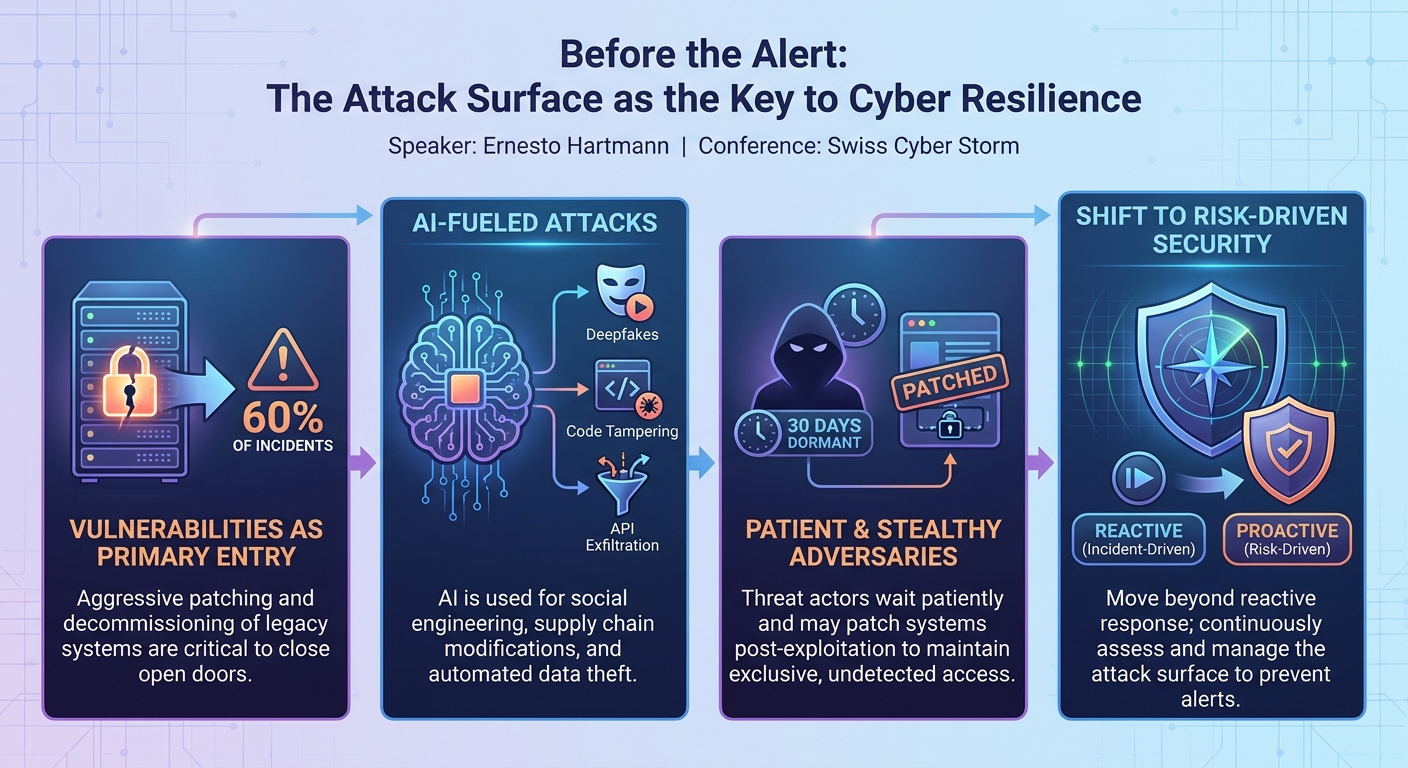
- Vulnerabilities as the Dominant Initial Access Vector: A staggering 60% of all incidents and 23% of ransomware cases originate from exploited vulnerabilities. This highlights a fundamental weakness in many organizations' security postures, often exacerbated by delayed patching or the failure to decommission outdated, vulnerable infrastructure, as demonstrated by the NetScaler case. Attackers are exploiting critical vulnerabilities within minutes or hours of their public disclosure.
- Threat Actors Patching Systems for Persistence: A counterintuitive but highly effective tactic observed is threat actors patching systems after exploiting them. This is done to "close the door" to other potential attackers, ensuring exclusive access to their "precious" foothold. This strategy makes detection incredibly difficult, as an administrator might log in, see the system is patched, and assume it's secure, missing the underlying compromise.
- Multi-Actor Exploitation of Single Systems: Hartmann presented a case where a single, unmonitored server in Azure was exploited by at least 70 different threat actors. These actors installed web shells, crypto miners (even competing to deinstall each other's miners), before a final actor encrypted the system for a mere $900 USD ransom. This scenario underscores the rapid commoditization of access and the chaotic nature of exposed systems.
- Sophisticated State-Sponsored Tactics: State-sponsored actors employ highly advanced techniques, as evidenced by an Ivanti vulnerability exploit. This involved placing a web shell, decrypting configurations to extract service account usernames, and leveraging Active Directory misconfigurations to obtain legitimate certificate requests with domain admin credentials. These actors then remained dormant for 30 days before deploying multiple backdoors, highlighting their patience and stealth. Detection often occurs only when they make a mistake.
- AI's Dual Role in the Cyber Landscape: AI is emerging as a significant force, both for offense and defense.
- Offensive AI: Threat actors are using AI for deepfakes in social engineering (4% of initial access). More alarmingly, AI is being used to tamper with code in software supply chains, modifying code to add backdoors while maintaining original functionality. AI crawlers are also indiscriminately pulling data from misconfigured APIs, leading to data breaches.
- Defensive AI: Infoguard is integrating AI into its security operations for attack disruption and enhancing forensic capabilities (e.g., with Velociraptor).
- Unintended AI Consequences: Internal users are leveraging AI to find "silly" workarounds, such as bypassing RDP access restrictions, potentially introducing vulnerabilities. Also, mismanaged cloud resources can lead to massive bills from token consumption (e.g., 300,000 Euro in Google tokens).
- Geopolitical Impact on Cloud Security: The talk noted instances where geopolitical conflicts directly impacted cloud infrastructure (e.g., AWS being affected by war), leading to customer data loss. This highlights the importance of geographical redundancy and understanding data residency in cloud environments.
- The Imperative for Risk-Driven Security: The overarching finding is that organizations must shift from a purely incident-driven reactive model to a proactive risk-driven security approach. This means continuous assessment of the attack surface, identifying and closing "open doors" before they are exploited, and integrating risk management into every layer of security operations.
Technical Deep Dive
▶ Watch: State-sponsored attack: Long dormancy and sophisticated lateral movement (14:00)
The technical depth of the talk is illustrated through concrete case studies and discussions of specific vulnerabilities, tools, and architectural considerations.
One prominent example involved an industry company with over 15,000 employees and €1.4 billion in revenue that suffered a ransomware attack. The initial access point was a NetScaler infrastructure that was slated for decommissioning. Critically, its support contract had just ended days before a severe vulnerability emerged. The threat actor exploited this vulnerability within minutes, highlighting the extreme speed with which adversaries act on newly disclosed flaws, especially on unmaintained or neglected systems. Further technical gaps in this organization included being a "late follower" with no 7x24 security operations capabilities and an inadequate Microsoft E5 license deployment, which provided endpoint protection on clients but not servers, leaving traditional antivirus on servers with significant detection and prevention gaps.
Another striking technical detail concerned state-sponsored actors exploiting an Ivanti vulnerability. The attack chain was meticulous:
- Initial Access: Exploitation of the Ivanti vulnerability to place a web shell on the system.
- Configuration Decryption: On the same day, the actors managed to decrypt the system's configuration.
- Credential Harvesting: From the decrypted configuration, they extracted the username of a service account connected to the Active Directory (AD).
- AD Misconfiguration Abuse: In combination with a misconfigured Active Directory, they leveraged this information to request legitimate certificates with domain admin credentials. This signifies a sophisticated understanding of AD trust models and certificate services.
- Dormancy and Persistence: The actors remained dormant for 30 days, demonstrating advanced OPSEC (Operations Security) and evasion techniques. After this period, they deployed multiple backdoors on different servers over several days, establishing robust persistence. Detection only occurred due to a mistake made by the attackers, underscoring the challenge of monitoring such stealthy operations without granular logging and sophisticated analytics.
The talk also delved into the technical implications of AI in cyber warfare. On the offensive side, AI is used to generate deepfakes for social engineering. More insidiously, AI can tamper with code in software repositories, modifying existing code to inject backdoors or malicious functionalities while ensuring the code still performs its original purpose, making detection difficult during code reviews. This directly contributes to supply chain attacks, with numerous NPM-related breaches cited as examples. Furthermore, misconfigured APIs are being exploited by AI crawlers, indiscriminately pulling sensitive data out of systems, leading to large-scale data breaches without traditional "attacks."
Defensively, Infoguard is leveraging a platform approach for security, emphasizing data collection, prevention, detection, and automated response. This includes using AI-based operations for attack disruption. For highly regulated customers, Infoguard has implemented a tiered LLM (Large Language Model) hosting strategy: generic models in Europe, more sensitive ones in Switzerland, and on-premise hardware for the most stringent data residency requirements. For forensics, Infoguard uses Velociraptor as its platform, actively integrating AI capabilities to enhance investigation speed and depth. This allows for scalable forensics across thousands of systems, correlating artifacts and reconstructing complex attack paths.
Demo / Proof of Concept
▶ Watch: Evolving risks: AI-tampered code, supply chain attacks, data breaches (17:50)
While the talk did not feature a live technical demonstration or a specific proof-of-concept code walkthrough, Ernesto Hartmann effectively presented compelling evidence through detailed case studies and statistics derived from Infoguard's extensive incident response and SOC operations. These real-world examples, such as the NetScaler ransomware incident, the multi-actor Azure server compromise, and the sophisticated state-sponsored Ivanti breach, served as powerful "proofs" of the attack methodologies and defensive challenges discussed. The data shared on initial access vectors, payment rates, and the evolution of ransomware provided empirical backing for the speaker's core arguments about the changing threat landscape and the necessity of a risk-driven security approach.
Defensive Implications
▶ Watch: Q&A: Ransomware payment, decryption, and full recovery process (26:30)
The insights presented by Ernesto Hartmann carry profound defensive implications for organizations striving for cyber resilience:
- Proactive Attack Surface Management: Organizations must gain a comprehensive understanding of their entire digital footprint. This includes all internet-facing assets, internal systems, and shadow IT. Continuous discovery and mapping of the attack surface are non-negotiable.
- Rigorous Vulnerability Management: Patching must be timely and aggressive. Systems slated for decommissioning, like the NetScaler example, represent critical blind spots and must be taken offline or secured before their support contracts expire. A "set it and forget it" mentality for patching is no longer viable, especially given threat actors' speed of exploitation.
- Comprehensive Security Monitoring: A 7x24 Security Operations Center (SOC) is essential. Monitoring must extend to all critical assets, not just client endpoints. The Microsoft E5 licensing example highlights the need to ensure server protection is as robust as client protection, guarding against detection and prevention gaps. Organizations should also consider "second opinion" systems to detect when primary security controls are bypassed or evaded.
- Active Directory Hardening: Given the state-sponsored attack on Ivanti leveraging AD misconfigurations, organizations must rigorously audit and harden their Active Directory environments. This includes securing service accounts, implementing least privilege, and closely monitoring AD audit logs for suspicious activities like certificate requests by non-standard accounts.
- Supply Chain Security: With AI-assisted code tampering and NPM package breaches, organizations must implement stringent controls for third-party software and open-source components. This involves vetting suppliers, scanning code for vulnerabilities and malicious insertions, and maintaining software bill of materials (SBOMs).
- API Security Best Practices: Misconfigured APIs are a significant source of data breaches. Organizations need to implement strong API authentication, authorization, rate limiting, and continuous monitoring to prevent AI crawlers or other automated tools from exfiltrating sensitive data.
- AI Governance and Education: Develop clear policies for AI tool usage within the organization. Educate employees about the risks of using AI for "silly" workarounds or to bypass security controls. Implement technical controls to prevent sensitive data from being fed into public AI models, and explore private or on-premise LLM solutions for regulated data, as Infoguard has done.
- Integrated Security Platforms: Invest in a cohesive security platform strategy that integrates prevention, detection, and automated response capabilities. This platform should be data-driven, providing a unified view of threats and exposures. Automated attack disruption capabilities are becoming increasingly critical to mitigate fast-moving threats.
- Robust Incident Response and Forensics: Even with strong prevention, incidents will occur. Organizations need well-defined incident response plans, scalable forensic capabilities (like Velociraptor with AI integration), and the expertise to reconstruct full attack paths, clean compromised systems, and ensure threat actors are fully eradicated. Immutable backups are paramount for recovery.
- Shift to a Risk-Driven Security Model: The most crucial implication is to move beyond a purely reactive, incident-driven approach. Implement continuous risk assessment and managed risk exposure programs. Identify and prioritize risks based on their potential impact and likelihood, and proactively address them by "closing the doors" before an alert is triggered. This fundamental shift is key to building true cyber resilience.
Key Takeaways
- Vulnerabilities are the primary entry point: A staggering 60% of all incidents and 23% of ransomware cases leverage exploited vulnerabilities, underscoring the critical need for aggressive patching and timely decommissioning of legacy systems.
- Threat actors actively patch systems: Adversaries are observed patching systems post-exploitation to maintain exclusive access, making detection challenging for unsuspecting administrators who might overlook the underlying compromise.
- AI fuels sophisticated attacks: AI is increasingly used for deepfake social engineering, code tampering in supply chains (e.g., NPM packages), and data exfiltration from misconfigured APIs, demanding new defensive strategies and AI governance.
- Sophisticated and patient adversaries: State-sponsored actors demonstrate advanced techniques, including long dwell times (e.g., 30 days dormant), complex lateral movement (Ivanti/AD exploit), and multi-stage backdoor deployment, requiring advanced monitoring and threat hunting.
- Shift to a risk-driven security approach: Organizations must move beyond reactive incident response to a proactive model of continuous risk assessment and attack surface management, identifying and "closing the doors" before attackers find them.
- Invest in integrated security platforms and advanced forensics: A strong technological foundation with a platform approach for prevention, detection, and automated response, coupled with scalable forensic tools like Velociraptor, is essential for modern cyber defense.
About the Speaker(s)
Ernesto Hartmann is the Chief Cyber Defense Officer at Infoguard, a leading cybersecurity company. In his role, he is responsible for Infoguard's cyber defense operations, which include managed detect and response services and CSIRT (Computer Security Incident Response Team) practices. With 25 years of extensive experience in the IT industry, Hartmann leads a substantial team of over 90 analysts and incident responders, providing critical expertise in navigating the complex landscape of cyber threats and incident management. His insights are drawn from a deep understanding of real-world cyber incidents and the evolving tactics of threat actors across the DACH region.
Reviews
Dr. Zero (Offensive Security Researcher) — SOLID
Hartmann shares some decent frontline IR stats from the DACH region, but wraps them in exhausting marketing fluff about paradigm shifts and AI. The war stories about NetScaler and Ivanti are competent, but pretending that attack surface management is a new idea is just silly.
Heather Calloway (CISO) — STRONG ACCEPT
An incident response briefing that actually delivers the autopsy details you need to change your program. The data on lapsed support contracts and licensing gaps provides exactly the ammunition required for your next infrastructure budget fight.