Enterprise Shadow Cryptography – Why Visibility Matters Now More Than Ever
Yannik Goldgräbe (Security Architect · Swisscom B2B)
Swiss Cyber Storm 2026 · Day 1 · Panorama
Overview
In his Swiss Cyber Storm talk, "Enterprise Shadow Cryptography – Why Visibility Matters Now More Than Ever," Yannik Goldgräbe, a Security Architect at Swisscom B2B, sheds light on a pervasive yet often overlooked challenge in modern enterprise environments: shadow cryptography. This term refers to the cryptographic mechanisms and assets that organizations rely on daily but lack full visibility, inventory, or end-to-end governance over. Goldgräbe argues that while cryptography is fundamental to secure operations, its unmanaged proliferation introduces significant future risks, particularly as the threat landscape evolves.
Key moments
- 1:40 Defining enterprise shadow cryptography and its challenges.
- 2:10 Practical enterprise example: EAM and hidden crypto usage.
- 5:40 Four catalyzing storms accelerating shadow cryptography risks.
- 6:50 Solution: building a comprehensive cryptographic inventory for visibility.
- 10:00 Playbook: how to start building your crypto inventory.
- 12:00 Managing cryptography within third-party vendor components (Q&A).
- 13:25 Discovery mechanisms and reusing existing tools for inventory (Q&A).
Enterprise Shadow Cryptography – Why Visibility Matters Now More Than Ever
Speakers: Yannik Goldgräbe, Security Architect, Swisscom B2B
Conference: Swiss Cyber Storm
YouTube: https://www.youtube.com/watch?v=YT6Icy1KX8c
Overview
In his Swiss Cyber Storm talk, "Enterprise Shadow Cryptography – Why Visibility Matters Now More Than Ever," Yannik Goldgräbe, a Security Architect at Swisscom B2B, sheds light on a pervasive yet often overlooked challenge in modern enterprise environments: shadow cryptography. This term refers to the cryptographic mechanisms and assets that organizations rely on daily but lack full visibility, inventory, or end-to-end governance over. Goldgräbe argues that while cryptography is fundamental to secure operations, its unmanaged proliferation introduces significant future risks, particularly as the threat landscape evolves.
The presentation moves beyond theoretical concerns, offering practical examples and a strategic framework for addressing this visibility gap. Goldgräbe illustrates the complexity of cryptographic usage within typical enterprise systems, such as an Identity and Access Management (IAM) solution, demonstrating how decentralized ownership and intricate interdependencies obscure the cryptographic attack surface. He emphasizes that the issue isn't inherently weak cryptography, but rather the absence of comprehensive management and oversight across the entire organizational infrastructure.
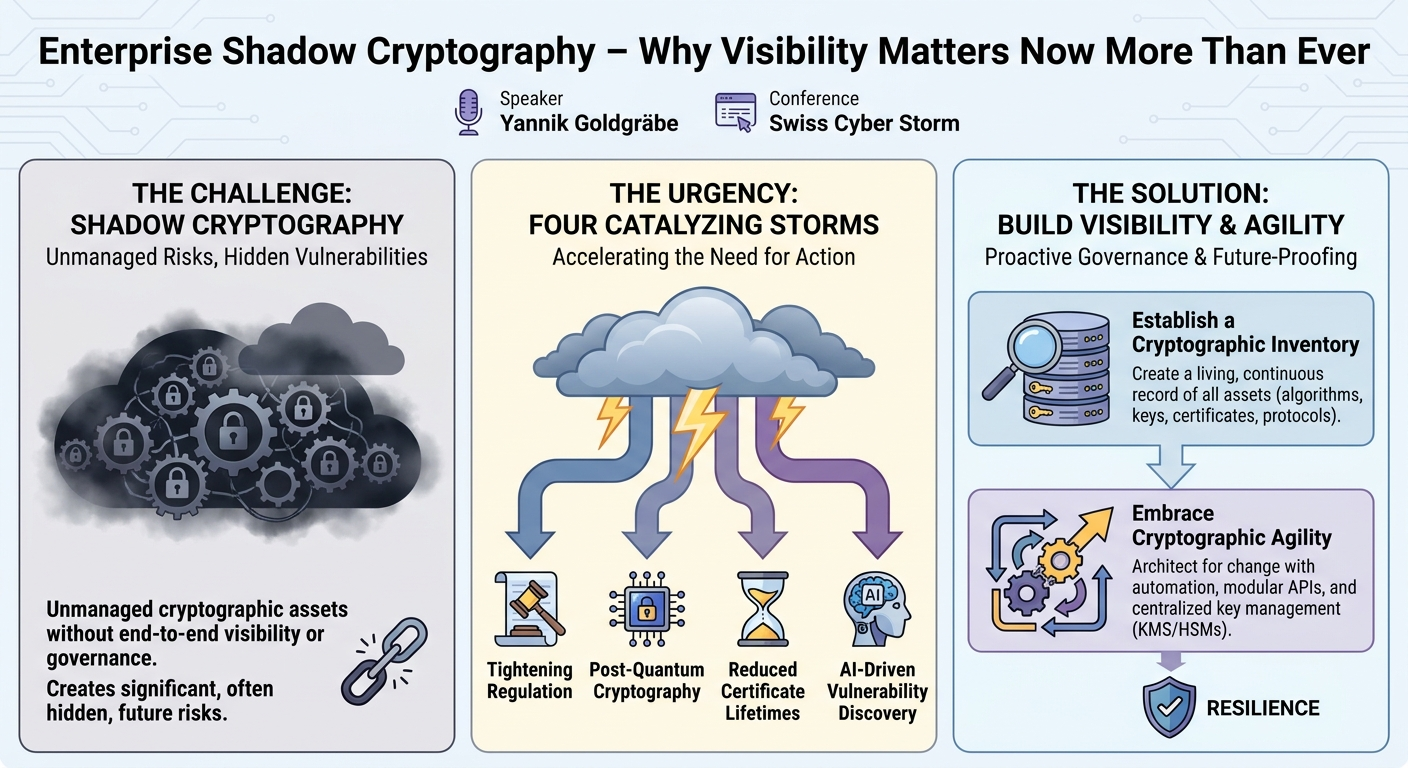
The urgency of tackling shadow cryptography is underscored by what Goldgräbe identifies as "four catalyzing storms": tightening regulations, the advent of post-quantum cryptography, reductions in certificate lifetimes, and the accelerating impact of AI on vulnerability discovery. These converging factors demand a proactive approach, with Goldgräbe advocating for the implementation of a cryptographic inventory and the adoption of cryptographic agility to secure enterprise systems against current and future threats.
Background
▶ Watch: Defining enterprise shadow cryptography and its challenges. (1:40)
The concept of "shadow IT" is familiar to many in cybersecurity, describing unauthorized or unmanaged technology within an organization. Goldgräbe introduces "shadow cryptography" as a specialized but equally critical manifestation of this phenomenon. He defines it as "the cryptography you rely on day-to-day already, but you cannot really see, inventory, inventorize, or govern end-to-end" [02:00]. This invisibility is often benign; cryptography simply works as intended, embedded deep within applications, protocols, and hardware. However, this very invisibility breeds a lack of management, transforming a foundational security mechanism into a potential source of significant future risk [04:00].
Goldgräbe illustrates this problem through a detailed architectural zoom-in on an Enterprise Access Management (EAM) system, a common component in many organizations. An EAM, responsible for managing identities and access, is not a monolithic entity but a complex ecosystem of interconnected services. Internally, it comprises authentication services, session services, and various other components, all communicating securely, typically via Transport Layer Security (TLS) [02:00-03:00]. Externally, the EAM interacts with a host of other critical services, including databases, Key Management Systems (KMS), logging services, and policy databases. Each of these external dependencies introduces additional cryptographic touchpoints and complexities.
The challenge escalates when considering the broader enterprise context. Beyond the EAM and its direct dependencies, the architecture includes elements like Web Application Firewalls (WAFs) and load balancers serving clients, often managed by different teams. Furthermore, the Software Development Life Cycle (SDLC) itself involves cryptographic operations like code signing and workload attestation. Beneath this software layer lies the underlying hardware infrastructure, which also relies on cryptography. This sprawling, multi-layered environment means that cryptography is "everywhere," making an end-to-end picture extremely difficult to obtain [04:00-05:00]. The core issue, Goldgräbe stresses, is not the inherent weakness of the cryptography itself, but its pervasive, unmanaged nature, which creates substantial risks that are often unrecognized until a crisis emerges.
Key Findings
▶ Watch: Four catalyzing storms accelerating shadow cryptography risks. (5:40)
Goldgräbe's presentation highlights several critical findings regarding the state of cryptography in enterprise environments and the imperative for change. The primary discovery is the widespread prevalence of shadow cryptography, where essential cryptographic assets and operations exist without comprehensive visibility, inventory, or centralized governance. This lack of an "end-to-end picture" is not merely an inconvenience but a significant security vulnerability, as organizations cannot effectively assess or mitigate risks associated with cryptographic components they don't fully understand or control [04:00, 06:00].
A key finding is that the problem isn't weak cryptographic algorithms but rather unmanaged cryptography. While modern cryptographic protocols are generally robust, their deployment in a decentralized and unmonitored manner creates a fertile ground for misconfigurations, outdated implementations, and unaddressed vulnerabilities. This unmanaged state directly translates into "future risks," making organizations susceptible to emerging threats and compliance challenges [04:00].
Goldgräbe identifies four "catalyzing storms" that are accelerating the urgency of addressing shadow cryptography [06:00]:
- Tightening Regulation: Regulatory bodies, such as FINMA in the finance industry, are increasingly issuing recommendations and mandates for better cryptographic oversight and management.
- Post-Quantum Cryptography (PQC): The looming threat of quantum computing necessitates a migration to quantum-resistant algorithms, a monumental task made impossible without a clear understanding of an organization's current cryptographic footprint.
- Certificate Lifetime Reduction: Shorter certificate lifetimes (e.g., 90 days) increase the frequency of certificate rotations, demanding more agile and automated management processes, which are hindered by shadow cryptography.
- Artificial Intelligence (AI): AI is not only accelerating the discovery of general software vulnerabilities but also specifically cryptographic vulnerabilities, making proactive management crucial.
The central contribution and proposed solution is the concept of a cryptographic inventory. This inventory is presented as a "living, continuous record of every cryptographic asset," including algorithms, keys, certificates, protocols, hardware, and their dependencies [07:00]. Goldgräbe asserts that establishing such an inventory is fundamental to gaining the necessary visibility, enabling smarter decision-making, prioritizing migration efforts, and establishing a robust governance and control layer for cryptographic assets. Without this foundational step, organizations remain blind to a critical aspect of their security posture, leaving them unprepared for the evolving threat landscape.
Technical Deep Dive
▶ Watch: Solution: building a comprehensive cryptographic inventory for visibility. (6:50)
Goldgräbe's technical deep dive begins by meticulously dissecting the pervasive nature of cryptography within a typical enterprise architecture, using an Identity and Access Management (EAM) system as a prime example. An EAM is not a standalone application but a complex constellation of interdependent services. Internally, components like authentication services and session services communicate using secure protocols, predominantly TLS [02:00-03:00]. Externally, the EAM relies on diverse systems: databases for storing user information, Key Management Systems (KMS) or Hardware Security Modules (HSMs) for managing cryptographic keys, dedicated logging services, and policy databases. Each of these interactions involves cryptographic operations, from data encryption at rest and in transit to key generation and storage.
The complexity intensifies when considering the broader network perimeter and the software development lifecycle. In front of the EAM, Web Application Firewalls (WAFs) and load balancers handle client connections, often performing their own TLS termination and re-encryption. These devices introduce additional cryptographic components and configuration points. Furthermore, the Software Development Life Cycle (SDLC) itself is inherently cryptographic, involving processes like code signing for integrity verification and workload attestation to ensure trusted execution environments [04:00]. Beneath all these layers, the underlying hardware infrastructure, from CPUs with secure enclaves to storage devices, also leverages cryptographic primitives.
The core technical challenge highlighted by Goldgräbe is the decentralized management of these cryptographic components. In a typical enterprise, different teams are responsible for distinct parts of the infrastructure: Team 1 for the WAF, Team 3 for the EAM, and Teams 4 and 5 for various backend services [06:00]. This siloed ownership structure means no single team possesses an end-to-end view of the cryptographic landscape. This fragmentation is precisely what creates "shadow cryptography" – a situation where an organization is profoundly reliant on cryptography but lacks a holistic understanding of its deployment, configuration, and dependencies.
To combat this, Goldgräbe proposes the development of a cryptographic inventory. This isn't just a static list but a "living, continuous record" encompassing every cryptographic asset. This includes:
- Algorithms: Symmetric (e.g., AES-256), asymmetric (e.g., RSA, ECC), hashing functions (e.g., SHA-256).
- Keys: Their types, lengths, usage, storage locations (KMS, HSM, software), and ownership.
- Certificates: TLS/SSL certificates, code signing certificates, their issuers, validity periods, and associated public key infrastructure (PKI) components.
- Protocols: TLS versions (e.g., TLS 1.2, TLS 1.3), SSH, IPsec, and their configurations.
- Hardware and Software Dependencies: The specific hardware (e.g., HSM models) and software libraries (e.g., OpenSSL versions) that implement or rely on cryptography [07:00].
Goldgräbe emphasizes that the inventory can be built with varying "layers of depth" based on organizational priorities, starting with network-level visibility, then moving to host and software levels [08:00]. The benefits are manifold: enhanced visibility, enabling smarter decisions, better prioritization for migrations (e.g., to PQC), and robust governance.
The methodology for building this inventory is practical and iterative:
- "Light what you can reach": Start by documenting the cryptography in areas that are immediately visible and manageable, then expand outwards by following data flows and system handshakes [09:00-10:00].
- Shift Ownership to Flows: Instead of assigning ownership to individual components, assign it to data flows. This encourages an end-to-end perspective and breaks down silos [10:00].
- Prioritization: Focus modernization efforts on "long-lived confidential systems using legacy algorithms first," especially those with "external and public-facing interfaces." Internal, short-lived components can be prioritized later [10:00].
A critical aspect of long-term cryptographic health is cryptographic agility. This involves designing systems to be resilient to changes in cryptographic standards or the discovery of new vulnerabilities. Goldgräbe advocates for:
- Automation: Automating certificate rotations, key management, and configuration updates.
- Modular Architecture and APIs: Decoupling cryptographic functions from core application logic through well-defined APIs. This allows for easier swapping of algorithms or libraries without re-architecting entire applications.
- Centralized Key Management: Leveraging KMS and HSMs to abstract key management, ensuring keys are securely stored, rotated, and accessed [10:00].
Finally, Goldgräbe suggests establishing a Cryptographic Center of Excellence (CCoE), particularly for larger organizations. Comprising "two to three people," a CCoE would be responsible for setting the cryptographic agenda, defining policies, reviewing data flows, and maintaining the stability and accuracy of the cryptographic inventory. This centralized function ensures sustained oversight and strategic direction for cryptographic security [10:00].
The "four catalyzing storms" further underscore the urgency for this technical overhaul:
- Regulation Tightening: The speaker specifically mentions FINMA recommendations in the finance industry [06:00]. These regulations often mandate clear documentation of cryptographic controls, audit trails, and robust lifecycle management for cryptographic assets.
- Post-Quantum Cryptography (PQC): The anticipated threat from quantum computers necessitates a complex and lengthy migration to new, quantum-resistant algorithms. Without an inventory, identifying all systems that need upgrading and managing the transition (e.g., hybrid modes) becomes an impossible task. Goldgräbe's involvement in Swisscom's internal PQC migration program highlights the real-world impact of this challenge [00:00].
- Certificate Lifetime Reduction: Historically, certificates had long lifespans, simplifying management. However, industry trends (e.g., browsers enforcing 90-day validity) demand highly automated certificate management. Shadow cryptography makes this automation impossible, leading to outages due to expired certificates.
- AI's Impact: AI is accelerating the discovery of vulnerabilities, including those specific to cryptographic implementations or configurations. This means that unmanaged, legacy cryptographic deployments are at an even higher risk of being exploited.
Demo / Proof of Concept
▶ Watch: Managing cryptography within third-party vendor components (Q&A). (12:00)
While Yannik Goldgräbe's talk meticulously details the architectural complexities of shadow cryptography and the conceptual framework for a cryptographic inventory, it does not include a live technical demonstration or a specific proof of concept tool. Instead, the presentation relies on illustrative architectural diagrams and animated sequences to demonstrate the "shadowiness" of unmanaged cryptography and the process of "shedding light" on these hidden components by progressively extending visibility from an initial point, such as an EAM component, to connected services like KMS and databases [09:00]. This visual approach effectively conveys the problem and the proposed solution's methodology without requiring a functioning system demonstration.
Defensive Implications
▶ Watch: Discovery mechanisms and reusing existing tools for inventory (Q&A). (13:25)
The insights shared by Yannik Goldgräbe offer concrete defensive strategies for organizations grappling with shadow cryptography. The overarching implication is the critical need to shift from reactive, component-centric security to a proactive, flow-centric and inventory-driven approach to cryptographic management.
- Establish a Cryptographic Inventory: This is the foundational defensive measure. Organizations must build a "living, continuous record" of all cryptographic assets, including algorithms, keys, certificates, protocols, hardware, and their dependencies [07:00]. This inventory should identify ownership not just of individual components, but of the data flows that utilize cryptography, providing an end-to-end view of cryptographic reliance [10:00]. This newfound visibility allows defenders to understand their true cryptographic attack surface.
- Prioritize High-Risk Cryptography: With an inventory in place, defenders can strategically prioritize remediation efforts. Goldgräbe recommends focusing on "long-lived confidential systems using legacy algorithms first," particularly those with "external and public-facing interfaces" [10:00]. This ensures that the most vulnerable and exposed assets are addressed before internal or short-lived components.
- Embrace Cryptographic Agility: To counter the accelerating "catalyzing storms," organizations must architect for cryptographic agility. This means designing systems that can easily adapt to changes in cryptographic standards, algorithm deprecations, or emerging threats like quantum computing. Key aspects include:
- Automation: Automating certificate lifecycle management (issuance, rotation, revocation), key rotation, and cryptographic configuration updates to reduce manual errors and overhead, especially with reduced certificate lifetimes.
- Modular Architecture and APIs: Decoupling cryptographic functions from application logic through well-defined APIs. This allows for updating underlying cryptographic libraries or algorithms without extensive code changes, facilitating rapid response to vulnerabilities or PQC migration [10:00].
- Centralized Key Management: Utilizing KMS and HSMs to manage cryptographic keys. This centralizes control, enforces policies, and abstracts key handling from developers, improving security and auditability.
- Consider a Cryptographic Center of Excellence (CCoE): For larger enterprises, establishing a dedicated CCoE is a strategic defensive move. This small team (2-3 people) would be responsible for setting cryptographic policies, reviewing architectural designs for cryptographic soundness, maintaining the cryptographic inventory, and driving the organization's cryptographic agenda. This centralizes expertise and ensures consistent application of best practices [10:00].
- Engage Third-Party Vendors for C-BOMs: Goldgräbe highlights the challenge of gaining visibility into third-party components [12:00]. Defenders should proactively engage vendors by sending "readiness questionnaires" and requesting C-BOMs (Cryptographic Bill of Materials). Integrating these C-BOMs into the internal cryptographic inventory is crucial for a complete end-to-end picture, especially as supply chain risks become more prominent.
- Leverage Existing Security Tools: Organizations don't necessarily need to acquire entirely new tools for cryptographic discovery. Goldgräbe suggests integrating data from existing security solutions like vulnerability scanners and EDR (Endpoint Detection and Response) tools into the central cryptographic inventory [13:00]. These tools often already gather data relevant to cryptographic usage, which can be aggregated and analyzed for a holistic view.
By implementing these defensive strategies, organizations can transform their unmanaged shadow cryptography into a visible, governed, and agile security asset, thereby significantly reducing future risks and enhancing their overall cybersecurity posture.
Key Takeaways
- Shadow cryptography is a critical, unmanaged risk: Organizations rely heavily on cryptography but often lack end-to-end visibility and governance over these assets, creating significant future vulnerabilities.
- An end-to-end cryptographic inventory is essential: A continuous record of algorithms, keys, certificates, protocols, hardware, and dependencies is fundamental for visibility, risk assessment, and informed decision-making.
- Four "catalyzing storms" accelerate the urgency: Tightening regulations (e.g., FINMA), post-quantum cryptography, reduced certificate lifetimes, and AI's impact on vulnerability discovery demand immediate action.
- Shift ownership to data flows, not components: To gain a holistic view, focus on the cryptographic usage within data flows across different systems and teams, rather than isolated components.
- Embrace cryptographic agility through automation and modularity: Design systems to easily adapt to cryptographic changes using APIs, KMS/HSMs, and automated processes to ensure long-term resilience.
- Consider a Cryptographic Center of Excellence (CCoE): A dedicated team can drive cryptographic policy, maintain the inventory, and ensure consistent security standards across the organization.
About the Speaker(s)
Yannik Goldgräbe is a Security Architect at Swisscom B2B. He possesses a strong background in applied cryptography and protocols, which forms the foundation of his expertise in addressing complex cryptographic challenges within enterprise environments. Goldgräbe is also actively involved in Swisscom's internal Post-Quantum Cryptography (PQC) migration program, highlighting his practical experience and commitment to preparing organizations for future cryptographic transitions. His work focuses on bridging the gap between theoretical cryptographic principles and their practical implementation and management in large-scale systems.
Reviews
Dr. Zero (Offensive Security Researcher) — WEAK
Goldgräbe correctly identifies that enterprise cryptographic inventory is a disaster, especially with the PQC migration and 90-day certificates looming. But the talk offers consulting-level platitudes instead of engineering solutions. Telling defenders to demand CBOMs and start a 'Center of Excellence' without dropping any tooling or methodology to actually instrument the network makes this a talk that should have been an email.
Heather Calloway (CISO) — SOLID
A pragmatic, highly actionable blueprint for getting ahead of 90-day TLS certificate mandates and looming post-quantum compliance requirements. It successfully shifts the conversation from abstract cryptographic math to concrete asset management and data flows.