Nobody's Watching: When Self-Managed Becomes Unmanaged
Antony Ancelin (Incident Responder · Swiss Post)
Swiss Cyber Storm 2026 · Day 1 · Panorama
Overview
In an insightful and sobering presentation at Swiss Cyber Storm, Antony Ancelin, an Incident Responder at Swiss Post, dissected the profound security implications of Shadow IT through the lens of a real-world incident. Far from the common understanding of employees using unauthorized personal apps or cloud storage, Ancelin highlighted a more insidious form: entire unmanaged network segments, servers, and appliances operating completely outside the security team's purview. This talk illuminated how such environments, often born from specific business needs or "ninja projects," transform into critical vulnerabilities that can severely cripple an organization's incident response capabilities, leading to extended dwell times and costly recoveries.
Key moments
- 1:30 Defining Shadow IT: from small apps to entire subnets
- 3:00 Real-world incident begins: IDS alert on unknown host
- 6:00 Discovering a massive, unmonitored Shadow IT network
- 10:30 Attacker's 3-hour compromise vs. IR team's 5-day delay
- 14:00 The high costs of unmanaged Shadow IT incidents
- 18:00 Strategies to discover and prevent Shadow IT
- 23:00 Q&A: The tough decision to cut access during an incident
Nobody's Watching: When Self-Managed Becomes Unmanaged
Speakers: Antony Ancelin (Incident Responder, Swiss Post)
Conference: Swiss Cyber Storm
YouTube: https://www.youtube.com/watch?v=uCVlYB5wIs8
Overview
In an insightful and sobering presentation at Swiss Cyber Storm, Antony Ancelin, an Incident Responder at Swiss Post, dissected the profound security implications of Shadow IT through the lens of a real-world incident. Far from the common understanding of employees using unauthorized personal apps or cloud storage, Ancelin highlighted a more insidious form: entire unmanaged network segments, servers, and appliances operating completely outside the security team's purview. This talk illuminated how such environments, often born from specific business needs or "ninja projects," transform into critical vulnerabilities that can severely cripple an organization's incident response capabilities, leading to extended dwell times and costly recoveries.
Ancelin's experience, rooted in both offensive security with the French Armed Forces and incident response at Swiss Post, provided a unique perspective on how attackers exploit these blind spots. The presentation served as a stark reminder that even organizations with robust security postures on paper – complete with a CISO, dedicated security teams, EDR, and SOC SLAs – can fall victim to the inherent risks posed by unmanaged infrastructure. The incident detailed underscored that Shadow IT is fundamentally a governance challenge, not merely a technical one, demanding a holistic approach to discovery, readiness, and policy enforcement.
This article delves into the technical specifics of the incident, the challenges faced by the incident response team, and the critical defensive strategies proposed by Ancelin. It aims to provide security professionals with a comprehensive understanding of how to identify, mitigate, and respond to the pervasive threat of unmanaged systems, emphasizing the vital importance of visibility and accountability across the entire enterprise.
Background
▶ Watch: Defining Shadow IT: from small apps to entire subnets (1:30)
The concept of Shadow IT has evolved significantly over the years. Initially, it referred to employees using personal devices, unapproved messaging applications, or consumer-grade cloud storage for work-related tasks, often driven by convenience or a perceived lack of suitable official tools. While these "small stuff" examples remain important and require addressing, Antony Ancelin's talk unveiled a far more dangerous manifestation: the existence of full subnets, networks, servers, and appliances that operate entirely off the security team's radar. These are not merely isolated rogue devices but often entire ecosystems that generate legitimate business value, yet are completely unmanaged from a security perspective.
The root cause of such extensive Shadow IT is rarely malicious intent. Instead, it frequently stems from a disconnect between business urgency and IT/security processes. Ancelin identified several common scenarios:
- "Ninja Projects": Departments or individuals bypass standard IT procedures to rapidly deploy solutions, often driven by a need to "ship it fast" or a belief that security measures would impede progress. These projects are typically cheap, quickly forgotten by their creators, but inevitably discovered by threat actors.
- Mergers and Acquisitions: When one company acquires another, the security posture of the acquiring entity may not seamlessly integrate with or even be aware of the acquired company's existing infrastructure, leading to unmanaged segments being absorbed into the larger enterprise.
- Specialized Research Needs: As highlighted in the case study, research departments often require highly customized operating systems, specific hardware configurations, or isolated environments that corporate IT struggles to support, prompting them to build and manage their own infrastructure independently.
- Test and Staging Environments: These environments are frequently overlooked in security planning, with the assumption that they are not critical or exposed. However, they can contain sensitive data or provide an easy entry point for attackers to pivot into production networks.
- Outsourced IT Assumptions: Smaller and medium-sized enterprises (SMEs) sometimes assume that local IT providers manage all aspects of their infrastructure, including backups and security, only to discover during an incident that these responsibilities were partial or vaguely defined in contracts.
Ancelin emphasized that these scenarios collectively point to a fundamental governance issue, rather than solely a technical one. The case presented involved a company with approximately 10,000 employees, a dedicated security team, a CISO, a solid logging policy, functioning security products like EDR, and a defined SOC SLA. On paper, this organization was "kind of well prepared" with a "good security posture." Yet, the existence of a substantial unmanaged network segment demonstrated how even robust security frameworks can be undermined by a lack of visibility and control over all operational assets. This sets the stage for the incident, illustrating how a seemingly well-secured organization can harbor critical blind spots that attackers are all too eager to exploit.
Key Findings
▶ Watch: Discovering a massive, unmonitored Shadow IT network (6:00)
The incident began with an Intrusion Detection System (IDS) alert – a common occurrence that often turns out to be a false positive or legitimate but unusual activity. However, in this case, the alert signaled a new and concerning behavior: a previously unseen host on a new subnet was performing two different types of network scans, notably outside business hours. This immediate red flag prompted the security team to notify the affected customer department.
The customer quickly identified the source as the research department, admitting that this network was "not really monitored" and anticipating "some surprise." This initial acknowledgment spiraled into a "ping-pong escalation" as the incident response (IR) team struggled to find owners, access credentials, or even basic system knowledge for the assets in question. Key challenges included:
- No Culprit: Admins were on holiday.
- No Access: No passwords to servers.
- No System Knowledge: No one could confirm asset criticality.
- Rushed Actions: Under pressure, some individuals attempted reboots or shutdowns, complicating forensic efforts.
The IR team was formally escalated two days after the initial alert. A kickoff meeting, initially involving 20 people and eventually growing to 40, took three hours just to establish context and identify relevant personnel. What emerged was the discovery of a massive Shadow IT environment: approximately 1,000 Linux hosts running custom operating systems for research purposes. Crucially, this network had no logging centralization, no security products, no central configuration management, and most alarmingly, SSH ports openly exposed to the internet.
The core findings of the technical investigation revealed a clear attack kill chain:
- Initial Access: The threat actor gained entry via SSH admin protocols exposed to the internet.
- Lateral Movement: Leveraging brute-force techniques, weak passwords, a flat network architecture, and unpatched assets, the attacker rapidly spread.
- Privilege Escalation: Implied by the widespread compromise and ability to deploy malicious payloads.
- Goal: The ultimate objective was to deploy crypto-mining software across the compromised hosts.
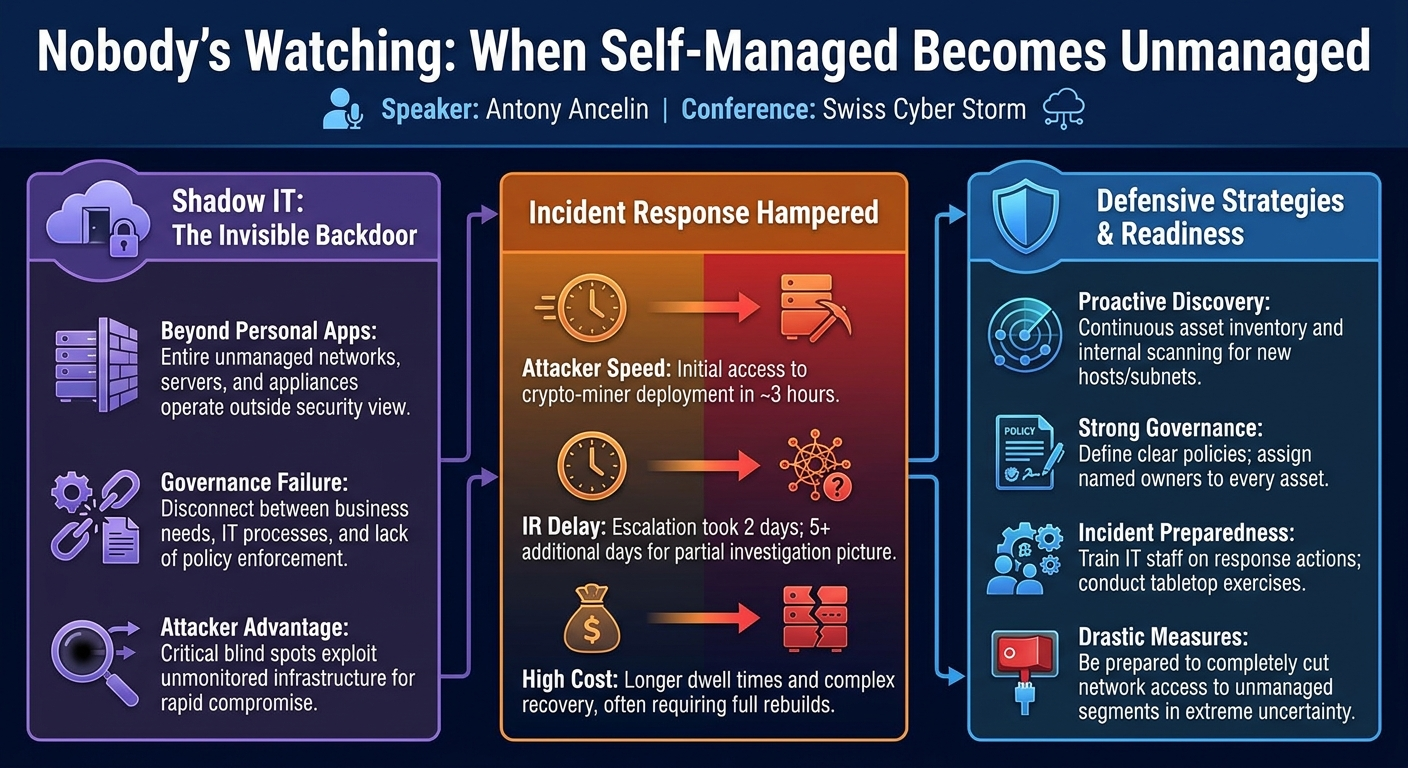
The impact was severe: 200 hosts were compromised within the research network. A critical timeline comparison highlighted the disparity between attacker efficiency and IR response: the threat actor achieved initial access and deployed the crypto-miner in just 3 hours. In stark contrast, due to the Shadow IT environment, it took the IR team 2 days to be escalated and 5 additional days to gain even a partial picture of the attack, with further days required for remediation and rebuilding.
Ancelin revealed that this was not an isolated incident, estimating that 10% of Swiss Post's incident response cases involve some form of Shadow IT. The costs associated with such incidents are significant:
- Longer Dwell Time: Attackers operate rapidly (3 hours), while IR teams are severely hampered by lack of visibility and ownership, leading to extended investigation and containment periods (5+ days for a partial picture).
- Costly Recovery: Recovery often necessitates rebuilding systems from scratch, a time-consuming and expensive endeavor.
- Partial Telemetry: The absence of centralized logging means critical questions from management (e.g., data exfiltration, backup impact) often receive incomplete or no answers, forcing decisions based on insufficient information.
- False Containment Risk: Without a complete asset inventory and understanding of network flows, there's a high risk that attackers may persist in unmapped areas, requiring prolonged post-incident monitoring.
- Team Fatigue: The emotional toll of a crisis is exacerbated by thousands of manual administrative tasks, the struggle to find owners, and constant "surprises."
- Rushed Actions: Untrained personnel making impulsive decisions (e.g., rebooting machines) can destroy crucial forensic evidence, making the IR team's job exponentially harder.
Ultimately, the key finding was a stark validation of the talk's title: when systems are self-managed, they often become unmanaged, creating an ideal backdoor for attackers because, quite simply, "nobody's watching."
Technical Deep Dive
▶ Watch: Attacker's 3-hour compromise vs. IR team's 5-day delay (10:30)
The incident began with an IDS alert indicating unusual scanning activity from a new host within a previously unknown subnet. This host was observed performing two distinct types of scans outside of business hours, immediately raising suspicions. The novelty of the host and its subnet, coupled with the timing, transformed what might otherwise be a routine alert into a critical incident.
Upon escalation, the IR team faced an immediate and profound challenge: a complete lack of visibility. The research network of approximately 1,000 Linux hosts had no asset inventory, no centralized logging, no security products, and no central configuration management. This meant standard IR tools and procedures were ineffective. To gain visibility for current and future analysis, Ancelin's team prioritized deploying monitoring agents:
- auditd: For Linux hosts,
auditdwas chosen to capture crucial system events, including process creation and network connections. This tool provides a detailed trail of activity, essential for understanding attacker actions post-compromise. - Velociraptor: To address the need for forensic data collection at scale and to quarantine external threats, Velociraptor was deployed. Its capabilities for rapid forensic acquisition across numerous endpoints proved invaluable in this unmanaged environment.
However, deploying these tools was not straightforward. The absence of an asset inventory meant uncertainty about coverage. The lack of central configuration tools necessitated manual deployment, requiring significant human resources. Furthermore, the presence of very old operating systems on some hosts meant certain tools were incompatible, demanding dedicated, time-consuming approaches. Integrating telemetry from thousands of new hosts into the existing Security Information and Event Management (SIEM) system required substantial scaling and additional resources to avoid impacting current monitoring.
The starting point for the investigation was the host responsible for the initial scanning. The IR team was "kind of lucky" to discover that the threat actor, perhaps due to carelessness, had failed to remove their working tools. This forensic windfall allowed the team to recover:
- masscan: A tool specifically designed for high-speed port scanning, confirming the initial IDS alerts.
- Brute-force scripts: The scripts used for credential stuffing and lateral movement.
- Results files: Files containing lists of compromised accounts and targeted hosts, providing an immediate understanding of the attack's scope.
This discovery allowed the IR team to reconstruct the attacker's kill chain:
- Initial Access: The attacker exploited SSH admin protocols exposed directly to the internet. This critical vulnerability, likely a misconfiguration in the unmanaged network, provided the initial foothold.
- Lateral Movement: Once inside, the attacker leveraged brute-force techniques against other hosts. This was facilitated by a flat network architecture, prevalent weak passwords, and numerous unpatched assets within the research subnet. The lack of segmentation and basic security hygiene allowed for rapid propagation.
- Privilege Escalation: While not explicitly detailed as a separate step, the widespread compromise and ability to deploy persistent crypto-mining software imply successful privilege escalation across numerous systems.
- Objective: The ultimate goal was to deploy crypto-mining software, turning the compromised 200 hosts into an illicit revenue stream for the attacker.
Containing the compromise presented another significant hurdle. With no clear asset owners, no understanding of asset criticality, and no documentation of internal or external network flows, isolating compromised systems was akin to "diffusing some bombing." The fear of breaking critical production services without knowing the full impact was a constant concern.
Ultimately, facing a lack of visibility and the potential for ongoing data exfiltration or further lateral movement, the difficult decision was made to cut the internet access for the entire affected research network. This drastic step, taken out of necessity, highlighted the severe consequences of operating unmanaged infrastructure. Post-containment, the remediation involved credential rotation, thorough hunting for backdoors, and the eventual recommendation for a complete rebuild of the affected systems from scratch, emphasizing the need for a managed onboarding process for new machines.
Demo / Proof of Concept
▶ Watch: Strategies to discover and prevent Shadow IT (18:00)
This particular conference talk focused on a real-world incident case study and its implications, rather than demonstrating a specific tool, exploit, or proof of concept. Antony Ancelin did not present a live demo or a simulated attack scenario. Instead, the "demonstration" of the problem and its solution was conveyed through the detailed narrative of the Shadow IT incident, the challenges faced by the incident response team, and the strategies employed and recommended.
Defensive Implications
▶ Watch: Q&A: The tough decision to cut access during an incident (23:00)
The incident detailed by Antony Ancelin offers critical lessons and actionable strategies for defenders grappling with the pervasive challenge of Shadow IT. The defensive implications can be categorized into three main pillars: Discovery, Readiness, and Governance.
Discovery
The fundamental problem with Shadow IT is the lack of visibility. Defenders cannot protect what they don't know exists.
- Asset Inventory: This is the "boring but crucial" first step. Organizations must implement continuous processes to discover and catalog all assets, regardless of their perceived criticality or origin.
- Internal Network Scanning: Regularly perform internal scans to identify active hosts, open ports, and running services. This can uncover rogue devices or misconfigured systems operating within the corporate network.
- IDS Deployment for Anomaly Detection: Deploy IDS/IPS solutions not just at the perimeter but also internally. Configure alerts for the detection of new, unknown hosts or subnets, as well as unusual scanning activity (like the initial alert in this case). Treat such alerts with high priority.
- Threat Hunting with Shadow IT Hypotheses: Proactively hunt for indicators of Shadow IT. This is particularly vital during mergers and acquisitions or when onboarding new departments. Hypotheses could include looking for unapproved operating systems, unusual network traffic patterns, or devices lacking standard security agents.
Readiness
Once discovered, organizations must be prepared to respond effectively when Shadow IT inevitably leads to an incident.
- Train IT Staff for Response Actions: It is paramount to train IT administrators and operational teams on basic incident response procedures. They should know how to safely pause a virtual machine, collect initial forensic data, or isolate a host without destroying evidence. Learning to deploy security tools at scale should not happen during a crisis.
- Develop Playbooks for Shadow IT Incidents: Create specific playbooks for scenarios involving unmanaged assets. These playbooks should outline steps for initial containment, data collection, communication, and escalation pathways when asset ownership is unclear.
Governance
Ultimately, Shadow IT is a governance failure. Addressing it requires clear policies, accountability, and cross-departmental collaboration.
- Define Clear Policies and Agreements: Establish explicit policies regarding asset acquisition, deployment, and management. Formalize agreements with all departments, especially those with specialized needs (e.g., research), outlining security requirements and responsibilities.
- Name Owners and Points of Contact: Every application, service, and network segment must have a designated owner or point of contact. This ensures accountability and provides the IR team with immediate contacts during an incident, avoiding "ping-pong escalations." Maintain an up-to-date registry of these contacts.
- Tabletop Exercises for Shadow IT Scenarios: Conduct tabletop exercises specifically simulating Shadow IT incidents. Involve diverse stakeholders from IT, security, business units, and legal. These exercises help uncover communication gaps, expose differing operational assumptions, and foster a shared understanding of risks and responsibilities.
- Treat Untrusted Assets as Isolated: If a department or owner refuses to integrate systems into the corporate security framework, treat those assets as untrusted. Isolate them network-wise as much as possible, and rigorously monitor their borders for any anomalous activity. This creates a security perimeter around the unmanaged segment.
During an Incident
Even with proactive measures, Shadow IT incidents can still occur. When they do, structured response is key.
- Organize Work Streams: During a crisis, organize the response into task-driven work streams, classifying personnel by department or role. Assign a clear point of contact (responsible individual) for each stream. This brings rationality to an emotional situation.
- Regular Follow-ups: Conduct frequent, structured follow-up meetings to discuss findings, proposed actions, and identify any blocking points (e.g., lack of access to firewall logs).
- Reinforce Data Preservation Best Practices: Crucially, remind all involved personnel about data preservation. Impulsive actions like rebooting or shutting down machines can destroy volatile memory and logs, severely hindering forensic analysis.
Antony Ancelin's ultimate defensive implication is a potent warning: Shadow IT is "one of the best backdoors an attacker can get" because it thrives in an environment where "nobody is watching." Proactive discovery, robust readiness, and strong governance are not just best practices; they are existential necessities in safeguarding an organization against this silent, pervasive threat.
Key Takeaways
- Shadow IT is a Pervasive and Critical Threat: It extends beyond personal devices to encompass entire unmanaged networks and servers, posing significant risks even to organizations with seemingly strong security postures.
- Governance, Not Just Technical, is the Root Cause: The existence of Shadow IT often stems from a disconnect between business needs, IT processes, and a lack of clear ownership and policy enforcement.
- Incident Response is Severely Hampered: Shadow IT drastically increases incident dwell times (attacker 3 hours vs. IR 5+ days for partial picture), recovery costs (often requiring full rebuilds), and introduces uncertainty due to lack of telemetry, leading to difficult management decisions.
- Visibility is Paramount but Challenging: Gaining visibility into unmanaged networks requires dedicated efforts, often involving manual deployment of tools like
auditdandVelociraptorin environments with no asset inventory or central configuration. - Proactive Discovery and Strong Governance are Essential: Continuous asset inventory, internal scanning, IDS deployment for new host detection, and tabletop exercises are crucial. Every asset must have a named owner and operate under defined policies.
- Be Prepared to Isolate Drastically: In situations of extreme uncertainty (no owner, no visibility into data exfiltration), the most prudent defensive action may be to cut off network access to the unmanaged segment.
About the Speaker(s)
Antony Ancelin is an experienced Incident Responder currently working with Swiss Post's Computer Emergency Response Team (CERT). With approximately 10 years of experience in the cybersecurity field, Ancelin brings a diverse background to his role. He began his career in offensive security with the French Armed Forces, gaining valuable insights into attacker methodologies and techniques. For the past five years, he has applied this expertise to incident response at Swiss Post, focusing on detecting, analyzing, and mitigating cyber threats. His presentation at Swiss Cyber Storm reflects his practical, real-world experience in navigating complex security challenges, particularly those arising from unmanaged IT infrastructure.
Reviews
Dr. Zero (Offensive Security Researcher) — SOLID
This is an honest, painful IR war story about what happens when "ninja projects" metastasize into a thousand unmanaged Linux boxes with SSH exposed to the internet. It's not a technical research drop, but Ancelin tells the truth about the absolute chaos of scoping a breach when nobody knows who owns the hardware. A solid, sobering reminder that your EDR coverage means nothing if you don't know the network exists.
Heather Calloway (CISO) — MUST SEE
This is a sobering, necessary look at what happens when business units bypass IT and security governance fails. It is required reading for any risk committee that assumes a mature SOC and a broad EDR deployment mean the enterprise is actually covered.