Quantum Computing and the Threat to Digital Security
Marco Brenner (IBM Research Labs)
Swiss Cyber Storm 2026 · Day 1 · Arena
Overview
Marco Brenner from IBM Research Labs delivered a compelling talk at Swiss Cyber Storm, dispelling the myth that quantum computing is a distant, theoretical concept. Instead, he presented a clear, urgent message: quantum computing is here, rapidly advancing, and poses an existential threat to the digital security foundations that underpin our modern world. His presentation, "Quantum Computing and the Threat to Digital Security," served as a critical wake-up call, emphasizing that the time to prepare for a quantum-safe transformation is not in the future, but now.
Key moments
- 3:50 IBM's twofold quantum mission: innovation & security
- 7:50 Error-corrected qubits by 2029: biggest challenge
- 10:00 Quantum's business advantage, industrialization, no waiting
- 13:50 Symmetric crypto safe, public key algorithms need replacement
- 16:50 Quantum removes digital trust, an existential risk
- 20:30 Activate hybrid key exchange for TLS 1.3 tomorrow
- 22:30 Accelerating timeline: targeted crypto-breaking machines, Bitcoin risk
- 28:00 Q&A: Quantum transition is a hard cut, not gradual
Quantum Computing and the Threat to Digital Security
Speakers: Marco Brenner, Senior Technical Staff Member, IBM Research Labs
Conference: Swiss Cyber Storm
YouTube: https://www.youtube.com/watch?v=FV0MwKLyhVE
Overview
Marco Brenner from IBM Research Labs delivered a compelling talk at Swiss Cyber Storm, dispelling the myth that quantum computing is a distant, theoretical concept. Instead, he presented a clear, urgent message: quantum computing is here, rapidly advancing, and poses an existential threat to the digital security foundations that underpin our modern world. His presentation, "Quantum Computing and the Threat to Digital Security," served as a critical wake-up call, emphasizing that the time to prepare for a quantum-safe transformation is not in the future, but now.
Brenner, an expert with a background in cryptography and a leader in IBM's global quantum-safe initiative, outlined the dual mission of quantum research: harnessing its immense potential for computational breakthroughs while simultaneously addressing its "unpleasant collateral effect" – the ability to break current public-key cryptography. He highlighted IBM's significant contributions to both quantum hardware development and the creation of post-quantum cryptography (PQC) standards, positioning the company at the forefront of this impending paradigm shift. The talk underscored the profound implications for organizations, stressing that this is not merely an IT upgrade but a fundamental re-evaluation of digital trust across entire ecosystems.
The core message revolved around the immediacy of the threat. While fully cryptographically relevant quantum computers are not yet operational, the trajectory of quantum development, coupled with the "harvest now, decrypt later" threat model, demands urgent action. Brenner urged attendees to recognize that the established mechanisms of digital trust—confidentiality, integrity, authenticity, and non-repudiation—are at stake, transforming a cryptographic problem into an information security crisis and, ultimately, an existential business risk.
Background
▶ Watch: IBM's twofold quantum mission: innovation & security (3:50)
The journey to quantum computing at IBM Research Labs, particularly at the Rüschlikon facility in Zurich, spans decades, building on foundational scientific breakthroughs. Brenner highlighted the lab's rich history, including two Nobel Prizes in the 1980s for the scanning tunneling microscope and high-temperature superconductivity – innovations that proved material to the development of quantum computers. This long-term research perspective underscores IBM's deep engagement with "what's next" in technology, extending far beyond immediate industry applications. The presence of world-class cryptographers, many of whom have contributed significantly to the new quantum-safe algorithms, further solidifies the lab's global leadership in this critical domain.
IBM's mission in quantum computing is twofold. On one hand, it aims to unlock the "game-changer" potential of quantum computation across a wide spectrum of industries, from finance to materials science, acknowledging that the true scope of this technology is only beginning to be understood. Early examples, like HSBC's 34% improvement in decision-making using quantum-enhanced algorithms, hint at the massive competitive advantages awaiting early adopters. On the other hand, there's the unavoidable and "very unpleasant collateral effect": the impending threat to current digital security. This threat, initially posed by state-sponsored intelligence services and later by organized crime and individual hackers, affects virtually all digital infrastructure and activities reliant on today's traditional cryptographic architectures.
The fundamental problem lies with three typical mathematical challenges underpinning much of modern public-key cryptography: integer factorization, discrete logarithm, and problems related to elliptic curves. Algorithms like Shor's algorithm, first theorized 30 years ago, demonstrate that a sufficiently powerful quantum computer can efficiently solve these problems, rendering widely used cryptographic schemes like RSA and Elliptic Curve Cryptography (ECC) obsolete. While symmetric cryptography (e.g., AES) was initially thought to be vulnerable to Grover's algorithm, subsequent analysis has largely mitigated this concern, suggesting that a quantum computer capable of breaking AES-128 would be prohibitively large and inefficient. However, the situation for public-key algorithms is entirely different; they require complete replacement. This represents a "hard cut" from legacy cryptography, a stark contrast to previous cryptographic upgrades that often involved simply extending key sizes or optimizing algorithms. The new post-quantum algorithms are also considerably more resource-intensive, making this transformation a significant technological and operational challenge.
Key Findings
▶ Watch: Quantum's business advantage, industrialization, no waiting (10:00)
Marco Brenner's talk articulated several critical findings that underscore the urgency and nature of the quantum threat:
- Quantum Computing is Here and Industrialized: Quantum computers are no longer theoretical. IBM provides access to advanced quantum systems via the cloud, with models like the Quantum System Two running in data centers. Furthermore, IBM is building a quantum chip fab with a $1 billion investment from the US government, signaling a shift towards industrial-scale production rather than mere lab-based research. Intel, in collaboration with IBM, is also establishing a new quantum computer in Lugano, Switzerland, making the technology increasingly accessible and usable.
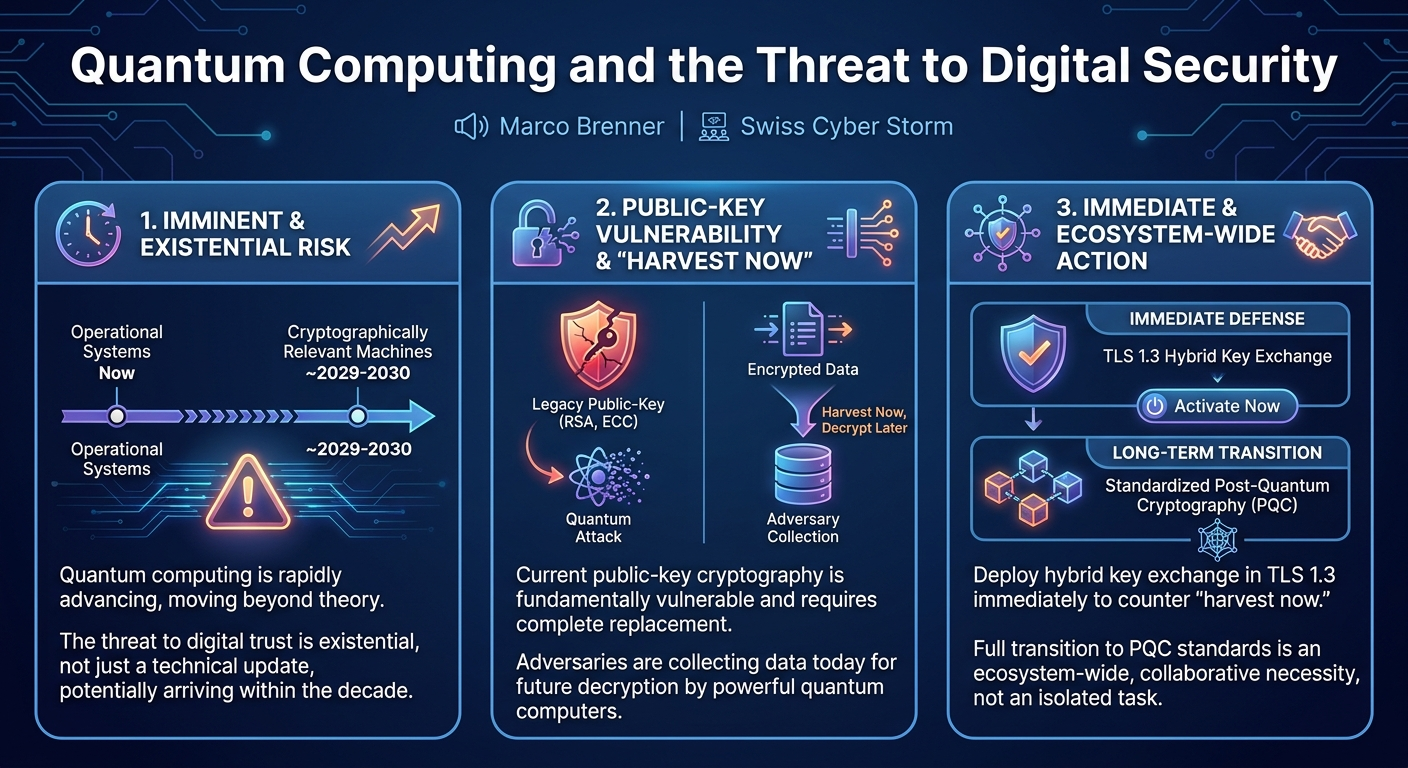
- Rapid Progress Towards Cryptographically Relevant Quantum Computers: While current quantum computers are not yet powerful enough to break significant cryptography, their capabilities are rapidly advancing. Key metrics include the number of programmable qubits (currently in the 120-150 range for IBM's most advanced chips), stability (thousands of computational steps before noise overwhelms results), and speed (nanoseconds per operation). The most significant development is the pursuit of error-corrected qubits, which aim to increase stability to hundreds of millions or billions of operations. IBM plans to build a quantum computer with 200 error-corrected qubits by 2029, a class of machine that "may well be" in the area of being able to crack cryptography.
- Symmetric Cryptography is Largely Safe; Public-Key Cryptography is Not: A crucial clarification was made regarding symmetric cryptography. Initial fears that Grover's algorithm could break AES-128 have been largely dismissed; building such a quantum computer would be infeasible. Therefore, increasing AES key sizes due to quantum concerns is unnecessary. However, all public-key algorithms currently in use, based on integer factorization, discrete logarithm, or elliptic curves, are fundamentally at risk and must be replaced.
- Post-Quantum Cryptography (PQC) Solutions Exist and are Being Standardized: The good news is that replacements are available. NIST (National Institute of Standards and Technology) has evaluated and standardized four PQC algorithms in 2022, three of which saw significant contributions from IBM Research Labs in Zurich. This demonstrates that cryptographic solutions to the quantum threat are maturing.
- The Threat is an "Existential Risk" to Digital Trust: The implications extend far beyond a technical upgrade. Brenner argued that quantum computers will not just create vulnerabilities but "remove the reason why we trust digital services, digital activities." This translates into an existential risk for most organizations, as the four pillars of information security—confidentiality, integrity, authenticity, and non-repudiation—are fundamentally undermined. Cryptography is pervasive across the entire digital stack, meaning "everything is affected."
- "Harvest Now, Decrypt Later" is a Present Danger: Adversaries are currently collecting encrypted information, anticipating that future quantum computers will enable its decryption. This threat, known as harvest now, decrypt later, requires immediate action.
- Dedicated Crypto-Breaking Quantum Computers are Being Designed: A worrying development is the shift from designing general-purpose quantum computers to machines specifically optimized for breaking cryptography. Research papers are already demonstrating theoretical machines capable of breaking highly efficient elliptic curve algorithms (like those protecting Bitcoin) as early as 2029 or 2030, significantly accelerating the timeline compared to earlier estimates. This means organizations "don't have until 2035" to prepare.
Technical Deep Dive
▶ Watch: Quantum removes digital trust, an existential risk (16:50)
The technical aspects of quantum computing's threat and the proposed solutions are multi-faceted, revolving around the unique properties of quantum systems and the mathematical foundations of cryptography.
Central to quantum computing is the qubit, the quantum analogue of a classical bit. Unlike a classical bit that can be either 0 or 1, a qubit can exist in a superposition of both states simultaneously. Multiple qubits can also become entangled, meaning their states are interdependent, enabling parallel computation that vastly surpasses classical limits for certain problems. Brenner emphasized key parameters for evaluating quantum computer potential:
- Qubits: The sheer number of qubits is often cited, but Brenner clarified the distinction between total qubits and programmable qubits (the ones users can actually work with). Current IBM systems feature 120-150 programmable qubits, but many more are dedicated to error mitigation and calibration, highlighting the complexity behind reported qubit counts.
- Stability (Coherence Time) and Noise Resistance: Qubits are extremely sensitive to environmental noise, causing them to lose their quantum information (decoherence). This limits the number of computational steps a quantum program can execute reliably to a few thousand before results become indistinguishable from noise. The holy grail is error-corrected qubits, which use redundant encoding to protect quantum information, aiming for hundreds of millions or billions of operations. IBM's roadmap targets a 200-qubit error-corrected quantum computer by 2029, a significant milestone towards cryptographically relevant capabilities.
- Speed (Gate Fidelity/Operation Time): The time it takes for a single quantum operation (a quantum gate) varies from nanoseconds to milliseconds. For billions of operations, this speed difference is critical, determining whether a computation takes hours or centuries.
The threat stems from quantum algorithms like Shor's algorithm, which can efficiently solve the integer factorization problem (breaking RSA) and the discrete logarithm problem (breaking Diffie-Hellman and ECC). While Grover's algorithm could theoretically speed up brute-force searches for symmetric keys, requiring a square-root increase in key length, detailed analysis shows that a quantum computer capable of breaking AES-128 using Grover's would be astronomically large and impractical. Thus, AES-256 remains robust against quantum attacks. However, all currently deployed public-key infrastructure (PKI) based on RSA, DH, or ECC is fundamentally vulnerable.
To counter this, the cryptographic community, led by NIST, has been developing and standardizing Post-Quantum Cryptography (PQC) algorithms. These are classical algorithms designed to be resistant to attacks by both classical and quantum computers. In 2022, NIST selected and began standardizing four PQC algorithms:
- Kyber (Key Encapsulation Mechanism, KEM) – for key exchange
- Dilithium (Digital Signature Algorithm, DSA) – for digital signatures
- Falcon (Digital Signature Algorithm, DSA) – for digital signatures
- SPHINCS+ (Digital Signature Algorithm, DSA) – for digital signatures (stateless hash-based)
IBM Research Labs played a significant role in the development of three of these four algorithms, underscoring their cryptographic expertise. These new algorithms are generally more computationally intensive and produce larger key sizes and signatures than their pre-quantum counterparts, posing integration challenges.
A critical immediate defensive measure against the harvest now, decrypt later threat is the deployment of hybrid key exchange in TLS 1.3. This involves combining a traditional (e.g., ECC) key exchange with a PQC key exchange, ensuring that even if one algorithm is compromised by a quantum computer, the other provides protection. For example, a Kyber key exchange can be run alongside an X25519 key exchange. If TLS 1.3 is properly configured, it can effectively protect current communications from future decryption by quantum computers. Brenner emphasized that this is a relatively easy step to take, but requires testing in loaded environments due to the increased computational overhead of PQC.
Demo / Proof of Concept
▶ Watch: Activate hybrid key exchange for TLS 1.3 tomorrow (20:30)
While the talk did not feature a live, interactive demonstration of quantum computing or its cryptographic implications, Marco Brenner presented several compelling examples that serve as proofs of concept for both the potential of quantum technology and the urgency of the quantum-safe transition.
One significant example cited was a rerun conducted by HSBC on a quantum-enhanced algorithm. Using an early quantum processor, HSBC re-evaluated an AI-triggered decision process for market offers. The results, though met with initial skepticism due to the nascent stage of quantum reproducibility, showed a staggering 34% improvement in matching. This abstract yet powerful example illustrates the "massive massive advantage" that early adopters in sectors like financial services could gain, reinforcing that "no one will wait for us" in information security. It serves as a strong proof of concept for the transformative business potential of quantum computing, even in its current noisy, intermediate-scale quantum (NISQ) era.
Furthermore, Brenner highlighted the accessibility of IBM's quantum computers. He explicitly stated that these systems are available on the cloud, including free access plans. Users can "just Google quantum access IBM or quantum.ibm.com" to "go and use these quantum computers." While he cautioned that one would "probably not break cryptography, only very, very, very short ciphers" with current systems, this invitation serves as a proof of concept for the practical usability and hands-on experimentation with quantum hardware by a wider audience, including security professionals seeking to understand the technology firsthand.
Finally, the discussion around theoretical machines designed specifically to break cryptography, such as those targeting Bitcoin's elliptic curve algorithms by 2029/2030, acts as a chilling proof of concept for the directed and imminent nature of the cryptographic threat. These aren't general-purpose machines, but specialized constructs, demonstrating that the threat isn't just about abstract computational power, but targeted attacks.
Defensive Implications
▶ Watch: Q&A: Quantum transition is a hard cut, not gradual (28:00)
The defensive implications of the quantum threat are profound and necessitate a fundamental shift in how organizations approach digital security. Brenner articulated that this is not merely an IT problem but an "existential risk" to most organizations, requiring a comprehensive, ecosystem-wide response.
- Elevate Quantum Safe to a Risk Register Item: The most immediate and critical defensive action is to formally recognize quantum safety as a significant organizational risk. By placing it on the risk register, organizations trigger established processes for risk assessment, mitigation planning, and executive oversight, making it difficult to ignore. This ensures that resources and attention are allocated to developing a quantum-safe transformation strategy.
- Implement Hybrid Key Exchange in TLS 1.3 Immediately: For the immediate threat of harvest now, decrypt later, organizations should activate hybrid key exchange in all TLS 1.3 connections. This involves combining a traditional (e.g., ECC) key exchange with a Post-Quantum Cryptography (PQC) key exchange (e.g., Kyber). This measure provides forward secrecy against future quantum attacks, protecting currently encrypted data from later decryption. Brenner cautioned that this should be tested in "loaded environments" due to potential performance impacts of the new, more resource-intensive PQC algorithms.
- Conduct a Comprehensive Cryptographic Inventory: While Brenner initially stated "it's everywhere" and a detailed inventory isn't needed first, it is absolutely necessary for the later stages of mitigation. Organizations must identify all instances of public-key cryptography across their entire digital stack—from basic services to digital currencies, internal systems, and external communications. This includes identifying vulnerable algorithms (RSA, ECC, DH) and understanding their dependencies.
- Prepare for an Ecosystem-Wide Technology Refresh: Unlike previous cryptographic updates, the quantum-safe transition is a "hard cut" that requires replacing virtually all public-key cryptography. This is not an isolated organizational task but a comprehensive refresh of technology across entire business ecosystems. Public-key cryptography drives digitalization in whole ecosystems, meaning an organization cannot become "quantum safe" in isolation if its business partners are not. This necessitates collaboration within industries and supply chains.
- Monitor Quantum Computing Roadmaps and Research Breakthroughs: The timeline for a cryptographically relevant quantum computer is uncertain and subject to rapid change due to research breakthroughs (e.g., the 10x reduction in physical qubits needed for error correction mentioned by Brenner). Organizations must stay informed about advancements in quantum hardware and algorithms, particularly improvements to Shor's algorithm, which could accelerate the timeline for cryptographic breaks. The emergence of quantum computers specifically designed for breaking cryptography, like the theoretical Bitcoin-breaking machine by 2029/2030, highlights this dynamic threat landscape.
- Seek and Provide Industry Guidance: Industry associations and large companies have a crucial role in providing guidance, sharing information, and making the transformation efficient. Governments also need to facilitate this by offering clear recommendations and support. Switzerland's FINMA guidance for banks and insurances, emphasizing organizations' responsibility for risk management, serves as an example of regulatory bodies acknowledging the impending shift.
- Understand the Resource Implications of PQC: The new PQC algorithms consume "considerably more resources" than their predecessors (e.g., larger key sizes, slower operations). This will have implications for network bandwidth, processing power, storage, and potentially user experience, requiring careful planning and infrastructure upgrades.
In summary, the defensive posture against quantum computing requires a proactive, strategic, and collaborative approach. It's a race against time, not just to deploy new algorithms, but to fundamentally rebuild the trust mechanisms of the digital world before the capabilities of quantum computers render current security infrastructure obsolete.
Key Takeaways
- Quantum Computing is an Imminent Threat: Quantum computers are no longer science fiction; they are operational, rapidly advancing, and pose an "existential risk" to current digital security, with cryptographically relevant machines potentially arriving by 2029-2030.
- Public-Key Cryptography Must Be Replaced: All current public-key algorithms (RSA, ECC, DH) are vulnerable to quantum attacks and require a complete, "hard cut" replacement with Post-Quantum Cryptography (PQC).
- Symmetric Cryptography is Largely Safe: Contrary to earlier fears, AES-128 and stronger symmetric ciphers are not considered at risk from Grover's algorithm and do not need increased key sizes due to quantum concerns.
- "Harvest Now, Decrypt Later" Requires Immediate Action: Adversaries are already collecting encrypted data to decrypt later. Organizations must activate hybrid key exchange in TLS 1.3 now to protect current communications against future quantum decryption.
- PQC Solutions Are Standardized: NIST has selected and standardized PQC algorithms (e.g., Kyber, Dilithium) that are resistant to quantum attacks, providing viable replacements for current vulnerable cryptography.
- Transformation is Ecosystem-Wide: The transition to quantum-safe security is not an isolated organizational task but a complex, comprehensive technology refresh that must span entire digital business ecosystems, requiring broad collaboration.
About the Speaker(s)
Marco Brenner is a Senior Technical Staff Member at IBM Research Labs. With a background primarily in cryptography, he has dedicated the last five years to being part of an IBM Research Competence Team focused on the quantum-safe transformation. Since the first quarter of this year, he has been specifically tasked with orchestrating and driving IBM's global quantum-safe transformation efforts. His expertise spans both the theoretical underpinnings of cryptography and the practical implications of quantum computing for digital security, making him a leading voice in guiding industries through this critical technological shift. He is based at the IBM Research Lab in Rüschlikon, Zurich, a facility renowned for its deep research heritage, including significant contributions to quantum computing and post-quantum cryptography.
Reviews
Dr. Zero (Offensive Security Researcher) — WEAK
Marco Brenner delivers a technically accurate but entirely recycled primer on post-quantum cryptography. It functions less as a research briefing and more as a thinly veiled marketing vehicle for IBM's quantum cloud and 2029 hardware roadmap.
Heather Calloway (CISO) — SOLID
Brenner’s update on post-quantum cryptography provides the exact clarity a CISO needs to pause the panic and start the plumbing. He rightly kills the myth that we need to rip and replace AES, narrowing the blast radius strictly to public-key infrastructure.