Swiss Hacking Challenge
Marc Bollhalder, Manuel Bürge
Swiss Cyber Storm 2026 · Day 1 · Arena
Overview
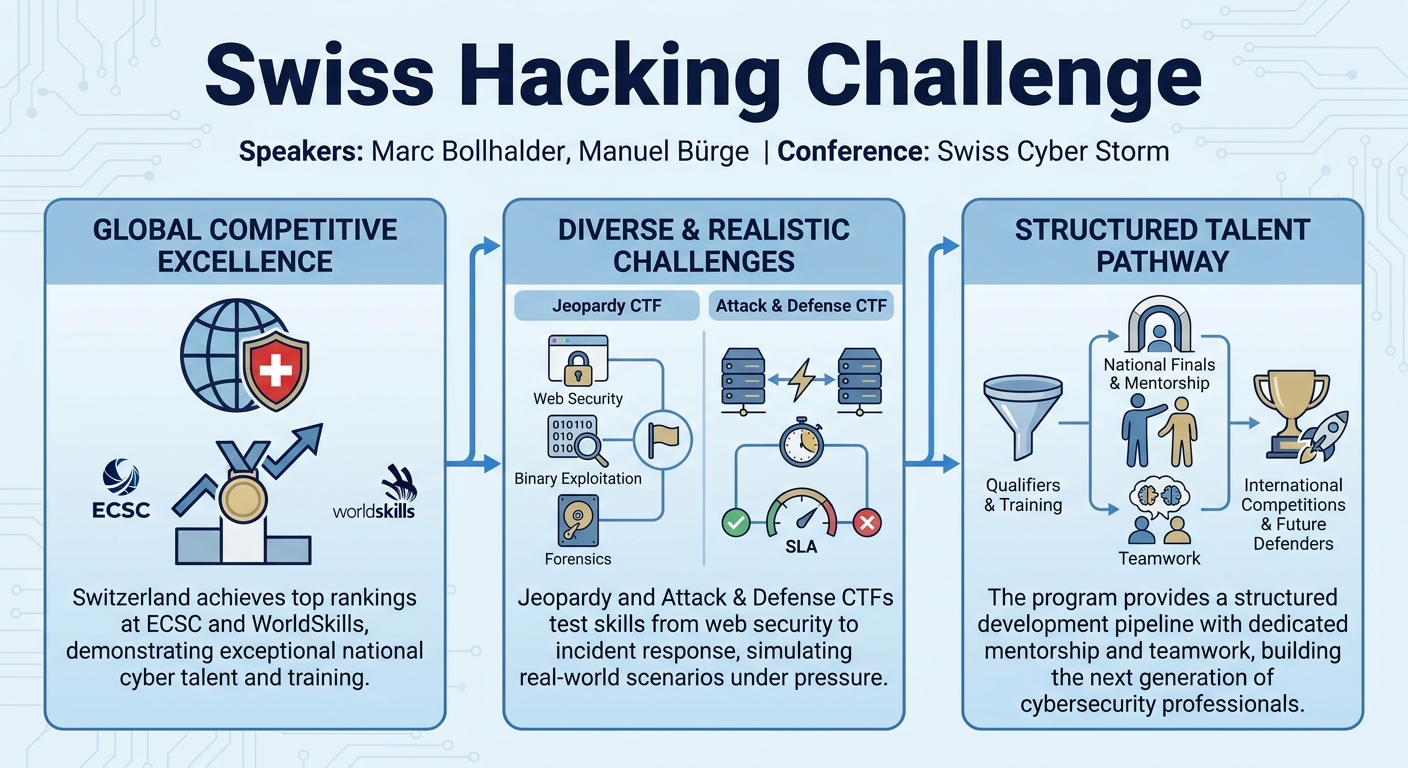
This talk, delivered by Marc Bollhalder and Manuel Bürge at Swiss Cyber Storm, provides a compelling overview of Switzerland's participation and success in leading international cybersecurity competitions: the European Cyber Security Challenge (ECSC) and WorldSkills. The speakers, deeply involved in fostering cyber talent through the Swiss Hacking Challenge program, highlight the rigorous training, diverse challenges, and remarkable achievements of young Swiss cybersecurity professionals on a global stage. This presentation is not merely a recap of competition results; it's a testament to the critical importance of practical, hands-on skill development in an increasingly complex digital landscape.
Key moments
- 0:00 Introduction to the European Cyber Security Challenge
- 1:50 Attack and Defense Capture The Flag (CTF) explained
- 4:05 Switzerland places 12th at European Cyber Security Challenge
- 4:30 Pathways to participate in Swiss and International Challenges
- 5:35 WorldSkills journey: from national to international stage
- 8:10 Cybersecurity competition days at WorldSkills (Red/Blue Team)
- 9:00 Switzerland ranks 3rd best country worldwide at WorldSkills
- 9:50 Investing in youth: They are our future in cybersecurity
Swiss Hacking Challenge
Speakers: Marc Bollhalder, Manuel Bürge
Conference: Swiss Cyber Storm
YouTube: https://www.youtube.com/watch?v=otfwP76pivU
Overview
This talk, delivered by Marc Bollhalder and Manuel Bürge at Swiss Cyber Storm, provides a compelling overview of Switzerland's participation and success in leading international cybersecurity competitions: the European Cyber Security Challenge (ECSC) and WorldSkills. The speakers, deeply involved in fostering cyber talent through the Swiss Hacking Challenge program, highlight the rigorous training, diverse challenges, and remarkable achievements of young Swiss cybersecurity professionals on a global stage. This presentation is not merely a recap of competition results; it's a testament to the critical importance of practical, hands-on skill development in an increasingly complex digital landscape.
The discussion delves into the intricate formats of both the ECSC and WorldSkills, detailing the types of challenges faced, from Jeopardy-style Capture The Flag (CTF) events testing broad technical knowledge to Attack and Defense CTFs simulating real-world incident response scenarios. It underscores the multifaceted skills required, encompassing everything from web security and binary exploitation to infrastructure hardening and forensics. By showcasing the journey of these aspiring experts, the talk emphasizes the significant investment Switzerland is making in cultivating its next generation of cybersecurity defenders and innovators, positioning the nation as a formidable player in the global cyber arena.
Ultimately, this article explores the educational and strategic significance of these competitions, demonstrating how they serve as vital platforms for identifying, nurturing, and validating cybersecurity talent. The speakers articulate a clear vision for how such initiatives not only prepare individuals for demanding careers but also contribute to a stronger national cybersecurity posture. Their insights offer valuable lessons for organizations, educators, and aspiring professionals on the pathways to excellence in cybersecurity.
Background
▶ Watch: Introduction to the European Cyber Security Challenge (0:00)
The global cybersecurity landscape is characterized by a persistent and widening skill gap, with a critical shortage of qualified professionals to defend against an ever-evolving array of threats. Traditional academic curricula, while foundational, often struggle to keep pace with the rapid advancements in attack techniques and defensive strategies. This disparity necessitates alternative, hands-on approaches to talent development that can simulate real-world pressures and foster practical problem-solving abilities. Cybersecurity competitions, particularly Capture The Flag (CTF) events, have emerged as a highly effective methodology for addressing this challenge.
These competitions provide a dynamic environment where participants can apply theoretical knowledge to practical scenarios, learn new techniques, and hone their skills under timed conditions. They are instrumental in building a pipeline of skilled individuals, offering a pathway from local qualifiers to prestigious international stages like the European Cyber Security Challenge (ECSC) and WorldSkills. The Swiss Hacking Challenge (SHC) program serves as a national framework designed to identify and cultivate this talent, starting with individual qualifiers and progressing to team-based finals that select representatives for these global events. This structured approach ensures that Switzerland consistently fields highly capable teams, leveraging competitions not just for individual recognition but as a strategic investment in national cyber resilience. The problem these initiatives tackle is fundamental: how to rapidly and effectively train a workforce that can defend critical infrastructure and data against sophisticated adversaries, a challenge that requires more than just theoretical understanding—it demands practical mastery.
Key Findings
▶ Watch: Switzerland places 12th at European Cyber Security Challenge (4:05)
The talk highlights several key findings and achievements that underscore the success and importance of Switzerland's engagement in international cybersecurity competitions:
- Strong Performance in ECSC: The Swiss team achieved an impressive 12th place out of over 42 competing teams at the European Cyber Security Challenge (ECSC) 2026 in Bochum, Germany. This places Switzerland firmly within the top third of European nations, demonstrating a high level of collective skill and preparation. The team comprised 10 players, split evenly between junior (14-20 years old) and senior (21-25 years old) categories, showcasing talent across different age groups.
- Exceptional WorldSkills Achievement: Switzerland's performance at WorldSkills 2026 in Shanghai was truly outstanding. The Swiss team, represented by four highly skilled hackers, secured a Medal of Excellence, contributing to a national tally of 37 medals in total (4 gold, 4 silver, 6 bronze, and 23 Medals of Excellence) across all skills. This remarkable result positioned Switzerland as the third best country worldwide in the overall WorldSkills competition, a testament to the rigorous training and dedication of its participants and coaches.
- Comprehensive Skill Development: The competitions, particularly the ECSC, exposed participants to a broad spectrum of cybersecurity disciplines. The Jeopardy CTF format covered web security, reverse engineering, binary exploitation, and hardware challenges. The Attack and Defense CTF further developed skills in vulnerability identification, patch management, exploit development, and incident response under pressure, while also requiring the maintenance of Service Level Agreements (SLAs).
- Real-World Simulation: The Attack and Defense CTF notably included a fully working telephone system as a target, emphasizing the need to secure diverse and often overlooked components of modern infrastructure. This practical approach moves beyond theoretical exercises, forcing teams to think like real-world defenders and attackers.
- Structured Talent Pathway: The Swiss Hacking Challenge program provides a clear and progressive pathway for aspiring cybersecurity professionals, from individual qualifiers (Swiss Hacking Challenge Qualifier, Swiss Skills) to national finals (Swiss Hacking Challenge Final) and ultimately to international competitions (ECSC, International Cybersecurity Challenge, WorldSkills). This structured approach is crucial for identifying and nurturing talent systematically.
- Importance of Mentorship and Teamwork: Speakers Marc Bollhalder and Manuel Bürge, as coaches and committee members, underscored the vital role of mentorship, intense preparation, and fostering strong team spirit. Manuel specifically noted that he often learns more from his young competitors than they do from him, highlighting the reciprocal nature of the coaching process and the innovative thinking brought by new generations. The emphasis on communication, even non-verbal, during high-pressure situations, was also a key takeaway from the WorldSkills preparation.
These findings collectively demonstrate Switzerland's robust commitment to cybersecurity talent development, the effectiveness of competition-based learning, and the high caliber of its emerging professionals.
Technical Deep Dive
▶ Watch: WorldSkills journey: from national to international stage (5:35)
The technical core of the talked-about competitions lies in their diverse and challenging formats, designed to push participants beyond theoretical knowledge into practical application. The European Cyber Security Challenge (ECSC), for instance, featured two primary competition modes: a Jeopardy CTF and an Attack and Defense CTF.
The Jeopardy CTF format is a staple in cybersecurity competitions, presenting participants with a series of independent challenges across various categories. Each challenge, once solved, yields a "flag" – a specific string of text – that is submitted for points. The ECSC Jeopardy CTF covered critical domains:
- Web Security: This category typically involves identifying and exploiting vulnerabilities in web applications. Common challenges include SQL Injection (SQLi), where attackers manipulate database queries; Cross-Site Scripting (XSS), injecting malicious scripts into trusted websites; Cross-Site Request Forgery (CSRF), tricking users into executing unwanted actions; arbitrary file uploads; and various forms of authentication bypass or insecure deserialization. Participants need to understand common web application frameworks, HTTP protocols, and how to use tools like Burp Suite or OWASP ZAP for analysis and exploitation.
- Reverse Engineering: This involves analyzing compiled software to understand its functionality, identify hidden logic, or extract secrets. Challenges often require participants to use disassemblers (e.g., IDA Pro, Ghidra, Radare2) and debuggers (e.g., GDB, x64dbg) to examine binary code, understand control flow, and bypass obfuscation techniques. This skill is crucial for malware analysis and understanding proprietary systems.
- Binary Exploitation: Often intertwined with reverse engineering, this category focuses on finding and exploiting vulnerabilities in compiled programs, typically those written in C/C++. Common exploits include buffer overflows, format string bugs, use-after-free vulnerabilities, and integer overflows. The goal is often to achieve arbitrary code execution or privilege escalation. Participants need a deep understanding of memory management, processor architectures (e.g., x86-64), and exploit mitigation techniques like ASLR (Address Space Layout Randomization), DEP (Data Execution Prevention), and Canaries.
- Hardware Challenges: While less common, these challenges involve interacting with physical hardware, often requiring participants to understand embedded systems, IoT devices, or specialized communication protocols. This could involve firmware analysis, side-channel attacks, or JTAG/SWD debugging to extract information or modify device behavior.
The Attack and Defense CTF presents a more dynamic and realistic simulation of a network environment. Teams are given identical infrastructure, often comprising multiple services (e.g., web servers, databases, messaging systems, custom applications). The objective is dual:
- Defend: Identify vulnerabilities within their own services, patch them promptly, and implement robust security measures to prevent other teams from exploiting them. This requires continuous monitoring, log analysis, and rapid response capabilities.
- Attack: Exploit vulnerabilities in the services of other teams to steal "flags" (which might be secret data, configuration files, or tokens) and earn points. This necessitates effective reconnaissance, vulnerability scanning, and exploit development.
A critical aspect of this CTF format is maintaining Service Level Agreements (SLAs). Teams cannot simply shut down services to secure them; they must remain operational and accessible to the judges (and sometimes other teams) to score points. This mirrors real-world business constraints where downtime is costly. A unique technical highlight of the ECSC's Attack and Defense CTF was the inclusion of a fully working telephone system as a target. This implies that participants had to consider Voice over IP (VoIP) security, potentially dealing with vulnerabilities in SIP (Session Initiation Protocol), RTP (Real-time Transport Protocol), or the underlying phone system software, adding another layer of complexity beyond typical IT services.
The WorldSkills competition, while broader in scope as it covers many professions, dedicated four intensive days to cybersecurity, each focusing on a distinct technical area:
- Infrastructure Hardening: This day focused on securing operating systems (Linux and Windows), network devices (routers, switches, firewalls), and various server applications. Tasks likely involved configuring firewall rules, implementing access control lists (ACLs), securing SSH/RDP access, applying security patches, configuring intrusion detection/prevention systems (IDS/IPS), and hardening common services like web servers (Apache, Nginx) or database servers (MySQL, PostgreSQL) against known attack vectors.
- Forensics: Participants were tasked with investigating digital incidents. This involves digital evidence collection from compromised systems, disk image analysis, memory forensics (e.g., using Volatility Framework), network packet analysis (e.g., Wireshark), and log analysis to reconstruct events, identify the root cause of breaches, and extract indicators of compromise.
- Blue Team (Incident Response): This day simulated an active cyber attack, requiring teams to detect, analyze, contain, eradicate, and recover from a security incident. This includes deploying and configuring Endpoint Detection and Response (EDR) tools, utilizing Security Information and Event Management (SIEM) systems for alert correlation, isolating compromised systems, and restoring operations while minimizing impact.
- Red Team (Offensive Security): The final day focused on offensive operations, where teams acted as adversaries. This typically involves reconnaissance (OSINT, network scanning), vulnerability assessment, exploitation of identified weaknesses, privilege escalation on compromised systems, lateral movement within a network, and maintaining persistence. Tools like Nmap, Metasploit Framework, Empire, or Cobalt Strike are commonly used in such scenarios.
The comprehensive nature of these challenges ensures that participants develop a well-rounded skillset essential for modern cybersecurity roles, covering both offensive and defensive disciplines, critical thinking, and rapid problem-solving under pressure. The emphasis on write-ups in the Jeopardy CTF also fosters clear communication of technical findings, a crucial skill in professional cybersecurity.
Demo / Proof of Concept
▶ Watch: Cybersecurity competition days at WorldSkills (Red/Blue Team) (8:10)
This particular talk focused on the structure, challenges, and outcomes of cybersecurity competitions rather than presenting a specific technical demonstration or proof of concept for a vulnerability or tool. The "demo" aspect in this context is the experiential learning provided by the competitions themselves, where participants actively build, defend, and attack systems. The speakers effectively showcased the results of these competitive efforts, such as the successful exploitation of a "fully working telephone system" by competitors, which serves as an abstract proof of concept for the real-world applicability of the skills honed in these events.
Defensive Implications
▶ Watch: Investing in youth: They are our future in cybersecurity (9:50)
The insights gleaned from the Swiss Hacking Challenge and WorldSkills competitions carry significant defensive implications for organizations and national cybersecurity strategies. The rigorous training and real-world scenarios embedded in these events directly translate into enhanced defensive capabilities:
- Proactive Vulnerability Management: Participants in Attack and Defense CTFs are forced to identify and patch vulnerabilities within their own services under extreme pressure. This cultivates a proactive mindset essential for real-world vulnerability management programs, where continuous scanning, assessment, and patching are paramount. Organizations can adopt similar internal "purple team" exercises to regularly test and improve their defenses.
- Enhanced Incident Response Capabilities: The Blue Team (Incident Response) day at WorldSkills directly trains individuals in the critical phases of incident response: detection, analysis, containment, eradication, and recovery. Professionals emerging from these competitions possess hands-on experience in using SIEMs, EDRs, and other tools to respond effectively to live threats, minimizing dwell time and impact.
- Infrastructure Hardening Expertise: The focus on Infrastructure Hardening at WorldSkills ensures that participants understand how to secure operating systems, network devices, and applications from the ground up. This knowledge is directly applicable to implementing security best practices, configuring firewalls, managing access controls, and securing cloud environments to build resilient systems.
- Understanding Attacker Mindset: By engaging in Red Team (Offensive Security) challenges and attacking other teams in Attack and Defense CTFs, participants gain invaluable insight into the methodologies and tactics of real adversaries. This "attacker mindset" is crucial for defenders, enabling them to anticipate threats, identify potential attack paths, and design more robust defenses. Knowing how a system can be exploited is the first step to securing it.
- Developing Critical Thinking and Problem-Solving: Cybersecurity is an ever-evolving field. The complex, often novel challenges presented in Jeopardy CTFs and other competition formats foster critical thinking, adaptability, and creative problem-solving skills. These are indispensable qualities for defenders who must confront new threats and vulnerabilities daily.
- Importance of Teamwork and Communication: The emphasis on teamwork and effective communication, even non-verbal, within competition teams mirrors the collaborative nature of modern Security Operations Centers (SOCs) and incident response teams. A well-coordinated team can respond to incidents much more effectively than isolated individuals.
- Securing Diverse Technologies: The inclusion of a fully working telephone system as a target in the ECSC highlights the need for organizations to consider the security of all their assets, including often-overlooked operational technology (OT) or legacy systems. Defenders must broaden their scope beyond traditional IT infrastructure.
In essence, these competitions act as high-fidelity training grounds, producing cybersecurity professionals who are not only technically proficient but also resilient, adaptive, and capable of operating effectively under pressure. Investing in such talent development programs is a direct investment in strengthening an organization's and a nation's defensive posture against the pervasive threats of the digital age.
Key Takeaways
- Cybersecurity competitions are vital for talent development: Events like the ECSC and WorldSkills provide critical hands-on experience, bridging the gap between theoretical knowledge and practical application, which is essential for developing skilled cybersecurity professionals.
- Switzerland excels on the global stage: The Swiss team's 12th place at ECSC out of 42+ teams and Switzerland's overall 3rd place worldwide at WorldSkills underscore the nation's strong commitment to and success in nurturing cyber talent.
- Comprehensive skill sets are crucial: Competitions cover a broad spectrum of cybersecurity domains, including web security, reverse engineering, binary exploitation, hardware challenges, infrastructure hardening, forensics, incident response (Blue Team), and offensive security (Red Team), fostering well-rounded experts.
- Real-world scenarios enhance readiness: The Attack and Defense CTF with its SLA requirements and the inclusion of targets like a fully working telephone system provide realistic training for managing security under operational constraints.
- Mentorship and teamwork are indispensable: The success of the teams is heavily reliant on effective coaching, intensive preparation, and strong team dynamics, emphasizing the collaborative nature of cybersecurity defense.
- Investing in youth is investing in the future: As highlighted by Manuel Bürge, guiding and investing in young talent is a societal responsibility, particularly in the "age of AI," to ensure a robust future for cybersecurity.
About the Speaker(s)
Marc Bollhalder is an integral part of the Swiss Hacking Challenge team, playing a key role in organizing and facilitating Switzerland's participation in European and international cybersecurity competitions. His involvement spans from the national qualifier stages to supporting the Swiss team at prestigious events like the European Cyber Security Challenge. His passion lies in developing and showcasing the talents of young cybersecurity enthusiasts in Switzerland.
Manuel Bürge is a dedicated coach and mentor within the Swiss Skills national team family, specifically guiding competitors for the WorldSkills competition in Cybersecurity. He is deeply committed to nurturing the next generation of cybersecurity professionals, emphasizing teamwork, communication, and pushing personal limits. Manuel's perspective highlights the profound learning experience for both competitors and coaches, underscoring the importance of investing in young talent as the future builders of the digital world.
Reviews
Dr. Zero (Offensive Security Researcher) — HARD PASS
This is a press release masquerading as a conference talk. Bollhalder and Bürge spent their time on stage explaining what a CTF is and reading off Switzerland's WorldSkills scorecard. Unless you needed an awareness session to learn that people practice buffer overflows, this is a complete waste of time.
Heather Calloway (CISO) — WEAK
This is a straightforward overview of Switzerland’s national youth cyber competition pipeline. It is a feel-good presentation about training the next generation, but it offers minimal strategic value for enterprise risk or board-level governance. I would skip it unless your HR partner is actively redesigning your entry-level hiring rubrics.