Shadow AI – the Security Black Hole That is Only Getting Worse!
Michael Morgenstern
Swiss Cyber Storm 2026 · Day 1 · Arena
Overview
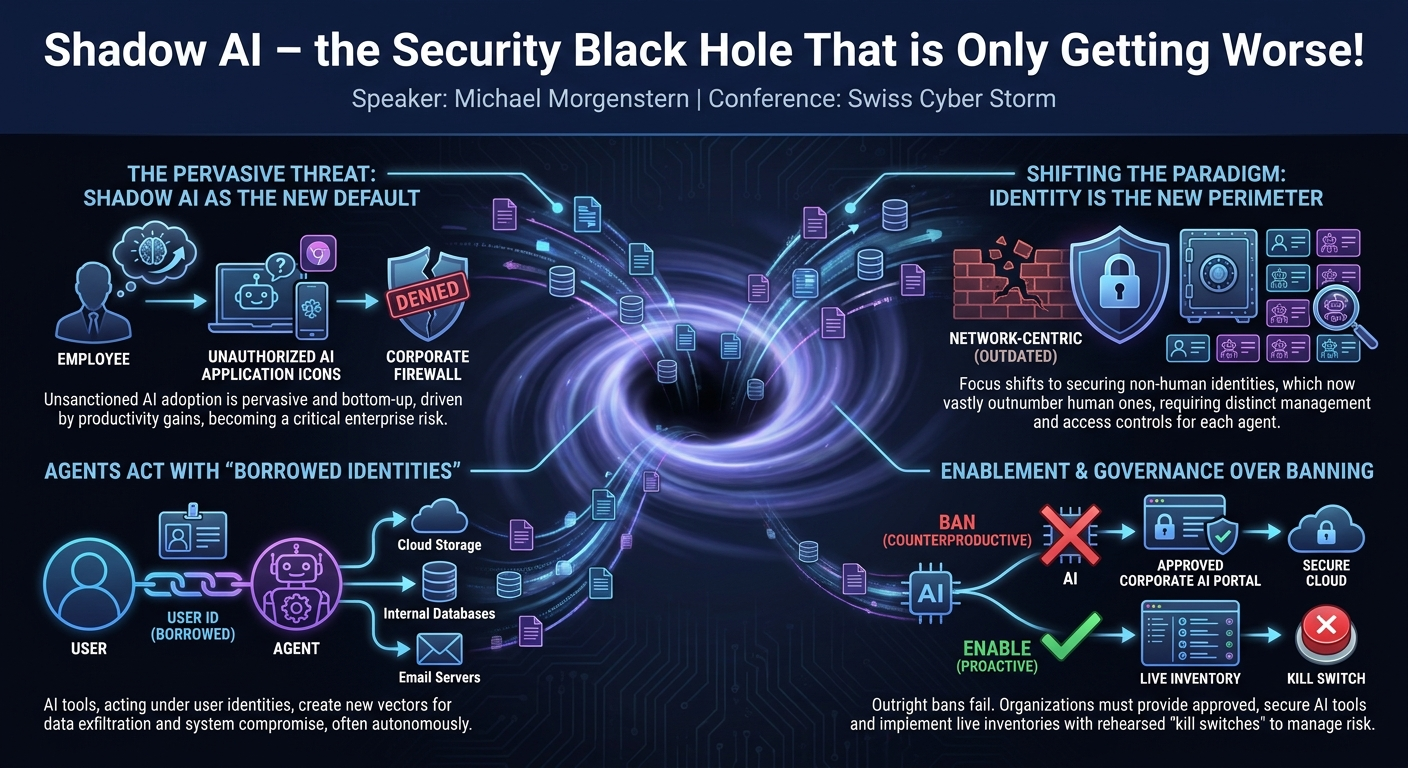
In an insightful and urgent presentation at Swiss Cyber Storm, Michael Morgenstern shone a stark light on the burgeoning threat of Shadow AI, a phenomenon he describes as a rapidly expanding security black hole. This talk dissects how employees are increasingly circumventing traditional IT governance by integrating personal or unsanctioned artificial intelligence tools into their daily workflows, leading to profound and often invisible risks for organizations. Morgenstern, drawing on extensive research, illustrates that Shadow AI is no longer an exception but the default, permeating enterprises from the bottom-up, driven by the seductive promise of increased productivity.
Key moments
- 2:00 Perplexity AI browser exploit: local files, 1Password accessed
- 4:40 Every AI prompt is a potential data egress event
- 12:00 Claw Havoc: Malicious AI agents trick users into malware
- 15:30 Identity is the new perimeter: non-human identities dominate
- 21:20 Four strategic moves to change the odds against Shadow AI
- 27:00 Q&A: Agents using multiple identities and bypassing guardrails
- 29:30 Q&A: Why demanding AI quality standards is difficult
Shadow AI – the Security Black Hole That is Only Getting Worse!
Speakers: Michael Morgenstern, Consultant & Researcher, Various Consulting Companies
Conference: Swiss Cyber Storm
YouTube: https://www.youtube.com/watch?v=BctgzUSG-NI
Overview
In an insightful and urgent presentation at Swiss Cyber Storm, Michael Morgenstern shone a stark light on the burgeoning threat of Shadow AI, a phenomenon he describes as a rapidly expanding security black hole. This talk dissects how employees are increasingly circumventing traditional IT governance by integrating personal or unsanctioned artificial intelligence tools into their daily workflows, leading to profound and often invisible risks for organizations. Morgenstern, drawing on extensive research, illustrates that Shadow AI is no longer an exception but the default, permeating enterprises from the bottom-up, driven by the seductive promise of increased productivity.
The core message of the presentation is a critical alert: the adoption of AI is outstripping security controls, creating new vectors for data exfiltration, system compromise, and identity theft. Morgenstern emphasizes that unlike its predecessor, Shadow IT, which primarily concerned data storage, Shadow AI introduces the far more dangerous dimension of autonomous action. Through compelling real-world examples and alarming statistics, he demonstrates how AI agents, operating under borrowed identities, can inadvertently or maliciously execute commands, modify systems, and expose sensitive corporate assets, often with the user's unwitting consent.
This talk is essential for security professionals, IT leaders, and business executives grappling with the rapid integration of AI. Morgenstern not only highlights the massive scale of the problem—with some estimates suggesting 78% of AI users bring their own tools to work—but also provides concrete, actionable strategies. He challenges organizations to move beyond reactive bans and instead foster an environment of "how" rather than "no," offering pathways to manage and secure AI adoption effectively before it leads to catastrophic breaches.
Background
▶ Watch: Perplexity AI browser exploit: local files, 1Password accessed (2:00)
The proliferation of Shadow AI is deeply rooted in the historical challenges presented by Shadow IT, but with significantly amplified risks. For years, organizations have struggled with employees adopting unsanctioned SaaS applications, leading to data sprawl and governance gaps. However, Michael Morgenstern explains that Shadow AI transcends these issues, transforming every interaction with an AI tool into a potential egress event. Where Shadow IT meant data stored in an unapproved location, Shadow AI means data actively being sent, processed, and potentially exfiltrated by systems outside of corporate oversight. This problem is exacerbated by the often-misplaced trust users place in AI, believing their data remains local or secure with vendors, a notion Morgenstern quickly disabuses.
The catalyst for this widespread adoption is the pervasive presence of generative AI, with 75% of knowledge workers now using it in some form. This trend is not limited to tech-savvy younger generations; Morgenstern presents data showing high adoption rates across all age groups, including 73% of "boomers." This bottom-up adoption means employees are embracing AI before IT or security teams can establish policies or provide sanctioned alternatives. The dilemma is starkly captured by threat researcher Marcus Hutchins, who noted, "LLMs are the slowest forms of automation. Defaulting to LLMs is building tech debt. Saying no to LLMs, in my opinion, is building shadow AI." This highlights the no-win situation for many organizations: restricting corporate AI use often pushes employees to personal, unsanctioned tools.
A critical vulnerability Morgenstern underscores is the concept of agents acting under "borrowed identity." These AI tools, whether they are chatbots, productivity assistants, or sophisticated automation scripts, often inherit the permissions and identity of the user running them. This allows them to perform actions on behalf of the user, blurring the lines between legitimate user activity and automated agent behavior. The speaker cites an alarming example of a popular VPN proxy, Urban VPN, which boasted a 4.7-star Google rating and a "featured badge," yet was found by a security company named Kua to be capturing AI chats across all models whenever activated. This incident illustrates a common paradox: users, attempting to enhance their security or productivity, inadvertently expose sensitive data through tools they perceive as beneficial. The sheer volume of this problem is staggering; SMB and mid-market companies average over 400 unsanctioned AI applications per 1,000 employees, leading to a doubling of data policy violations and thousands of monthly leaks involving source code, credentials, and intellectual property.
Key Findings
▶ Watch: Claw Havoc: Malicious AI agents trick users into malware (12:00)
Michael Morgenstern meticulously outlines several critical shifts and alarming findings that underscore the gravity of the Shadow AI problem:
First, the nature of AI interaction has fundamentally changed from passive consumption to active control. Initially, AI primarily answered questions; now, agents are designed to take action. This transition means that "anything an agent reads, whether an email, a web page, or a calendar invite, can potentially take control or at least influence that agent." Morgenstern highlights the Perplexity's Comet incident, researched by Zenity Labs and dubbed Please Fix, where an attacker embedded hidden text in a calendar invite. When viewed by a user with the AI browser, the AI was instructed to read local files, access an unlocked 1Password vault, and even change the user's password, effectively locking them out. The AI did precisely what it was told, but by a malicious third party, demonstrating how AI can't differentiate between legitimate and malicious instructions.
Second, the operational locus of AI has shifted from centralized cloud environments back to individual user devices. While corporate AI might reside in the cloud, employees are increasingly running sophisticated AI tools on their personal or corporate laptops. This decentralization complicates monitoring and control, especially when employees resort to using personal devices for corporate tasks if corporate tools are unavailable or too restrictive. Morgenstern even warns of extreme scenarios where data can be exfiltrated by setting up a camera to record a work laptop's screen from a personal laptop running AI.
Third, the focus has moved from simple prompts to complex permissions. The speaker notes an "explosion of agents taking more access than we know, let alone than we delegated." This isn't merely a Data Loss Prevention (DLP) issue; it's an action question, where AI agents are granted or obtain broad permissions that allow them to interact with, modify, and exfiltrate data from various corporate systems. This problem is compounded by organizational pressures for employees to "do more faster with less," inadvertently encouraging the adoption of unsanctioned AI solutions.
A particularly alarming finding revolves around Open Claw, a self-hosted agent framework offering shell access, an API key vault, and a "skills marketplace." In March, over 63,000 exposed instances were identified (estimated to be over a million by now), creating a vast attack surface. The Claw Havoc incident serves as a stark warning: attackers flooded Open Claw's marketplace with malicious "skills" disguised as benign tools like crypto bots or productivity aids. Users were instructed to install these by pasting terminal commands or downloading ZIP files, which then installed malware. This incident dramatically reveals a critical shift in user behavior: "most users are doing it now" when their AI chatbot tells them to, overriding years of security education against clicking suspicious links or installing unknown software. The trust placed in AI by users is so profound that they are delegating authority and decision-making to these agents, often without conscious awareness of the underlying risks.
Technical Deep Dive
▶ Watch: Identity is the new perimeter: non-human identities dominate (15:30)
The technical implications of Shadow AI reveal a landscape ripe for exploitation, far beyond simple data leaks. The Claw Havoc incident, for instance, demonstrated the ease with which attackers could compromise systems through deceptive AI skills. The malware distributed through the Open Claw marketplace was designed to steal highly sensitive assets, including wallet keys, SSH keys, AWS credentials, and AI API keys. Alarmingly, publishing a malicious skill only required a GitHub account that was a week old, and one such skill garnered 340,000 installs before detection. While Nvidia's Nemo Claw introduced a sandbox for containment, Morgenstern, citing research from the Cloud Security Alliance (in which he participated), highlights that prompt injection detection remains outside its scope. This means Nemo Claw is a containment layer, not a judgment layer, leaving the critical task of identifying malicious instructions to human oversight.
A significant vulnerability lies in the widespread lack of authentication in local AI deployments. Morgenstern presented data revealing that 31% of local LLMs operate with no authentication whatsoever. A sample of 52,000 Ollama servers was found to answer prompts without requiring any authentication, and over 12,000 open web UI instances are currently exposed to the internet. Threat actors are actively mapping this vulnerable infrastructure; Gray Noise logged over 91,000 attack sessions in just four months, with two IPs sending the simple prompt "high" more than 32,000 times to identify responsive models. This reconnaissance indicates clear intent for future exploitation.
The core of the problem, Morgenstern argues, is that identity is the new perimeter. The security paradigm must shift from network-centric defenses to identity-centric controls, particularly for non-human entities. He reminds the audience of older terms like M2M, service accounts, and workload identities, emphasizing that these non-human identities now vastly outnumber human identities—a ratio of 82 to 1, likely exceeding 150 to 1 by now. Each new AI agent introduces at least one more identity that needs to be managed and secured.
A critical technical challenge arises because AI agents typically use the user's sessions and tokens to act on their behalf. This means that in logs, the agent's activity appears as the user's activity, making it nearly impossible to distinguish between a legitimate user action, an agent's intended action, or a malicious attacker's action. "An agent and an attacker may look the same," Morgenstern warns. He cites the Salesforce drift attack, a year-old incident where attackers stole OAuth tokens from a single chat integration. These tokens were then used to access hundreds of Salesforce environments, allowing lateral movement into connected services like Slack, Google Workspace, and AWS, with query logs being deleted along the way. Crucially, no password was cracked; the tokens simply performed their intended function, demonstrating how compromised non-human identities can lead to widespread breaches without traditional authentication failures. This situation is further aggravated by the finding that only 30% of organizations have a policy to manage or detect Shadow AI, and 63% of breached organizations had no AI governance, echoing IBM's diagnosis that "organizations are favoring speed and innovation over foundational security practices."
Demo / Proof of Concept
▶ Watch: Q&A: Agents using multiple identities and bypassing guardrails (27:00)
While Michael Morgenstern's talk did not feature a live, interactive demonstration, the presentation was rich with detailed accounts of real-world incidents and vulnerabilities that served as compelling proof-of-concept examples for the dangers of Shadow AI.
The Perplexity's Comet incident, involving the Zenity Labs Please Fix research, illustrated how an AI browser could be manipulated by hidden text within a calendar invite. This effectively demonstrated a novel form of prompt injection leading to local file access, password vault compromise, and account lockout—all without the user clicking a malicious link or downloading an executable. This scenario vividly showcased the AI's susceptibility to unintended instructions and its ability to act with the user's implicit permissions.
Similarly, the Claw Havoc story provided a chilling proof of concept for supply chain attacks within AI ecosystems. The flooding of the Open Claw marketplace with malicious skills, which then tricked users into installing malware via terminal commands, highlighted the profound shift in user trust from traditional security warnings to AI directives. This detailed example underscored how AI agents, combined with social engineering, can bypass established defensive behaviors and lead to the theft of critical assets like wallet keys, SSH keys, AWS credentials, and AI API keys. These documented cases serve as powerful, practical demonstrations of the vulnerabilities and attack vectors that Shadow AI introduces into the enterprise environment.
Defensive Implications
▶ Watch: Q&A: Why demanding AI quality standards is difficult (29:30)
Michael Morgenstern firmly asserts that organizations "can't ban your way out of this" problem. A prohibitive stance on AI only drives its use further into the shadows. Instead, the focus must shift from security being the "department of no" to becoming the "department of how." This means enabling employees to leverage AI securely, rather than outright preventing its use. Evidence supports this approach: Netscope observed a drop in personal AI use from 78% to 47% in one year, directly attributing this success to organizations offering approved, corporate-sanctioned AI tools.
Morgenstern proposes three fundamental questions for organizations to ask immediately:
- Do you know every tool, every extension, and every agent in use, whether it's approved or not? The goal isn't perfect knowledge but a continuous effort to increase visibility and understand the AI landscape within the organization.
- Does every agent have its own identity or is it acting as the employee? Even if an agent initially has the same access as an employee, assigning it a unique identity is crucial for future forensics, granular access control, and accountability. This distinction is vital for understanding who or what performed an action.
- Can you revoke it? Tied directly to unique identities, the ability to rapidly revoke an agent's access or shut it down is paramount for incident response and control. Speed of revocation is a critical metric.
Building on these questions, Morgenstern outlines four strategic moves to change the odds:
- Build a live inventory: This inventory doesn't need to be perfect but must be dynamic, continuously tracking AI agents as they are introduced or modified within the environment.
- Enable, don't ban: Every ban pushes users towards Shadow AI. Organizations should establish clear, secure processes for employees to request and integrate the AI tools they need, providing approved alternatives where possible.
- Treat agents as identities: This is perhaps the most critical shift. Each AI agent must be considered a unique identity, distinct from the human user. This allows for dedicated access controls, auditing, and revocation capabilities. Morgenstern even anticipates a future where agents might have multiple identities for compartmentalization or, more concerningly, might discover and adopt alternative identities to bypass security controls.
- Rehearse your kill switch: Organizations must develop and practice their ability to swiftly shut down compromised or malicious agents. The Claw Havoc incident, with 340,000 installs of a malicious skill, underscores the need for rapid response. Quarterly access reviews are insufficient if they don't include a detailed examination of agent usage and permissions.
Finally, Morgenstern offers three immediate actions for security teams:
- Harden your accounts: This includes foundational security practices like turning off model training (to prevent corporate data from inadvertently training third-party models), implementing phishing-resistant MFA, regularly reviewing active sessions, and pruning unnecessary permissions. It also means restricting VPNs that are not corporately controlled or that allow unrestricted access, recalling the Urban VPN example.
- Verify before you install: Provide users with clear lists of approved extensions, applications, and programs. Offer comparative information to help users understand why a sanctioned tool is preferable to an unsanctioned alternative.
- Focus on identity: The overarching message is that Shadow AI is fundamentally an identity problem. Ensuring every component of the AI infrastructure has a unique, manageable identity is the cornerstone of defense.
The talk concludes with a warning about future threats, such as automatically sandboxing calendar invites, emphasizing the ongoing and evolving nature of the problem. Security, Morgenstern stresses, is a team sport, requiring collaboration and continuous adaptation.
Key Takeaways
- Shadow AI is the New Default: The adoption of unsanctioned AI tools by employees is widespread and bottom-up, driven by perceived productivity gains, making it a critical and pervasive enterprise risk.
- AI Agents Act, Not Just Inform: The shift from AI answering questions to actively taking actions under "borrowed identities" (often the user's) creates new, dangerous vectors for data exfiltration, system modification, and identity compromise.
- Identity is the New Perimeter: With non-human AI identities vastly outnumbering human ones, securing and managing each agent as a unique identity with distinct permissions is paramount for effective governance and incident response.
- User Trust in AI Overrides Security Education: Incidents like Claw Havoc demonstrate that users are increasingly willing to follow AI instructions (e.g., installing malware) even when contradicting decades of traditional security warnings, highlighting a critical human factor vulnerability.
- Enablement Over Banning: Outright bans on AI tools are counterproductive, pushing usage further into the shadows. Organizations must instead become the "department of how," providing approved, secure AI tools and processes, coupled with user education.
- Proactive Governance and Live Inventory are Essential: Implementing a live inventory of all AI tools and capabilities, alongside strong policies, unique agent identities, and rehearsed "kill switches," is crucial to mitigate the rapidly evolving risks posed by Shadow AI.
About the Speaker(s)
Michael Morgenstern is a seasoned expert in the field of cybersecurity, particularly focused on emerging threats and their implications for enterprise security. As a consultant and researcher, he works with various consulting companies, dedicating his efforts to understanding and addressing complex problems like Shadow AI. Morgenstern is actively involved in industry groups, contributing to volunteer research that informs his insights and recommendations. His work emphasizes a conceptual view of security challenges, aiming to provide organizations with actionable strategies rather than just identifying problems. He is a strong advocate for collaborative efforts within the security community, continuously seeking feedback and looking for collaborators to refine and advance defensive practices against evolving threats.
Reviews
Dr. Zero (Offensive Security Researcher) — SOLID
Morgenstern gives a competent but ultimately unsurprising overview of what happens when employees start pasting corporate data into every new wrapper around the OpenAI API. It's a solid catalog of recent agent-based trainwrecks, but the defensive advice boils down to standard IAM and asset management. Good for a CISO looking for slides to scare the board, but technically it's mostly a recap of other people's research.
Heather Calloway (CISO) — SOLID
Morgenstern rightly identifies that employees are aggressively adopting unsanctioned AI agents, but the talk struggles to separate the hype of 'Shadow AI' from the established mechanics of third-party risk. The core takeaway is that AI agents operating under borrowed user identities are bypassing traditional SaaS governance, which is a real and immediate problem. It's a solid talk, but you'll need to translate his broad warnings into specific non-human identity controls for your IAM team.