Digital Fraud and IT Services – Understanding the Risks and Dependencies
Andres Maurer
Swiss Cyber Storm 2026 · Day 1 · Scenario
Overview
In an increasingly digital world, the threat of fraud is escalating, impacting individuals and financial institutions alike. Andres Maurer's talk, "Digital Fraud and IT Services – Understanding the Risks and Dependencies," at Swiss Cyber Storm, delves into the intricate landscape of modern digital fraud, highlighting its pervasive nature and the critical need for a paradigm shift from mere detection to comprehensive digital fraud resilience. Maurer, with over three decades of experience, particularly in financial services, emphasizes that traditional security measures are often insufficient against the sophisticated, multi-faceted attacks prevalent today.
Key moments
- 2:15 Detailed real-life SIM swap and identity theft case
- 9:15 Alarming global and Swiss digital fraud statistics
- 10:45 AI, new payment systems, QR codes drive fraud
- 13:50 Speaker's Trident Digital Resilience Framework introduced
- 16:00 Practical actions for consumers and platforms
- 22:15 FINMA guidance and Singapore's shared responsibility model
- 26:30 Essential takeaways: responsibility, teamwork, staying informed
- 28:20 Prediction: fraud will worsen due to digital adoption
Digital Fraud and IT Services – Understanding the Risks and Dependencies
Speakers: Andres Maurer, Digital Fraud Resilience Expert, Startup Mentor
Conference: Swiss Cyber Storm
YouTube: https://www.youtube.com/watch?v=Ic5i0VNsttw
Overview
In an increasingly digital world, the threat of fraud is escalating, impacting individuals and financial institutions alike. Andres Maurer's talk, "Digital Fraud and IT Services – Understanding the Risks and Dependencies," at Swiss Cyber Storm, delves into the intricate landscape of modern digital fraud, highlighting its pervasive nature and the critical need for a paradigm shift from mere detection to comprehensive digital fraud resilience. Maurer, with over three decades of experience, particularly in financial services, emphasizes that traditional security measures are often insufficient against the sophisticated, multi-faceted attacks prevalent today.
The presentation opens with a compelling real-life case study, illustrating how a combination of social engineering, malware, identity theft, and SIM swapping can lead to devastating financial losses and significant emotional distress for victims. This serves as a stark reminder of the human cost of digital fraud and underscores the urgency for robust protective mechanisms. Maurer asserts that the problem is not only widespread but rapidly growing, fueled by advancements in AI and the proliferation of new digital payment systems.
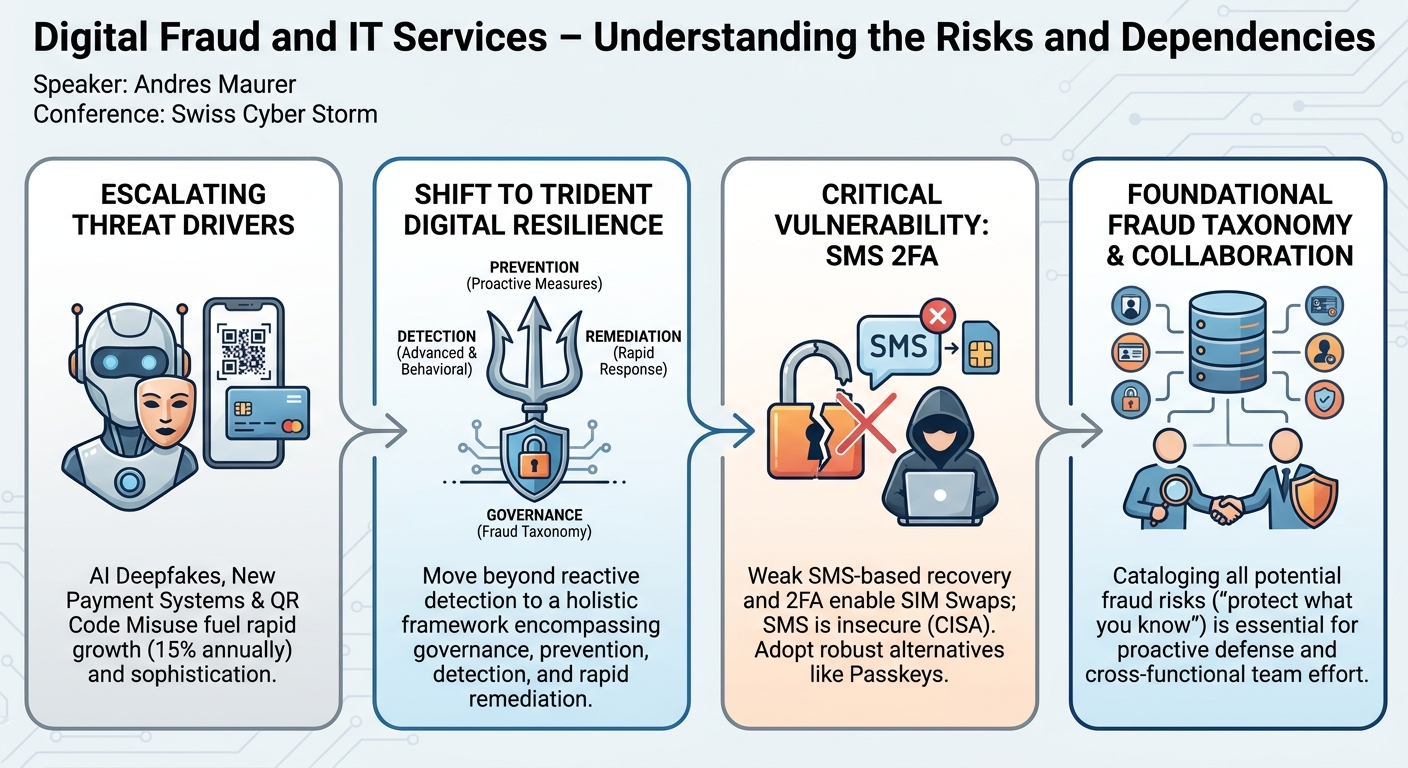
The core of Maurer's contribution is the introduction of the Trident Digital Resilience Framework, a holistic and systematic approach designed to empower both consumers and organizations to better anticipate, detect, and respond to digital fraud. This framework, along with a detailed discussion of regulatory efforts and practical defensive implications, positions the talk as an essential guide for anyone grappling with the complexities of securing digital interactions and financial transactions in the face of evolving cyber threats.
Background
▶ Watch: Detailed real-life SIM swap and identity theft case (2:15)
The landscape of digital fraud is vast and rapidly expanding, presenting a significant challenge to individuals, businesses, and governments worldwide. Andres Maurer sets the stage by illustrating the sheer scale of the problem. Globally, digital fraud losses are estimated to reach a staggering 580 billion US dollars by 2025, a figure reported by Nasdaq with Verafin. In the USA, the FBI reported 17.7 billion dollars in actual fraud claims, a number that Maurer suggests could be eight to nine times higher when unreported incidents are factored in, aligning closely with Nasdaq's global estimates. Critically, 85% of all reported frauds in the USA are cyber-enabled, underscoring the digital nature of the threat. Switzerland, despite its reputation for security, is not immune, experiencing approximately 1.9 billion Swiss francs in fraud losses annually, equating to roughly 1,000 francs per person. This places Switzerland among the top 20 nations globally for fraud, with Austria and Saudi Arabia surprisingly leading the pack.
Maurer attributes the rapid acceleration of digital fraud to several key drivers. Firstly, the exponential advancement of Artificial Intelligence (AI), particularly diffusion engines, is turbocharging the creation of highly realistic deepfakes and synthetic identities. He cites an example of a deepfake of Brad Pitt soliciting financial aid, which, despite its early imperfections, successfully defrauded individuals of significant sums. Today's AI capabilities make it increasingly difficult for even experts to distinguish between genuine and fabricated digital content, opening new avenues for sophisticated social engineering and identity impersonation.
Secondly, the continuous emergence of new payment systems and digital wallets introduces novel vulnerabilities. While these innovations aim for convenience, they often present unforeseen bugs or "funny behavior on edge cases" that fraudsters, acting as highly effective penetration testers, quickly exploit. This constant cycle of innovation and exploitation creates a moving target for security professionals. Thirdly, the misuse of everyday technologies like QR codes has become a prevalent fraud vector. Maurer highlights instances of malicious QR codes on parking meters and, more alarmingly, in physical scam letters designed to mimic legitimate financial communications. These letters often direct victims to fake e-banking login pages via embedded QR codes, leading to account takeover and financial depletion, as seen in cases impacting Swiss institutions like Raiffeisen and PostFinance. The confluence of these factors contributes to a frightening trend: digital fraud is growing at an alarming rate of 15% annually, a pace that current fraud detection mechanisms struggle to match, necessitating a strategic shift towards resilience.
Key Findings
▶ Watch: AI, new payment systems, QR codes drive fraud (10:45)
The central finding of Andres Maurer's presentation is the urgent necessity for a proactive, holistic approach to combat the escalating threat of digital fraud. He identifies that existing fraud detection methods, while advanced, are often reactive and cannot keep pace with the dynamic and increasingly sophisticated nature of attacks, especially those that originate outside traditional system boundaries. This realization underpins his primary contribution: the Trident Digital Resilience Framework.
Maurer argues that the industry must shift its focus from merely detecting fraud to building comprehensive resilience. His framework provides a structured methodology for achieving this, emphasizing that true resilience encompasses not only technological defenses but also robust governance, continuous threat intelligence, and rapid remediation capabilities. A critical component of this framework is the development of a detailed fraud taxonomy, which he stresses is fundamental for any organization to understand and protect against potential attack vectors. "You cannot protect what you don't know," Maurer succinctly states.
Another key finding highlighted by the real-life case study is the dangerous convergence of multiple attack techniques in targeted fraud campaigns. The victim experienced identity theft, SIM swapping, suspected malware/spyware, and account takeover of critical platform accounts like Apple ID and credit card apps. This demonstrates that modern fraudsters are not relying on single exploits but orchestrating complex, multi-stage attacks that exploit weaknesses across various digital touchpoints and human vulnerabilities.
Furthermore, Maurer identifies specific technical and process-related weaknesses that enable these sophisticated attacks. He points out that weak migration or account recovery processes, particularly those relying on SMS-based One-Time Authentication (OTA) codes, are critical enablers for SIM swap attacks. This vulnerability is so pronounced that the Cybersecurity and Information Security Agency (CISA)** declared SMS insecure for 2FA in December 2024, a declaration Maurer strongly reiterates. The challenge of detecting fake and synthetic identities, even for experienced Telco CISOs, is also a significant finding, necessitating a combination of technical controls and extensive employee training. Ultimately, the talk underscores that digital fraud is a systemic issue requiring a coordinated, multi-faceted defense strategy that extends beyond isolated security measures.
Technical Deep Dive
▶ Watch: Practical actions for consumers and platforms (16:00)
Andres Maurer's presentation provides a granular look into the technical underpinnings of modern digital fraud, detailing both the attack vectors and the proposed defensive architectures. The real-life case study serves as a masterclass in how multiple techniques converge to achieve a devastating outcome. The attack began with a malicious link in an SMS, likely leading to the installation of malware or spyware on the victim's phone. This initial compromise would have facilitated the exfiltration of personal data, potentially including credentials or copies of identification documents, leading to identity theft.
The critical escalation point was the SIM swap attack. Fraudsters, having acquired sufficient personal data (including a copy of the victim's partner's passport), managed to convince the telco to transfer the victim's mobile number to a new SIM card under their control. Maurer notes the fraudsters attempted this 14 times before succeeding on the 15th try by using a "new SIM number" after initial attempts from foreign numbers failed. This SIM swap then enabled account takeover of the victim's Apple ID and potentially other platform accounts. With control over the phone number, the fraudsters could intercept One-Time Authentication (OTA) codes sent via SMS, bypass Two-Factor Authentication (2FA), and gain access to the victim's Apple Wallet and associated credit card applications. The immediate availability of newly issued credit card details within the compromised app further exacerbated the problem, creating a "repeating cycle" of card cancellation and re-compromise. The fraudsters' modus operandi involved small initial purchases (e.g., "a little bit over 20 francs at a petrol station") to test card validity, followed by larger transactions (e.g., "2,200 Swiss francs at a Telco shop"), often aligning with common cash withdrawal limits to maximize illicit gains.
Maurer highlights that the underlying technical vulnerabilities enabling such attacks include weak account recovery processes that rely on insecure methods like SMS for 2FA. He explicitly references CISA's declaration in December 2024 that SMS is not secure for 2FA, urging a shift to more robust alternatives. The proliferation of deepfakes and synthetic identities, generated by advanced AI diffusion engines, poses a significant challenge during account opening and identity verification, as even experts struggle with identification.
To counter these sophisticated threats, Maurer introduces the Trident Digital Resilience Framework. This framework is structured around three core prongs, anchored by a robust governance base:
- Governance: This foundational layer requires organizations to establish a comprehensive fraud taxonomy – a detailed list of all potential fraud cases and risks. This continuous process ensures that organizations "cannot protect what they don't know" and remain agile against evolving threats.
- Prevention Prong: Focuses on proactive measures. For consumers, this means secure application usage, strong passwords, 2FA (or passwordless solutions like Passkeys), and awareness training. For platforms, it involves providing secure applications, robust processes, secure communication channels, protecting sensitive information (like key material and secrets), and critically, the ability to detect fake and synthetic identities during account creation. Maurer notes the difficulty of detecting SIM swapping and recommends a combination of technical controls and employee training.
- Detection Prong: While acknowledging the maturity of the vendor market in leveraging machine learning and AI for fraud detection, Maurer points out its limitations, especially for scams originating outside the system. For merchants, specific technical controls should include the ability to detect "multiple duplicate transactions," which are often "a red flag for monetization of illegal funds" and potential money laundering.
- Remediation Prong: This prong emphasizes rapid response. For consumers, it means being prepared to quickly cancel cards, deactivate digital wallets (e.g., through Apple account settings), and reset platform passwords (Google, Apple ID). For platforms, it involves having processes in place to quickly mitigate ongoing fraud, interrupt transactions, and, if possible, recover funds. A significant challenge here is managing compromised accounts where "bad guys and good guys" might both have access. Maurer also advocates for providing users with clear login history to enable self-detection of suspicious activity.
Maurer also briefly mentions the "pastry fork model" as a quick win strategy, emphasizing a strong fraud taxonomy, building security into software development from the outset, organizational compensation, and continuous customer awareness. This approach, he argues, can significantly increase fraud resistance "without writing one single line of code."
Demo / Proof of Concept
▶ Watch: FINMA guidance and Singapore's shared responsibility model (22:15)
Andres Maurer's presentation did not include a live technical demonstration or a traditional proof of concept involving code or exploit tools. Instead, the talk leveraged a highly detailed and compelling real-life case study as its primary illustrative example. This case study, involving a family friend who fell victim to a sophisticated digital fraud scheme, served as an impactful "proof of concept" for the multi-faceted nature of modern attacks and the vulnerabilities they exploit.
The case study meticulously walked the audience through the victim's experience, starting with a malicious SMS link received in Dubai, leading to a suspected malware infection. This initial compromise paved the way for identity theft, which was subsequently used to execute a SIM swap attack. With control over the victim's mobile number, the fraudsters gained access to her Apple Wallet and credit card applications, enabling them to add new cards and make multiple fraudulent purchases. The narrative highlighted the repeated attempts by the fraudsters to SIM swap (succeeding on the 15th try) and their continuous ability to access new credit card details even after cancellations, demonstrating the depth of the account takeover.
This real-world scenario effectively illustrated the convergence of social engineering, technical exploits (malware, SIM swap), and process weaknesses (SMS-based 2FA, telco handling of fraud cases as technical issues). It provided concrete examples of how fraudsters operate, from small test transactions to larger, targeted withdrawals, and the significant distress caused to victims. While not a technical demo in the conventional sense, this detailed account powerfully demonstrated the practical implications of the vulnerabilities and attack techniques that the Trident Digital Resilience Framework aims to address.
Defensive Implications
▶ Watch: Prediction: fraud will worsen due to digital adoption (28:20)
The defensive implications stemming from Andres Maurer's talk are extensive, targeting both individual consumers and large organizations, particularly those in the financial services sector. The overarching message for defenders is to embrace a holistic, resilience-focused strategy rather than relying solely on reactive detection.
For consumers, Maurer provides actionable advice rooted in the Prevention and Remediation prongs of his framework:
- Awareness and Information: Understand the risks associated with credit and debit cards, treating them like physical cash. Stay informed about current threats and scams (e.g., through BACS, NCSC reports, and upcoming Swiss Banking Association campaigns).
- Secure Practices: Use strong passwords, enable Two-Factor Authentication (2FA) where possible, and consider adopting passwordless solutions like Passkeys despite their "teething issues." Crucially, do not send copies of IDs or passports digitally, given AI's ability to create perfect copies.
- App and Security Settings: Learn how to use payment apps securely and configure appropriate security settings, such as restricting card usage geographically if not traveling. Enable security messages for all transactions.
- Proactive Monitoring: Regularly monitor payment transactions, especially when in high-risk situations (e.g., abroad). Early detection can lead to quick cancellation and potential fund recovery.
- Incident Preparedness: Prepare for inevitable incidents by knowing how to quickly cancel all cards, deactivate digital wallets (e.g., via Apple account settings), and reset platform passwords (Google, Apple ID).
For organizations and platforms, especially those in financial services, the implications are more profound, requiring systemic changes across Governance, Prevention, Detection, and Remediation:
- Comprehensive Fraud Taxonomy: Develop and continuously update a full list of fraud cases that could impact the organization and its clients. This forms the bedrock of a robust fraud risk management program.
- Protect Critical Information: Safeguard key material, secrets, and other trusted information.
- Robust Identity Verification: Implement mechanisms to detect fake and synthetic identities during account opening. This is a crucial challenge, particularly with the rise of AI-generated deepfakes.
- Secure Authentication and Recovery: Migrate away from SMS-based 2FA for authentication and account recovery, in line with CISA's December 2024 declaration that SMS is insecure. Invest in more robust alternatives.
- Enhanced Detection: Beyond standard fraud detection, implement controls to detect "multiple duplicate transactions," which are red flags for illicit activities like money laundering.
- Rapid Remediation: Develop processes for quick reaction to ongoing fraud, including interrupting transactions and recovering funds. Address the complex challenge of managing accounts that are simultaneously used by legitimate users and fraudsters.
- User Transparency: Provide users with clear login history to enable them to identify suspicious activity on their accounts.
- Clear Responsibilities: Establish clear ownership for digital fraud within the organization. Maurer warns against situations where "no one is responsible or everyone is responsible," both of which are detrimental.
- Cross-Functional Collaboration: Recognize digital fraud as a "team sport" requiring collaboration between fraud investigation, cybersecurity, threat intelligence, behavioral intelligence, and KYC (Know Your Customer) teams.
- Regulatory Compliance and Proactivity: Financial institutions must integrate digital fraud risk into their operational risk frameworks, as mandated by FINMA Guidance 02/2026. Proactively address challenges like deepfakes in online account opening. Maurer points to the Monetary Authority of Singapore's (MAS) model as an advanced example, which includes informing customers of high-risk transactions, providing investigation guidance, and a shared responsibility model with waterfall reimbursement. This model holds financial institutions liable first, then telcos, and finally the consumer, only after each party proves due diligence. MAS also uniquely has a law allowing government intervention in fraudulent payments, which, while trading some privacy, offers strong protection for vulnerable populations.
Maurer suggests that even without major overhauls, "quick wins" can be achieved by focusing on a strong fraud taxonomy, embedding security into development processes, and, most importantly, continuously raising customer awareness. This "pastry fork model" (as he playfully calls it) can immediately increase fraud resistance without writing a single line of code.
Key Takeaways
- Digital fraud is escalating rapidly: Fueled by AI-generated deepfakes, new payment systems, and QR code misuse, digital fraud is growing at 15% annually, with global losses projected at $580 billion by 2025.
- Shift from detection to resilience: Traditional fraud detection is insufficient; organizations and individuals must adopt a proactive, holistic approach to digital fraud resilience, encompassing governance, prevention, detection, and rapid remediation.
- Weak account recovery is a critical vulnerability: SMS-based Two-Factor Authentication (2FA) and account recovery processes are highly susceptible to SIM swap attacks, a weakness acknowledged by CISA in December 2024. Organizations must seek more robust alternatives.
- Comprehensive fraud taxonomy is foundational: Understanding and cataloging all potential fraud risks is essential for effective protection. "You cannot protect what you don't know."
- Digital fraud is a "team sport": Effective defense requires cross-functional collaboration between cybersecurity, fraud investigation, threat intelligence, behavioral intelligence, and KYC teams. Clear responsibility for digital fraud must be established within organizations.
- Consumer awareness and preparedness are paramount: Individuals must be educated on risks, practice secure digital hygiene, monitor transactions, and prepare for rapid incident response (e.g., card cancellation, account resets).
About the Speaker(s)
Andres Maurer is a seasoned professional with over 30 years of diverse industry experience, the last two decades of which have been primarily focused on the financial services sector. Initially starting his career as a project manager, he transitioned into IT security, continuously updating his expertise to include cloud technologies and, more recently, AI. His commitment to staying at the forefront of evolving threats is underscored by his latest certification in fraud risk management, which directly aligns with his current professional focus on digital fraud resilience.
Beyond his professional endeavors, Maurer is also deeply involved in promoting broader resilience and fostering innovation. He volunteers as an advisory board member for the Resilience Association, advocating for a holistic view of resilience that includes cyber resilience as a critical component. Additionally, he serves as a startup mentor and the president of Startup Academy Zurich, demonstrating his dedication to nurturing new ventures and sharing his extensive knowledge. Maurer also expresses a keen interest in agentic AI, believing in its potential to positively impact humanity if leveraged correctly.
Reviews
Dr. Zero (Offensive Security Researcher) — WEAK
This is a basic awareness session dressed up as a strategic keynote. We have known SMS 2FA is broken for a decade, and wrapping that reality in a proprietary "Trident" framework does not make it new research.
Heather Calloway (CISO) — STRONG ACCEPT
Maurer nails the institutional reality of modern fraud: it is no longer just a cybersecurity problem, and treating it like one guarantees failure. His breakdown of the regulatory liability waterfall and the required convergence of fraud, cyber, and KYC teams is required reading for any financial sector leadership team.