The Shadow Traffic Problem: Combating AI-Driven Automated Threats to Websites
Tin Zaw (Staff Technical Product Manager · Fastly)
Swiss Cyber Storm 2026 · Day 1 · Scenario
Overview
In an era where automated traffic now regularly surpasses human interactions on the internet, Tin Zaw, Staff Technical Product Manager at Fastly and co-lead of the OWASP Automated Threats to Web Applications project, presented a critical analysis of "The Shadow Traffic Problem." This talk at Swiss Cyber Storm delved into the escalating challenge posed by sophisticated bots, particularly those supercharged by artificial intelligence, and their profound impact on website operations and economics. Zaw illuminated how traditional bot mitigation strategies are becoming increasingly ineffective against this new wave of advanced, evasive automation.
Key moments
- 0:00 Introduction and the scale of bot traffic
- 3:20 The core problem: legitimate features abused by machines
- 10:30 Today's sophisticated 'shadow traffic' and scraping-as-a-service
- 13:40 AI's impact: bot traffic now exceeds human traffic
- 20:20 The problem is economic: charging for bot interactions
- 21:45 Proposed solutions: HTTP 402 and signed requests
- 26:15 Q&A: Fingerprinting challenges for CDNs and cost responsibility
The Shadow Traffic Problem: Combating AI-Driven Automated Threats to Websites
Speakers: Tin Zaw, Staff Technical Product Manager, Fastly
Conference: Swiss Cyber Storm
YouTube: https://www.youtube.com/watch?v=lPjK1Jcw41w
Overview
In an era where automated traffic now regularly surpasses human interactions on the internet, Tin Zaw, Staff Technical Product Manager at Fastly and co-lead of the OWASP Automated Threats to Web Applications project, presented a critical analysis of "The Shadow Traffic Problem." This talk at Swiss Cyber Storm delved into the escalating challenge posed by sophisticated bots, particularly those supercharged by artificial intelligence, and their profound impact on website operations and economics. Zaw illuminated how traditional bot mitigation strategies are becoming increasingly ineffective against this new wave of advanced, evasive automation.
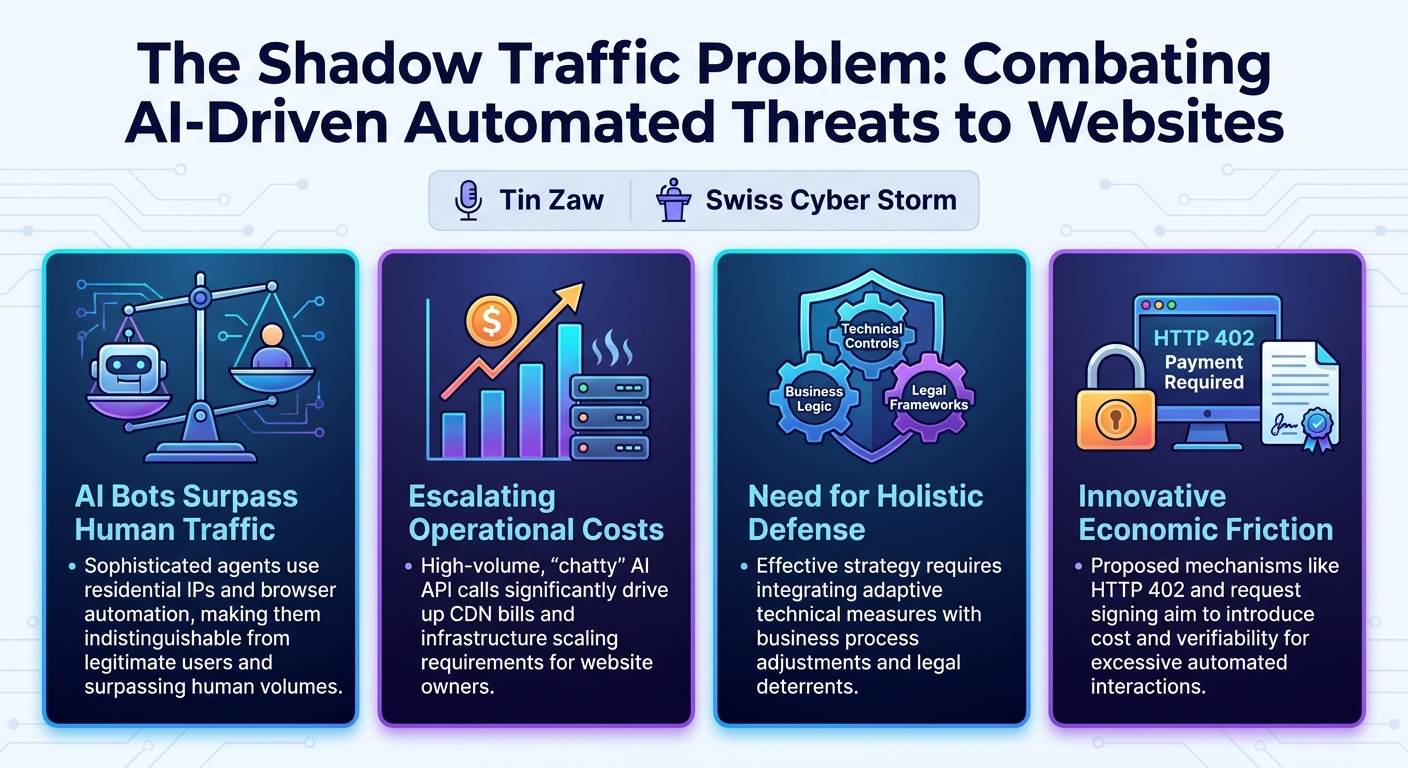
The core of the problem, as Zaw articulated, lies in the abuse of legitimate web application features by machines operating at scale and speed. These aren't just simple scrapers; they are full browser automation agents, often distributed across residential and mobile IPs, making them indistinguishable from human users. The advent of AI has further exacerbated this issue, creating "chattier" bots that generate significantly more traffic and operational costs, pushing the internet towards an economic breaking point where every interaction might eventually carry a price tag.
Zaw's presentation underscored the urgent need for a paradigm shift in how organizations perceive and combat automated threats. Moving beyond mere technical controls, he advocated for a holistic strategy encompassing business logic, legal frameworks, and continuous adaptation. The insights shared from Fastly's unique vantage point as a Content Delivery Network (CDN) provider, coupled with the comprehensive framework developed by the OWASP project, offer critical guidance for defenders grappling with this rapidly evolving and economically significant challenge.
Background
▶ Watch: Introduction and the scale of bot traffic (0:00)
The journey into understanding and combating automated threats to web applications gained significant traction with the inception of the OWASP Automated Threats to Web Applications project in 2015. Initiated by Colin Watson, the project aimed to categorize and define the diverse array of automated attacks that exploit legitimate application features. Tin Zaw joined as a co-lead in 2016, contributing extensively to the project's output: an ontology of attacks, real-world examples, and practical countermeasures. This foundational work recognized that unlike traditional vulnerabilities, automated threats often don't stem from exploitable bugs but rather from the abuse of features working precisely as intended for human users, but at machine speed and scale. This makes them impossible to "patch" in the conventional sense.
Initially, the cybersecurity community's understanding of bots was relatively simplistic. Common assumptions held that bots originated from cluster IPs or data centers, lacked JavaScript execution capabilities, would fail CAPTCHA challenges, and exhibited fast, repetitive traffic patterns, making them amenable to rate-limiting. However, this early model proved inadequate as attackers rapidly evolved their tactics. The OWASP project, therefore, developed a comprehensive list of 20 distinct attack vectors, meticulously defining the mechanisms and immediate threats rather than just the attacker's end goal. For instance, Cracking (a dictionary attack to guess credentials) and Stuffing (using stolen credentials from other breaches) both aim for account takeover, but their underlying signals and required countermeasures are fundamentally different.
As the threat landscape evolved, so did the OWASP ontology. Around 2016, a new category emerged to address the abuse of limited-item sales: Denial of Inventory. This attack focuses on monopolizing scarce resources like concert tickets or promotional airfares, causing direct financial harm to businesses. More recently, the project updated its definition of Ad Fraud to Cost Inflation Fraud, encompassing broader scenarios like SMS Pumping, where attackers exploit legitimate SMS sending services to incur charges for the website operator. These updates highlight the project's continuous effort to provide a relevant and actionable framework for a problem that is constantly shifting. The countermeasures developed by the project are also holistic, spanning technical controls like rate limiting and monitoring, as well as business considerations like contractual terms and conditions and value of goods. They are mapped across the Software Development Lifecycle (SDLC) stages (e.g., builder for code changes, defender for external controls) and categorized by their purpose: prevent, detect, or recover (post-transaction actions). This comprehensive approach forms the backdrop against which the current "shadow traffic problem" is understood and addressed.
Key Findings
▶ Watch: Today's sophisticated 'shadow traffic' and scraping-as-a-service (10:30)
The talk revealed a stark reality: the internet's traffic composition has fundamentally shifted. Data from Cloudflare in May indicated that bot traffic had already surpassed human traffic, a trend corroborated and further expanded by Fastly's insights from August/September of the same year. This surge is not merely an increase in volume but a dramatic evolution in sophistication, driven significantly by AI.
Tin Zaw highlighted several critical findings:
- Sophisticated Shadow Traffic: Today's bots, termed "shadow traffic," are far more advanced than their predecessors. They originate from residential and mobile IPs, making them difficult to distinguish from legitimate users. They utilize full browser automation, capable of running JavaScript and solving complex challenges, often with human assistance (e.g., CAPTCHA farms) if automated solutions fail. Crucially, they are random and paced, avoiding the tell-tale spikes of older botnets, thereby evading traditional rate-limiting defenses.
- "Scraping as a Service" (SaaS): The proliferation of commercial services offering advanced scraping capabilities further democratizes sophisticated bot attacks. These services boast the ability to mimic residential users, scrape any website globally, and deliver structured data in real-time, effectively outsourcing the complexity of large-scale automated abuse.
- Backdoor Access to Devices: A significant contributor to the residential IP bot problem is the compromise of millions of cheap, internet-connected devices (e.g., picture frames, smart TVs) through ambiguous End-User License Agreements (EULAs). Users unwittingly grant access to their devices, which are then occasionally used to send web requests, creating a vast, distributed, and stealthy botnet that largely goes unnoticed by the device owners.
- AI's Amplifying Effect: AI has become a primary driver of bot traffic. Fastly's data revealed a multi-fold increase in AI-driven traffic, with AI code generation showing a staggering 34 times increase in activity. The Python Package Index (PyPI), a service Fastly supports, exhibited a "J-curve" growth in traffic directly correlating with the release of AI models like ChatGPT.
- "Chattier" AI Agents: A key characteristic of AI agents is their conversational nature. Before making a purchase or completing a transaction, they send a significantly higher volume of API calls, asking numerous questions about products, reviews, and features. This "chattiness" dramatically increases the operational cost for website operators, even if the infrastructure can handle the load, primarily due to increased CDN bills.
- Masquerading as AI Crawlers: A joint study by Fastly and GreyNoise revealed a concerning trend: a large number of user agents are intentionally pretending to be legitimate AI crawlers (e.g., "AI crawler"). Attackers assume that website operators, eager to be indexed by new AI services, will be less likely to block these agents, providing a new vector for evasion.
- Anticipated Video Traffic: Zaw warned that the current situation is just the beginning. While AI agents are already generating significant API traffic, widespread adoption of AI agents for tasks like watching videos will further escalate bandwidth usage and associated costs, presenting an even greater challenge.
These findings collectively paint a picture of an internet grappling with an existential economic and operational challenge, where the lines between legitimate and malicious automation are increasingly blurred, and the cost of doing business online is rapidly rising due to unwanted machine interactions.
Technical Deep Dive
▶ Watch: AI's impact: bot traffic now exceeds human traffic (13:40)
The OWASP Automated Threats to Web Applications project, co-led by Tin Zaw, provides a robust ontology of 21 distinct attack vectors, offering a granular understanding of how automated threats manifest. This framework is crucial because it differentiates attacks not by their ultimate goal but by their mechanisms and immediate threats, enabling more precise detection and mitigation. For instance, Account Takeover can occur via Cracking (dictionary attacks, brute-forcing credentials) or Stuffing (using previously compromised credential pairs from other breaches). While both aim to compromise an account, the signals to detect them (e.g., repeated failed logins from various IPs for cracking vs. successful logins from diverse IPs for stuffing) and the appropriate countermeasures differ significantly.
The project continuously updates its threat categories to reflect evolving attack methods. A notable addition was Denial of Inventory, introduced to address bots that rapidly reserve or purchase limited-edition goods, concert tickets, or promotional items, effectively denying legitimate customers access and causing direct financial harm to businesses. More recently, Ad Fraud was redefined as Cost Inflation Fraud to encompass a broader range of monetary abuses, including SMS Pumping, where attackers exploit legitimate SMS services to generate high costs for the website operator by triggering numerous premium-rate messages.
The countermeasures proposed by the OWASP project are designed for a holistic defense, categorized by their application within the Software Development Lifecycle (SDLC) and their defensive purpose. SDLC stages include the builder (developers who can modify code) and the defender (operations teams who implement external controls like WAFs or proxies). Countermeasure types are prevent (stopping the attack before it occurs), detect (identifying an attack in progress), and recover (post-transaction actions like cancelling fraudulent orders). This framework emphasizes that security is not solely a technical problem but involves business processes and contractual agreements.
Zaw highlighted the critical shift in bot capabilities, rendering previous assumptions obsolete:
| Old Bot Assumptions (circa 10 years ago) | Today's Shadow Traffic (AI-driven) H2AI, the integration of AI into bot operations has made detection significantly more challenging. These advanced bots are not merely generating more traffic; they are creating realistic, human-like interaction patterns that defeat traditional statistical anomaly detection. Fastly's observations indicate that AI traffic, particularly for tasks like AI code generation, has seen a 34x increase, leading to a "J-curve" growth in traffic for associated services like PyPI.
The economic implications are severe. Zaw described AI agents as "chattier," meaning they generate a significantly higher volume of API calls and data requests before a transaction, thereby increasing the operational costs for website owners. This includes increased CDN bills and higher resource utilization. Furthermore, the practice of user agents falsely identifying as "AI crawlers" (a finding from a joint study with GreyNoise) underscores the desire of malicious actors to exploit the perceived legitimacy of AI services to bypass security measures. This suggests a strategic attempt to leverage the "AI halo effect" to avoid blocking.
This new reality necessitates a continuous and adaptive defense strategy. Zaw emphasized that it's "not a rule set" that can be deployed and forgotten; rather, it requires constant monitoring and improvement across three phases: before transaction (prevention), during transaction (detection and blocking), and post transaction (recovery). This iterative approach is crucial for staying ahead of rapidly evolving automated threats.
Demo / Proof of Concept
▶ Watch: Proposed solutions: HTTP 402 and signed requests (21:45)
The conference talk did not include a live demonstration or a specific proof of concept of an attack or defense mechanism. Instead, Tin Zaw focused on presenting a comprehensive analysis of the "shadow traffic problem" based on Fastly's extensive data and the theoretical framework developed by the OWASP Automated Threats project.
Defensive Implications
▶ Watch: Q&A: Fingerprinting challenges for CDNs and cost responsibility (26:15)
The rise of AI-driven shadow traffic demands a fundamental re-evaluation of defensive strategies. Traditional bot mitigation, focused on simple rate limiting or IP blocking, is largely ineffective against sophisticated, distributed, and adaptive bots. Defenders must adopt a holistic, multi-layered approach that transcends purely technical controls, integrating business logic, legal considerations, and continuous adaptation.
Firstly, the core principle is that security is "not a rule set" that can be deployed and forgotten; it requires continuous improvement and monitoring. Defenses must be adaptive, operating across the entire transaction lifecycle:
- Before Transaction (Prevention): This involves establishing robust front-line defenses. While rate limiting is challenged by paced bots, advanced fingerprinting techniques that analyze browser characteristics, JavaScript execution, and client-side telemetry (e.g., Fastly's proprietary Java 4+ checks) remain crucial. Legal frameworks, such as clear terms and conditions, can also serve as a deterrent and provide legal recourse.
- During Transaction (Detection and Blocking): Real-time analysis is paramount. This includes behavioral anomaly detection to identify "chattier" AI agents that make excessive API calls or exhibit unusual interaction patterns. CDN providers, with their vantage point at the edge, play a critical role in observing and filtering this traffic. The speaker also proposed exploring new HTTP status codes like HTTP 402 "Payment Required" as a mechanism to introduce friction for overly aggressive bots, signaling a paywall or credit exhaustion before further resource consumption.
- Post Transaction (Recovery): Even with robust prevention and detection, some sophisticated bots may succeed. Defenders must have mechanisms for post-transaction recovery, such as the ability to cancel fraudulent orders, revoke bookings, or prevent shipment of goods identified as illicitly acquired.
Secondly, the economic dimension of shadow traffic cannot be ignored. The speaker framed the problem as fundamentally economic, similar to a physical store incurring costs from non-buying visitors. Website operators are currently bearing the significant costs of unwanted bot traffic through increased CDN bills, higher infrastructure scaling requirements, and wasted computational resources. This necessitates a shift in thinking: rather than simply blocking, organizations might need to consider strategies that monetize or disincentivize excessive bot interaction. The proposal of HTTP 402 and the RFC for signing requests (where requests are signed by a private key and verified against a public key at a well-known source) are forward-thinking technical solutions that could enable more granular control and potentially introduce a "cost" for interactions.
Finally, defenders must acknowledge the blurred lines between wanted and unwanted automation. While aggressive mass crawling needs to be mitigated, allowances for legitimate "small crawling" (e.g., backlink checkers for SEO) are essential for a healthy internet ecosystem. This requires intelligent systems that can differentiate between occasional, low-impact automated requests and persistent, resource-draining bot activity. The responsibility for this distinction is shared, but CDN providers are increasingly expected to offer sophisticated tools that empower customers to define their tolerance levels and manage these costs effectively.
Key Takeaways
- Bots Dominate Internet Traffic: Automated bot traffic now consistently exceeds human traffic, driven by increasingly sophisticated and AI-powered agents, posing a significant challenge to web operations.
- AI Enhances Evasion: AI enables bots to mimic human behavior, use residential IPs, run full browser automation, and pace their requests, making them extremely difficult to detect with traditional security measures.
- Economic Burden on Operators: AI-driven "chattiness" (high API call volume) and masquerading as legitimate crawlers significantly increase operational costs for website owners, primarily through CDN bills and infrastructure scaling.
- Holistic, Adaptive Defense Required: Effective defense against shadow traffic demands a continuous, adaptive strategy that integrates technical controls, business logic, and legal frameworks across prevention, detection, and recovery phases.
- New Mechanisms for Control: Innovative solutions like the HTTP 402 "Payment Required" status code and RFC-defined request signing offer promising avenues for introducing economic friction and verifiable interactions for automated traffic.
- The Problem is Fundamentally Economic: The long-term sustainability of web services requires a re-evaluation of how online interactions are valued and potentially monetized, moving towards a model where excessive, unwanted automation incurs a cost.
About the Speaker(s)
Tin Zaw is a Staff Technical Product Manager at Fastly, a leading edge cloud platform. In his role, he is responsible for critical product areas including DDoS mitigation, bot management, and application security. With a career spanning back to 2003 in cybersecurity, preceded by experience as a software engineer in infrastructure, Zaw brings a deep technical and operational understanding to the challenges of web security. He is also a prominent figure in the open-source security community, serving as a co-lead for the OWASP Automated Threats to Web Applications project since 2016 (having joined the project in 2015). Through this OWASP initiative, he has significantly contributed to the development of an ontology of automated attacks, providing practical examples and countermeasures that are widely utilized by security professionals.
Reviews
Dr. Zero (Offensive Security Researcher) — SOLID
A competent landscape briefing on modern bot traffic and the OWASP automated threats ontology. Zaw correctly identifies the economic pain of scraping-as-a-service, but wraps standard distributed browser automation in unnecessary 'AI-driven' marketing speak.
Heather Calloway (CISO) — SOLID
Tin Zaw frames the AI bot problem exactly how your CFO already sees it: as a massive, escalating line item on your CDN bill. By mapping the OWASP automated threat ontology to actual business economics, this talk bridges the gap between edge engineering and corporate P&L. Strong, pragmatic material for any security leader managing a large consumer web footprint.