Vulnerability Management in the Age of AI
Jeroen van der Ham-de Vos
Swiss Cyber Storm 2026 · Day 1 · Arena
Overview
In an era defined by an unprecedented explosion of new vulnerabilities, traditional approaches to vulnerability management (VM) are failing. Jeroen van der Ham-de Vos, an Associate Professor at the University of Twente and a seasoned expert in vulnerability disclosure, delivered a compelling talk at Swiss Cyber Storm, highlighting the critical shortcomings of the widely adopted Common Vulnerability Scoring System (CVSS). His presentation, "Vulnerability Management in the Age of AI," argues that CVSS, despite its ubiquity, is fundamentally ill-equipped to help organizations manage risk effectively in the current threat landscape.
Key moments
- 1:50 The exploding number of CVEs
- 8:15 CVSS: Understanding severity vs. true risk
- 12:00 Why KEV list and EPSS aren't enough
- 16:00 Introducing SSVC: A decision tree approach
- 19:15 SSVC: Separating technical and business context
- 22:00 The National Vulnerability Database (NVD) crisis
- 28:00 Q&A: From patching to strategic security posture
- 32:00 Q&A: Communicating vulnerability impact to the board
Vulnerability Management in the Age of AI
Speakers: Jeroen van der Ham-de Vos, Associate Professor, University of Twente
Conference: Swiss Cyber Storm
YouTube: https://www.youtube.com/watch?v=R2UvHGzMlgE
Overview
In an era defined by an unprecedented explosion of new vulnerabilities, traditional approaches to vulnerability management (VM) are failing. Jeroen van der Ham-de Vos, an Associate Professor at the University of Twente and a seasoned expert in vulnerability disclosure, delivered a compelling talk at Swiss Cyber Storm, highlighting the critical shortcomings of the widely adopted Common Vulnerability Scoring System (CVSS). His presentation, "Vulnerability Management in the Age of AI," argues that CVSS, despite its ubiquity, is fundamentally ill-equipped to help organizations manage risk effectively in the current threat landscape.
The core problem, as van der Ham-de Vos articulates, is a growing "waterfall of information" – an overwhelming volume of Common Vulnerabilities and Exposures (CVEs) that renders manual prioritization impossible. He contends that CVSS measures technical severity rather than actual organizational risk, leading to misinformed decisions and analyst burnout. The talk introduces Stakeholder-Specific Vulnerability Categorization (SSVC) as a superior, action-oriented framework that explicitly integrates business context, offering a more intuitive and efficient path to vulnerability prioritization and remediation. This shift is crucial for organizations to move beyond reactive patching and adopt more strategic, preventative security postures.
Background
▶ Watch: The exploding number of CVEs (1:50)
The landscape of cybersecurity is currently undergoing a radical transformation, primarily driven by an exponential increase in identified vulnerabilities. Van der Ham-de Vos starkly illustrates this trend, noting that in the year of his talk (2024), the number of CVEs had already surpassed 80,000, more than double the 40,000 reported in the entirety of the previous year. This translates to over 400 new CVEs per day, a volume that has pushed existing vulnerability management frameworks to their breaking point. The speaker, himself a regular publisher of CVEs and a contributor to the CVSS standard, speaks from direct experience about the systemic stress this volume places on organizations.
At the heart of traditional vulnerability management lies CVSS, a standardized system designed to provide a numerical score (0-10) reflecting the severity of a vulnerability. CVSS scores are commonly cited in news headlines, with "CVSS 10" vulnerabilities often sparking immediate alarm. The system is structured into several modules, with the Base Score being the most frequently used. This score considers technical aspects such as the CIA triad (Confidentiality, Integrity, Availability impact), attack vector, and attack complexity. However, van der Ham-de Vos critiques the genesis of these scores, revealing that the constants within the CVSS calculation formulas were "magic numbers," essentially "made up by people who are part of the CVSS working group." For CVSS version 4, the methodology shifted to an expert-driven approach where scores are assigned based on a representative set of vulnerabilities, essentially boiling down to "because experts say that it is a 10."
A fundamental flaw, according to van der Ham-de Vos, is that CVSS explicitly measures severity, not risk. The official manual states this, yet organizations routinely misuse CVSS scores as a proxy for risk. A high CVSS score indicates a severe technical impact if exploited, but it provides no insight into the likelihood of exploitation, the exposure of the affected system, or the actual business impact on a specific organization. To address some of these gaps, CVSS has evolved to include additional modules. The Threat Metric Group, for instance, can adjust the score based on whether an exploit is publicly available. The US government's Known Exploited Vulnerabilities (KEV) list further aids in identifying vulnerabilities actively being exploited in the wild. While useful, the KEV list is inherently reactive; as the speaker points out, if a vulnerability is on the KEV list, it means it has already been exploited, potentially leaving systems connected to the internet vulnerable. He shares a personal anecdote about the Dutch Institute for Vulnerability Disclosure (DIVD), where a Zammad system vulnerability with a low EPSS score (5%) was exploited, immediately landing it on the KEV list.
The Exploit Prediction Scoring System (EPSS), a machine learning model, attempts to predict the probability of a vulnerability being exploited in the next 30 days. While an improvement, EPSS also has limitations. Its probabilistic nature is difficult for humans to grasp, and a low score doesn't guarantee safety (as shown by the Zammad incident). Critically, EPSS relies on past data, and the current "paradigm shift" in vulnerability publication rates may undermine its predictive accuracy. The Environmental Metric in CVSSv4, intended to incorporate organizational context, demands an extensive asset management system and requires security teams to assess numerous factors for each asset. This represents an enormous workload, often without a clear actionable outcome, further underscoring the impracticality of CVSS for effective risk management.
Adding to these systemic issues, the talk reveals a significant crisis at the National Vulnerability Database (NVD), historically the primary source for CVSS scores. Starting in 2024, the NVD began experiencing severe capacity issues, leading to a drastic reduction in the vulnerabilities it could score. By 2026 (the speaker's projected timeline based on current trends), the NVD had effectively admitted defeat, only scoring "mission-critical" vulnerabilities and delegating the rest to vendors. This shift introduces inconsistency, as vendors may score vulnerabilities differently based on their own interests, further eroding the reliability and comparability of CVSS scores across the industry. This collective breakdown underscores the urgent need for a new paradigm in vulnerability management.
Key Findings
▶ Watch: Why KEV list and EPSS aren't enough (12:00)
Jeroen van der Ham-de Vos's presentation culminates in several critical findings that challenge the foundational assumptions of modern vulnerability management:
- CVSS is Obsolete and Misleading: The speaker emphatically states that CVSS, designed to measure technical severity, is no longer fit for purpose as a risk management tool. Its "magic numbers" and expert-driven scoring lack transparency, and its inability to explicitly incorporate organizational context renders it an inadequate approximation of true risk. The sheer volume of new CVEs (over 80,000 in 2024) has completely overwhelmed the system, making a 0-10 score an insufficient and often unhelpful metric for prioritization.
- The NVD Crisis Undermines Score Consistency: The National Vulnerability Database (NVD), once the authoritative source for CVSS scores, is suffering from severe capacity issues. This has led to a dramatic reduction in NVD-assigned scores, with the responsibility increasingly shifting to vendors. This decentralization introduces significant inconsistencies and biases, making it impossible to rely on CVSS scores as a standardized, objective measure across different products and organizations.
- Business Context is Paramount and Must Be Explicit: The most crucial finding is that effective vulnerability management must explicitly integrate an organization's unique business context. Current systems, including CVSS's environmental metrics, either fail to do this adequately or demand an impractical level of effort. Vulnerability analysts are often technical experts lacking business acumen, leading to a disconnect between technical severity and actual organizational impact.
- SSVC Offers a Superior, Action-Oriented Framework: The talk champions Stakeholder-Specific Vulnerability Categorization (SSVC) as a transformative alternative. Instead of generating a numerical score, SSVC uses a decision tree to directly output an action (e.g., "Act Immediately," "Track," "Defer"). This framework forces explicit consideration of business context and provides an auditable trail for decisions, making prioritization clearer, faster, and more aligned with organizational risk appetite.
- Separation of Concerns Improves Efficiency and Reduces Burnout: SSVC's design explicitly separates technical properties of a vulnerability (e.g., exploitability, technical impact) from contextual, organization-specific properties (e.g., mission impact, system exposure). This allows technical experts to focus on what they do best, while business stakeholders can provide essential context, fostering better communication and reducing the burden and potential for burnout among vulnerability analysts.
Technical Deep Dive
▶ Watch: SSVC: Separating technical and business context (19:15)
The technical core of the talk revolves around a critical examination of CVSS and the introduction of SSVC as a more robust alternative. Van der Ham-de Vos dissects CVSS, explaining its modular structure. The CVSS Base Score, the most commonly cited, evaluates a vulnerability's inherent characteristics. It considers the Attack Vector, Attack Complexity, Privileges Required, and User Interaction for exploitability, alongside the Confidentiality, Integrity, and Availability (CIA) impacts on the vulnerable system. However, the speaker highlights the "magic numbers" embedded in the calculation formula of older versions, and the current expert-driven assignment process for CVSSv4, which essentially means scores are determined by a consensus of experts rather than a truly objective, empirically derived formula. This subjective foundation is a major weakness, particularly when the score is then misconstrued as a definitive measure of risk.
Further CVSS modules, like the Threat Metric Group, attempt to incorporate real-world threat intelligence by adjusting the score based on factors like whether an exploit is available or if the vulnerability is being actively exploited. The Environmental Metric (introduced in CVSSv4) is designed to allow organizations to tailor the score based on their specific environment, considering factors like the presence of security controls, the value of the affected asset, and its business criticality. While conceptually sound, its implementation requires an exhaustive asset management system and a detailed assessment for each asset, which is practically unfeasible for most organizations given the volume of vulnerabilities. This module's complexity often leads to it being underutilized or ignored, rendering CVSS scores largely generic and context-agnostic.
The speaker then introduces Stakeholder-Specific Vulnerability Categorization (SSVC) as a paradigm shift. SSVC abandons the idea of a single numerical score in favor of a decision tree model. The core principle is that the output of vulnerability analysis should be a direct action, not an abstract number. This action is determined by navigating a series of objective, measurable decision points.
Van der Ham-de Vos illustrates SSVC with a partial decision tree example. Key decision points include:
- Exploitation: Is there a proof of concept (PoC) available? Is it actively exploited? This moves beyond simple "exploit available" to a more nuanced view of the threat.
- Exposure: How exposed is the vulnerable system? Options might include "Small" (e.g., internal, limited access), "Controlled" (e.g., behind a firewall, specific access controls), or "Open" (e.g., directly internet-facing). This is a crucial contextual factor that CVSS often struggles to integrate effectively.
- Mission Impact: What is the business impact if this system fails? This is directly tied to the organization's operations. Examples range from "Minimal" to "Catastrophic" (e.g., "my business will stop running"). This is far more intuitive for business stakeholders than a technical impact score.
- Safety Impact: Will people die if this system fails? This is particularly relevant for critical infrastructure, medical devices, or industrial control systems.
A key technical innovation of SSVC is its explicit separation of technical properties (which are generally universal and can be assessed by security vendors or external experts) from contextual properties (which are unique to each organization and must be determined internally). For example, whether an exploit exists is a technical property. However, the "Mission Impact" of a system failure is a contextual property. This division allows organizations to leverage external expertise for technical analysis while empowering internal teams to apply their specific business knowledge, streamlining the decision-making process. The speaker notes that the US government has adopted an SSVC-like system for federal agencies, underscoring its practical applicability and effectiveness in large-scale vulnerability management.
Demo / Proof of Concept
▶ Watch: The National Vulnerability Database (NVD) crisis (22:00)
While the talk did not feature a live, interactive software demonstration, Jeroen van der Ham-de Vos effectively presented the conceptual "proof of concept" for SSVC by walking the audience through an illustrative decision tree. He displayed a simplified SSVC tree structure, highlighting how different choices at each node lead to a specific, actionable outcome rather than a numerical score.
The demonstration involved tracing a hypothetical vulnerability through several decision points:
- Exploitation: Assuming a Proof of Concept (PoC) is available.
- Exposure: Considering the system's exposure as "Controlled".
- Mission Impact: Assessing the business criticality, for example, if the system's failure would halt business operations.
- Safety Impact: Evaluating if human lives would be at risk.
By methodically progressing through these nodes, the speaker illustrated how SSVC guides an analyst to a concrete action like "Act Immediately" or "Defer." This walkthrough served as a clear, conceptual demonstration of how SSVC translates technical vulnerability data and organizational context into direct, unambiguous remediation instructions. It showed how SSVC's objective, measurable decision points create an auditable trail for vulnerability management decisions, contrasting sharply with the often subjective interpretation of a CVSS score.
Defensive Implications
▶ Watch: Q&A: Communicating vulnerability impact to the board (32:00)
The implications of van der Ham-de Vos's analysis for security defenders are profound and necessitate a fundamental rethinking of vulnerability management strategies.
Firstly, organizations must deprioritize CVSS scores as the primary driver for remediation efforts. While CVSS can still provide a baseline understanding of technical severity, it should no longer be the sole or even primary metric for determining risk and action. Defenders should instead pivot towards a framework like SSVC (Stakeholder-Specific Vulnerability Categorization).
Implementing SSVC means developing tailored decision trees that reflect the organization's unique risk appetite and business context. This requires collaboration between technical security teams and business stakeholders to define what "mission impact" and "safety impact" truly mean for their specific assets. By explicitly separating technical vulnerability properties from contextual business properties, SSVC enables more efficient and accurate prioritization. Technical analysts can focus on the exploitability and technical impact, while business owners contribute critical information about asset value and operational criticality.
For Shadow IT, a pervasive challenge in many organizations, van der Ham-de Vos proposes a proactive, "assume critical" approach. When an unmanaged or unknown asset is discovered with vulnerabilities, defenders should initially assume it is mission-critical. Scoring its vulnerabilities under this assumption will often flag them for immediate patching. This strategy serves a dual purpose: it forces rapid remediation for potentially high-risk systems and incentivizes business owners to properly register their assets and provide accurate context, thereby improving overall asset management.
Beyond immediate patching, SSVC facilitates a shift from reactive to strategic vulnerability management. By using SSVC to evaluate past decisions and analyze trends, organizations can identify systemic weaknesses in their security posture. For example, if a particular system consistently generates high-priority SSVC outcomes, it might indicate a need for more fundamental architectural changes, like implementing stronger firewalls, improving access controls, or re-architecting the system for greater resilience, rather than just patching individual vulnerabilities. This proactive approach helps address the root causes of risk and reduces the overall attack surface.
Finally, adopting SSVC can significantly reduce analyst burnout. By providing a clear, structured framework for decision-making, it removes much of the ambiguity and subjective burden currently placed on vulnerability analysts. It streamlines the prioritization process, making it a matter of seconds rather than hours, and fosters clearer communication between technical and business teams, ensuring that remediation efforts are aligned with actual organizational risk and capacity.
Key Takeaways
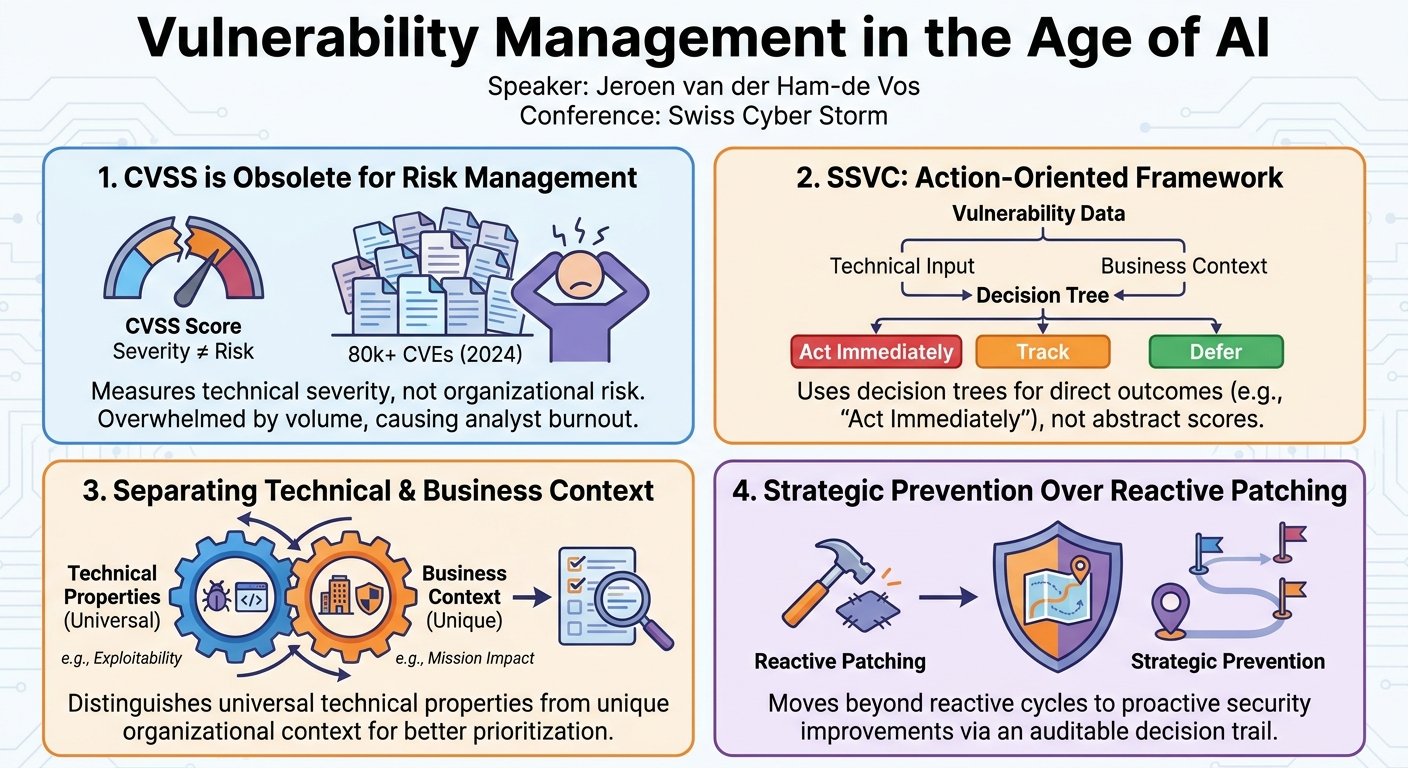
- CVSS is Obsolete for Risk Management: The Common Vulnerability Scoring System (CVSS) measures technical severity, not organizational risk, and is overwhelmed by the sheer volume of new CVEs (over 80,000 in 2024), leading to ineffective prioritization and analyst burnout.
- SSVC Offers a Superior, Action-Oriented Approach: Stakeholder-Specific Vulnerability Categorization (SSVC) utilizes decision trees to generate direct, actionable outcomes (e.g., "Act Immediately") instead of abstract scores, explicitly integrating business context into vulnerability management.
- Contextualization is Key: SSVC effectively separates universal technical vulnerability properties from unique organizational contextual properties (like mission and safety impact), enabling better collaboration between technical and business stakeholders.
- Strategic Prevention Over Reactive Patching: By providing clearer prioritization and an auditable decision trail, SSVC helps organizations move beyond a reactive "patch everything" mentality towards strategic improvements in security posture and preventative measures.
- Address Shadow IT Proactively: For unmanaged or unknown assets, assume mission-criticality when scoring vulnerabilities with SSVC. This forces rapid remediation and incentivizes business owners to properly register assets, improving overall asset visibility and management.
- Empower Analysts and Improve Communication: SSVC streamlines the decision-making process, reducing ambiguity and fostering clearer communication between technical teams and business leadership, thereby reducing analyst burnout and ensuring remediation efforts align with actual business risk.
About the Speaker(s)
Jeroen van der Ham-de Vos is an Associate Professor at the University of Twente, specializing in cybersecurity. His diverse academic and professional background spans artificial intelligence, networking, and, more recently, vulnerability management. He is a recognized expert in the field, having contributed to the CVSS standard and served as an international expert on Coordinated Vulnerability Disclosure (CVD) policy. Van der Ham-de Vos is actively involved in the vulnerability ecosystem, regularly publishing CVEs himself. He is also a volunteer at the Dutch Institute for Vulnerability Disclosure (DIVD), an organization that scans the internet for vulnerable systems and notifies affected parties, giving him practical, real-world experience in the challenges of vulnerability management. His extensive experience allows him to offer a unique perspective on the systemic issues facing vulnerability management today.
Reviews
Dr. Zero (Offensive Security Researcher) — SOLID
Jeroen van der Ham-de Vos gives a necessary, if slightly overdue, eulogy for CVSS and the collapsing NVD. The title promises AI, but the session is purely a pragmatic argument for adopting CISA's SSVC framework to stop drowning in 80,000 CVEs a year.
Heather Calloway (CISO) — STRONG ACCEPT
The National Vulnerability Database is functionally breaking down, and CVSS was never a risk metric to begin with. This talk formally buries the idea that you can run a vulnerability management program by chasing 10s. If your VM team is still gating patching SLAs on CVSS base scores, your program is broken, and SSVC is the framework you need to fix it.