Shadow IT: Mapping Switzerland's External Attack Surface
Mazin Ahmed (Application Security and Offensive Security Engineer, Founder · FullHunt)
Swiss Cyber Storm 2026 · Day 1 · Arena
Overview
In his compelling talk at Swiss Cyber Storm, Mazin Ahmed, founder of FullHunt.io, presented a deep dive into the often-overlooked yet critically dangerous realm of Shadow IT. His research focused on meticulously mapping the external attack surface of an entire nation, with Switzerland serving as a detailed case study. Ahmed's presentation underscored the pervasive challenge organizations face in maintaining a comprehensive inventory of their internet-facing assets, revealing a landscape rife with forgotten systems, misconfigured services, and easily exploitable vulnerabilities.
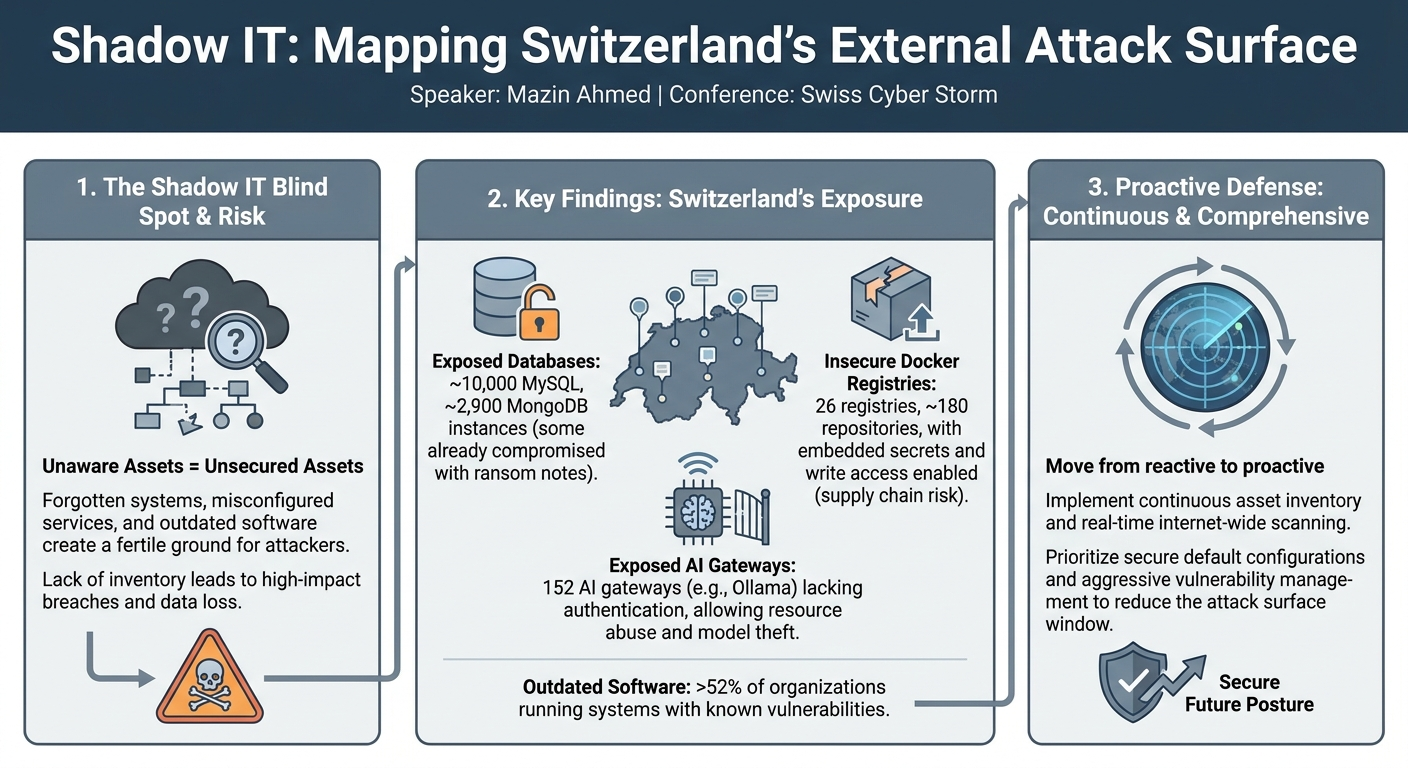
Key moments
- 3:20 Defining Shadow IT and its prevalence
- 6:20 Equifax breach: a classic Shadow IT example
- 14:40 Discovery of easily identifiable honeypot infrastructure
- 17:00 Critical risk of exposed Docker registries
- 22:00 Emerging threat: Unauthenticated AI gateways
- 26:00 Call for continuous national attack surface mapping
- 28:10 Addressing the challenge of IPv6 attack surface discovery
Shadow IT: Mapping Switzerland's External Attack Surface
Speakers: Mazin Ahmed, Application Security and Offensive Security Engineer, Founder, FullHunt
Conference: Swiss Cyber Storm
YouTube: https://www.youtube.com/watch?v=3DxQUGzsG10
Overview
In his compelling talk at Swiss Cyber Storm, Mazin Ahmed, founder of FullHunt.io, presented a deep dive into the often-overlooked yet critically dangerous realm of Shadow IT. His research focused on meticulously mapping the external attack surface of an entire nation, with Switzerland serving as a detailed case study. Ahmed's presentation underscored the pervasive challenge organizations face in maintaining a comprehensive inventory of their internet-facing assets, revealing a landscape rife with forgotten systems, misconfigured services, and easily exploitable vulnerabilities.
The core premise of Ahmed's work is stark: if an organization doesn't know about an internet-facing asset, it cannot possibly secure it. This blind spot, commonly known as Shadow IT, creates fertile ground for attackers seeking low-hanging fruit. The talk illuminated how these unmanaged assets frequently lead to significant data breaches, emphasizing that the problem isn't just theoretical but has tangible, high-impact consequences for both private enterprises and national infrastructure.
Ahmed's research, powered by FullHunt’s internet-wide scanning capabilities, serves as a critical call to action for defenders. By exposing the scale and specific types of Shadow IT prevalent in Switzerland, he provided actionable insights into the vulnerabilities that threat actors are actively exploiting. The presentation highlighted the urgent need for continuous, proactive attack surface management to prevent future compromises and protect sensitive data across an increasingly complex digital landscape.
Background
▶ Watch: Defining Shadow IT and its prevalence (3:20)
The concept of Shadow IT is a broad term, but Mazin Ahmed clarified its essence: any internet-facing asset that an organization is unaware of, and consequently cannot properly secure. His talk primarily focused on shadow infrastructure, encompassing forgotten cloud deployments, neglected development instances, and other systems that have slipped through the cracks of official IT oversight. The prevalence of Shadow IT is a significant issue, as evidenced by a quick poll where only a handful of attendees confidently claimed to have a complete and regularly updated asset inventory.
Ahmed illustrated the severe repercussions of Shadow IT with several high-profile examples. The European Commission experienced a data breach due to a vulnerability in a mobile identity platform, which was likely an exposed Ivanti instance, given the timing of several Ivanti remote code execution (RCE) CVEs. A threat actor exploited this vulnerability before the Commission could patch it, highlighting the critical time window between vulnerability disclosure and exploitation. A more infamous example is the Equifax data breach in 2017, which stemmed from a forgotten Apache Struts server running an outdated Java framework with a known RCE vulnerability. Because the system was undocumented, Equifax failed to patch it in a timely manner, leading to a massive compromise. Ahmed himself, using his tool Struts-Pwn, identified and reported a similar Apache Struts RCE on a forgotten US Department of Defense website, demonstrating that even large, well-resourced organizations struggle with comprehensive asset inventory.
Attackers actively target Shadow IT because it offers an easier path to compromise with a lower risk of detection. While social engineering and direct scams are becoming harder, exploiting system vulnerabilities remains a viable and often simpler approach. Ahmed outlined several common reasons why Shadow IT proliferates:
- Rapid Deployment without Documentation: In fast-paced environments, new services are often deployed hastily to meet deadlines, bypassing proper documentation and security reviews.
- Employee Transitions: As employees move between teams or leave organizations, ownership of systems can be lost, leaving infrastructure unmanaged.
- Experiments and Personal Projects: Tools or products initially developed as experiments can scale company-wide without undergoing formal security assessments.
- Mergers & Acquisitions (M&A): Acquiring smaller companies often means inheriting their attack surface and associated risks, especially if the acquired entity has a less mature security program.
- Third-Party Companies: While organizations may offshore IT systems and data to third parties, they cannot offshore the associated security risk, remaining ultimately responsible for any breaches.
Understanding these vectors is crucial for appreciating the scale of the problem that FullHunt aims to address through internet-wide scanning and attack surface intelligence.
Key Findings
▶ Watch: Discovery of easily identifiable honeypot infrastructure (14:40)
FullHunt's extensive internet-wide scanning efforts for Switzerland revealed a concerning landscape of exposed Shadow IT and vulnerabilities. The research, which mapped the top 3,000 organizations in Switzerland, leveraged the 25 million IPv4 addresses reserved for the nation, indexing and making them searchable. This comprehensive approach uncovered hundreds of vulnerabilities at scale, painting a detailed picture of the nation's external attack surface.
Among the most striking discoveries were:
- Exposed MySQL Databases: FullHunt identified approximately 10,000 IP addresses running MySQL services directly exposed to the internet. Through attribution, at least 1,800 hosts belonging to Swiss organizations were found to have public, open MySQL services, presenting a significant data leakage risk.
- Honeypot Detection: A peculiar finding was the identification of at least 120 honeypots. These were easily detectable due to a critical misconfiguration: all honeypots shared identical passwords, database schemas, and structures. This lack of randomization made them trivial to identify and bypass, undermining their intended purpose of trapping attackers.
- Exposed MongoDB Databases: The scans uncovered around 2,900 MongoDB instances, with eight hosts publicly exposed to the internet. Crucially, 13 of these databases lacked any authentication enabled, making their data freely accessible. Alarmingly, by the time FullHunt conducted its research, seven of these databases were already compromised, evidenced by ransom notes left by attackers. This highlights the speed at which threat actors exploit known, easily discoverable misconfigurations.
- Exposed Docker Registries: A modern and particularly dangerous finding was the presence of 26 externally accessible Docker registries. These registries contained approximately 180 unique repositories and 24 GB of image data, representing significant intellectual property. Some of this data included embedded secrets, such as database credentials, which could be downloaded and leveraged for further attacks. Even more concerning, 22 of these 26 registries had write access enabled, meaning anyone could upload or overwrite images. This vulnerability could lead to supply chain attacks, where legitimate systems pull backdoored images, compromising production environments.
- Exposed ElasticSearch Instances: Despite being a well-known risk, ElasticSearch instances continue to be publicly exposed. Around 2,000 ElasticSearch instances were found in Switzerland, with 76 instances publicly accessible without authentication. Generic analysis of the exposed data revealed the presence of security operations infrastructure data, meaning attackers could gain access to live infrastructure and security intelligence belonging to security teams.
- Exposed AI Gateways: A more contemporary finding involved 152 exposed AI gateways, such as Ollama. These services often lack authentication by default, allowing external actors to use an organization's infrastructure to run AI models, consume hardware resources, or even exfiltrate proprietary AI models.
- Outdated Software: A pervasive issue across the Swiss attack surface was the prevalence of outdated software. FullHunt's passive scanning indicated that at least 52% of scanned organizations had systems with known vulnerabilities, underscoring a widespread failure in vulnerability management programs.
- Other Vulnerabilities: Additional honorable mentions included subdomain takeovers affecting 66 Swiss organizations, as well as exposed InfluxDB and CouchDB instances, all lacking proper authentication.
These findings collectively demonstrate that while Switzerland possesses a mature external attack surface in some areas, there remains a critical gap in coverage and continuous monitoring, especially concerning modern services and fundamental security hygiene.
Technical Deep Dive
▶ Watch: Critical risk of exposed Docker registries (17:00)
FullHunt's methodology for mapping a nation's external attack surface relies on sophisticated internet-wide scanning and robust attribution techniques. The process begins with comprehensive scanning of the entire IPv4 address space, identifying open ports, running services, and associated network metadata. For organizations, attribution is then performed primarily through DNS records, linking IP addresses back to specific companies or entities. This approach is particularly critical for discovering assets that might not be directly owned by an organization but are hosted by third parties or are part of their extended digital footprint.
The technical implications of the identified vulnerabilities are severe due to fundamental security misconfigurations:
- Database Exposures (MySQL, MongoDB, ElasticSearch): The core issue here is the lack of authentication or the use of default, weak credentials. When services like MySQL, MongoDB, or ElasticSearch are deployed directly to the internet without proper access controls, they become open books. Attackers can simply connect and dump entire databases, which often contain sensitive customer data, intellectual property, or even internal security logs (as seen with ElasticSearch exposing security operations data). The rapid compromise of MongoDB instances, with ransom notes appearing quickly, underscores that automated tools are constantly probing for these known weaknesses.
- Docker Registry Exposures: This vulnerability presents a unique and potent supply chain attack vector. Docker registries, by default, often lack authentication. An exposed registry allows attackers to:
- Exfiltrate Intellectual Property: Download private container images, which may contain proprietary code, configuration files, and even hardcoded secrets (e.g., database credentials, API keys).
- Inject Malicious Images: If write access is enabled (as it was for 22 out of 26 exposed registries), an attacker can upload new, malicious images or, more insidiously, overwrite existing image tags. When internal CI/CD pipelines or deployment systems pull these compromised tags, they inadvertently deploy backdoored applications to production, granting attackers a foothold within the corporate network. This bypasses traditional perimeter defenses and directly compromises the application delivery pipeline.
- AI Gateway Exposures (Ollama): The rise of local AI models introduces new attack surfaces. Platforms like Ollama, designed for local model serving, often ship with no authentication enabled by default. When these are inadvertently exposed to the internet, attackers can:
- Resource Consumption: Utilize the exposed server's computational resources (CPU/GPU) to run their own AI models, effectively turning the victim's infrastructure into a free, powerful compute cluster.
- Model Exfiltration: If proprietary models are hosted, attackers could download them, leading to intellectual property theft.
- Abuse for Malicious Prompts: Even if models are public, an attacker could use the exposed gateway to run malicious prompts, potentially bypassing internal content filters or rate limits, and attribute the activity to the victim organization.
- Outdated Software & Apache Struts RCE: The Equifax breach and Ahmed's US DoD finding highlight a classic problem: forgotten systems running old software with publicly known vulnerabilities. The Apache Struts RCE (CVE-2017-5638, for example, which was central to the Equifax breach) allowed remote code execution simply by manipulating HTTP headers. The technical detail here is that such vulnerabilities are often well-documented and have publicly available exploits, making them trivial for attackers to leverage once an unpatched, forgotten instance is discovered. Tools like Ahmed's Struts-Pwn automate the identification of these vulnerable systems.
- Honeypot Identification: The detection of honeypots with identical configurations (passwords, schemas) demonstrates a failure in security engineering. Randomization is a basic security principle for such deployments; without it, an attacker can quickly fingerprint a honeypot and avoid it, or worse, use this knowledge to identify legitimate systems by exclusion.
Regarding IPv6 scanning, Ahmed acknowledged the immense challenge. While full-range scanning of IPv6 is practically impossible, FullHunt addresses this by relying on DNS attribution. If an organization uses IPv6 addresses, they are almost certainly linked via DNS records, allowing FullHunt to discover and map them as part of an organization's attack surface. This pragmatic approach ensures that even with the vastness of IPv6, discoverable assets are still brought into scope.
Demo / Proof of Concept
▶ Watch: Call for continuous national attack surface mapping (26:00)
While the talk did not feature a live technical demonstration or a step-by-step proof-of-concept exploit, Mazin Ahmed presented concrete data and examples derived from FullHunt's internet-wide scanning efforts, effectively serving as a large-scale demonstration of the practical implications of exposed Shadow IT. He showed an example of how data would look on the FullHunt platform, illustrating that by simply typing an organization's domain name, an attacker could obtain a complete asset inventory including exposed ports, network services, and DNS records.
The detailed findings across various services (MySQL, MongoDB, Docker, ElasticSearch, AI gateways) with specific numbers (e.g., 1,800 exposed MySQL hosts, 26 Docker registries, 76 open ElasticSearch instances) served as compelling evidence of the vulnerabilities. The observation of ransom notes on seven compromised MongoDB instances provided a stark, real-world "proof of concept" of how quickly and effectively attackers exploit these misconfigurations in the wild. Similarly, the discussion of how Docker registries with write access could be used for supply chain attacks, by overwriting image tags and deploying backdoored versions, outlined the theoretical and practical attack vectors without needing a live exploit. The overall presentation, therefore, functioned as a comprehensive demonstration of the results of attack surface mapping and the critical security issues uncovered.
Defensive Implications
▶ Watch: Addressing the challenge of IPv6 attack surface discovery (28:10)
The findings presented by Mazin Ahmed demand a fundamental shift in how organizations approach their cybersecurity posture, moving from reactive defense to proactive, continuous attack surface management.
- Implement Continuous Asset Inventory: This is the most critical takeaway. Organizations cannot protect what they don't know they have. A robust asset inventory system must be in place, continuously updated, and encompass all internet-facing assets, including those deployed in cloud environments or by third parties. Tools like FullHunt can provide this external perspective.
- Embrace Continuous Internet-Wide Scanning: Monthly or quarterly vulnerability scans are insufficient. Attackers are constantly probing and exploiting new vulnerabilities as they emerge. Organizations need to adopt a strategy of continuous, real-time or near real-time internet-wide scanning to detect new exposures and misconfigurations as they appear, significantly reducing the window of opportunity for attackers.
- Overhaul Vulnerability Management Programs: The statistic that 52% of Swiss organizations had systems with known vulnerabilities highlights a widespread failure in patching and vulnerability remediation. Vulnerability management programs must be more aggressive, prioritizing patches for critical systems and implementing automated processes to identify and update outdated software.
- Enforce Secure Default Configurations: Developers and IT teams must be educated on the importance of secure-by-default configurations. Databases (MySQL, MongoDB, InfluxDB, CouchDB), Docker registries, and new services like AI gateways (Ollama) should never be deployed to the internet without robust authentication and access controls enabled. Default settings should prioritize security over convenience.
- Strengthen Ownership and Documentation: Clear ownership must be assigned to every internet-facing asset. Comprehensive documentation for newly deployed services, cloud instances, and development environments is essential to prevent systems from becoming "forgotten" when employees transition or leave.
- Integrate Security into M&A Processes: During mergers and acquisitions, a thorough security due diligence process is paramount. This should include mapping the acquired company's external attack surface and integrating its assets into the acquiring company's security program from day one to avoid inheriting significant risks.
- Robust Third-Party Risk Management: Organizations must recognize that while they can outsource IT systems, they cannot outsource the risk. Comprehensive third-party risk assessments and continuous monitoring of third-party exposures are crucial to ensure vendors adhere to security best practices.
- Randomize Honeypot Deployments: For organizations utilizing honeypots, it is imperative to randomize their configurations, including passwords and database schemas. Identical honeypots are easily identifiable and bypassable, rendering them ineffective.
- Support National CERT Initiatives: The Swiss NCSC's efforts in external vulnerability scanning are valuable, but the research suggests a need for broader coverage and more continuous scanning, particularly for modern attack surfaces. Organizations should collaborate with and support national CERTs in their efforts to enhance national cybersecurity posture, including contributing to vulnerability research at scale.
Key Takeaways
- You cannot protect what you don't know you have: A complete, continuously updated asset inventory is the foundational pillar of effective cybersecurity.
- Attackers exploit process gaps: Shadow IT thrives in the absence of proper documentation, ownership, and security reviews, making these systems prime targets for compromise.
- Country-scale visibility is achievable but requires significant effort: Mapping a nation's attack surface is a complex task, but tools and methodologies exist to gain this critical understanding.
- Default insecure configurations are a persistent and critical risk: Services like MongoDB, Docker registries, and AI gateways (Ollama) are frequently exposed due to default settings lacking authentication, leading to rapid compromise.
- Outdated software remains a widespread vulnerability: A significant portion of organizations (52% in Switzerland) operate systems with known vulnerabilities, highlighting a systemic issue in vulnerability management.
- Continuous, internet-wide scanning is essential: To keep pace with evolving threats and the speed of attackers, organizations need to move beyond periodic scans to real-time or near real-time attack surface monitoring.
About the Speaker(s)
Mazin Ahmed is an accomplished Application Security and Offensive Security Engineer and the founder of FullHunt.io, a company specializing in internet-wide scanning and attack surface intelligence. A veteran of Swiss Cyber Storm, he first presented at the conference at the age of 19, discussing bug bounty hunting. Ahmed is an occasional bug bounty hunter himself, with a notable track record of reporting vulnerabilities to major organizations such as Meta, X, and the US Department of Defense. His security research includes predicting mass security breaches through supply chain attacks on VS Code extensions, a prediction that later materialized with a GitHub employee compromise. He possesses a passion for cloud security, web security, and distributed systems.
Reviews
Dr. Zero (Offensive Security Researcher) — SOLID
A competent but entirely predictable walk through internet-wide scanning data for Switzerland. It proves companies still suck at asset inventory, but finding open Docker registries and ransomed databases is exactly what you expect from an Attack Surface Management vendor showing off their tool.
Heather Calloway (CISO) — MUST SEE
This is a stark quantification of exactly how asset management programs fail at scale. Ahmed’s scan of the Swiss IPv4 space proves that the gap between what organizations think they own and what they actually expose remains massive. Required reading for any leadership team that assumes their CMDB is accurate, especially if you have an active M&A pipeline.