SwissCyber Initiative: Mapping Switzerland’s Cybersecurity R&D Ecosystem
Dr. Loïc Maréchal (scientific collaborator · HES-SO Valais-Wallis)
Swiss Cyber Storm 2026 · Day 1 · Scenario
Overview
Dr. Loïc Maréchal, a scientific collaborator at HES-SO Valais-Wallis, presented an insightful talk on the Swiss Cyber Initiative, a two-year project dedicated to mapping Switzerland’s cybersecurity research and development (R&D) ecosystem. Financed by the Swiss Confederation through the State Secretariat for Education, Research and Innovation (SERI), and conducted in collaboration with SATV and the Cyber Defense Campus, this initiative aims to consolidate fragmented information about Swiss cybersecurity organizations. The project focuses specifically on firms and organizations providing cybersecurity services, rather than those targeted by cyber incidents, with the strategic goal of identifying national strengths and weaknesses in the cybersecurity domain.
Key moments
- 0:00 Introduction to the Swiss Cyber Initiative project
- 2:00 Project goals: unified database and public platform
- 4:00 Data sources and methodology, including Common Crawl
- 6:40 Platform demonstration: geographical company concentration
- 10:00 Key data insights: concentration and foreign investment
- 12:00 Stakeholder survey reveals strengths and challenges
- 14:00 Cybersecurity Innovation Index and Exposure Score explained
- 22:15 Q&A: Public data access and adversary concerns
SwissCyber Initiative: Mapping Switzerland’s Cybersecurity R&D Ecosystem
Speakers: Dr. Loïc Maréchal, Scientific Collaborator, HES-SO Valais-Wallis
Conference: Swiss Cyber Storm
YouTube: https://www.youtube.com/watch?v=Jqa2nBsMxO4
Overview
Dr. Loïc Maréchal, a scientific collaborator at HES-SO Valais-Wallis, presented an insightful talk on the Swiss Cyber Initiative, a two-year project dedicated to mapping Switzerland’s cybersecurity research and development (R&D) ecosystem. Financed by the Swiss Confederation through the State Secretariat for Education, Research and Innovation (SERI), and conducted in collaboration with SATV and the Cyber Defense Campus, this initiative aims to consolidate fragmented information about Swiss cybersecurity organizations. The project focuses specifically on firms and organizations providing cybersecurity services, rather than those targeted by cyber incidents, with the strategic goal of identifying national strengths and weaknesses in the cybersecurity domain.
The core challenge addressed by the Swiss Cyber Initiative is the scattered and often non-exhaustive nature of data regarding Switzerland’s cybersecurity capabilities. By aggregating and validating diverse data sources, the project seeks to create a unified, reliable database accessible to policymakers, investors, and researchers. This consolidated view is crucial for informed decision-making, strategic planning, and fostering the growth of Switzerland's cybersecurity sector. Dr. Maréchal's presentation offered a preview of the project's integrated ecosystem database, its user-friendly public platform, and key findings derived from their comprehensive analysis and nationwide surveys.
The importance of this initiative cannot be overstated in an era where cyber threats are escalating. A clear understanding of the national cybersecurity landscape—including R&D capabilities, investment flows, workforce expertise, and technological specializations—is fundamental to maintaining digital sovereignty and resilience. The Swiss Cyber Initiative provides a foundational tool to achieve this, offering unprecedented transparency and actionable insights into the dynamic and critical sector of cybersecurity in Switzerland.
Background
▶ Watch: Introduction to the Swiss Cyber Initiative project (0:00)
The necessity for the Swiss Cyber Initiative stems from a pervasive problem in national cybersecurity strategy: the lack of a consolidated, accurate, and comprehensive overview of the domestic R&D and industry landscape. While Switzerland recognizes the strategic importance of cybersecurity, evidenced by its frequent discussion at conferences like Swiss Cyber Storm, the underlying data required to assess its strengths and weaknesses has historically been fragmented across numerous sources. These sources often include internal platforms, public registries, academic publications, and commercial vendor data, which can be inconsistent, incomplete, or even spurious.
To address this critical data vacuum, the SERI financed the Swiss Cyber Initiative. The project's initial scope was defined by five key working packages: data collection and analysis, target state analysis (defining aspirational goals), platform development (creating a publicly accessible interface), delta analysis and recommendations (comparing current state to target state), and dissemination and networking. The project's ambition was to move beyond simply identifying victim companies to understanding the ecosystem of providers that bolster national cyber defenses. This involved meticulous data cleaning and validation, a process crucial for any data science endeavor, to ensure that the insights derived are sound and relevant for various stakeholders, from policy makers shaping national strategy to investors seeking opportunities and researchers identifying gaps.
The initiative leverages existing collaborations, particularly with the Cyber Defense Campus, which provides valuable initial datasets, and SATV, which focuses on dissemination and communication. This collaborative approach underscores the complexity of the task and the need for diverse expertise. By building a robust, unified database, the project aims to provide an evidence-based foundation for understanding the Swiss cyber market, thereby enabling more targeted interventions to foster innovation, attract investment, and enhance national cybersecurity capabilities.
Key Findings
▶ Watch: Data sources and methodology, including Common Crawl (4:00)
The Swiss Cyber Initiative's comprehensive data aggregation and analysis have yielded several significant findings regarding the country's cybersecurity R&D ecosystem, highlighting both strengths and areas for improvement.
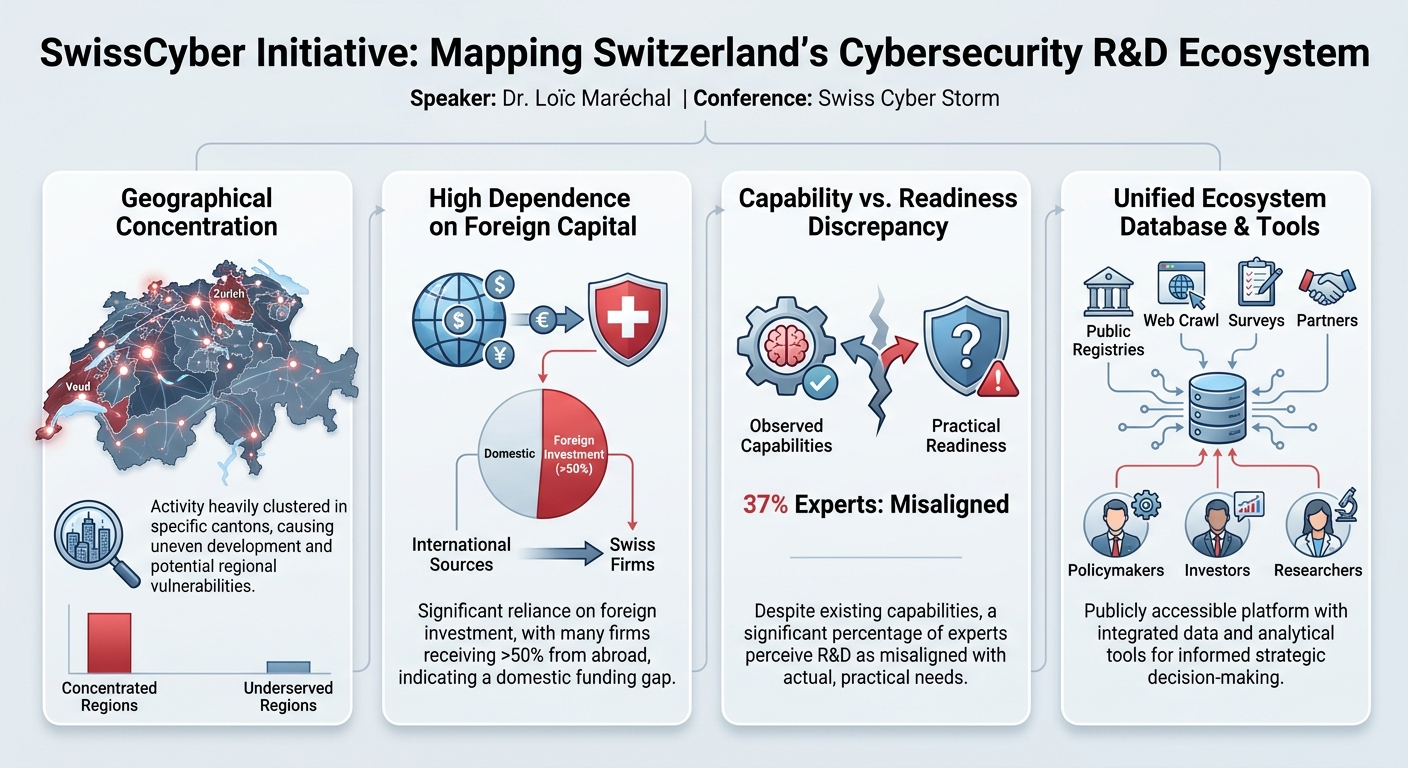
One of the most striking observations is the geographical concentration of cybersecurity activity. The platform visualizations clearly show that R&D and industry presence are heavily clustered in certain cantons, while others remain significantly underserved. This uneven distribution has implications for regional development and national resilience.
Another crucial finding is the high degree of international connectivity, particularly concerning investment. The analysis revealed that a substantial portion of funding for Swiss cybersecurity companies originates from abroad. Dr. Maréchal noted that applying a filter for companies receiving at least 50% of investments from foreign sources still left a large number of active companies, indicating a significant dependence on external capital. This points to a potential weakness in Switzerland's domestic private equity and venture capital landscape, a systemic issue that extends beyond cybersecurity.
The ecosystem also exhibits large heterogeneity in terms of covered cyber sectors. While some cybersecurity categories are robustly represented, others are notably underdeveloped or "left out." This suggests an uneven distribution of expertise and innovation, which could leave certain critical areas vulnerable or lacking in domestic solutions. Furthermore, the investment structure itself is highly concentrated, with a few dominant players controlling a significant portion of the market, potentially limiting opportunities for smaller, emerging innovators.
Stakeholder insights, gathered through a nationwide survey of cybersecurity experts, largely corroborated and complemented these data-driven observations. Experts identified Switzerland's key strengths as its skilled personnel, existing capabilities, and strong collaboration across the ecosystem. However, they also highlighted significant challenges:
- Investment constraints: Echoing the data, experts perceived a lack of sufficient domestic capital, leading to reliance on foreign investment.
- Lack of executive understanding and awareness: A surprising number of respondents indicated that leadership often lacks a deep understanding of cybersecurity implications.
- Limited knowledge or use of available frameworks: Despite the proliferation of cybersecurity frameworks, their practical application in daily work was reported to be limited.
- Uncertainty about future threats: Experts expressed varying degrees of concern and clarity regarding short-term versus long-term threat landscapes.
Crucially, the co-analysis of data and expert views revealed both convergences and divergences. There was strong convergence on the issues of investment concentration and geographical concentration. Approximately 70% of respondents agreed that a lack of investment actively hinders cybersecurity development in Switzerland. However, a significant divergence was noted in perceived readiness: while the project's data often indicated robust capabilities, 37% of the survey sample perceived R&D efforts as not aligned with actual needs, suggesting a more pessimistic view among experts regarding the translation of observed capabilities into practical readiness. This highlights a critical gap between what is technically available and what is effectively utilized or developed in response to real-world challenges.
Technical Deep Dive
▶ Watch: Key data insights: concentration and foreign investment (10:00)
The technical backbone of the Swiss Cyber Initiative is a sophisticated data aggregation and analysis pipeline designed to create a comprehensive and accurate view of the cybersecurity R&D ecosystem. The methodology combines various data sources and advanced analytical techniques to overcome the inherent fragmentation and inconsistency of existing information.
At the core of the data collection is the TMM 2.0 (Technology Market Monitoring platform), an internal platform developed by the CYD Campus. This proprietary dataset is enriched with a multitude of external and public sources to ensure breadth and accuracy. These external sources include:
- OpenStreetMap and GeoNames: Utilized for precise geographical localization of companies and organizations.
- Zefix: The official Swiss registry of commerce, providing foundational legal and registration data for entities.
- Nationwide Survey Results: Direct input from cybersecurity experts in Switzerland, offering qualitative insights and perceptions.
- Common Crawl: A massive open repository of web crawl data. The project leverages its own servers to process this vast amount of information. Natural Language Processing (NLP) methods are applied to extract relevant information about organizations, not only from their self-disclosed content but also from news articles and other mentions across the web. This allows for a more nuanced classification and understanding of a company’s activities and focus areas.
All this disparate data is integrated through entity resolution, a process that identifies and links records pertaining to the same real-world entity across different datasets, thereby building a single, unified database. This integrated ecosystem database serves as the foundation for the publicly accessible platform and subsequent analytical layers.
Beyond raw data aggregation, the project developed several key analytical tools and indicators:
- Cybersecurity Exposure Score: This metric aims to differentiate between companies that merely operate in the cyber domain (e.g., consulting firms, legal services) and those that are genuinely at the forefront of innovation. It helps to disentangle "soft" cybersecurity engagement from "hard" innovation, identifying entities pushing technological boundaries and actively developing new solutions.
- Cybersecurity Innovation Index: Recognizing the difficulty in directly observing R&D metrics for private companies (which are not obligated to disclose such figures), this index serves as a proxy for innovation. It is a percentile rank derived from several factors:
- The aforementioned Cybersecurity Exposure Score.
- The age of the company: Younger companies are generally assumed to be more innovative.
- Total funding received: Higher funding often correlates with greater capacity for R&D.
- Date of the last funding round: Recent funding rounds typically provide companies with more financial flexibility to invest in innovation.
This composite index provides a valuable, albeit indirect, measure of who in Switzerland innovates the most.
- Taxonomy Standardization: The project is actively working on changing and standardizing the taxonomy used to classify cybersecurity companies and their activities. Existing industry taxonomies are often found to be either not granular enough for the cybersecurity sector or simply outdated. The project adopted the GRC (European Joint Research Center) taxonomy for its survey, finding it to be a good trade-off between granularity and comparability with previous research. This standardization is crucial for unifying data, enabling consistent analysis, and facilitating cross-comparisons.
The resulting platform is designed for user-friendliness, featuring interactive maps, filtering options, and "smart filters" (collections of pre-defined filters) that help users quickly find strategic information, such as companies with significant foreign investment. The platform also provides detailed company profiles, including funding histories, workforce indicators, and timelines of investments by cybersecurity categories. The long-term vision includes semi-supervised self-updates to ensure the platform's sustainability and continued relevance for at least five years post-launch.
Demo / Proof of Concept
▶ Watch: Stakeholder survey reveals strengths and challenges (12:00)
During the talk, Dr. Maréchal provided a live demonstration of the Swiss Cyber Initiative platform, showcasing its interactive features and the depth of data it provides. The demo, presented on an iPad, illustrated the platform's user-centric design and powerful analytical capabilities.
The core of the platform's visualization is an interactive map that displays all Swiss-connected cybersecurity companies. A "Swiss-connected" company is broadly defined as any organization with a "leg in Switzerland," including those with headquarters, significant investments, acquisitions, or employees within the country. This broad definition ensures a comprehensive view of the ecosystem's digital sovereignty. Users can zoom in on the map to observe clusters of companies in various regions, such as 173 nodes in the Lausanne area or 23 in Neuchâtel.
The platform offers different data views, including a company count view for a rough geographical distribution and a total investments view, which provides a proxy for where capital is flowing into the cybersecurity sector since company inception. A key feature demonstrated was the use of smart filters. For instance, Dr. Maréchal applied a filter for "dependence on foreign investment," which automatically selected companies that had received at least 50% of their investments from abroad. This highlighted the significant international capital flow into the Swiss market. Users have the flexibility to customize filters and create their own strategic views.
Delving into specific company details, the demo showed a profile for WISeKey, illustrating the rich information available. This included a complete history of funding rounds, details regarding their workforce, and a timeline showing the evolution of investments categorized by cybersecurity sectors. The platform also allows for comparative analysis, enabling users to compare cantons against each other or Switzerland against the rest of the world based on various metrics, both pre- and post-filtering.
Beyond company and investment data, the platform integrates insights from the nationwide stakeholder survey. Users can access demographic information about respondents, their perceptions of strengths and weaknesses across different cybersecurity metrics and categories, and their views on talent, short-term and long-term threats, and emerging technologies. These survey results are also filterable, allowing users to explore specific segments of expert opinion. The demonstration underscored the platform's potential as a powerful, publicly accessible tool for understanding, analyzing, and strategizing within Switzerland's cybersecurity landscape.
Defensive Implications
▶ Watch: Q&A: Public data access and adversary concerns (22:15)
The findings of the Swiss Cyber Initiative, while focused on the R&D ecosystem, carry significant defensive implications for Switzerland's overall cybersecurity posture. Understanding the national landscape, its strengths, and particularly its weaknesses, is crucial for strategic defense planning at both governmental and organizational levels.
Firstly, the identified geographical concentration of cybersecurity activity means that certain regions may be highly resilient, while others could be critically vulnerable due to a lack of local expertise and resources. Defenders, particularly national and cantonal agencies, should assess if this concentration creates single points of failure or leaves peripheral regions inadequately supported. Strategic investments in less-covered cantons could diversify the national defense footprint.
The heavy dependence on foreign investment introduces a layer of complexity for national digital sovereignty. While foreign capital can fuel innovation, it may also imply external influence on strategic directions or a reduced focus on uniquely Swiss cybersecurity challenges. Procurement agencies within the Swiss Confederation, for instance, need a validated "Swissness score" (a future extension of the project) to make informed decisions about supply chain resilience and national security implications when choosing cybersecurity providers. Defenders should advocate for policies that encourage domestic investment in critical cyber capabilities to reduce reliance on external entities.
The large heterogeneity in covered cyber sectors and the concentrated investment structure suggest that certain areas of cybersecurity R&D might be neglected. This could lead to capability gaps against specific threats or a lag in adopting cutting-edge defensive technologies. Defenders should leverage the platform's data to identify these underserved areas and push for targeted research funding or talent development initiatives. For example, if a critical infrastructure sector relies on a cybersecurity domain with minimal domestic R&D, this presents a significant national vulnerability.
Furthermore, the stakeholder survey highlighted critical behavioral and awareness issues. The lack of executive understanding and awareness about cybersecurity risks is a perennial problem that directly impacts an organization's defensive readiness. This finding underscores the need for continuous education and awareness campaigns targeting senior leadership, emphasizing that cybersecurity is a business risk, not just an IT problem. Similarly, the limited knowledge or use of available frameworks (like the newly presented ones at the conference) indicates a gap between best practices and practical implementation. Defenders should prioritize training and adoption of recognized cybersecurity frameworks to establish a baseline of robust security controls across organizations.
Finally, the perceived misalignment between R&D and actual needs by 37% of respondents is a stark warning. It suggests that even with innovation happening, it might not be addressing the most pressing or emerging threats faced by Swiss organizations. Defenders, in collaboration with policymakers and researchers, must foster better communication channels to ensure that R&D efforts are directly informed by current threat intelligence and operational requirements. This proactive alignment is essential to develop truly effective defensive capabilities for the future. The Swiss Cyber Initiative platform provides the evidence base for these strategic discussions and interventions, enabling a more informed and adaptive national cybersecurity defense.
Key Takeaways
- Geographical Concentration: Switzerland's cybersecurity R&D and industry activity are highly concentrated in specific cantons, raising questions about national resilience and balanced regional development.
- Foreign Investment Dependence: The ecosystem exhibits significant reliance on foreign capital, with a substantial portion of companies receiving over 50% of their investments from abroad, highlighting a potential gap in domestic venture capital.
- Capability-Readiness Discrepancy: While data may indicate existing capabilities, a significant percentage of experts (37%) perceive R&D efforts as misaligned with actual needs, suggesting a gap between observed potential and practical readiness.
- Executive Awareness & Framework Adoption: Stakeholders identified a critical lack of executive understanding regarding cybersecurity and limited adoption of available security frameworks in daily operations.
- Unified Data for Strategic Decisions: The Swiss Cyber Initiative platform provides a publicly accessible, unified database and analytical tools (like the Cybersecurity Exposure Score and Innovation Index) for policymakers, investors, and researchers to make informed decisions and identify strategic gaps.
- Sustainability and Future Vision: The project aims for long-term sustainability, with the platform designed for semi-supervised self-updates and a future extension to develop a "Swissness score" for supply chain assessment.
About the Speaker(s)
Dr. Loïc Maréchal is a scientific collaborator at HES-SO Valais-Wallis. He serves as the lead for the Swiss Cyber Initiative, a pivotal two-year project financed by the Swiss Confederation through SERI. In his role, Dr. Maréchal is responsible for overseeing the project's comprehensive data collection, analysis, and the development of its integrated ecosystem database and public platform. His work involves close collaboration with partners such as SATV, which handles dissemination, and the Cyber Defense Campus, which contributes data aggregation expertise. Dr. Maréchal's research focuses on understanding and mapping the cybersecurity R&D landscape to inform national strategy and foster innovation.
Reviews
Dr. Zero (Offensive Security Researcher) — SOLID
Maréchal’s SwissCyber Initiative is a rare strategic mapping project that actually brings receipts instead of just complaining about the skills gap. By aggregating registry data and web crawls, they proved what we already suspected: the Swiss cyber market is heavily propped up by foreign VC and a third of the R&D doesn't match actual defender needs. It's a vendor dashboard, but it's one policymakers should actually use.
Heather Calloway (CISO) — SOLID
A comprehensive, government-backed mapping of the Swiss cybersecurity vendor and R&D ecosystem. Valuable for national policy and private equity, but for corporate CISOs, it serves primarily as a lens into vendor viability and third-party concentration risk.