Control Plane under Control – Securing Privileged Access with Managed Red Tenant
Thomas Naunheim (cyber security architect · Glueckauf)
Swiss Cyber Storm 2026 · Day 1 · Panorama
Overview
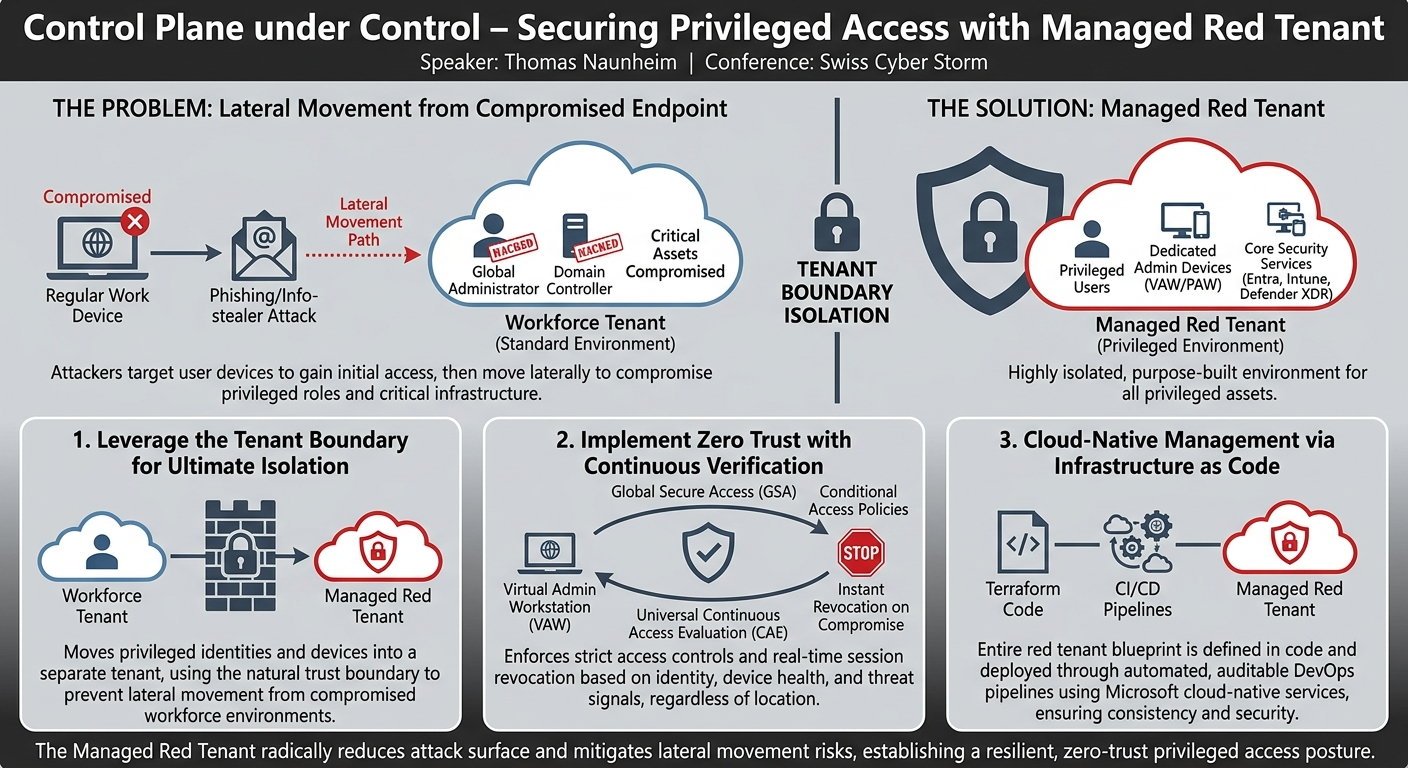
In today's complex cloud and hybrid environments, securing privileged access remains one of the most critical and challenging aspects of cybersecurity. Attackers relentlessly target "crown jewels" – such as domain controllers in Active Directory or Global Administrator roles in Microsoft Entra ID – as these provide the ultimate control over an organization's IT infrastructure. The unfortunate reality is that many organizations still allow privileged users to manage critical systems from their regular work devices, creating a dangerous attack path where a simple phishing attack or info-stealer can lead directly to a full tenant compromise.
Key moments
- 2:00 Problem: Privileged access vulnerabilities and tenant compromise
- 7:40 Introducing the Managed Red Tenant solution concept
- 10:40 Shared responsibility model for supply chain risk
- 14:40 Virtual Admin Workstation (VAW) for flexible privileged access
- 20:50 Zero Trust and real-time token revocation (Universal CAE)
- 23:30 Passwordless on-premises access with FIDO2 and SKipMan
- 26:00 Practical insights and common questions on Red Tenant adoption
Control Plane under Control – Securing Privileged Access with Managed Red Tenant
Speakers: Thomas Naunheim, Cyber Security Architect, Glueckauf
Conference: Swiss Cyber Storm
YouTube: https://www.youtube.com/watch?v=qaMe0EwWVXI
Overview
In today's complex cloud and hybrid environments, securing privileged access remains one of the most critical and challenging aspects of cybersecurity. Attackers relentlessly target "crown jewels" – such as domain controllers in Active Directory or Global Administrator roles in Microsoft Entra ID – as these provide the ultimate control over an organization's IT infrastructure. The unfortunate reality is that many organizations still allow privileged users to manage critical systems from their regular work devices, creating a dangerous attack path where a simple phishing attack or info-stealer can lead directly to a full tenant compromise.
Thomas Naunheim, a cyber security architect at Glueckauf and a Microsoft security MVP, presented a compelling solution to this pervasive problem: the Managed Red Tenant. This innovative approach leverages the inherent security boundaries of cloud tenants to create a highly isolated and rigorously controlled environment specifically for privileged users and their administrative tasks. By shifting all high-critical privileged access assets into a dedicated "red tenant," organizations can significantly reduce their attack surface and mitigate the risk of lateral movement from compromised endpoints.
The Managed Red Tenant is not merely an architectural concept but a comprehensive managed service designed to implement and maintain this secure posture. Glueckauf's solution integrates a suite of cloud-native Microsoft services, infrastructure as code, and a unique shared responsibility model to ensure that even a compromise of either the customer or the managed service provider does not lead to a breach of the privileged environment. This talk offers a deep dive into how this architecture works, its technical underpinnings, and the profound defensive implications for organizations striving to achieve true zero-trust privileged access.
Background
▶ Watch: Problem: Privileged access vulnerabilities and tenant compromise (2:00)
The motivation behind the Managed Red Tenant stems directly from observable attack patterns documented by frameworks like MITRE ATT&CK and prevalent in real-world incident responses. Attackers consistently aim for privilege escalation, often starting from a seemingly low-privilege entry point, such as a compromised regular "office PC" or enterprise device. Tools like phishing, adversary-in-the-middle (AiTM) attacks, or info-stealers can easily compromise these devices, giving attackers initial user-level access. The critical flaw in many existing security models is the lack of strict isolation between these regular user environments and the highly privileged administrative functions.
Even with security measures like Privileged Identity Management (PIM), which reduces the duration of elevated privileges, the fundamental issue persists: if an administrator activates their privileged role from a standard workstation, the resulting credentials, token artifacts, or session cookies still reside on that potentially compromised device. This creates a direct lateral movement path to control plane (Tier Zero) privileges, bypassing the intended security benefits of PIM. The speaker highlighted that the adoption of Privileged Admin Workstations (PAWs) – dedicated, hardened devices for administrative tasks – has not become widespread enough to counter this threat effectively.
A stark example of the potential blast radius was the "Striker attack" earlier in the year, where the compromise of a single Microsoft Intune administrator led to the wiping of approximately 80,000 company devices across multiple countries. This incident underscored that the vulnerability was not necessarily a sophisticated malware, but rather the opportunity to obtain Intune admin credentials from a weakly protected environment. The root cause is often as simple as an administrator using the same browser profile for both regular Outlook access and privileged portals like Azure or Entra admin. An info-stealer running as a local system on the device faces no boundary in stealing these critical session cookies.
Furthermore, achieving robust intra-tenant isolation within a single Microsoft Entra tenant is inherently difficult. Microsoft's architecture imposes limitations on scoping permissions to specific groups or devices, making it challenging to logically separate privileged users and devices from enterprise users and devices within the same tenant. While organizations might use separate tenants for customer identities, staging environments, or regulatory compliance, the speaker emphasized that the "tenant boundary" itself offers a powerful, natural separation that is often underutilized for privileged access. This fundamental challenge, coupled with the shortcomings of existing solutions, necessitated a more radical approach to securing the control plane.
Key Findings
▶ Watch: Shared responsibility model for supply chain risk (10:40)
The central finding and core innovation presented is the concept of leveraging the tenant boundary as the ultimate isolation mechanism for privileged access. Instead of attempting complex and often insufficient intra-tenant isolation, the Managed Red Tenant approach proposes moving all privileged users and their associated devices out of the primary "workforce tenant" and into a completely separate, purpose-built tenant. This "red tenant" has no inherent trust relationship with other tenants by default, creating a natural and robust security separation.
Key findings and contributions of this approach include:
- Tenant Boundary as a Security Primitive: The red tenant architecture capitalizes on the fact that if an Intune admin in the workforce tenant is compromised, they have no intrinsic access to Intune devices managed within the red tenant. This provides a clear, unassailable segregation of duties and assets.
- High-Security Environment: The red tenant enforces the highest possible security settings at the tenant level, unburdened by the need to support diverse business use cases that might necessitate lower security configurations in the workforce tenant.
- 100% Cloud-Native Management: The Managed Red Tenant is built and operated entirely using cloud-native Microsoft services, including the Entra suite, Intune, and Defender XDR, ensuring a modern, integrated security posture.
- Infrastructure as Code (IaC) & DevOps: The entire red tenant blueprint is defined in Terraform and deployed via CICD pipelines using a DevOps approach, ensuring consistency, repeatability, and version control.
- Shared Responsibility Model: To address potential supply chain risks with a managed service, Glueckauf implements a unique shared responsibility model. They contribute code to the red tenant, but the customer retains the role of reviewer, ensuring that neither party's compromise alone can jeopardize the privileged environment.
- Closed System Architecture: The red tenant is designed as a self-contained, closed system. All core services necessary for its security and operation run within the red tenant itself, eliminating dependencies on external services that could introduce vulnerabilities.
- Just-in-Time, Just-Enough Access: Users within the red tenant are never privileged by default. They are standard member users in their home red tenant. Privileged access to target tenants (like the workforce tenant) is granted only through B2B (cross-tenant access) and Entitlement Management access packages, ensuring granular, time-bound, and audited privilege elevation.
- Virtual Admin Workstation (VAW) for Scalability: Recognizing the practical challenges of deploying physical PAWs to a large admin base, the solution offers a Virtual Admin Workstation (VAW). This Azure Virtual Desktop (AVD) instance, hosted securely within the red tenant, provides a strong security posture with an "identity switch" mechanism, allowing access from a regular device while enforcing strict conditional access checks and FIDO2 authentication for the privileged session.
- Zero Trust with Universal Continuous Access Evaluation (CAE): The architecture deeply integrates Zero Trust principles, leveraging Global Secure Access (GSA) for secure connectivity and Universal CAE for near real-time token revocation. This means if the initial accessing device (e.g., the regular office PC) is compromised, the privileged session is instantly terminated.
- Passwordless On-Premises Administration: The solution extends its secure principles to on-premises Active Directory environments using Entra Private Access and a custom cloud PKI (SKipMan) with FIDO2 security keys, enabling passwordless Kerberos TGT issuance without relying on potentially vulnerable on-premises ADCS.
- Enhanced Security Signals: The centralized and controlled nature of privileged access through the red tenant vastly improves the quality of security logs. Defenders can clearly identify all privileged access originating from a known, hardened source, simplifying threat hunting and detection.
These findings collectively present a robust, scalable, and operationally sound framework for radically enhancing privileged access security in modern IT environments.
Technical Deep Dive
▶ Watch: Virtual Admin Workstation (VAW) for flexible privileged access (14:40)
The Managed Red Tenant is an architectural marvel that meticulously redefines how privileged access is secured in Microsoft cloud and hybrid ecosystems. At its core, the solution establishes a completely independent Microsoft Entra tenant, referred to as the red tenant, whose sole purpose is to host and manage all high-critical privileged users and their administrative workstations. This dedicated tenant acts as a fortified bastion, fundamentally separated from the organization's primary "workforce tenant" by the inherent tenant boundary – a natural, default lack of trust between two distinct Microsoft Entra instances.
Within this red tenant, all tenant-level security settings are configured to their absolute highest possible maturity and security levels. This is a critical advantage, as the red tenant doesn't need to accommodate the diverse business requirements or legacy applications that often necessitate compromise on security settings in a production workforce tenant. The entire environment is managed exclusively using cloud-native Microsoft services, including components from the Microsoft Entra suite, Microsoft Intune for device management, and Microsoft Defender XDR for comprehensive threat protection and monitoring.
The deployment and ongoing management of the red tenant are driven by an Infrastructure as Code (IaC) philosophy. Glueckauf defines the entire blueprint in Terraform, which is then deployed and updated via CICD pipelines leveraging a DevOps approach. This ensures consistency, auditability, and rapid, controlled changes. A unique aspect of this managed service is its shared responsibility model: Glueckauf contributes the code for the red tenant, but the customer remains in the loop as a reviewer for all code changes. This collaborative security model significantly reduces supply chain risk; a compromise of Glueckauf would not automatically grant access to the customer's red tenant, and vice versa.
A golden rule of the red tenant architecture is that it operates as a closed system. All core services essential for its security and functionality, including identity lifecycle management and device provisioning, run within the red tenant itself. There are no security dependencies on external services, ensuring maximum isolation. Users provisioned in the red tenant are by default regular member users, never inheriting any birthright privileges within the red tenant. Their path to privilege in target environments is strictly controlled: they must request access via Entitlement Management access packages, which, upon approval, grant them specific, time-bound privileged roles (e.g., Global Administrator) in the target workforce tenant through B2B (cross-tenant access). This ensures just-in-time, just-enough access and prevents any standing privileges.
For administrative workstations, the solution offers two primary options: the traditional Privileged Admin Workstation (PAW), providing the strongest physical separation, and the innovative Virtual Admin Workstation (VAW). The VAW addresses the practical challenges of deploying physical PAWs to a large number of administrators. It is implemented using Azure Virtual Desktop (AVD), with all underlying Azure resources hosted securely within a virtual network inside the red tenant. Crucially, this AVD environment has no public endpoint, making it inaccessible from the open internet. All external and internal network traffic to and from the VAW is routed through Global Secure Access (GSA), Microsoft's new SASE (Secure Access Service Edge) solution.
The access mechanism for the VAW is particularly sophisticated, incorporating an "identity switch." To even establish connectivity to the AVD, an administrator must first authenticate with their enterprise user account from their regular office PC. During this initial authentication, a series of stringent Conditional Access policies evaluate signals from the accessing device: whether strong authentication (e.g., MFA) is used, if there's any machine risk detected, and if the device is compliant with organizational policies. Only if these conditions are fully satisfied is a private channel to the AVD established. The administrator then proceeds to a second authentication step, signing in as their managed red tenant user using a FIDO2 security key (e.g., a YubiKey Bio) for phishing-resistant authentication. This multi-stage authentication ensures that access to the VAW is conditional not only on the privileged identity but also on the security posture of the initial access device. Once on the VAW, the environment is highly restricted, with no open internet access and all outbound traffic strictly controlled via GSA.
The architecture deeply embeds Zero Trust principles through continuous verification. Universal Continuous Access Evaluation (CAE) is a cornerstone of the incident response strategy. If the initial accessing device (the regular office PC) is compromised, Universal CAE enables near real-time token revocation, instantly closing the private channel to the AVD and disconnecting all other privileged connections (e.g., to portals or on-premises environments). GSA plays a multifaceted role, enabling Entra Private Access for secure connectivity to on-premises resources, Entra Private Internet Access for TLS inspection and restricting SaaS application access from privileged endpoints, and Tenant Restrictions to limit which other tenants the PAW/VAW can authenticate to. The clarity of audit logs is significantly enhanced, allowing security operations centers (SOCs) to crystal-clearly identify all privileged access attempts originating from the hardened red tenant via GSA and a PAW/VAW.
Finally, the Managed Red Tenant addresses the persistent challenge of securing on-premises Active Directory administration in a passwordless, zero-trust manner. Entra Private Access facilitates secure connectivity from the red tenant to on-premises infrastructure, again enforced by strong conditional access policies. For passwordless authentication to on-prem environments, the solution leverages the FIDO2 security key in conjunction with Glueckauf's custom cloud PKI (SKipMan). This allows for the issuance of certificates, which are then used to obtain Kerberos TGTs in the Active Directory environment. Critically, the sensitive token and certificate issuance process occurs entirely within the secure red tenant, eliminating any security dependency on potentially vulnerable on-premises ADCS (Active Directory Certificate Services). Once more, Universal CAE ensures that in the event of an incident, on-premises access can be revoked in near real-time.
Demo / Proof of Concept
▶ Watch: Passwordless on-premises access with FIDO2 and SKipMan (23:30)
During the presentation, Thomas Naunheim provided a concise yet effective demonstration of the Virtual Admin Workstation (VAW) in action, illustrating the user experience and the underlying security mechanisms. The demo focused on the seamless process for an administrator to access their privileged environment.
The demonstration began with the speaker launching the Windows app for Azure Virtual Desktop on a standard Windows device. This initiated the first step of authentication, where the administrator was prompted to sign in with their managed red tenant user account. For this step, a YubiKey Bio was used, showcasing the implementation of strong, phishing-resistant FIDO2 authentication.
Upon successful authentication with the YubiKey Bio to the red tenant, the interface displayed the available virtual desktops. The speaker then selected the specific virtual desktop designated for administration. The system proceeded to establish the connection, and within moments, the administrator was presented with the familiar Windows desktop of their VAW.
What the audience didn't visually perceive during the demo, but which Naunheim emphasized as "the magic behind the scene," was the intricate sequence of security checks occurring in the background. This included the evaluation of Conditional Access policies on the initial accessing enterprise device. These policies verified factors such as the device's compliance, the absence of machine risk, and the use of strong authentication. Only after these stringent checks were passed was the private channel to Azure Virtual Desktop established, preceding the second-factor authentication with the FIDO2 key for the red tenant user. This demonstration effectively conveyed the user-friendliness of the VAW while highlighting the robust, multi-layered security framework underpinning it.
Defensive Implications
▶ Watch: Practical insights and common questions on Red Tenant adoption (26:00)
The Managed Red Tenant architecture presents a paradigm shift in securing privileged access, offering profound defensive implications for organizations. By adopting this model, defenders can significantly bolster their security posture against some of the most persistent and damaging attack vectors.
- Eliminate Lateral Movement Paths: The most crucial defensive implication is the effective eradication of lateral movement paths from compromised regular user devices to privileged accounts. By physically and logically separating privileged access into a dedicated tenant, the risk of an info-stealer or phishing attack on an office PC leading to a full tenant compromise is drastically reduced. This directly addresses the root cause of incidents like the Striker attack.
- Enforce Strong Isolation at the Tenant Boundary: The red tenant leverages the inherent security of the tenant boundary, which provides a natural, default lack of trust. This architectural decision makes it far more difficult for attackers to pivot between environments, as any compromise of the workforce tenant does not automatically grant access to the privileged red tenant. This is a much stronger isolation mechanism than attempting complex and often imperfect intra-tenant segmentation.
- Mandate Zero Trust for Privileged Access: The solution fully embraces Zero Trust principles, requiring continuous verification for every access attempt. The use of Global Secure Access (GSA), stringent Conditional Access policies, and Universal Continuous Access Evaluation (CAE) ensures that access is granted only after verifying identity, device health, and location, and is revoked in near real-time if any trust signals degrade. This dynamic security model is vital in today's threat landscape.
- Improve Security Signal Quality and Threat Hunting: By centralizing and standardizing all privileged access through the red tenant and GSA, security operations teams gain vastly improved visibility. Audit logs clearly indicate that privileged actions originate from the hardened red tenant, making it much easier to distinguish legitimate administrative activity from anomalous or malicious behavior. This simplifies threat hunting and allows for more precise detection rules.
- Promote Least Privilege and Role Rationalization: The "tearing limbo" observed by the speaker – where administrators become more willing to accept least privilege roles to avoid a second device – is a significant cultural shift. This encourages organizations to scrutinize and rationalize their administrative roles, ensuring that users only possess the minimum necessary permissions. The option of a Virtual Admin Workstation (VAW) for read-only or less sensitive privileged tasks further supports this, offering a balance between security and usability.
- Modernize On-Premises Administration: The integration of Entra Private Access and a cloud PKI (SKipMan) with FIDO2 security keys for passwordless on-premises Kerberos authentication offers a robust method to secure traditional Active Directory environments. This eliminates the reliance on vulnerable on-premises ADCS and removes passwords from the on-premises admin workflow, significantly reducing credential theft opportunities.
- Enhance Incident Response Capabilities: Universal CAE's ability to revoke tokens in near real-time upon detection of a compromised accessing device dramatically shrinks the window of opportunity for attackers. This enables security teams to react swiftly and decisively, cutting off attacker access to privileged resources almost instantly.
- Mitigate Supply Chain Risk for Managed Services: The unique shared responsibility model, where the customer reviews code contributions from Glueckauf, provides an essential layer of protection against compromise of the managed service provider itself. This builds trust and resilience into the privileged access solution.
In essence, the Managed Red Tenant empowers defenders to move from a reactive to a proactive security posture for privileged access, building a resilient, isolated, and continuously verified environment that is far more challenging for attackers to compromise and exploit.
Key Takeaways
- Tenant Boundary as a Foundational Security Primitive: Leveraging the inherent isolation of distinct Microsoft Entra tenants provides a superior security boundary compared to attempting complex intra-tenant segmentation for privileged access.
- Comprehensive Cloud-Native Solution: The Managed Red Tenant offers an end-to-end, integrated approach to privileged access security, built entirely on cloud-native Microsoft services (Entra, Intune, Defender XDR) and managed via Infrastructure as Code.
- Virtual Admin Workstation (VAW) for Practical Adoption: The VAW, powered by Azure Virtual Desktop and Global Secure Access, provides a highly secure, yet accessible, alternative to physical PAWs, bridging the gap between ideal security and operational realities for a broad range of administrators.
- Zero Trust with Dynamic Policy Enforcement: Deep integration of Global Secure Access, Conditional Access, and Universal Continuous Access Evaluation (CAE) ensures continuous verification of identity and device health, enabling near real-time token revocation upon compromise.
- Secure Passwordless On-Premises Administration: The solution extends its zero-trust principles to Active Directory, enabling passwordless Kerberos authentication via FIDO2 security keys and a cloud PKI, eliminating reliance on on-premises ADCS and traditional passwords.
- Improved Visibility and Reduced Attack Surface: Centralizing privileged access in a hardened red tenant drastically improves the quality of security logs, simplifies threat hunting, and eliminates critical lateral movement paths from regular workstations.
About the Speaker(s)
Thomas Naunheim is a distinguished cyber security architect at Glueckauf, a German consultancy renowned for its specialization in Microsoft technologies. He is also recognized as a Microsoft Security MVP (Most Valuable Professional), a testament to his deep expertise and contributions to the Microsoft security community. Thomas is particularly focused on Microsoft Entra security and is an advocate for modern identity and access management practices. His work at Glueckauf involves developing and implementing advanced security solutions, including the Managed Red Tenant, to protect critical IT environments.
Reviews
Dr. Zero (Offensive Security Researcher) — SOLID
Naunheim lays out a highly practical architecture for isolating Entra ID privileged access using Azure Virtual Desktop and a dedicated Tier Zero tenant. It is fundamentally a pitch for his consultancy's managed service, but the underlying engineering is a blueprint worth stealing.
Heather Calloway (CISO) — MUST SEE
Token theft against cloud administrators is the single fastest way to lose your company. Naunheim’s architecture abandons the myth of intra-tenant isolation and uses a dedicated Entra tenant as a hard boundary for Tier 0 access. If your cloud engineering team hasn't decoupled your administrative control plane from your everyday workforce environment, you need to hand them this blueprint tomorrow.