Horror Stories from the Automotive Industry
Thomas Sermpinis (Automotive Penetration Testing Lead)
TROOPERS23 · Day 2 · Track 3
Overview
In his compelling TROOPERS talk, "Horror Stories from the Automotive Industry," Thomas Sermpinis, an Automotive Penetration Testing Lead at Auxilium Cybersecurity, peeled back the layers of security vulnerabilities plaguing modern vehicles. Drawing from his extensive experience conducting over 100 penetration tests and research projects, Sermpinis illuminated the critical state of cybersecurity within an industry increasingly reliant on complex, interconnected software and hardware. The presentation served not only as a stark warning but also as an educational call to action, emphasizing the unique challenges and methodologies required for automotive security assessments.
Key moments
- 2:00 Recent automotive vulnerabilities and attack surface growth
- 9:00 Real-world backdoored UDS security access example
- 16:00 Supercar architecture flaws and ECU reset demo
- 20:00 Physical access to internal buses via bad design
- 28:00 Bypassing bootloader restrictions with battery isolator
- 31:00 Hidden bootloader bypasses and weak seed randomness
- 38:00 Call to action for automotive cybersecurity community
- 40:00 Q&A: Impact of UNR 155 automotive regulation
Horror Stories from the Automotive Industry
Speakers: Thomas Sermpinis, Automotive Penetration Testing Lead, Auxilium Cybersecurity
Conference: TROOPERS
YouTube: https://www.youtube.com/watch?v=ts1qSlW10dw
Overview
In his compelling TROOPERS talk, "Horror Stories from the Automotive Industry," Thomas Sermpinis, an Automotive Penetration Testing Lead at Auxilium Cybersecurity, peeled back the layers of security vulnerabilities plaguing modern vehicles. Drawing from his extensive experience conducting over 100 penetration tests and research projects, Sermpinis illuminated the critical state of cybersecurity within an industry increasingly reliant on complex, interconnected software and hardware. The presentation served not only as a stark warning but also as an educational call to action, emphasizing the unique challenges and methodologies required for automotive security assessments.
The core of Sermpinis's talk revolved around practical, real-world examples of security bypasses and architectural flaws that can lead to catastrophic outcomes, from vehicle theft to the remote disruption of safety-critical systems. He meticulously detailed how seemingly minor misconfigurations, compounded by weak development practices and a reactive security posture among some Tier 1 suppliers, create significant attack surfaces. The talk underscored the urgent need for robust security from the earliest design phases, advocating for a shift from compliance-driven, checkbox security to a proactive, threat-informed approach that genuinely protects passengers and pedestrians.
This discussion is particularly pertinent given the automotive sector's rapid evolution into sophisticated "computers on wheels." As vehicles become more connected and autonomous, the implications of cyber vulnerabilities extend beyond data breaches, directly impacting physical safety and public trust. Sermpinis's insights are crucial for cybersecurity professionals, automotive engineers, and policymakers striving to navigate the complex landscape of vehicle security in an increasingly digital world.
Background
▶ Watch: Recent automotive vulnerabilities and attack surface growth (2:00)
The automotive industry, once primarily mechanical, has undergone a profound transformation, with modern vehicles now integrating vast networks of electronic control units (ECUs), sophisticated software, and constant connectivity. This shift, while enabling advanced features and convenience, has simultaneously introduced a complex array of cybersecurity challenges. Thomas Sermpinis contextualized these challenges by referencing prior work, such as Martin's talk from the previous year's TROOPERS conference, which highlighted a decade of automotive vulnerabilities. Despite this historical awareness, Sermpinis noted his continued "fascination by the quality of findings" still prevalent in 2023, citing recent incidents like fixed code vulnerabilities in Nissan, vehicle thefts via USB cables, remote unlocks of entire vehicle fleets due to flaws in SiriusXM head units, and easy access to CAN buses leading to vehicle compromise.
The underlying reasons for this persistent vulnerability are multifaceted. A significant factor is the fragmented nature of vehicle manufacturing, where OEMs (Original Equipment Manufacturers) assemble cars from components supplied by numerous Tier 1 suppliers. Many of these suppliers, particularly those operating in regions with "low transparency and weak governance," often adhere to cybersecurity requirements in a superficial or exploitable manner. Sermpinis pointed out that OEM requirements are frequently "written in a way that the Tier 1s can exploit it by searching for parts that can be hidden between the lines," leading to inadequate security implementations. Furthermore, both OEMs and their suppliers often adopt a "reactive approach on security testing," assuming that all requirements have been met, which results in weak penetration testing methodologies that miss crucial attack surfaces. Financial restrictions and narrow testing scopes further exacerbate these issues.
The increasing complexity of modern vehicles, exemplified by the BMW i7 described by Sermpinis, compounds the problem. This vehicle, akin to "a whole living room inside," exposes numerous services via its telematics unit. While individual vehicle networks might be isolated, a single compromised vehicle can serve as a beachhead for "mass exploitation," extending vulnerabilities that once affected home devices to safety-critical systems within the car. In response to this escalating threat landscape, regulatory bodies are attempting to impose order on what Sermpinis called a "completely unregulated mess." The UNR 155 regulation, slated for effect in 2024, mandates requirements for vehicle cybersecurity and the implementation of a certified Cybersecurity Management System (CSMS). However, Sermpinis cautioned that the effectiveness of this regulation hinges on proper implementation and diligent oversight by certification authorities and regulators.
Key Findings
▶ Watch: Supercar architecture flaws and ECU reset demo (16:00)
Thomas Sermpinis's talk unveiled a series of critical security findings, highlighting pervasive vulnerabilities across the automotive industry, from fundamental authentication flaws to architectural missteps and exploitable physical design choices.
A primary area of concern was sloppy authentication implementations, particularly within the Unified Diagnostic Services (UDS) security access service (0x27). Sermpinis detailed instances where authentication relied on trivial methods such as "byte additions and single digit integer integer additions to the seeds," making brute-forcing trivial. A more alarming finding was the widespread use of "weak seed randomness sources," with the system clock being a common culprit, which can lead to complete compromise through predictable seed generation. Most critically, he exposed "backdoors implemented outside of the scope of the requirements," such as an extra security access subservice (e.g., 0x70) that allowed zero-based authentication, granting full access to an ECU by simply supplying zeros.
Bad architectural design emerged as another recurring theme. The widespread integration of telematics units means vehicles are constantly connected to cellular networks, exposing functionalities previously confined to the head unit to a much wider attack surface. Sermpinis criticized the lack of proper isolation mechanisms, such as hypervisors, and the frequent bypassing of gateways designed for message filtering and routing. He presented a hypothetical, yet common, architecture where safety-critical components (like BMS, inverter, battery, electronic braking system) were directly connected to the head unit, creating "stepping stones to the safety critical components" when the head unit itself is compromised.
Common misconfigurations were also abundant. Sermpinis demonstrated how the ECU Reset service (0x11), often found to be unauthenticated or lacking preconditions, could be used to power cycle vital components. He showed a real-world example of resetting a blind spot protection ECU in a rental car, illustrating how this could confuse drivers or disrupt advanced driver-assistance systems. Beyond software, physical design flaws were highlighted, such as the Toyota hack where direct access to internal CAN buses was possible simply by removing a headlight, enabling vehicle theft. This "external access to internal buses" is a common misconfiguration, often due to poor design choices linking external sensors (radars, cameras) to safety-critical buses.
The talk also delved into bootloader vulnerabilities, revealing that while bootloaders are critical for reprogramming and memory access, security measures are often inadequate. Sermpinis found that the UDS diagnostic session control service (0x10), used to switch to a programming session, was frequently unauthenticated. This allowed direct access to the bootloader. Even when bootloader services were authenticated, the speaker demonstrated a technique to stay in the bootloader session using the Tester Present service (0x3E) during the boot process, especially after a power cycle.
Finally, Sermpinis uncovered hidden bypasses and duplicate vulnerabilities. He observed that authentication mechanisms for the application layer and the bootloader often differed, with the bootloader frequently using the weaker "system clock again" for seed randomness, even when the application layer utilized a more secure HSM (Hardware Security Module). This "story of duplicates" meant that even if the application layer was robust, a separate, vulnerable bootloader authentication provided a backdoor. His team developed automated fuzzing tools, leveraging Caribou, to systematically discover these weak seed randomness issues, achieving a "20 percent of duplicates out of 1K samples" when combined with automated power cycling via publicly accessible battery isolators, proving the efficacy of exploiting physical design choices to compromise internal software controls.
Technical Deep Dive
▶ Watch: Bypassing bootloader restrictions with battery isolator (28:00)
Thomas Sermpinis's presentation provided a granular look into several technical vulnerabilities and attack vectors commonly found in automotive systems. Central to many of these exploits is the Unified Diagnostic Services (UDS) protocol, an application layer protocol (ISO 14229) used for diagnostics, fault reading, and authorized access to ECUs.
One of the most frequently exploited UDS services is the Security Access service (0x27). This service is designed to authenticate external clients, granting elevated access for diagnostic or reprogramming tasks. The standard process involves the client requesting a seed from the ECU, which generates a random seed and calculates an expected key using a secret algorithm and key. The ECU then sends the seed to the client, which must possess the same secret algorithm and key to calculate its own key and send it back for verification. Sermpinis highlighted critical flaws in this implementation:
- Weak Seed Randomness: Instead of cryptographically secure random number generators, ECUs often rely on easily predictable sources like the system clock. This allows attackers to predict or reproduce seeds, bypassing authentication.
- Trivial Key Calculation: Some implementations use extremely simple calculations, such as "byte additions and single digit integer integer additions," making key derivation trivial even without the secret algorithm.
- Undocumented Backdoors: A particularly egregious finding was the presence of additional security access subservices (e.g., 0x70) not specified in OEM requirements. These often had alarmingly weak security, such as accepting "only zeros" for authentication, granting full access.
Another frequently abused UDS service is the ECU Reset service (0x11). This service initiates a power cycle of the target ECU. Sermpinis demonstrated that in many systems, this service is unauthenticated, allowing any connected client to trigger a reset. The implications are severe, especially for safety-critical components. Resetting an ECU responsible for blind spot protection or, in a more extreme hypothetical, the electronic braking system, could lead to driver confusion, system malfunction, or even catastrophic accidents at high speeds.
Architectural deficiencies play a crucial role in amplifying these vulnerabilities. Modern vehicles heavily rely on telematics units for cellular connectivity, enabling features like remote updates and fleet management. However, these units often expose functionalities previously isolated within the vehicle's internal network (e.g., the head unit) to the wider internet. Sermpinis stressed the absence of robust isolation mechanisms:
- Lack of Hypervisors: Exposed systems are rarely isolated from the rest of the vehicle's ECUs using hypervisors, allowing a compromise of the internet-facing unit to spread internally.
- Gateway Bypass: Vehicle networks typically employ gateways for message filtering and routing between different domains (e.g., infotainment, powertrain, chassis). However, Sermpinis showed architectures where critical components were directly connected to the head unit, bypassing these gateways. This "results in direct interception and communication of kind of messages," allowing an attacker to enumerate and exploit target ECUs without the assumed restrictions. He illustrated this with a diagram showing cameras and radars on a bus shared with an electronic braking system, where a compromise through the radar could lead to control over braking.
The talk also delved into bootloader exploitation. Bootloaders are firmware components responsible for initializing the ECU and loading the main application. They also provide services for reprogramming and memory access. Sermpinis highlighted that while bootloaders are critical, their security is often neglected:
- Unauthenticated Session Changes: The Diagnostic Session Control service (0x10), used to switch an ECU into a "programming session" (which typically redirects to the bootloader), was frequently found to be unauthenticated. This immediately grants an attacker access to the bootloader's services.
- Persistent Bootloader Access: Even if direct session switching is restricted, an attacker can leverage a power cycle (via UDS ECU Reset or physical battery isolator) to force the ECU to restart its boot process. During the brief window when the bootloader is active, the attacker can repeatedly send the Tester Present service (0x3E). This service instructs the ECU to stay in its current active session, effectively preventing it from transitioning to the application layer. This technique allows an attacker to maintain persistent access to the bootloader, even if its services are designed to be transient.
A significant "horror story" involved the discovery of hidden bypasses and disparate authentication mechanisms. Sermpinis found that even when the application layer of an ECU used a secure Hardware Security Module (HSM) for cryptographic operations and seed randomness, the bootloader's security access might still rely on the vulnerable system clock. This disparity, often due to separate development teams or externally sourced code, creates a critical backdoor. An attacker could compromise the bootloader through its weaker authentication, then use its reprogramming capabilities to manipulate the application.
To uncover these vulnerabilities, Sermpinis's team developed automated tools. They utilized Caribou, a modular tool for automotive security enumeration, and extended it with custom modules for UDS fuzzing, database identifier fuzzing, and support for proprietary CAN interfaces. For automated power cycling, they employed Raspberry Pis with relays connected to vehicle battery isolators, allowing for precise and repeatable testing. This setup was instrumental in demonstrating the efficacy of exploiting predictable seed randomness, yielding a "20 percent of duplicates out of 1K samples" in one fuel cell ATV test, confirming the reliance on weak randomness sources like the system clock.
Demo / Proof of Concept
▶ Watch: Hidden bootloader bypasses and weak seed randomness (31:00)
Thomas Sermpinis punctuated his technical explanations with several compelling demonstrations and real-world examples, illustrating the practical impact of the vulnerabilities discussed. While some specific details were protected by NDAs, he provided clear instances of compromise.
One of the earliest and most striking demonstrations involved the UDS Security Access service (0x27). Sermpinis presented a real-world scenario from a penetration test where a target vehicle's cybersecurity requirements specified two distinct authentication levels (subfunctions 0x01 and 0x03). However, during enumeration, his team discovered an undocumented third security access implementation, subservice 0x70. Crucially, when a seed was requested for this subservice, simply supplying "only zeros" as the key resulted in a positive authentication response (0x6773), granting authorized access to the ECU. This "easiest and first thing that we tried" highlighted a critical backdoor, likely implemented by a Tier 1 supplier without the OEM's knowledge or consent, leading to a complete compromise of the vehicle.
To illustrate the dangers of unauthenticated ECU Reset (0x11), Sermpinis showed a video demonstration on a rental car. The video depicted the successful remote resetting of the blind spot protection ECU. While a rental car scenario might seem less critical, Sermpinis emphasized the implications if this were applied to safety-critical systems in a high-performance vehicle, potentially causing driver confusion or disrupting essential ADAS functionalities at speed. He also referenced a hypothetical (due to NDA) Supercar manufacturer's architecture, where pre-production vehicles boasted connectivity for secure updates and remote management. This setup, however, featured a telematics unit connected to the main head unit, which in turn had direct, un-filtered connections to several safety-critical components like the BMS (Battery Management System), inverter, and battery. This architecture meant that a compromise of the head unit, often equipped with publicly available and vulnerable interfaces like SSH, could provide a direct path to critical systems.
The talk also included a short video from a truck manufacturer demonstrating a publicly accessible battery isolator switch. This physical switch, designed for safety and maintenance, allows for a complete power cycle of the vehicle's electrical system. Sermpinis then connected this to his final, most sophisticated proof of concept: an automated seed randomness fuzzer. In this demonstration, targeting a fuel cell ATV, his team used a Raspberry Pi connected to relays to programmatically control the battery isolator. This allowed them to repeatedly power cycle the vehicle, forcing it through the boot process. By issuing the Tester Present service (0x3E) at the precise moment the bootloader was active, they could stay in the programming session. They then repeatedly requested seeds from the bootloader's security access service. The results were telling: "around 20 percent of duplicates out of 1K samples," strongly indicating that the bootloader was sourcing its randomness from the predictable system clock, rather than a secure source. This not only bypassed several layers of programming protections but also exploited a fundamental design and architectural choice, leveraging a physical control (the battery isolator) to compromise software-level security.
Defensive Implications
▶ Watch: Q&A: Impact of UNR 155 automotive regulation (40:00)
The "horror stories" shared by Thomas Sermpinis underscore a critical need for a paradigm shift in automotive cybersecurity, moving from reactive compliance to proactive, integrated security by design. Defenders—OEMs, Tier 1 suppliers, and security researchers—must adopt a multi-faceted approach to mitigate the pervasive vulnerabilities identified.
For OEMs:
- Stricter Cyber Security Requirements: OEMs must develop more rigorous and unambiguous cybersecurity requirements for their Tier 1 suppliers. These requirements should be granular, leaving no room for misinterpretation or exploitation of "hidden lines."
- Holistic Security Design: Security must be integrated from the very first steps of vehicle design and production, rather than being an afterthought. This includes proper segmentation of safety-critical and non-critical components, implementing internal buses, and designing robust communication architectures. Changing architecture after production begins is "almost impossible."
- Mandatory Proactive Testing: OEMs should mandate and oversee penetration testing methodologies that go beyond mere compliance with requirements. Testing should cover a "realistic amount of test cases" and actively hunt for undocumented services, backdoors, and weak implementations, assuming that requirements might be incomplete or misleading.
- Education and Collaboration: OEMs need to "educate the client" (Tier 1 suppliers and internal development teams) on secure development practices, the implications of vulnerabilities, and the methodologies used in penetration testing. Clear communication and collaboration are essential to securing the vehicle effectively.
- Robust Isolation and Filtering: Implement strong isolation mechanisms, such as hypervisors, to separate exposed systems (e.g., infotainment, telematics) from safety-critical ECUs. All communication between domains should pass through gateways with stringent message filtering and routing rules to prevent unauthorized access and lateral movement.
- Physical Security Considerations: OEMs must account for the physical accessibility of critical components. External access to internal buses (e.g., through headlights) and publicly accessible battery isolators should be eliminated or protected with strong authentication.
For Tier 1 Suppliers:
- Adherence to Requirements: Suppliers must strictly comply with OEM cybersecurity requirements, avoiding shortcuts, hidden backdoors, or trivial implementations.
- Proactive Security Testing: Implement their own robust security testing throughout the development lifecycle, not just at the end. This includes comprehensive testing of all UDS services, bootloader functionalities, and randomness sources.
- Secure Coding Practices: Adopt secure coding guidelines and ensure that all authentication mechanisms, especially for bootloaders and diagnostic services, utilize strong cryptographic principles and truly random seed generation (e.g., HSM).
- Transparency: Maintain open and honest communication with OEMs regarding security implementations, potential issues, and any deviations from requirements.
General Defensive Measures:
- Comprehensive Threat Modeling: Conduct thorough threat modeling exercises early in the design phase to identify potential attack vectors and critical assets.
- Layered Security: Employ a defense-in-depth strategy, ensuring that multiple layers of security controls are in place, so that the compromise of one component does not lead to a full system compromise.
- Regular Security Audits: Perform regular, independent security audits and penetration tests on all vehicle components, including third-party modules and bootloaders, to uncover vulnerabilities before they can be exploited in the wild.
- Update Mechanisms: Ensure secure over-the-air (OTA) update mechanisms are in place, as required by UNR 155, to promptly patch discovered vulnerabilities.
By adopting these defensive implications, the automotive industry can move closer to building truly secure vehicles, safeguarding both passengers and the broader public from the "horror stories" of cyber compromise.
Key Takeaways
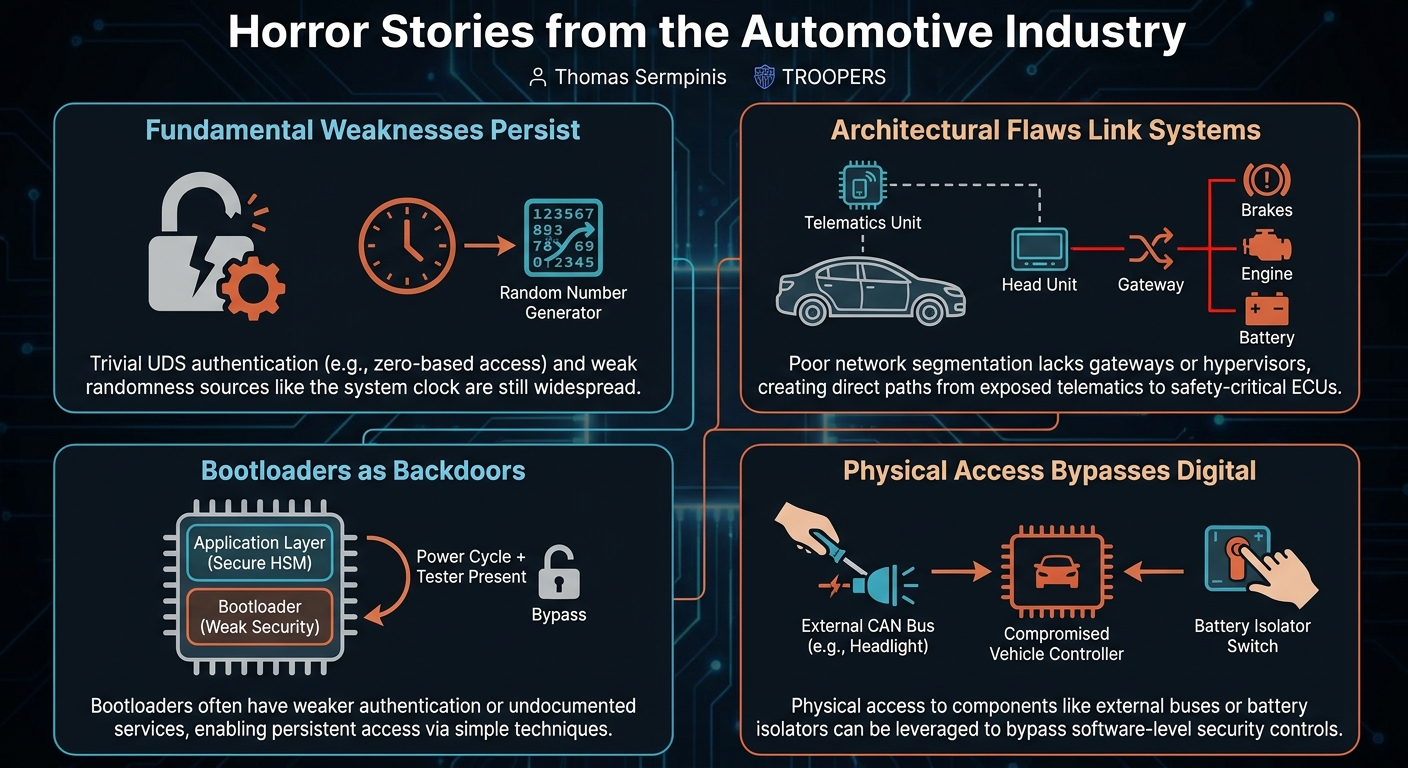
- Pervasive Fundamental Weaknesses: Despite increasing connectivity and regulatory pressure (like UNR 155), the automotive industry still suffers from basic, exploitable vulnerabilities, including trivial authentication bypasses in UDS Security Access (0x27) and reliance on weak randomness sources like the system clock.
- Architectural Flaws Amplify Risk: Poor architectural design, such as direct connections between telematics/head units and safety-critical ECUs without proper gateway filtering or hypervisor isolation, creates easily exploitable "stepping stones" for attackers to compromise critical vehicle functions.
- Bootloaders Are Critical Backdoors: Bootloaders, often overlooked, frequently contain weaker authentication mechanisms or undocumented services compared to the application layer. Techniques combining ECU Reset (0x11) or physical power cycling with Tester Present (0x3E) can grant persistent, unauthenticated access.
- Physical Access Bypasses Digital Controls: Publicly accessible physical components like battery isolators or exposed CAN bus lines (as seen in the Toyota hack) can serve as powerful bypasses for software-level security, enabling deep system compromise through automated power cycling and timing attacks.
- Beyond Compliance: Proactive, Realistic Testing is Key: Effective automotive penetration testing must extend beyond stated OEM requirements, employing robust methodologies, creative approaches, and automation (e.g., with tools like Caribou and custom fuzzers) to uncover hidden vulnerabilities and design flaws.
- Security by Design, Not Afterthought: OEMs and Tier 1 suppliers must prioritize security from the initial design phase, implementing stricter requirements, ensuring proper segmentation, and fostering a culture of transparency and collaboration to build inherently secure vehicles.
About the Speaker(s)
Thomas Sermpinis, known in the security community as Crow Tom, is an accomplished professional in the field of automotive cybersecurity. By day, he serves as the Automotive Penetration Testing Lead for Auxilium Cybersecurity, where he leads efforts to identify and mitigate vulnerabilities in modern vehicles. By night, he channels his passion into security research, exploring and dissecting various systems. A returning speaker at TROOPERS, Sermpinis is a fervent advocate for enhancing automotive security, driven by a "romantic" vision of making the world a safer place. He actively works with manufacturers to spread a culture of security, emphasizing that vulnerabilities are not mere "moldy ways" but issues that can "directly affect the safety of the passengers and pedestrians on the streets." His extensive experience, derived from conducting over a hundred penetration tests and research projects, provides him with unique insights into the persistent challenges and critical needs of the automotive industry.
Reviews
Dr. Zero (Offensive Security Researcher) — SOLID
Sermpinis cuts through the automotive compliance bullshit to show how Tier 1 suppliers are still shipping trivially exploitable ECUs. It's a highly practical, hardware-grounded breakdown of UDS abuse that proves why regulation won't fix bad engineering. If you audit vehicle networks, watch this.
Heather Calloway (CISO) — STRONG ACCEPT
This talk is a masterclass in supply chain failure disguised as a technical penetration testing brief. Sermpinis demonstrates how fragmented procurement and weak oversight of Tier 1 suppliers lead directly to unauthenticated backdoors in safety-critical systems. If your organization operates a connected fleet or builds hardware with third-party components, this is required viewing for your product security and vendor risk teams.