The Wire on Fire: The Spies Who Loved Telcos
Aleksandar Milenkoski (Senior Threat Researcher · SentinelLabs)
TROOPERS23 · Day 2 · Track 3
Overview
In "The Wire on Fire: The Spies Who Loved Telcos," Aleksandar Milenkoski, a Senior Threat Researcher at SentinelLabs, unveils the persistent and evolving threat landscape targeting telecommunication providers. The talk meticulously details the tactics, techniques, and procedures (TTPs) employed by Advanced Persistent Threat (APT) groups, with a particular focus on Chinese-speaking actors, who are responsible for an overwhelming majority of these incidents. Milenkoski highlights recent trends observed since early 2022, providing critical insights into initial infection vectors, sophisticated post-intrusion activities at both system and network levels, and the increasing abuse of public cloud infrastructure.
Key moments
- 0:00 Introduction, speaker, and talk agenda
- 2:00 Why telcos are targeted and key threat actors
- 14:00 Chinese APTs' multi-year, long-term attack campaigns
- 16:20 Key defensive takeaways for initial access
- 19:00 Post-intrusion: Abusing 'living off the land' binaries
- 22:50 Advanced credential theft and anti-detection techniques
- 27:50 Post-intrusion: Threat actors abusing public cloud for C2
- 32:00 Strategies and challenges in defending against cloud C2
The Wire on Fire: The Spies Who Loved Telcos
Speakers: Aleksandar Milenkoski, Senior Threat Researcher, SentinelLabs
Conference: TROOPERS
YouTube: https://www.youtube.com/watch?v=HiFaiqQaM-c
Overview
In "The Wire on Fire: The Spies Who Loved Telcos," Aleksandar Milenkoski, a Senior Threat Researcher at SentinelLabs, unveils the persistent and evolving threat landscape targeting telecommunication providers. The talk meticulously details the tactics, techniques, and procedures (TTPs) employed by Advanced Persistent Threat (APT) groups, with a particular focus on Chinese-speaking actors, who are responsible for an overwhelming majority of these incidents. Milenkoski highlights recent trends observed since early 2022, providing critical insights into initial infection vectors, sophisticated post-intrusion activities at both system and network levels, and the increasing abuse of public cloud infrastructure.
This presentation is crucial for understanding the strategic importance of telecommunication companies as targets for espionage-oriented threat actors. Telcos serve as the communication backbone of modern societies, offering unparalleled access to vast amounts of sensitive customer data, critical infrastructure, and advanced technology. By dissecting real-world attack campaigns, Milenkoski aims to equip defenders with actionable intelligence, emphasizing the need for robust, adaptive security strategies to counter these long-term, highly evasive threats. The talk underscores that these are not merely opportunistic attacks but well-resourced, strategic operations designed for deep and prolonged access.
Background
▶ Watch: Introduction, speaker, and talk agenda (0:00)
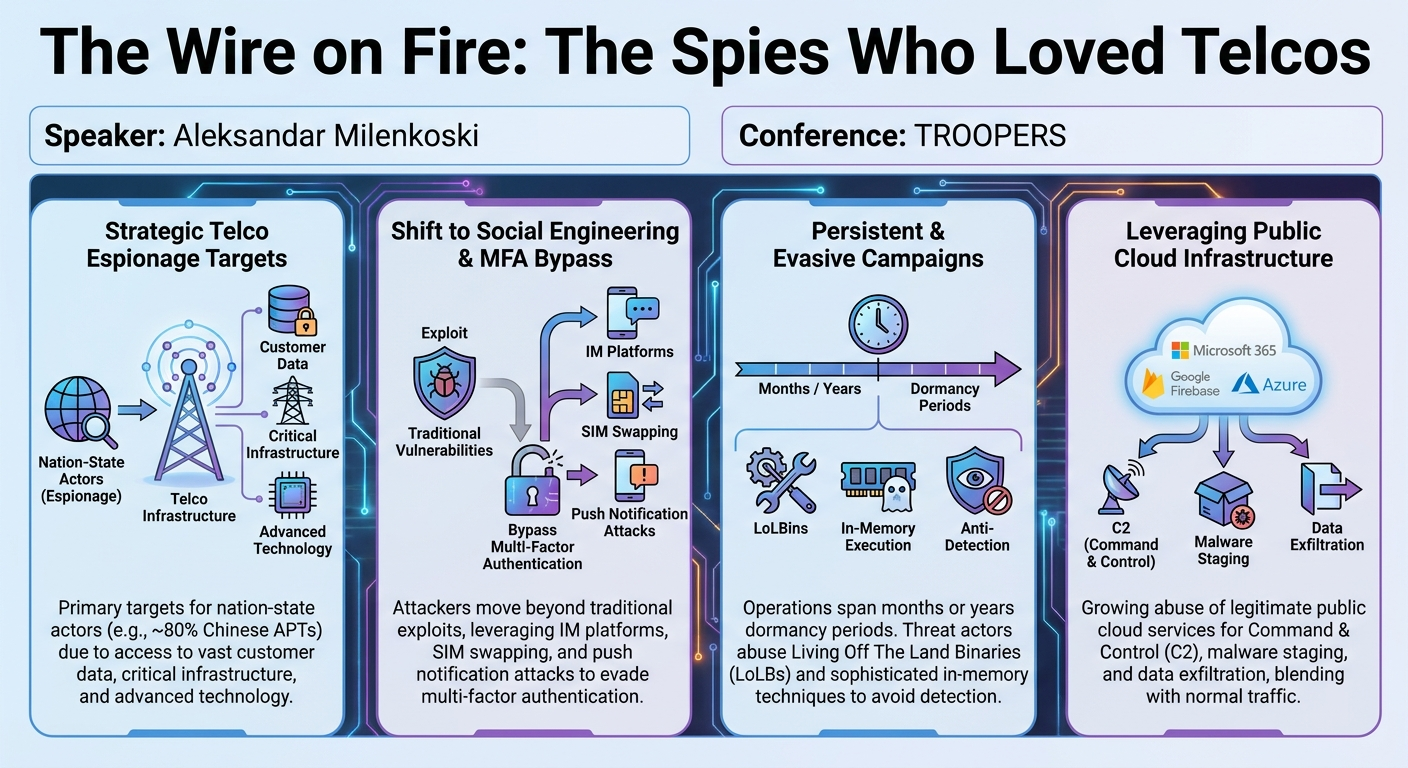
The targeting of telecommunication providers by nation-state actors, particularly for espionage, is a critical and growing concern. As Milenkoski explains, telcos represent a strategic asset due to their foundational role in global communication. This strategic value stems from three primary areas: data, infrastructure, and technology. Telcos manage extensive customer bases, providing threat actors with access to a wealth of private information and communication data. Their large network infrastructure deployments can also be leveraged to target entities affiliated with the initially compromised telcos, creating a cascading effect. Furthermore, the advanced technologies inherent in telecommunication systems are of significant interest for intelligence gathering and industrial espionage.
SentinelLabs' observations indicate a stark reality: Chinese-speaking threat actors are overwhelmingly dominant in this space, accounting for approximately 80% of all observed incidents targeting telecommunication providers. Milenkoski introduces several key threat actors tracked by SentinelLabs, each demonstrating unique characteristics and levels of sophistication:
- LightBasin: Active since at least 2016, this suspected Chinese threat actor specializes in targeting Linux, Unix, and Solaris environments, which are prevalent in mission-critical Telco infrastructures. Their distinguishing feature is an in-depth knowledge of Telco protocols and architecture, often employing telco-specific malware.
- Metador: An currently unattributed threat actor, Metador's activities were first observed between 2020 and 2021, primarily targeting telcos in the Middle East. Attribution for Metador has proven challenging due to a mix of artifacts, including English pop punk lyrics, Spanish/Argentinian references (e.g., the backdoor name "Mafalda"), and varied English usage. This group exhibits high opsec awareness, utilizing victim-specific infrastructure and highly obfuscated malware.
- WIP26 (Work in Progress 26): Also an unattributed actor, WIP26 emerged around February-March 2023. This group is characterized by its extreme reliance on public cloud infrastructure for staging malware, exfiltrating data, and command-and-control (C2). In contrast to Metador, WIP26 demonstrated somewhat looser opsec, with an exposed C2 database providing valuable insights into their operations and victimology.
- TaintedLove: Identified around February-March 2023, TaintedLove is another Chinese threat actor assessed to operate within the nexus of APT Gallium and APT-41. This assessment stems from the discovery of credential theft malware that was a newer version of a tool used in "Operation Soft Cell" (an APT Gallium campaign targeting Middle Eastern telcos between 2019-2021) and signed with a code-signing certificate known to be used by APT-41. Milenkoski suggests this could indicate a "digital quota master" among Chinese espionage groups, where tools and resources are shared or centrally managed.
These diverse threat actors underscore the complex and multi-faceted nature of the threats facing the telecommunications sector, necessitating a comprehensive and adaptive defense posture.
Key Findings
▶ Watch: Chinese APTs' multi-year, long-term attack campaigns (14:00)
Aleksandar Milenkoski's presentation distills several critical insights into the contemporary threat landscape targeting telecommunication providers:
- Telcos as Primary Espionage Targets: The core finding is the undeniable strategic value of telecommunication providers. They are not merely targets of opportunity but are systematically exploited for their access to vast customer data, critical network infrastructure, and advanced technology, making them prime targets for nation-state espionage, particularly by Chinese APTs.
- Dominance of Chinese Threat Actors: A striking statistic reveals that approximately 80% of all observed incidents targeting telcos are attributed to Chinese or Chinese-speaking threat actors. This highlights a concentrated and persistent effort from a specific geopolitical origin.
- Evolution of Initial Access Vectors: Attackers are diversifying their initial access methods. While traditional vulnerability exploitation (including zero-days) remains a constant threat, there's a significant shift towards sophisticated social engineering tactics leveraging instant messaging platforms, SIM swapping attacks, and push notification phishing to bypass multi-factor authentication and masquerade as trusted contacts.
- Prolonged and Stealthy Operations: A hallmark of these campaigns, especially those linked to Chinese APTs, is their long-term nature. Operations can span several months to over four years, characterized by periods of dormancy (up to seven months) followed by renewed activity. This "long-game" strategy is designed to evade detection by conventional short-term monitoring.
- Heavy Reliance on Living Off The Land Binaries (LoLBins): To avoid detection by endpoint detection and response (EDR) systems and other security solutions, threat actors extensively abuse legitimate system tools (LoLBins). This includes using debugging tools for malware injection, and leveraging system-native functionalities for credential theft and persistence while actively evading system-native monitoring capabilities like the Windows Event Log.
- Sophisticated Anti-Detection and Opsec: The malware employed by these groups is highly sophisticated, incorporating advanced anti-detection mechanisms such as in-memory image mapping, enumeration of security solutions and analysis tools, and careful management of operational security (opsec) to segment infrastructure and obfuscate activities.
- Widespread Abuse of Public Cloud Infrastructure: A significant and growing trend is the exploitation of public cloud services (e.g., Microsoft 365, Google Firebase, Azure, OneDrive, Google Drive) for command and control, malware staging, and data exfiltration. This allows threat actors to blend malicious traffic with legitimate cloud activity, making detection challenging, and offers flexibility by enabling easy provisioning of new C2 instances.
These findings collectively paint a picture of highly adaptive, persistent, and well-resourced adversaries who continuously refine their TTPs to achieve their strategic objectives within the telecommunications sector.
Technical Deep Dive
▶ Watch: Post-intrusion: Abusing 'living off the land' binaries (19:00)
The technical depth of the observed attacks on telecommunication providers is a central theme of Milenkoski’s presentation, detailing the intricate methods used for initial infection and post-intrusion activities.
Initial Infection Vectors
Threat actors employ a variety of initial access methods, often tailored to the target environment and their specific opsec requirements.
- Instant Messaging and Social Engineering (WIP26):
- WIP26, the cloud-reliant unattributed threat actor, initiated attacks by sending WhatsApp messages to employees of target telcos. These messages contained a malware loader.
- The loader subsequently deployed two backdoor variants: CMD 365 and CMD Ember. CMD 365 abused Microsoft 365 Mail for command and control, while CMD Ember leveraged a Google Firebase database for C2.
- The threat actors also utilized Microsoft Azure infrastructure for staging additional malware and exfiltrating data.
- A strong suspicion exists that SIM swapping attacks were used to masquerade as trusted contacts, thereby increasing the efficacy of the social engineering campaign. The malware loader itself was signed using an invalid Wondershare certificate and established persistence via a scheduled task.
- Vulnerability Exploitation (LightBasin):
- LightBasin's initial access in one observed case dates back to 2018, exploiting a then-zero-day vulnerability in an internet-facing Veritas Cluster Service. This high-availability system, designed for redundancy, was left exposed due to an operational mistake, which the attackers immediately leveraged.
- Following initial compromise, LightBasin deployed the SUN4ME malware. This highly capable tool provided reconnaissance, exploitation, and file exfiltration functionalities. Specifically, it was used to exfiltrate credential-related files for deeper compromise.
- Long-Term Attacks and Evasion (TaintedLove, LightBasin):
- Chinese APTs, including TaintedLove and LightBasin, are known for conducting extended campaigns to evade detection.
- TaintedLove exhibited a timeline spanning approximately 8-9 months:
- July 2022: Initial access and reconnaissance.
- February 2023: After a seven-month break, they redeployed a new version of a webshell for remote command execution.
- Late February 2023: Following a two-month dormancy, they resumed reconnaissance and credential theft.
- LightBasin demonstrated an even more extreme operational lifespan, with activities spanning from July 2018 to January 2023—nearly four and a half years. Throughout this period, they continuously deployed backdoors, established proxy communication channels, performed privilege escalation, and conducted ongoing reconnaissance, constantly adapting their TTPs based on their understanding of the compromised environment.
Post-Intrusion Activities: System Level (LoLBins & Evasion)
Once inside, threat actors prioritize stealth and persistence, often abusing legitimate system functionalities.
- Metador's LoLBin Abuse:
- Metador extensively used Living Off The Land Binaries (LoLBins). A notable example involved executing
cdb.exe, a legitimate Windows debugging tool. cdb.exewas used to inject a debugging script,cdb.ini, into the legitimatedefrag.exeprocess.cdb.iniwas, in fact, a malware loader.- This loader then loaded and executed another implant called
metaMain, which reflectively loaded the primary backdoor, Mafalda. - Mafalda communicated with its C2 server over TCP, HTTP, and even named pipes for local process communication.
- For persistence, Metador abused Windows Management Instrumentation (WMI) event subscriptions, configuring
cdb.exeto execute at every system reboot, thus restarting the entire infection chain. - Anti-Detection: Mafalda was highly sophisticated in its evasion, enumerating 36 detection mechanisms (totaling 404 individual files), including major security vendors and analysis tools like Sysinternals Suite, Wireshark, debuggers (x64dbg, OllyDbg), and IDA Pro. This suggests an effort to detect and potentially evade malware analysts' machines.
- TaintedLove's Credential Theft (mim221):
- TaintedLove employed a credential theft tool dubbed mim221, a variant of the well-known Mimikatz.
- This tool focused heavily on evading system-native monitoring:
- In-memory image mapping: The code was loaded and executed entirely in memory, without touching the disk, to bypass file-based detection.
- Event Log Evasion: mim221 terminated Event Log threads without stopping the Event Log Service itself, aiming to prevent logging of its activities.
- LSASS Process Staging: The credential theft capability was staged directly within the Local Security Authority Subsystem Service (LSASS) process. This technique evades detection mechanisms that look for external processes attempting to dump credentials from LSASS.
- LightBasin's Linux Opsec:
- In Linux environments, LightBasin exhibited more generic opsec practices rather than extensive XDR evasion, possibly due to lower prevalence of third-party security solutions on Linux systems.
- Techniques included conditional malware execution based on environment variables (potentially for deconfliction with other threat actors in contested environments), binary encryption, and anti-forensic measures like time stomping and log deletion.
Post-Intrusion Activities: Network Level (Public Cloud Abuse)
A prominent trend is the increasing abuse of public cloud infrastructure for C2 and data exfiltration.
- WIP26's Cloud-Centric C2:
- As mentioned, WIP26 utilized CMD 365 and CMD Ember for C2.
- CMD 365 functionality: The backdoor logged into
microsoftonline.comusing a client ID and client secret (investigation ongoing into whether these were compromised or self-registered). It created a victim-specific mail folder within Microsoft 365 Mail. Commands were provided by the threat actor as email messages with subjects starting with "input." The backdoor continuously polled this inbox, extracted commands, and piped them into the standard Windows command utility (cmd.exe), enabling remote command execution. - CMD Ember functionality: This backdoor operated similarly but queried a Google Firebase database using a victim-specific key to retrieve commands.
- Both backdoors exchanged JSON-formatted messages with the C2 server, using a "who" field to indicate communication direction (
who: serverfor commands,who: clientfor command output). - This public cloud abuse allows threat actors to blend malicious traffic with legitimate cloud traffic and provides flexibility, as new cloud instances can be easily provisioned if existing C2 channels are blocked. However, it also means sacrificing some opsec, as major cloud vendors have visibility into their platforms.
Demo / Proof of Concept
▶ Watch: Advanced credential theft and anti-detection techniques (22:50)
The talk provided a detailed analytical breakdown of the observed threat actor activities, including their initial infection vectors, post-intrusion techniques, and the specific malware functionalities. While Aleksandar Milenkoski thoroughly described the technical workings of tools like Metador's Mafalda, TaintedLove's mim221, and WIP26's CMD 365 and CMD Ember, the presentation did not include a live demonstration or a recorded proof of concept of these capabilities. The focus was on summarizing and outlining the observed trends and technical details from real-world incidents.
Defensive Implications
▶ Watch: Strategies and challenges in defending against cloud C2 (32:00)
The detailed analysis of APT activities targeting telecommunication providers provides critical insights for strengthening defensive postures. Milenkoski outlines several key recommendations for defenders:
- Treat Instant Messaging as a High-Risk Initial Intrusion Vector: With the rise of sophisticated social engineering, organizations must recognize IM platforms like WhatsApp as significant entry points. Employees should be educated on the risks of unsolicited messages, and robust policies should govern the use of personal devices and messaging apps for work-related communications.
- Adopt Attack-Resilient Multi-Factor Authentication (MFA): While MFA is essential, it is not bulletproof against advanced adversaries who employ SIM swapping and push notification fatigue attacks (as seen with groups like Lapsus). Defenders should prioritize more resilient MFA mechanisms, such as biometrics or hardware security keys (FIDO2), over less secure methods like one-time passwords (OTPs) via SMS or simple push notifications.
- Develop Long-Term Threat Activity Clustering Capabilities: Given the multi-month to multi-year attack lifecycles of many APTs, organizations need to evolve their detection strategies. Security operations centers (SOCs) should invest in tools and processes that enable the correlation and clustering of suspicious activities over extended periods, identifying subtle, protracted campaigns that might otherwise go unnoticed by short-term alerts.
- Prioritize Patching and Control Attack Surface: The exploitation of known or zero-day vulnerabilities in internet-facing services remains a constant threat, as exemplified by LightBasin's exploitation of the Veritas Cluster Service. A rigorous patching regimen is non-negotiable, and organizations must meticulously control and minimize their internet-facing attack surface, regularly auditing for inadvertently exposed services.
- Implement a Robust LoLBin Protection Strategy: The pervasive use of Living Off The Land Binaries (LoLBins) necessitates a shift in detection. Defenders should implement application execution restriction mechanisms, such as Windows Defender Application Control (WDAC), to limit the legitimate use of potentially abusive binaries. Furthermore, monitoring solutions should be configured to detect anomalous or malicious activity associated with LoLBins, rather than merely blocking their execution.
- Monitor the Active System Driver Landscape: Threat actors are increasingly leveraging legitimate but vulnerable drivers to achieve kernel privileges, often to terminate security solutions like EDRs. Organizations must actively monitor the integrity and legitimacy of loaded system drivers. Resources like the "LOLDrivers project" provide valuable lists of such vulnerable drivers, enabling proactive defense.
- Implement a Two-Phase Approach to Public Cloud Defense: The abuse of public cloud infrastructure for C2 and data exfiltration presents a significant challenge due to the volume and dynamicity of cloud traffic.
- Phase 1: Restrict Cloud Services: Organizations should first restrict access to only essential cloud services from their environments. This reduces the overall attack surface and the volume of traffic that needs monitoring.
- Phase 2: Monitor Malicious Cloud Traffic: While challenging due to scale and the ease with which threat actors can provision new instances, monitoring remains crucial. Traditional blocking of known Indicators of Compromise (IOCs) like specific URLs or IP addresses often proves ineffective against dynamic cloud environments. Instead, focus should be on behavioral analytics and anomaly detection within cloud traffic, identifying patterns indicative of C2 or data exfiltration.
By adopting these defensive strategies, telecommunication providers can build more resilient defenses against the sophisticated and persistent threats posed by nation-state actors.
Key Takeaways
- Telcos are High-Value Targets: Telecommunication providers are critical infrastructure, making them prime targets for nation-state espionage due to access to vast data, infrastructure, and technology. Chinese APTs account for roughly 80% of observed incidents.
- Evolving Initial Access: While vulnerability exploitation remains, threat actors increasingly leverage sophisticated social engineering via instant messaging platforms, SIM swapping, and push notification attacks to gain initial access and bypass traditional MFA.
- Long-Term, Stealthy Operations: APT campaigns, particularly from Chinese actors, are characterized by their multi-month to multi-year duration, often including extended periods of dormancy to evade detection. This necessitates long-term activity correlation.
- LoLBins and Advanced Evasion are Standard: Adversaries extensively use Living Off The Land Binaries (LoLBins) and sophisticated anti-detection techniques (e.g., in-memory execution, Event Log evasion, security tool enumeration) to maintain stealth and persistence on compromised systems.
- Public Cloud Abuse is a Growing Challenge: Threat actors are increasingly abusing public cloud infrastructure (Microsoft 365, Google Firebase, Azure) for C2, malware staging, and data exfiltration, blending malicious traffic with legitimate activity and easily adapting by provisioning new instances.
- Adaptive Defense is Crucial: Defenders must implement attack-resilient MFA (biometrics), prioritize patching, control their attack surface, develop LoLBin protection strategies, monitor for vulnerable drivers, and adopt a two-phase approach to public cloud security focusing on restriction and behavioral monitoring.
About the Speaker(s)
Aleksandar Milenkoski, known as Alex, is a Senior Threat Researcher at SentinelLabs, the dedicated threat research department of SentinelOne. His work primarily focuses on Advanced Persistent Threat (APT) research and specialized malware analysis. Milenkoski brings a unique perspective to cybersecurity, having previously worked for ENISA (the European Union Agency for Cybersecurity), which he noted as a special pleasure to be back at TROOPERS. His expertise lies in dissecting complex attack campaigns and understanding the sophisticated TTPs employed by nation-state actors.
Reviews
Dr. Zero (Offensive Security Researcher) — SOLID
Milenkoski delivers a highly competent, no-bullshit intel briefing on Telco-targeting APTs. It's mostly a live-action recap of SentinelLabs research on LightBasin, Metador, and WIP26, but the technical details are concrete enough to make it worth the seat time if you missed the whitepapers.
Heather Calloway (CISO) — SOLID
This is a clear, unvarnished look at how top-tier adversaries are dismantling telecom infrastructure for long-term espionage. While the primary victims are telcos, the implications for enterprise defenders are direct: if you rely on push-notification MFA or allow unmonitored outbound access to consumer cloud services, your architecture is vulnerable to these exact TTPs.