Beyond Java: Obfuscating Android Apps with Purely Native Code
Laurie Kirk (Reverse Engineer · Microsoft)
TROOPERS23 · Day 2 · Track 3
Overview
In this compelling talk at TROOPERS, Laurie Kirk, a Reverse Engineer at Microsoft specializing in cross-platform mobile malware, unveiled advanced techniques for obfuscating Android applications using purely native C++ code. The presentation meticulously detailed how to strip away traditional Java entry points, translate core application logic into native binaries, and, most critically, mask Android API calls by interacting directly with the Binder inter-process communication (IPC) framework. Kirk's research demonstrates a powerful method to evade antivirus detections and significantly complicate reverse engineering efforts, representing a potential "next phase" in Android malware obfuscation.
Key moments
- 0:00 Introduction: Obfuscating Android apps with native code
- 3:30 Advantages of native code for obfuscation
- 8:15 Removing Java entry point with Native Activity
- 18:20 Translating Java methods to C++ using JNI
- 27:30 Hiding API calls using direct Binder communication
- 34:00 Bypassing hidden APIs with reflection
- 46:00 VirusTotal results for the obfuscated Anubis app
- 58:00 Q&A: Hidden APIs, logging, VM obfuscation
Beyond Java: Obfuscating Android Apps with Purely Native Code
Speakers: Laurie Kirk (Reverse Engineer, Microsoft)
Conference: TROOPERS
YouTube: https://www.youtube.com/watch?v=1D5h-zxc800
Overview
In this compelling talk at TROOPERS, Laurie Kirk, a Reverse Engineer at Microsoft specializing in cross-platform mobile malware, unveiled advanced techniques for obfuscating Android applications using purely native C++ code. The presentation meticulously detailed how to strip away traditional Java entry points, translate core application logic into native binaries, and, most critically, mask Android API calls by interacting directly with the Binder inter-process communication (IPC) framework. Kirk's research demonstrates a powerful method to evade antivirus detections and significantly complicate reverse engineering efforts, representing a potential "next phase" in Android malware obfuscation.
The motivation behind this research stems from the inherent ease of analyzing typical Android applications, which are predominantly written in Java or Kotlin. Standard tools like jadx can quickly decompile these apps back to highly readable source code, exposing their functionality. By shifting to native C++ and employing low-level system interactions, attackers can force reverse engineers into a much more arduous and knowledge-intensive analysis process, requiring expertise in assembly, C++, the Java Native Interface (JNI), and the intricate Android Binder architecture.
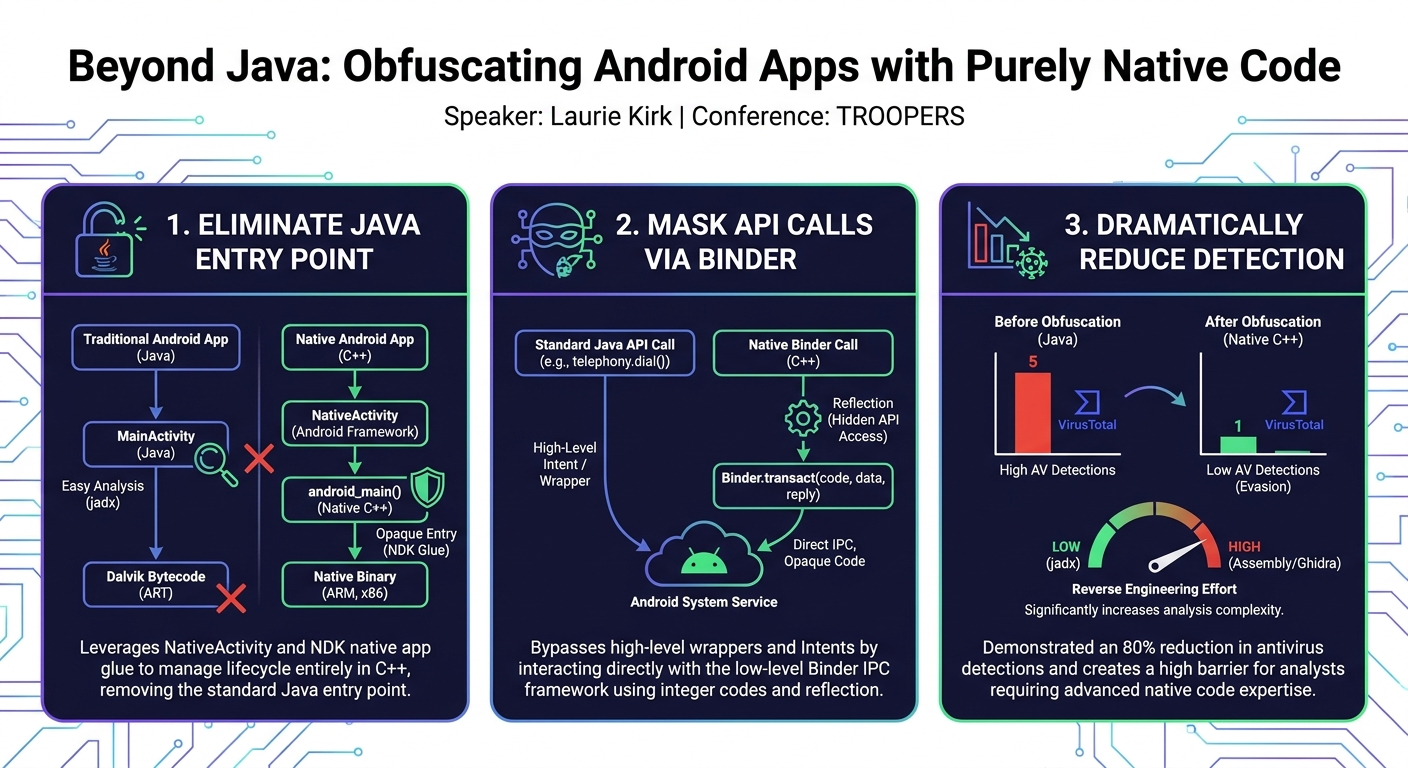
Through a practical demonstration using a defanged version of the Anubis Android malware, Kirk illustrated the dramatic impact of these techniques. An application that initially garnered five detections on VirusTotal, when re-engineered with purely native code and direct Binder calls, saw its detection rate plummet to just one, highlighting the efficacy of this approach against contemporary security defenses. This talk serves as a critical warning and a blueprint for defenders to anticipate and counter sophisticated Android threats.
Background
▶ Watch: Introduction: Obfuscating Android apps with native code (0:00)
Android applications are typically developed using Java or Kotlin, which compile into Dalvik bytecode for execution on the Android Runtime (ART). This "managed code" environment provides numerous benefits for developers but poses a significant challenge for security: it is notoriously easy to decompile. Tools like jadx can often reconstruct Java source code almost perfectly, making it trivial for reverse engineers to understand an application's logic and identify malicious functionality.
While Java and Kotlin are the primary languages, Android has long supported the inclusion of native C or C++ code through the Android Native Development Kit (NDK). This native code is compiled directly for specific instruction set architectures (e.g., ARM, x86) and offers performance benefits for computationally intensive tasks like gaming or multimedia processing. However, Kirk's research highlights an often-underestimated advantage of native code: its inherent obfuscation capabilities. As she demonstrated, merely adding a stub executable of C++ code to an existing Android application can reduce antivirus detections, suggesting that many security tools struggle with even rudimentary native components.
The advantages of native code obfuscation extend beyond simple evasion. Native binaries are significantly more challenging to reverse engineer than managed Java code. Analysts are forced to confront assembly code or decompiled C++ in tools like IDA Pro or Ghidra, a far cry from the human-readable Java source. This process demands a much deeper understanding of processor architectures, calling conventions, and the Android ecosystem, particularly the Java Native Interface (JNI), which acts as the bridge between Java and native code. Furthermore, malware authors can leverage native code to remove support for specific processor architectures (e.g., x86), thereby hindering analysis on common Android emulators. The core problem Kirk sought to address was: how far can this native obfuscation be pushed to create an entirely native Android application, devoid of easily parsable Java, and how can even the JNI's inherent transparency be overcome?
Key Findings
▶ Watch: Removing Java entry point with Native Activity (8:15)
Laurie Kirk's research culminated in several key findings that fundamentally challenge existing Android security paradigms and offer a glimpse into the future of mobile malware obfuscation:
- Purely Native Android Applications are Feasible: The talk definitively demonstrated that it is possible to create an Android application with no traditional Java entry point. By leveraging the Native Activity class within the Android framework and the native app glue provided by the NDK, the application's lifecycle can be entirely managed by native C++ code, specifically starting execution from an
android_main()function. This effectively removes the primary target for many static analysis tools. - Dramatic Antivirus Evasion: The most striking finding was the significant reduction in antivirus detections. A defanged Anubis malware variant, when fully translated into native C++ and employing advanced API call masking, saw its detection count on VirusTotal drop from an initial five to just one. This underscores the current blind spot many security solutions have when faced with sophisticated native code obfuscation.
- Binder-Based API Call Masking is Highly Effective: Kirk showed how to bypass high-level Android API wrappers like Intents and even the more direct, but often transparent, JNI calls. By directly interacting with the low-level Binder IPC framework, an application can invoke system services (e.g.,
TelephonyManager) using abstract integer "method codes" rather than plain-text method names. This makes static analysis of API calls exceedingly difficult, as the intent is obscured. - Reflection Unlocks Hidden APIs: A crucial enabler for direct Binder interaction is the use of reflection to access Android's hidden APIs. The
ServiceManagerclass, essential for obtaining Binder objects for system services, is a hidden API in modern Android versions. Kirk demonstrated that reflection (Class.forName().getMethod().invoke()) can bypass these restrictions, allowing user-land applications to interact with system services in ways not officially intended or easily monitored. - Elevated Reverse Engineering Barrier: The combination of these techniques creates an extremely high barrier for reverse engineers. Analysts must contend with raw assembly or complex decompiled C++ code, decipher intricate JNI call sequences, understand the nuances of the Binder protocol, and even perform trial-and-error to map numeric method codes to actual API calls. This multi-layered obfuscation drastically increases the time, effort, and specialized knowledge required for analysis.
Technical Deep Dive
▶ Watch: Hiding API calls using direct Binder communication (27:30)
The core of Laurie Kirk's presentation revolved around three interconnected technical strategies for achieving deep obfuscation in Android applications: removing the Java entry point, translating Java methods to native C++ via JNI, and masking API calls by directly interacting with the Binder framework.
Removing the Java Entry Point
Traditional Android applications are structured around Java Activities, which are declared in the AndroidManifest.xml file. This manifest explicitly points to the main Java class (e.g., com.example.MainActivity) that serves as the application's entry point. Decompilers like jadx can easily parse this manifest and navigate directly to the corresponding Java source code.
Kirk demonstrated how to bypass this by leveraging Native Activity. This is a special class within the Android framework, primarily designed for games that require highly efficient, low-latency graphics rendering. Instead of a Java class, Native Activity allows the AndroidManifest.xml to specify a native shared library (.so file) as the application's entry point via a <meta-data> tag. The android.app.NativeActivity class handles the lifecycle events (like onCreate) but delegates control to a native C++ function, typically android_main().
The heavy lifting for managing the application's context and event loop in a purely native environment is handled by the native app glue, a C++ library provided by the Android Native Development Kit (NDK). This android_app structure replaces the traditional Java ApplicationContext, allowing the native code to respond to user input and system events without any Java boilerplate. When demonstrating this with jadx, Kirk showed that the decompiled application's AndroidManifest.xml pointed to android.app.NativeActivity, and crucially, there were no custom Java classes or traditional MainActivity visible in the package explorer, effectively hiding the primary entry point from a quick glance. While the AndroidManifest.xml itself cannot be removed (it's essential for the system to understand and launch the app), its content can be manipulated to obscure the true starting point.
Translating Java Methods to Native C++
Once the native entry point is established, the next step is to translate the application's core logic, originally written in Java, into C++. While Java and C++ share some syntactic similarities, the interaction with the Android framework from C++ requires the Java Native Interface (JNI).
The JNI acts as a bridge, allowing native code to call Java methods, access Java fields, and create Java objects. Each native method that needs to interact with Java receives a JNIEnv* pointer, which provides access to a vast array of JNI functions. Kirk illustrated this by translating a method from the defanged Anubis malware, isEmulator(), which checks for the presence of an emulator by examining the Build.FINGERPRINT system property.
The process involves several steps:
- Finding the Java Class: Using
env->FindClass("android/os/Build"), the native code obtains a reference to theandroid.os.BuildJava class. Note the use of slashes instead of dots for package separators, a JNI syntax requirement. - Getting the Field ID: To access the
FINGERPRINTfield,env->GetStaticFieldID(buildClass, "FINGERPRINT", "Ljava/lang/String;")is called. This requires the class reference, the field name, and its JNI signature (e.g.,Ljava/lang/String;for a String). - Retrieving the Field Value: With the field ID,
env->GetStaticObjectField(buildClass, fingerprintID)fetches the actualfingerprintvalue as a Java String object. - Converting to C++ String: Since Java strings and C++ strings have different internal representations, the Java string must be converted to a C-style string using
env->GetStringUTFChars(fingerprintJava, NULL)before any string comparisons can be performed in C++.
While this process successfully moves the logic to native code, Kirk pointed out a significant weakness: the FindClass, GetStaticFieldID, and other JNI calls often expose plain-text strings (e.g., "android/os/Build", "FINGERPRINT"). These strings are easily identifiable by reverse engineers and are common targets for hooking frameworks, allowing analysts to intercept and observe the native code's interactions with the Java framework.
Hiding API Calls via the Binder
To overcome the transparency of plain-text JNI calls, Kirk introduced a more advanced obfuscation technique: directly interacting with the Android Binder framework. The Binder is Android's fundamental Inter-Process Communication (IPC) mechanism, implemented as a kernel driver. It's responsible for all communication between different applications and between applications and system services. High-level abstractions like Intents, Messengers, Content Providers, and even Android Interface Definition Language (AIDL) all ultimately rely on the Binder underneath.
The goal is to bypass these high-level wrappers and interact with the Binder directly. This involves:
- Obtaining a Binder Object: System services (like
TelephonyManager) are managed by theServiceManager. TheServiceManagerprovides anIBinderobject for each registered service. However, in modern Android,ServiceManageris a hidden API, meaning it's not directly accessible to regular user-land applications. Kirk demonstrated using reflection (Class.forName("android.os.ServiceManager").getMethod("getService", String.class).invoke(null, "phone")) to bypass this restriction and obtain theIBinderobject for theTelephonyManagerservice (which is internally named "phone"). Reflection is a powerful technique that allows dynamic invocation of classes and methods, even hidden ones, at runtime.
- Constructing Parcel Objects: Communication over the Binder uses Parcel objects. A Parcel is a lightweight, general-purpose serialization mechanism used to bundle data, method arguments, and return values. For invoking a method, an input Parcel is created containing:
- The interface descriptor (e.g.,
android.telephony.ITelephony). - The method arguments (e.g., the phone number to dial).
- Performing the Transaction: The core of direct Binder interaction is the
Binder.transact()method. This method takes several arguments:
code: An integer representing the method to be invoked. This is crucial for obfuscation, as it replaces the plain-text method name. Kirk discovered through source code exploration and trial-and-error that1corresponds to thedial()method inITelephony.data: The input Parcel containing method arguments.reply: An output Parcel to receive the method's return value.flags: Additional flags for the transaction.
When transact() is called, the Binder driver allocates memory in the target service's process, transfers the Parcel data, and the service's onTransact() method handles the invocation based on the code. The response is then written back to the reply Parcel.
Finally, Kirk demonstrated how to implement this entire Binder-based API call in C++ using JNI. This results in highly complex native code that performs reflective calls to ServiceManager, creates Parcel objects via JNI, and then invokes Binder.transact() with an opaque integer code (like 1). This completely obscures the intention of dialing a phone number, forcing an analyst to understand the entire Binder IPC mechanism and map the integer code to its corresponding method, a task requiring deep Android system knowledge and often manual source code analysis.
Demo / Proof of Concept
▶ Watch: Bypassing hidden APIs with reflection (34:00)
The talk featured several live demonstrations and a final proof-of-concept to validate the effectiveness of the obfuscation techniques.
- Initial Native App: Kirk first showcased a simple "Hello World" application written entirely in native C++, which merely printed colors to the screen. When this application's APK was opened in
jadx, it clearly demonstrated the absence of a traditional JavaMainActivityand instead showed theAndroidManifest.xmlpointing toandroid.app.NativeActivity. This visually confirmed the successful removal of the Java entry point.
- Java to C++ Translation (Anubis
isEmulator()): Next, she took a specific Java method,isEmulator(), from the defanged Anubis malware source code. This method checks for emulator presence by inspecting theBuild.FINGERPRINTsystem property. Kirk live-coded the translation of a portion of this method into C++, explicitly showing the JNI calls (FindClass,GetStaticFieldID,GetStaticObjectField,GetStringUTFChars) required to interact with the Android Java framework from native code. This illustrated the increased complexity and verbosity compared to the original Java.
- Binder Dial Method (Java Prototype): To demonstrate the concept of direct Binder interaction before diving into the C++ implementation, Kirk first presented a Java application that attempted to dial a phone number using the
TelephonyManagerservice. This prototype showcased the use of reflection to access the hiddenServiceManager.getService()method, obtaining theIBinderobject for the "phone" service. It then constructed Parcel objects to carry the interface descriptor and the phone number, and finally invokedbinder.transact(). Crucially, she demonstrated the trial-and-error process of discovering the correct integercodefor thedial()method, showing that0failed but1successfully initiated a call on the emulator. This highlighted how opaque these integer codes are to an analyst without prior knowledge.
- Final Obfuscated Anubis Application: The ultimate proof-of-concept involved a pre-compiled version of the defanged Anubis malware, which had been fully translated into native C++. This version incorporated both the removal of the Java entry point and the direct Binder-based API calls (like the
dial()method) using JNI to bridge to the reflective Java calls. Kirk then uploaded thisAnubis_purely_native.apkfile to VirusTotal.
- VirusTotal Results: The results were compelling. The original Java-based Anubis variant had five detections. The fully native, obfuscated version, however, showed only one detection, representing an 80% reduction in detection rate. This stark difference unequivocally proved the effectiveness of the presented obfuscation techniques against a wide array of antivirus engines.
- Ghidra Analysis of Native Code: To further emphasize the reverse engineering challenge, Kirk opened the final native binary (
.sofile) from the obfuscated Anubis application in Ghidra. She navigated to the C++ implementation of the Binder-baseddial()functionality. The decompiled C++ code, laden withJNIEnvpointers,jclassobjects,Parcelmanipulations, and thetransact(1, ...)call, appeared significantly more complex and less intuitive than any Java code. This visual comparison underscored the immense difficulty an analyst would face in deciphering the application's true intent without deep knowledge of the Android NDK, JNI, and Binder IPC.
Defensive Implications
▶ Watch: Q&A: Hidden APIs, logging, VM obfuscation (58:00)
The techniques demonstrated by Laurie Kirk present a significant challenge to current Android security defenses and necessitate a re-evaluation of detection and analysis strategies.
- Antivirus Evasion: The dramatic reduction in VirusTotal detections highlights a clear vulnerability in many signature-based and heuristic antivirus engines. These engines often rely on detecting known Java patterns, API call sequences, or readily identifiable strings. Purely native code, especially when combined with direct Binder calls, bypasses these traditional detection vectors, requiring AV solutions to develop more sophisticated native code analysis capabilities.
- Increased Reverse Engineering Effort: Security analysts and malware researchers must enhance their proficiency in native code analysis. Relying solely on Java decompilers like
jadxwill become increasingly ineffective. Expertise in disassemblers/decompilers like IDA Pro and Ghidra, understanding of various instruction set architectures (ARM, x86), JNI intricacies, and the low-level Binder IPC mechanism will become indispensable. This raises the barrier for entry for effective Android malware analysis.
- Challenges for Dynamic Analysis and Sandboxes: Traditional dynamic analysis tools and sandboxes often hook JNI calls or monitor Intent objects to observe application behavior. Direct Binder invocations, especially those bypassing high-level Intents, can evade these common hooking points. Defenders need to develop or integrate lower-level monitoring capabilities that can intercept and interpret direct Binder transactions, potentially requiring kernel-level instrumentation or advanced tracing tools to understand the intent behind opaque numeric method codes.
- Need for Advanced Static Analysis: Static analysis tools need to evolve to effectively parse and understand complex native binaries. This includes better C++ decompilation, automated identification and tracking of JNI calls, and the ability to symbolically execute or model the behavior of Binder transactions to identify potential malicious API invocations, even when obscured by integer codes and reflection.
- Focus on Behavioral Detection: As static analysis becomes harder, the emphasis on behavioral detection becomes paramount. Regardless of how an API call is initiated, the ultimate effect on the device (e.g., dialing a number, sending an SMS, accessing sensitive data) remains observable. Security systems should prioritize monitoring device-level actions and system calls, rather than relying solely on high-level code analysis, to catch such obfuscated threats.
- Developer Awareness for App Hardening: Android application developers should be aware of these obfuscation techniques. While malicious actors use them for evasion, legitimate applications could also adopt some hardening strategies (e.g., moving sensitive logic to native code) to protect against reverse engineering and intellectual property theft. However, this also introduces complexity and potential performance overhead.
In essence, Kirk's talk serves as a call to action for the Android security community to adapt its tools, methodologies, and expertise to address a growing class of highly evasive and complex native-code threats.
Key Takeaways
- Android applications can be developed with purely native C++ code, bypassing traditional Java entry points by leveraging Native Activity and the Android NDK's native app glue.
- Translating application logic from Java to native C++ significantly increases the difficulty of reverse engineering and drastically reduces antivirus detections, as demonstrated by an 80% detection drop on VirusTotal.
- Direct interaction with the Android Binder framework, utilizing Parcel objects and the
Binder.transact()method with opaque integer method codes, provides a stealthy way to invoke system services, effectively masking API calls from static analysis and common hooks. - Reflection can be used to bypass restrictions on hidden APIs (like
ServiceManager), enabling user-land applications to obtain Binder objects necessary for direct IPC with system services. - Defenders must enhance their native code analysis capabilities, develop low-level Binder monitoring tools, and shift towards more robust behavioral detection mechanisms to counter these advanced obfuscation techniques.
- While complex to implement, purely native obfuscation represents a highly effective and potentially emerging threat vector for Android malware, demanding increased vigilance from the security community.
About the Speaker(s)
Laurie Kirk is a Reverse Engineer at Microsoft, where she specializes in cross-platform malware analysis, with a particular focus on mobile threats. Beyond her work at Microsoft, she is also known for her educational contributions to the security community through her YouTube channel, "LaurieWired," where she shares insights and demonstrations related to reverse engineering and malware analysis. For this presentation at TROOPERS, Laurie Kirk explicitly stated that she was representing herself as a security researcher and not Microsoft.
Reviews
Dr. Zero (Offensive Security Researcher) — SOLID
Laurie Kirk dragged Android analysis back into the mud where it belongs. By stripping out the Java entry points and abusing raw Binder IPC via C++, she showed exactly how easily you can blind modern dynamic analysis. This is practical, gritty engineering that makes static analysis tools cry.
Heather Calloway (CISO) — SOLID
Laurie Kirk demonstrates how Android malware can completely evade standard static analysis and AV by shifting entirely to native C++ and raw Binder IPC calls. For teams managing corporate mobile fleets or BYOD environments, this means traditional signature-based MDM and AV controls are likely flying blind against modern Android threats. This is a technical reversing talk, but the strategic takeaway is that behavioral detection on mobile devices is no longer optional.