TR23 Badge - A RETROspective
Malte Heinzelmann (Senior Security Consultant · ERNW), Jeff Gough
TROOPERS23 · Day 2 · Track 3
Overview
This talk, "TR23 Badge - A RETROspective," delivered by Malte Heinzelmann and Jeff Gough at TROOPERS, offers a comprehensive look into the intricate process of designing, developing, and deploying the conference's highly anticipated badge. Far from being a mere identifier, the TROOPERS 2023 badge served as an interactive, retro-themed gaming device, powered by an ESP32 microcontroller. The speakers, representing ERNW for firmware and an independent designer for hardware, meticulously detail the journey from initial concept to final assembly, highlighting the myriad of challenges encountered and ingeniously overcome.
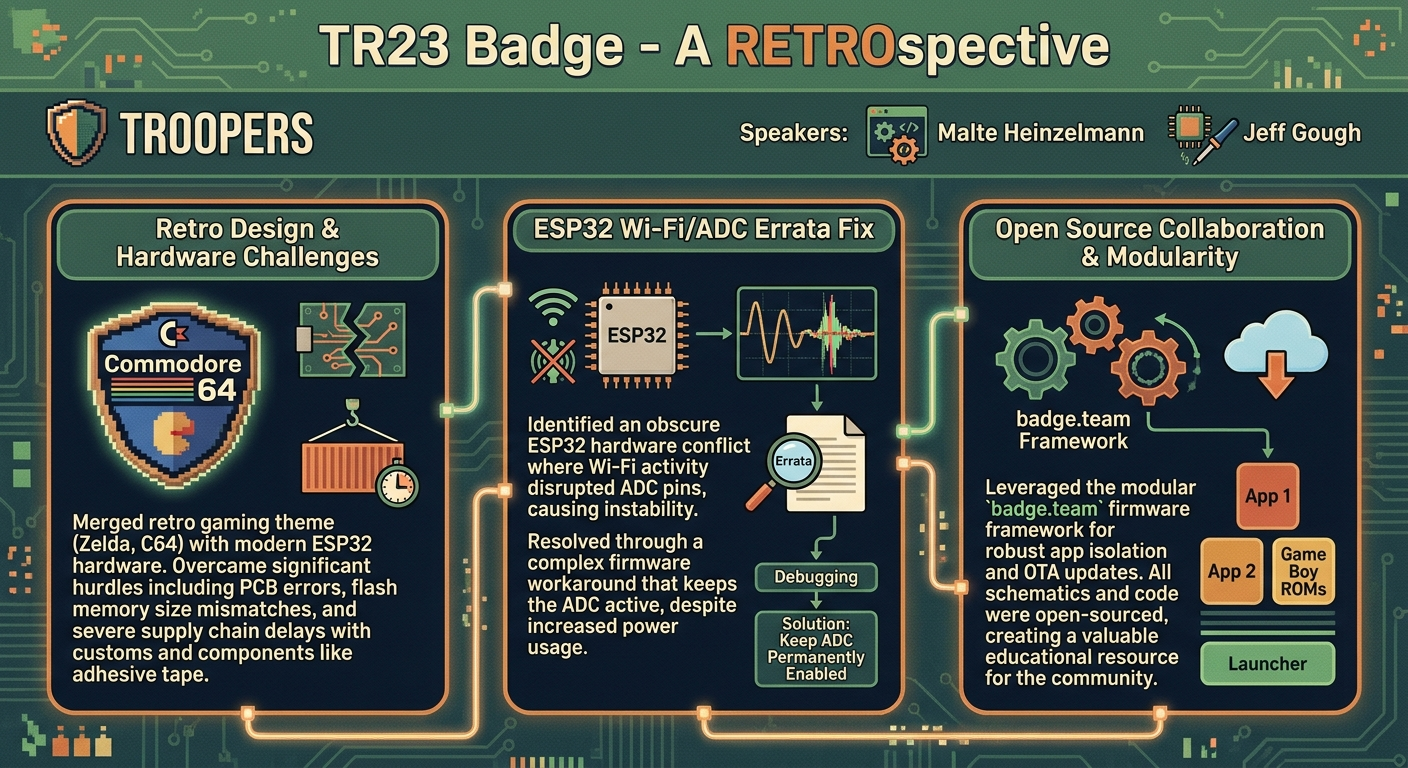
Key moments
- 0:17 Typical timeline of building a Troopers badge
- 6:25 Retro Adventure game concept for badge design
- 8:20 Custom switch and orange printing for aesthetics
- 9:40 Shipping, Customs, and Brexit challenges
- 13:50 Carpet tape failure and re-taping 300 badges
- 17:00 Hardware bug discovery and simple fix
- 19:00 Open-source resources for badge development
TR23 Badge - A RETROspective
Speakers: Malte Heinzelmann (Senior Security Consultant, ERNW), Jeff Gough
Conference: TROOPERS
YouTube: https://www.youtube.com/watch?v=gMb16rIFh8M
Overview
This talk, "TR23 Badge - A RETROspective," delivered by Malte Heinzelmann and Jeff Gough at TROOPERS, offers a comprehensive look into the intricate process of designing, developing, and deploying the conference's highly anticipated badge. Far from being a mere identifier, the TROOPERS 2023 badge served as an interactive, retro-themed gaming device, powered by an ESP32 microcontroller. The speakers, representing ERNW for firmware and an independent designer for hardware, meticulously detail the journey from initial concept to final assembly, highlighting the myriad of challenges encountered and ingeniously overcome.
The presentation is a candid exposé of the realities of hardware and firmware development under tight deadlines, covering everything from schematic design and PCB revisions to supply chain logistics, manufacturing, and last-minute bug fixes. It's a testament to the dedication required to deliver a complex technical artifact, showcasing the blend of engineering prowess, creative design, and sheer perseverance. For attendees and the broader security community, this talk is invaluable, providing transparency into the often-unseen struggles behind such projects and demonstrating the power of open-source collaboration in creating engaging and educational hardware platforms.
The talk matters because it demystifies the creation of a conference badge, transforming it from a simple gadget into a case study for embedded systems development. It provides practical insights into tackling unexpected hardware errata, navigating international customs, and managing complex assembly, all while maintaining a compelling thematic vision. By open-sourcing the design and firmware, the team not only delivered a functional and fun badge but also contributed a rich learning resource for aspiring hardware hackers and security researchers.
Background
▶ Watch: Typical timeline of building a Troopers badge (0:17)
The journey of the TROOPERS 2023 badge began in late December with the initial pitch of a "retro" theme to Jeff Gough. This concept quickly evolved, drawing inspiration from classic adventure games, the iconic Zelda shield, the low-resolution aesthetics of vintage computing like the Commodore 64, and nostalgic 90s mobile gaming platforms. The goal was to create an artifact that felt like it had "punched through time" into the conference, maintaining a pixelated, vintage look while incorporating modern functionality. This strong thematic foundation guided every design decision, from the physical shape to the choice of fonts and color palette.
The development timeline was aggressive and fraught with challenges. By March, Jeff had produced the first schematics, paving the way for the initial PCB (Printed Circuit Board) prototype, which arrived in May. This initial prototype phase was crucial for identifying early hardware flaws, such as incorrect button alignments and simple footprint mistakes, which were painstakingly resolved during an intensive week-long collaboration at the ERNW office. A significant hurdle at this stage was the discovery that the chosen ESP32 chips had only 4 megabytes of flash memory, while the firmware was compiled for 16 megabytes. This necessitated the desoldering of chips from previous year's badges and resoldering them onto the prototypes – a testament to the resourcefulness required under pressure.
Electronically, the badge aimed to maintain a similar hardware platform to previous TROOPERS badges, primarily deviating in its display technology. This continuity allowed Jeff to focus obsessively on the aesthetics and intricate details, such as finessing the radius of pixel corners for user comfort and customizing electronic components like switches and print colors to perfectly align with the TROOPERS brand orange. The firmware, led by Malte, was built upon the robust badge.team firmware from the MCH (May Contain Hackers) 2022 event, which had undergone a complete architectural overhaul to support modular, app-based functionality. This established a solid software foundation, enabling the team to develop new drivers for the TR23-specific hardware and integrate features like over-the-air (OTA) updates. The collaborative spirit, combined with the iterative design and development process, laid the groundwork for overcoming the numerous obstacles that would arise in the final weeks leading up to the conference.
Key Findings
▶ Watch: Custom switch and orange printing for aesthetics (8:20)
The development of the TROOPERS 2023 badge yielded several key findings, primarily centered around the complexities of hardware design, firmware integration, and supply chain logistics. These can be categorized as follows:
- Aesthetic-Driven Hardware Innovation: Jeff Gough's design philosophy, deeply rooted in the retro theme, pushed the boundaries of standard component usage. His "niche passion for reverse mount electronic devices" led to the development of a unique, pixelated keyboard concept. The commitment to aesthetics extended to customizing physical components, such as commissioning a factory to produce 5,000 custom switches and insisting on a specific shade of orange for the badge's printing. This demonstrated that thematic consistency can drive novel engineering solutions, even if it adds layers of complexity and cost.
- Unforeseen Hardware and PCB Errors: Despite meticulous design, initial prototypes revealed fundamental issues. The first turn-on attempt resulted in a "dead" badge due to a simple button alignment error on the PCB, requiring physical modification (cutting and resoldering traces). A more critical flaw involved the ESP32 chip's flash memory size: the initial chips on the prototype only had 4MB, while the firmware required 16MB. This necessitated a labor-intensive process of desoldering and resoldering correct-sized chips, highlighting the importance of verifying component specifications early and thoroughly.
- Logistical Nightmares and Supply Chain Vulnerabilities: The most significant non-technical challenges revolved around shipping and customs. The final production badges, shipped from China, took 12 days to arrive instead of the expected two, creating immense pre-conference pressure. Even more dramatically, a crucial package containing "shitty add-on" connectors and specialized 3M adhesive tape was held up by German customs for a full week. The customs officers demanded detailed descriptions for mundane items like tape and struggled to comprehend the concept of a "shitty add-on," resulting in 12 separate clearance events and ultimately requiring a team member to drive to Mannheim to physically retrieve the package. This underscores the fragility of global supply chains, especially post-Brexit, and the unpredictable nature of international logistics.
- Last-Minute Assembly and Quality Control Issues: Even after components arrived, assembly presented new hurdles. An initial attempt to use carpet tape for securing the batteries, due to the delay of the proper 3M tape, failed overnight, causing all batteries to detach. This forced the team to re-tape over 300 badges with the correct adhesive, highlighting that even seemingly minor component substitutions can have catastrophic consequences for product integrity and assembly time.
- Obscure Firmware-Hardware Interaction Bugs: A critical firmware bug emerged late in the development cycle, relating to an obscure ESP32 hardware errata. When Wi-Fi was enabled, the debug console was "completely spammed with interrupts," and buttons behaved erratically. This was traced to a conflict between Wi-Fi activity and the ADC (Analog-to-Digital Converter) pins, a known issue documented in the ESP32 errata, a GitHub issue, and a comment in the ESP32 source code. The fix, which involved keeping the ADC perpetually "on," consumed slightly more power but resolved the instability. This finding emphasizes that deep-seated hardware bugs can lurk in complex systems and require extensive debugging and knowledge of chip-specific documentation to resolve.
- The Power of Open Source and Collaborative Firmware: The decision to base the firmware on the
badge.teamMCH 2022 framework proved instrumental. This modular architecture, which treats each application as a separate ESP32 binary, provided flexibility and a robust foundation. The generous support from thebadge.teamdevelopers, particularly "Renze," was crucial for Malte in navigating the existing codebase. By open-sourcing all schematics and firmware, the team not only provided a working badge but also created a valuable educational resource, fostering community engagement and long-term utility for the hardware.
Technical Deep Dive
▶ Watch: Shipping, Customs, and Brexit challenges (9:40)
The TROOPERS 2023 badge represents a sophisticated integration of custom hardware and a modular, open-source firmware architecture, built around the versatile ESP32 microcontroller.
Hardware Architecture
The core of the badge's intelligence is an ESP32 chip. While the specific model wasn't explicitly stated, the initial prototype issues highlighted the importance of flash memory size, with the team needing to switch from 4MB to 16MB chips to accommodate the firmware. This decision is critical for embedded systems, as it dictates the complexity and number of applications that can be stored and executed.
The badge features a full-color display, a significant upgrade over previous monochrome designs, enabling the rich retro graphics and interactive user experience. Input is managed through a custom-designed, pixelated keyboard, which was a point of obsessive detail for Jeff Gough. These switches were custom-manufactured, requiring a minimum order of 5,000 units, underscoring the commitment to the unique aesthetic. The physical design of the badge itself, shaped like a Zelda shield with Commodore 64-inspired fonts and a custom orange color, is a masterclass in thematic integration. The corners of the "pixels" on the badge's surface were carefully finessed to balance a sharp, retro look with ergonomic comfort.
A notable hardware feature is the provision for "shitty add-on" connectors. These are standardized pin headers that allow users to connect external hardware modules, expanding the badge's functionality. This concept encourages experimentation and customization, aligning with the open-source ethos. Power is supplied by a battery, which is secured to the badge's rear using a specialized 3M adhesive tape, chosen for its strong bond on the limited surface area around the switches.
Firmware Architecture
The badge's firmware is built upon the highly modular badge.team firmware initially developed for the MCH 2022 conference. This architecture represents a significant departure from traditional monolithic embedded firmware, described as having "completely overthrown their old firmware approach." The core principle is a launcher (main menu) that can load and execute individual applications (apps). Crucially, each app is an independent ESP32 binary that boots from a separate partition on the flash memory. This design offers several advantages:
- Modularity: Apps can be developed, updated, or removed independently without affecting the core launcher or other applications.
- Stability: A crash in one app is less likely to bring down the entire system, as the launcher can restart or switch to another app.
- Flexibility: It allows for a diverse range of functionalities, from the agenda app to games and development tools.
Malte Heinzelmann was responsible for adapting this framework to the TROOPERS 2023 hardware. This involved developing new drivers in C for the specific display, input, and other peripherals unique to the TR23 badge. The firmware supports over-the-air (OTA) updates, allowing for remote deployment of new features and bug fixes without physical access to the device.
The badge's capabilities include running Game Boy ROMs, demonstrating its power as a retro gaming platform. It also features a MicroPython shell, accessible when connected to a PC. While the display integration for MicroPython was a "very last minute" addition and not fully functional during the conference, the I²C bus, SD card storage, and MP3 playback capabilities were confirmed to be working. This provides a powerful environment for users to interact with the badge's hardware and develop their own scripts and applications.
The ESP32 Wi-Fi/ADC Errata
A particularly insidious technical challenge was an obscure hardware bug within the ESP32 itself, discovered late in the development cycle. When the Wi-Fi module was activated for the agenda app, the debug console would be "completely spammed with interrupts," and the physical buttons would behave erratically. This issue was traced to an ESP32 errata, a known hardware defect documented by Espressif. Specifically, it concerned a conflict between Wi-Fi operations and the Analog-to-Digital Converter (ADC) pins.
The solution, found after extensive research through GitHub issues and source code comments, involved keeping the ADC permanently enabled. This workaround, while consuming "a little bit more power," effectively resolved the interrupt storm and restored stable button functionality. This incident highlights the critical importance of consulting chip manufacturer errata sheets and community forums when debugging complex embedded systems, as problems can often stem from low-level hardware interactions rather than just software logic. It also demonstrates the need for comprehensive testing, as this bug only manifested when Wi-Fi was active and debug output was enabled, easily missed in standard factory tests.
Demo / Proof of Concept
▶ Watch: Hardware bug discovery and simple fix (17:00)
The TROOPERS 2023 badge itself served as the primary demonstration and proof of concept for the team's ambitious design and development efforts. While the talk was a retrospective rather than a live, interactive demo, it detailed the badge's capabilities and the successful implementation of its core features.
The badge's ability to run Game Boy ROMs directly showcases its power as a functional retro gaming device, a central tenet of its "RETROspective" theme. This involves successfully emulating a classic console on the ESP32 hardware, utilizing the full-color display and custom input switches. The display, being full-color, significantly enhanced the visual experience compared to previous monochrome badge iterations.
Furthermore, the badge offered a MicroPython shell via a USB connection to a PC. Although the display output for this feature was described as "not fully working" due to last-minute integration, critical functionalities such as communication over the I²C bus, access to SD card storage, and MP3 playback were confirmed to be operational. This demonstrated the badge's potential as a versatile development platform, allowing users to write and execute their own Python scripts to interact with the badge's hardware and peripherals. The presence of the "shitty add-on" connectors further extended this concept, providing a physical interface for users to connect their own custom hardware modules, effectively turning the badge into a modular prototyping board.
The very fact that 350 badges were successfully assembled, flashed, and distributed to attendees, despite the numerous hardware, firmware, and logistical challenges, stands as the ultimate proof of concept. The attendees' ability to solve boot-up token challenges, find tokens within games like Battleships, and even solder together their own "shitty add-ons" confirmed the badge's interactive design and the community's engagement with its features. The talk's initial questions to the audience about their badge interactions served to validate the success of these embedded demonstrations.
Defensive Implications
▶ Watch: Open-source resources for badge development (19:00)
While the TROOPERS 2023 badge talk primarily focuses on the development process, it carries several significant defensive implications for security professionals, particularly in the realm of hardware and embedded systems.
- Supply Chain Security and Resilience: The struggles with shipping delays, unpredictable customs, and component availability (e.g., the 3M tape) highlight critical vulnerabilities in the hardware supply chain. Defenders, especially those involved in securing physical infrastructure or developing custom hardware, must account for these risks. Diversifying suppliers, pre-ordering components well in advance, and building contingency plans for logistical disruptions are crucial. The incident with German customs underscores the need for clear documentation and potentially engaging with customs brokers for complex international shipments of specialized hardware.
- Hardware Errata and Deep-Level Debugging: The ESP32 Wi-Fi/ADC bug serves as a potent reminder that even mature, widely-used microcontrollers can harbor obscure hardware errata. These low-level bugs can manifest as subtle, intermittent issues (like strange button behavior or interrupt storms) that are incredibly difficult to diagnose without deep technical knowledge, access to chip errata sheets, and detailed debugging tools. For defenders, this implies that thorough security audits of embedded systems must extend beyond application-level code to scrutinize the underlying hardware's behavior and known silicon defects. It also emphasizes the value of extensive, real-world testing that goes beyond standard factory QA.
- Open Source for Transparency and Scrutiny: The decision to open-source the badge's schematics and firmware is a significant defensive strength. Transparency allows for community review and scrutiny, which can help identify potential vulnerabilities or design flaws that might be missed by a small internal team. For security researchers, having access to the full source code and hardware design facilitates independent analysis, reverse engineering efforts, and the development of custom security tools or exploits (in a controlled, ethical manner). This approach fosters a more secure ecosystem by enabling collective intelligence to improve the platform's robustness.
- Hardware Security by Design: While not explicitly a security talk, the meticulous attention to detail in hardware design (e.g., finessing pixel corners for comfort, custom switches) indirectly contributes to physical security by ensuring a well-engineered and robust device. The "shitty add-on" concept, while encouraging modification, implicitly pushes the boundary of what users can do with the hardware. From a defensive perspective, enabling such extensibility requires careful consideration of potential attack vectors that could arise from third-party add-ons, though in this context, it's primarily for educational purposes.
- Importance of Robust Firmware Frameworks: The reliance on the
badge.teamfirmware, with its modular, app-based architecture, offers defensive benefits. By isolating applications into separate ESP32 binaries, a vulnerability or crash in one app is less likely to compromise the entire system. This compartmentalization aligns with principles of least privilege and fault tolerance, making the system more resilient to attacks or unexpected behavior. The built-in OTA update mechanism also provides a crucial defensive capability, allowing for rapid patching of vulnerabilities without requiring physical recall or manual intervention.
In essence, the TROOPERS 2023 badge development saga is a practical lesson in the challenges and best practices for building resilient and transparent embedded systems, areas of increasing importance in the broader cybersecurity landscape.
Key Takeaways
- Complexity of Hardware/Firmware Development: Building a sophisticated device like a conference badge involves an intricate dance between hardware design, firmware development, and real-world logistics, often leading to unexpected challenges from PCB errors and component mismatches to obscure hardware errata.
- Resilience Against Supply Chain Vulnerabilities: International shipping delays, stringent customs procedures, and material failures (like incompatible adhesive tape) can severely impact project timelines and require significant ingenuity and resourcefulness to overcome.
- Value of Open Source and Collaborative Frameworks: Basing the firmware on the
badge.teamMCH 2022 framework and open-sourcing all designs and code not only facilitated development through community support but also created a valuable educational platform for hardware hacking and security research. - Deep-Dive Debugging for Hardware Bugs: Obscure hardware errata, such as the ESP32 Wi-Fi/ADC conflict, can lurk in complex systems and require extensive research, knowledge of datasheets, and meticulous debugging to diagnose and resolve, emphasizing the need for thorough testing beyond standard QA.
- Aesthetic-Driven Engineering: A strong, consistent thematic concept (like "retro adventure") can profoundly influence design choices, pushing for innovative, customized hardware solutions that enhance user experience and make the device memorable, even if it adds to development complexity.
- Modular Firmware for Robustness: The
badge.teamarchitecture, treating each application as a separate ESP32 binary, provides a robust and flexible framework for embedded systems, offering benefits like stability, modularity, and easier over-the-air updates for future enhancements and security patches.
About the Speaker(s)
Malte Heinzelmann is a Senior Security Consultant at ERNW. In the context of the TROOPERS 2023 badge, Malte was primarily responsible for the firmware development. This included adapting the badge.team MCH 2022 firmware framework, developing new drivers for the TR23-specific hardware, integrating features like Game Boy ROM emulation and MicroPython, and meticulously debugging complex issues such as the ESP32 Wi-Fi/ADC errata. His work involved intense, last-minute development under significant pressure, collaborating closely with the badge.team community and the hardware designer.
Jeff Gough is an independent hardware designer with a clear passion for retro aesthetics and niche electronic components, specifically mentioning a fondness for "reverse mount electronic devices." For the TR23 badge, Jeff was the lead hardware designer, responsible for the PCB layout, selecting components, and overseeing manufacturing. His creative vision brought the "retro adventure" theme to life, from the Zelda shield shape and Commodore 64-inspired fonts to the custom-designed pixelated keyboard and bespoke orange switches. Jeff's role also involved managing the manufacturing process, dealing with prototypes, and navigating the often-challenging international shipping and customs procedures. His attention to detail was evident in aspects like finessing pixel corner radii for comfort and ensuring the precise shade of orange for the badge's printing.
Reviews
Dr. Zero (Offensive Security Researcher) — SOLID
Badge talks are a conference staple, and Heinzelmann and Gough deliver exactly what you want: supply chain nightmares, late-night soldering, and obscure silicon bugs. It won't change your threat model, but it's a brutally honest post-mortem of the TROOPERS 23 ESP32 badge. Good case study for the hardware hacking crowd.
Heather Calloway (CISO) — PASS
This is a hardware engineering retrospective on building a conference badge, not a strategic security briefing. While entertaining for hobbyists and embedded engineers, it holds no direct value for an enterprise leadership team. Pass, unless you are actively managing bespoke hardware manufacturing risk.