Homophonic Collisions: Hold me closer Tony Danza
Justin Ibarra (Threat Research and Detection Engineering Lead · Elastic), Reagan Short (Technical Director · BlueVoyant)
TROOPERS23 · Day 2 · Defense & Management · Defense & Management
Overview
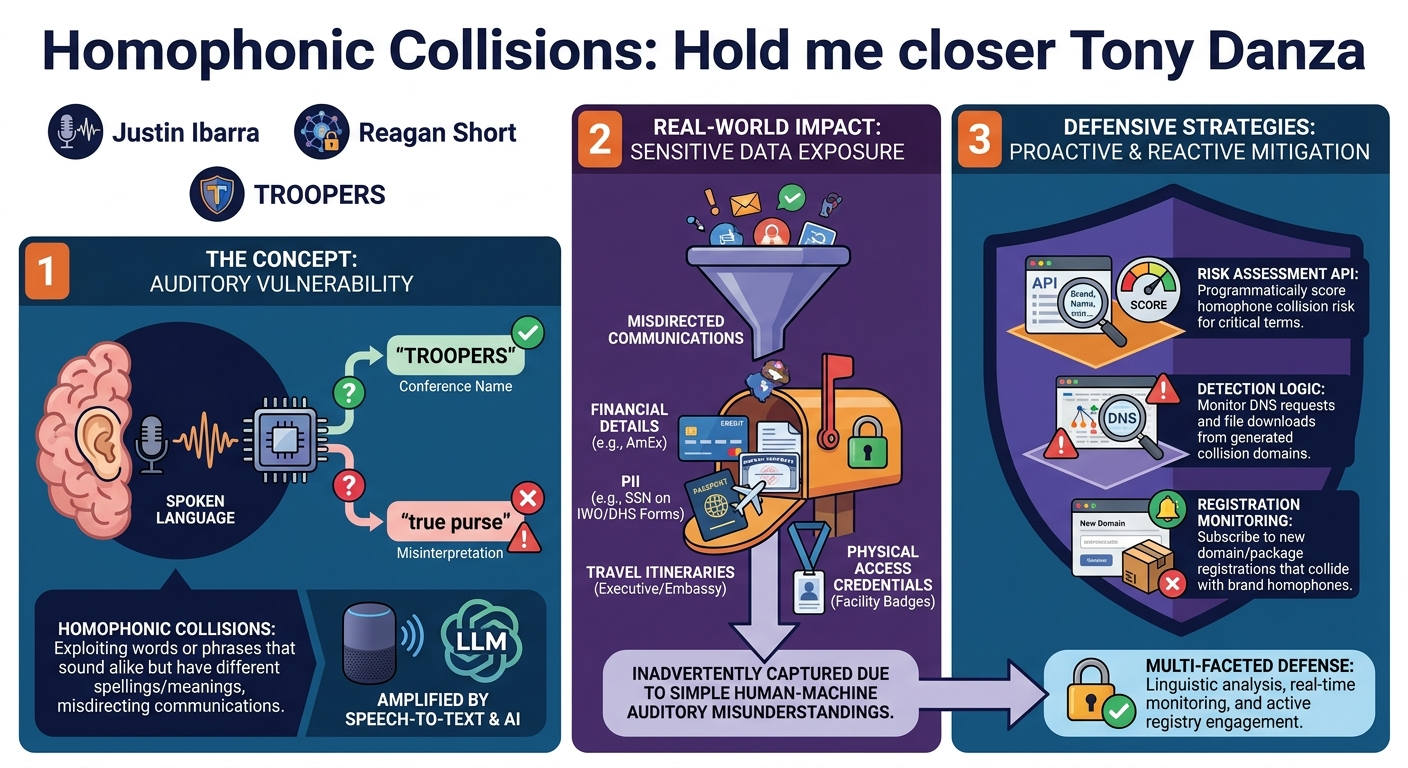
In their TROOPERS conference talk, "Homophonic Collisions: Hold me closer Tony Danza," Justin Ibarra and Reagan Short unveiled a subtle yet pervasive security vulnerability stemming from the fallibility of human-machine communication, particularly in the realm of spoken language. Drawing inspiration from a common mishearing of song lyrics, the speakers define homophonic collisions as the unintentional exploitation arising from words or phrases that sound alike but have different meanings or spellings. This phenomenon, often overlooked in security discourse, represents an emerging risk amplified by the increasing integration of speech-to-text technologies, large language models (LLMs), and voice assistants in daily life.
Key moments
- 0:00 Introduction and motivation for homophonic collisions
- 4:20 Defining homophonic collisions and communication chaos
- 6:20 Algorithms for determining and scoring near homophones
- 11:00 Methodology for finding vulnerable domains and PyPI packages
- 14:00 Real-world examples: Accidental PII and sensitive data exposure
- 19:20 B-Sides LV and conference sponsorship collision examples
- 20:20 Defensive opportunities and detection logic for collisions
- 22:20 Introducing Phoneminal: A toolkit for homophonic collisions
Homophonic Collisions: Hold me closer Tony Danza
Speakers: Justin Ibarra (Threat Research and Detection Engineering Lead, Elastic), Reagan Short (Technical Director, BlueVoyant)
Conference: TROOPERS
YouTube: https://www.youtube.com/watch?v=nj4fZAM_IDg
Overview
In their TROOPERS conference talk, "Homophonic Collisions: Hold me closer Tony Danza," Justin Ibarra and Reagan Short unveiled a subtle yet pervasive security vulnerability stemming from the fallibility of human-machine communication, particularly in the realm of spoken language. Drawing inspiration from a common mishearing of song lyrics, the speakers define homophonic collisions as the unintentional exploitation arising from words or phrases that sound alike but have different meanings or spellings. This phenomenon, often overlooked in security discourse, represents an emerging risk amplified by the increasing integration of speech-to-text technologies, large language models (LLMs), and voice assistants in daily life.
The core thesis of Ibarra and Short's presentation is that while visual-based attacks like phishing and homoglyph squatting are well-understood, sound-based vulnerabilities — which they term "sound squatting" — possess a high degree of prevalence coupled with a surprisingly low level of awareness within the security community. Their research highlights how easily sensitive information, including personally identifiable information (PII) and critical business data, can be misdirected due to simple auditory misunderstandings, often involving third parties. The talk not only defines this problem but also demonstrates its real-world impact through compelling examples of inadvertently captured data and outlines proactive defensive strategies.
This article delves into the technical underpinnings of homophonic collisions, exploring the linguistic concepts, computational methods for identifying near-homophones, and the practical implications for both attackers and defenders. It dissects the speakers' methodology for discovering vulnerable domains and software packages, showcases the astonishing array of sensitive data unintentionally exposed, and provides actionable recommendations for mitigating this often-ignored threat. As human-machine interfaces evolve, understanding and defending against the nuances of oral communication becomes increasingly critical.
Background
▶ Watch: Introduction and motivation for homophonic collisions (0:00)
The motivation for this research project stemmed from an accidental discovery made by Reagan Short back in 2016 while working in a Security Operations Center (SOC) with Justin Ibarra. Short registered a parody domain, crownstrike.com, for a local SOC challenge and, as part of the setup, configured a catch-all email address redirecting to his personal Gmail account. Almost immediately, he began receiving emails clearly not intended for him, containing intriguing and often sensitive information. This passive collection of misdirected communications sparked a mutual interest research project into the underlying cause: auditory confusion.
The speakers frame homophonic collisions within a broader context of linguistic attacks, likening their concept to a "coils of communication chaos" model, inspired by the Pyramid of Pain. This model illustrates various layers of linguistic exploitation, moving from high-level contextual attacks like phishing to visual attacks such as homoglyph squatting and domain squatting. At the lowest, most fundamental layer of this model reside homophonic collisions, which exploit phonetics and phonology—the sounds of words. Unlike visual attacks that rely on how words look, homophonic collisions leverage how words sound, making them a form of "sound squatting." Examples include mishearing "Bank of America" as "Bank of a miracle" or "TROOPERS" as "true purse."
The problem arises from the inherent ambiguity in spoken language. While humans often seek clarification through context in conversation, written language typically relies on precise spelling. When spoken words are transcribed or transmitted without sufficient contextual cues, or when a human intermediary mishears and then types, the potential for collision emerges. This issue is exacerbated by the rise of speech-to-text systems, voice assistants (like Siri and Google Assistant), and the pervasive integration of Large Language Models (LLMs) like ChatGPT, which increasingly bridge the gap between oral and written communication, inadvertently creating new attack surfaces for this type of misdirection.
Key Findings
▶ Watch: Algorithms for determining and scoring near homophones (6:20)
Ibarra and Short's research yielded several significant findings, underscoring the widespread and impactful nature of homophonic collisions. Their primary discovery was the sheer volume of sensitive information — including personally identifiable information (PII) and critical business data — that is inadvertently exposed due to simple auditory misunderstandings. This was vividly demonstrated through the accidental capture of executive travel itineraries, credit card details, income withholding orders (containing Social Security numbers), and even facility access badges. The passive nature of this collection, often through third-party intermediaries mishearing an email address over the phone, highlights a systemic vulnerability in communication processes.
Beyond individual data exposure, the speakers identified that homophonic collisions are actively exploited in broader digital ecosystems. By analyzing the Alexa top 1000 domains and popular PyPI packages, they uncovered numerous instances of "sound squatting" domains and malicious package names. For example, popular Python libraries like requests were targeted with homophonic variations such as dequest, eqest, and gquest, designed to trick users who might mishear or mistype the package name. Validation against Datadog’s GuardDog dataset confirmed many of these PyPI package collisions were indeed malicious.
The research also revealed the technical complexities in programmatically identifying homophones and near-homophones, particularly in a language as irregular as English. They found that while identical phonemic arrays define true homophones (e.g., "deer" and "dear"), the real susceptibility lies in near-homophones (e.g., "page" and "rage," "driver" and "diver"). These subtle distinctions, often less obvious to humans, create a vast number of permutations ripe for exploitation. The development of specialized algorithms and the use of linguistic tools like NLTK and the Carnegie Mellon Pronunciation Dictionary (CMUDict) were crucial in quantifying the "closeness" of these near-homophones, allowing for a more effective assessment of collision risk.
Technical Deep Dive
▶ Watch: Real-world examples: Accidental PII and sensitive data exposure (14:00)
The technical core of Ibarra and Short's research lies in their methodology for identifying and scoring homophones and near-homophones. This process involved leveraging computational linguistics to analyze the phonetic composition of words.
At the most fundamental level, audible words are composed of phonemes, which are the smallest units of sound that distinguish one word from another. The speakers utilized the ARPA Bet (ARPA-ARPABET) phonemic notation, which provides a standardized way to represent English phonemes, making it suitable for programmatic analysis. For instance, the word "besides" can have two distinct phonemic arrays depending on whether it refers to the adverb or the security conference "B-Sides," which has a collision with the former. Similarly, "TROOPERS" and "true purse" exhibit very similar phonemic structures.
True homophones, such as "new" and "knew," share identical phonemic arrays. However, the greater challenge and opportunity for exploitation lie in near-homophones, where phonemic arrays are similar but not identical. To address the vast permutations of near-homophones, the researchers employed multiple computational approaches:
- Syllabic Partitioning: The initial step involved attempting to break words down into syllables. This was done by identifying vowels and their stress patterns within the phonemic array. The goal was to programmatically partition words, as collisions are less likely with a whole word like "erosion" but become highly probable when split into components like "ER," "oh," and "sion," which can then be reassembled with different spellings (e.g., "ER-row-sion"). However, English's numerous exceptions posed significant challenges; for example, "enjoyment" doesn't syllabify as
en-joy-mentphonetically.
- Word Splitting: To overcome syllabic partitioning difficulties and maximize collision opportunities, words were split in two ways:
- Sub-words: Breaking a long word into its constituent parts (e.g., "ER-on-ion" from "erosion").
- Syllabic Partitioning: Despite its challenges, this method was still applied where feasible.
This splitting technique significantly increased the potential for identifying overlapping collisions by considering how parts of words might sound similar to other words or word fragments.
- Scoring Near Homophones: Given the immense number of potential near-homophones, a scoring system was necessary to determine their relative "closeness" and thus their susceptibility to collision. The speakers developed several algorithms for this:
- Absolute Phoneme Correlation: This algorithm walked the phonemic array forwards and backwards, incrementing a score for any overlapping phonemes.
- Contiguous Relative Phoneme Correlation: Similar to the absolute method, but space-independent, meaning overlaps anywhere within the phonemic array contributed to the score, increasing the chance of correlation for longer words.
- Levenshtein Distance (Edit Distance): This metric was applied in two ways:
- Phoneme-specific Levenshtein: Treating phonemes as "letters" and calculating the edit distance required to transform one phonemic array into another.
- Characteristic Levenshtein: A more advanced approach that considered the characteristics of sound production (e.g., what parts of the mouth are used to create the noise), calculating the Levenshtein distance based on these phonetic features.
The research also acknowledged significant challenges, particularly with tech lexicon (e.g., "Colorama," "schematics," "B-Sides," "IO"), which often lack standard pronunciations or have multiple common pronunciations, creating more collision opportunities. Dialects also present a major hurdle; a word pronounced differently across regions (e.g., an American Texan speaking German) can dramatically alter its phonetic representation, leading to unique collision vectors. This area is a significant focus in computational linguistics.
Looking ahead, the speakers suggested that future research could involve a more acoustic approach, using audio sampling to analyze actual spoken words. This would move beyond absolute phoneme pronunciations to a more literal, real-world assessment, accounting for individual variations in speech.
Demo / Proof of Concept
▶ Watch: B-Sides LV and conference sponsorship collision examples (19:20)
The most compelling segment of the talk was the demonstration of real-world homophonic collisions and the sensitive data inadvertently captured through Reagan Short's catch-all email address. These examples vividly illustrate the fallibility of oral transmission and the subsequent impact when information is misheard and then typed incorrectly.
- Executive Travel and Logistics:
- W Hotel Check-in: An executive's check-in confirmation for the W Hotel in San Francisco was received, notably during an RSA conference.
- Cayman Islands Flight: Details of another executive flying to the Cayman Islands, sparking speculative (though likely benign) intrigue.
- UPS Global Technology HQ Limo Order: A limo order destined for the UPS global technology headquarters, complete with date, time, and the phone number of a high-net-worth individual.
- International Relations and Business:
- French Embassy Itinerary: An email from a senior director at the French Embassy, expressing interest in helping a company set up business in France, also included his personal travel itinerary. This information could be highly valuable for targeted social engineering or physical surveillance.
- Financial and Personal Identifiable Information (PII):
- American Express Credentials: A credit card authorization form containing the full American Express credentials for an organization was received. This occurred after Short, acting as a "good guy," forwarded a misdirected vendor application to its intended recipient, who then replied all with the sensitive payment details.
- Indiana Income Withholding Order (IWO): An IWO for child support from the State of Indiana, intended for a specific employee, arrived at the catch-all. Crucially, this document included the employee's Social Security number.
- DHS Employment Eligibility Form: A scanned, presumably handwritten, DHS form for employment eligibility, which also contained sensitive PII like an applicant's Social Security number and telephone number.
- Physical Security and Network Access:
- FedEx Facility Access Badges: An email from FedEx regarding a package held in UK customs presented an opportunity to reroute a box full of facility access badges. Given the source address was the commercial address of the organization, these badges were likely pre-programmed, posing a significant physical access risk.
- Hotel Computer Security Issue: A general manager of a hotel reached out, expressing an urgent need to set up security telemetry and install an agent on their computer, demonstrating a potential entry point for an attacker to offer "help."
- AT&T VPN Onboarding: An attempt by an AT&T representative to schedule onboarding for "AccessMyLAN," presumably a VPN mechanism, into a corporate environment. An attacker could have potentially taken this meeting and gained unauthorized network access.
- Security Conference and Sponsorship:
- B-Sides LV Check-in: Shortly after registering
bsideslv.org, a participant of the B-Sides Las Vegas conference checked into the Tuscany Suites, the typical venue for the event, confirming the effectiveness of the homophonic domain. - Bill.com Sponsorship Offer: An email from bill.com offered a $12,000 sponsorship to an app-sec company, highlighting potential financial misdirection or phishing opportunities.
These examples collectively underscore that homophonic collisions are not theoretical but represent a tangible and ongoing source of data leakage and potential attack vectors, often facilitated by the simplest of human errors in communication.
Defensive Implications
▶ Watch: Introducing Phoneminal: A toolkit for homophonic collisions (22:20)
Understanding the pervasive nature of homophonic collisions necessitates a multi-faceted defensive strategy. Ibarra and Short outlined several methodologies and opportunities for detection and prevention, emphasizing both proactive and reactive measures.
Firstly, organizations should consider exposing an API that allows for the programmatic lookup of brand names, product names, or any critical terminology. This API would return a score indicating the potential risk of homophonic collisions, based on the algorithms developed in their research. This proactive approach enables organizations to identify their most vulnerable terms and take preventative action, such as registering defensive domains or package names.
Secondly, detection logic can be built around streaming data within an organization's security information and event management (SIEM) system or EDR. This involves:
- Generating Homophonic Collision Opportunities: Similar to how DNS Twister generates typosquatted domains, organizations can use tools like the speakers' upcoming
phoneminalpackage to generate a comprehensive list of potential homophonic collisions for their critical brand assets. - Monitoring DNS Requests: Detection rules can then be created to alert whenever internal network traffic attempts to resolve these known homophonic collision domains. For instance, if an internal user attempts to access
truepurse.cominstead oftroopers.com, an alert could be triggered. This initial alert focuses on attempts, indicating potential misdirection or user error. - Enhancing Detection with Success Criteria: To reduce noise, detection logic can be refined to only alert on successful connections to these homophonic domains (e.g., a successful HTTP status code). This indicates that a connection was not only attempted but established, suggesting a higher likelihood of malicious intent or significant misdirection.
- Layering with File Creation/Download: For even higher fidelity alerts, the logic can be extended to detect if a successful connection to a homophonic domain is followed by a file download or creation event on the endpoint. This scenario strongly indicates potential malware delivery, data exfiltration, or other compromise, making it a critical alert for security teams.
Thirdly, organizations should implement mechanisms to subscribe to registrations of new domains, software packages (e.g., on PyPI, NPM), and SSL certificates that collide with their brand's homophones. If an unexpected registration matching a high-risk homophone is detected, it could signal the setup of malicious infrastructure for phishing, malware distribution, or information gathering. Proactive monitoring services can help identify and potentially take down such registrations before they can be exploited.
Finally, the speakers stressed the importance of exposing resources to package ecosystems like PyPI. This means actively engaging with package managers and platforms to report and remove malicious homophonic packages. The recent increase in supply chain attacks targeting package repositories underscores the need for continuous vigilance and collaboration to keep these ecosystems secure.
In summary, defending against homophonic collisions requires a combination of linguistic analysis for proactive risk assessment, robust real-time monitoring of network and endpoint activity, and active engagement with external registries and package ecosystems to counter "sound squatting" attempts.
Key Takeaways
- Homophonic Collisions are an Emerging Risk: Beyond visual attacks like phishing, sound-based errors (homophonic collisions or "sound squatting") represent a significant, yet often overlooked, vulnerability in human-machine and human-human communication.
- Sensitive Data is Routinely Exposed: Real-world examples demonstrate that PII, financial details, travel itineraries, and even physical access credentials are inadvertently misdirected due to auditory misunderstandings, often involving third parties.
- Technical Methods for Identification Exist: Advanced computational linguistics, leveraging phonemes, syllabic partitioning, and scoring algorithms (e.g., Levenshtein distance on phonemes), can programmatically identify and quantify the risk of homophonic and near-homophonic collisions.
- Vulnerability Extends Beyond Domains: Homophonic attacks are prevalent in various namespaces, including email addresses, social media handles, and software package repositories (like PyPI), where malicious "sound-squatting" packages are actively deployed.
- Proactive and Reactive Defenses are Possible: Organizations can implement strategies such as homophone risk APIs, real-time detection logic for DNS requests and file downloads, and monitoring new domain/package registrations to mitigate this threat.
- Language Complexity is a Challenge: The irregularities of the English language, the rise of tech-specific jargon, and diverse dialects present ongoing challenges for automated homophone detection, requiring continuous research and refinement of linguistic models.
About the Speaker(s)
Reagan Short serves as a Technical Director at BlueVoyant, a security company, where he is a key member of the Operations Innovation team. His work primarily focuses on supporting the Security Operations Center (SOC) by collaborating with various internal teams. Short is known for his unique pronunciation of "regex" with a hard 'G', as in "harji."
Justin Ibarra holds the position of Threat Research and Detection Engineering Lead at Elastic. Prior to this role, he was a Principal Security Research Engineer at the same company. His team is dedicated to developing detection and prevention capabilities for EDR (Endpoint Detection and Response), SIEM (Security Information and Event Management), and other security features. Ibarra humorously notes that he pronounces "regex" with a soft 'G', the "correct way."
Reviews
Dr. Zero (Offensive Security Researcher) — SOLID
Ibarra and Short took the oldest trick in the book—typosquatting—and dragged it into computational linguistics. It's easy to laugh at a misspelled domain, but they backed it up with phonemic Levenshtein distance algorithms and proved it actively works against PyPI packages and corporate email. This is how you take a lucky SOC accident and turn it into actionable supply chain research.
Heather Calloway (CISO) — SOLID
This talk highlights a distinct blind spot in corporate brand protection: data leakage caused by speech-to-text and auditory confusion. Ibarra and Short demonstrate how phonetic domain squatting passively harvests highly sensitive corporate data, offering a necessary update to how we manage typosquatting and third-party risk.