Built to Spec, Ignored in Practice: Rebuilding AI Intake People Actually Use
Olivia Rose (Co-Founder · Williams Rose AI Cyber Advisory), Kayla Williams (Co-Founder · Williams Rose AI Cyber Advisory)
[un]prompted II 2026 — The AI Security Practitioner Conference · Day 2 · Stage 2
Overview
In the rapidly evolving landscape of artificial intelligence, organizations are scrambling to harness its potential, often at the expense of robust security and governance. This talk by Olivia Rose and Kayla Williams, Co-Founders of Williams Rose AI Cyber Advisory, addresses a critical and pervasive problem: the failure of traditional IT governance processes to manage the influx of AI tools, leading to widespread "shadow AI" and unmitigated risk. Drawing from their extensive experience as former CISOs, Rose and Williams present a compelling case study and a practical, six-step framework for building an AI intake process that is not only secure and compliant but also user-friendly and effective.
Key moments
- 1:10 The problem: CISO overwhelmed by shadow AI
- 3:45 Five reasons why current governance fails for AI
- 6:00 Introducing the 6-step AI intake solution
- 9:00 Decision criteria: focus on AI use case, not just tool
- 14:00 Tangible results and benefits of the new process
- 16:45 Demonstration of the automated AI intake tool
- 21:30 Q&A: Preventing users from 'cheating' the system
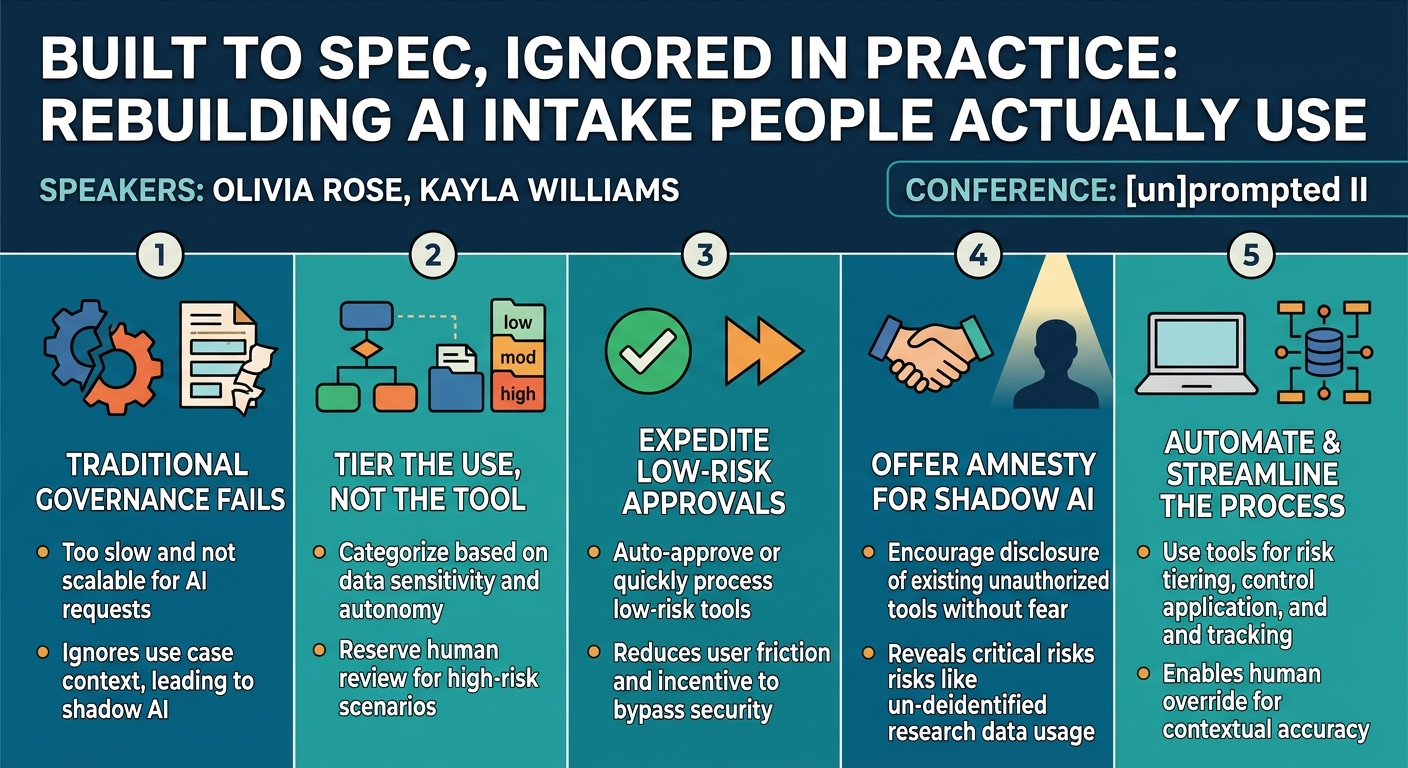
Built to Spec, Ignored in Practice: Rebuilding AI Intake People Actually Use
Speakers: Olivia Rose (Co-Founder, Williams Rose AI Cyber Advisory), Kayla Williams (Co-Founder, Williams Rose AI Cyber Advisory)
Conference: [un]prompted II
YouTube: https://www.youtube.com/watch?v=Ovr_d182YbU
Overview
In the rapidly evolving landscape of artificial intelligence, organizations are scrambling to harness its potential, often at the expense of robust security and governance. This talk by Olivia Rose and Kayla Williams, Co-Founders of Williams Rose AI Cyber Advisory, addresses a critical and pervasive problem: the failure of traditional IT governance processes to manage the influx of AI tools, leading to widespread "shadow AI" and unmitigated risk. Drawing from their extensive experience as former CISOs, Rose and Williams present a compelling case study and a practical, six-step framework for building an AI intake process that is not only secure and compliant but also user-friendly and effective.
The core of their presentation revolves around a real-world scenario where a CISO, overwhelmed by the rapid and unauthorized adoption of AI tools, discovered a staggering number of unapproved applications in use, including high-risk ones like deepfake generators. This talk is crucial for security professionals, GRC teams, and business leaders grappling with AI adoption, offering a clear roadmap to transition from reactive panic to proactive, risk-informed AI governance. By focusing on the use case rather than just the tool, and by streamlining approvals for low-risk applications, their methodology dramatically improves both security posture and organizational efficiency.
Background
▶ Watch: The problem: CISO overwhelmed by shadow AI (1:10)
The genesis of the "shadow AI" problem often begins with executive enthusiasm. As Olivia Rose illustrates with an anecdote, a CEO returns from a major AI conference, invigorated by promises of ROI and efficiency, and mandates immediate AI adoption across the company. This top-down directive, however, frequently overlooks the practicalities of secure implementation. Employees, eager to leverage new technologies, quickly adopt various AI tools, bypassing established, often cumbersome, IT and security review processes.
The conventional response from security teams, as depicted by the "fearless CISO" in Rose's story, is to adapt existing governance frameworks. This typically involves a standardized request form, risk tiers, review by an approval body, and monthly governance meetings. While seemingly logical, this approach proved disastrous in their client's case: after three months, only 20 official AI tool requests had been approved, yet a 24-hour log sample revealed 35 unauthorized AI tools in use, including a Deep Fake generator. This stark contrast highlights the fundamental disconnect between traditional governance and the realities of AI adoption.
Kayla Williams then meticulously breaks down why existing governance processes fail for AI, identifying five key areas of breakdown:
- Inadequate Rollout: Companies often fail to provide proper training on new AI policies or offer amnesty for previously adopted tools. This creates an environment of fear, discouraging users from disclosing their AI tool usage and driving it underground.
- Lengthy Request Intake Process: A single, undifferentiated queue for all IT requests means that low-risk AI tools get stuck behind high-risk applications (e.g., critical business systems or highly regulated processes like pharmacovigilance). This protracted waiting period (often weeks or months) frustrates users and incentivizes shadow IT.
- Blanket Risk Evaluation: Current assessment methods frequently focus on the vendor or the tool itself (e.g., "Grammarly is low risk"), rather than what the tool does or, more critically, what data it touches. As Williams points out, using a seemingly innocuous tool like Grammarly with confidential board meeting minutes or trade secrets can instantly elevate it to a high-risk use case.
- Non-Prioritized Review: AI governance committees often review every single request, regardless of its risk profile. This bogs down the process, diverting valuable expert attention from truly high-risk scenarios to trivial ones.
- Inconsistent Decisions: Without clear, standardized criteria, different reviewers may arrive at inconsistent decisions. This leads to confusion, back-and-forth communication, and further delays, exacerbating user frustration and ultimately promoting shadow AI.
These systemic failures culminate in a scenario where security teams are left blind to the actual AI tools in use, making effective risk management impossible.
Key Findings
▶ Watch: Introducing the 6-step AI intake solution (6:00)
The central finding presented by Williams and Rose is that your existing risk and governance processes, as they are today, do not work for AI tooling requests. The rapid pace of AI adoption, coupled with the unique risks associated with data handling, decision autonomy, and potential impact, renders traditional, generalized IT governance processes not scalable. A bespoke, AI-specific approach is imperative.
Their real-world case study with a pharmaceutical client vividly demonstrates the impact of their refined methodology. Prior to their intervention, the CISO's traditional process yielded:
- Only 20 official AI tool submissions over a three-month period.
- Approval times ranging from 4 to 8 weeks, even for low-risk items.
After implementing the new, streamlined, risk-based AI intake process, the results were transformative:
- 96 submissions in the subsequent three months, a nearly five-fold increase.
- 95 approvals (excluding explicitly prohibited tools like Deep Seek).
- Approval times drastically reduced: immediate or one day for low-risk items, and one week for high-risk items.
- Crucially, the introduction of amnesty resulted in 32 submissions of previously unauthorized tools. This amnesty revealed significant risks, such as a niche AI tool called Ganymede Bio being used to process non-deidentified research data, without contracts, leading to legal and privacy concerns.
- The client achieved an automatic approval rate of 70%, with a goal to reach 90%.
These results unequivocally prove that by designing a governance process that prioritizes user experience, differentiates risk effectively, and focuses on the use case rather than just the tool, organizations can achieve both significantly higher compliance and drastically improved operational efficiency. The key insight is to tier the use, not the tool, allowing low-risk applications to "fly right on through" while reserving human review for genuinely critical scenarios.
Technical Deep Dive
▶ Watch: Decision criteria: focus on AI use case, not just tool (9:00)
The core of Williams and Rose's solution is a six-step, sequential process designed to create a repeatable, consistent, governable, risk-based, visible, and streamlined AI use case request intake. Each step builds upon the previous, ensuring a robust and adaptable framework.
Step 1: Define Risk Tiers and Controls
This foundational step requires understanding the organization's risk appetite threshold. It involves engaging executive leadership (CFO, CEO, etc.) to define what constitutes low, moderate, and high risk in terms of financial impact, social media exposure, regulatory penalties, and operational disruption.
- Low Risk: If the company can absorb potential financial or reputational impact, these should be auto-approved. This prevents low-priority items from clogging the queue. For all AI tools, regardless of tier, certain mandated baseline controls should be enforced. Examples include Single Sign-On (SSO), Multi-Factor Authentication (MFA), and registration in a central AI inventory. The principle is to treat AI risk as an integral part of broader enterprise risk, not an isolated category.
- Moderate Risk: Approval typically involves the business owner, IT, security, and legal. The specific approval chain depends on the company's risk tolerance.
- High Risk: This tier is reserved for scenarios with potential for significant fines, legal penalties, client attrition, or severe reputational damage. The AI governance committee should focus its limited time and expertise here. Additional, more stringent controls are mandated, such as detailed Identity and Access Management (IAM) reviews for agents and scrutiny of their actions (e.g., "Are they cloning themselves?").
Step 2: Define Decision Criteria
This step moves beyond the blanket assessment of a vendor or tool to focus on the specifics of its deployment. Three critical questions guide the risk evaluation:
- What data does that request touch? This is paramount. The sensitivity of the data (e.g., PII, trade secrets, confidential board minutes) dictates the risk profile, regardless of the tool's general reputation. As an example, Grammarly, typically considered low-risk, becomes high-risk if used with sensitive corporate data.
- How much does a system decide on its own? This addresses the level of autonomy and decision-making capability of the AI. Higher autonomy often equates to higher potential risk.
- What happens if the inevitable hits the fan? This is an impact assessment, considering potential financial, regulatory, and brand risks if the AI system fails or is compromised.
The guiding principle here is to be conservative: if any of these questions point to a higher risk level, the use case should be escalated to that tier.
Step 3: Define Decision Outcomes
Standardizing the possible outcomes ensures consistency and transparency:
- Approved: The use case meets all criteria.
- Approved with conditions: The use case is approved, but specific controls or modifications must be implemented.
- Defer: The decision requires additional input (e.g., from privacy, legal, or finance teams) before a final determination can be made.
- Prohibit: The tool or use case is deemed too risky and is explicitly blocked (e.g., Deep Seek was universally prohibited by their clients).
An exception process is also critical. Acknowledging that not every control can always be implemented without breaking existing systems, a documented exception process, similar to those used in audits or certifications, allows for deviations with proper approval and documentation.
Step 4: Make It Easier for Users (The Form)
The intake form is the user's primary interaction point, and its design is crucial for adoption. It must be easy to understand and fill out, gathering essential information:
- What data is used and its sensitivity.
- Is a decision being made by the AI?
- What happens if the system fails?
- The business value of the AI use case.
- What controls can be put in place.
The form should include clear instructions and examples to guide users, especially those unfamiliar with risk assessments.
Step 5: Document and Communicate
This step ensures the longevity and effectiveness of the process:
- Standard Operating Procedure (SOP): Document every aspect of the process.
- AI Risk Framework: Create a dedicated framework, treating it with the same rigor as other enterprise risk frameworks, while acknowledging the unique and evolving risks of AI.
- Circulate for Consensus: Gain buy-in from all leaders across the organization. This prevents finger-pointing and ensures collective ownership in case of incidents.
- Train, Train, Train: Over-communicate the new process through multiple channels (Slack, email, SharePoint, Teams, cybersecurity awareness campaigns).
- Amnesty: Crucially, announce an amnesty period for existing, unauthorized AI tools. This encourages employees to disclose shadow AI without fear of reprisal, bringing hidden risks into the light. "We don't want shadow AI. We want to know what you're doing."
- Executive Support and Direction: Essential for reinforcing the policy and addressing inevitable complaints.
Step 6: The Automated Tool (Demo / Proof of Concept)
While the talk presented screenshots due to internet issues, the speakers showcased a custom-built tool designed to automate this entire process. This tool exemplifies how the framework can be operationalized:
- Configurable Parameters: It allows for the definition of high-risk trigger words (e.g., "patient PII" for a pharmaceutical client) and risk tier definitions based on the organization's specific enterprise risk tolerance.
- Control Library: Integrates the defined control library, automatically applying baseline controls for Tier 1 and additional controls for Tier 3 requests.
- Reporting and Dashboards: Generates "pretty reports" for executives, including department heat maps (identifying departments with high AI usage or risk, often legal, HR, or marketing), lists of use cases requesting action, and control gap analyses.
- User-Friendly Form: Incorporates the three decision criteria questions from Step 2, designed with examples and clear instructions.
- Use Case Inventory: Provides a centralized tracking system for all requests and their results.
- Detailed Decision View: Clicking on an inventory item reveals the decision, the reason (e.g., a trigger word like "code" elevating it to moderate risk), and required controls. Crucially, it allows an analyst to manually override the automatically assigned tier if context dictates a different risk level (e.g., "Rovo and ServiceNow" using "code" might be low risk despite the trigger word). This human in the loop ensures accuracy and flexibility.
This automated solution dramatically streamlines the intake process, reduces human review time for low-risk items, and provides transparent, auditable records of all AI tool approvals and their associated risks.
Demo / Proof of Concept
▶ Watch: Demonstration of the automated AI intake tool (16:45)
The speakers demonstrated a custom-built automated tool designed to implement their six-step AI intake process. Although presented via screenshots due to technical difficulties, the demonstration effectively showcased the tool's capabilities and its practical application.
The tool's interface highlighted several key features:
- Configurable Risk Parameters: It allowed administrators to define high-risk trigger words specific to the organization's industry (e.g., "patient PII" for their pharmaceutical client). These words would automatically flag requests for higher scrutiny. Similarly, risk tier definitions could be customized to align with the enterprise's unique risk tolerance.
- Control Library Integration: The tool displayed a comprehensive control library, categorizing controls by risk tier. For instance, Tier 1 requests might require baseline controls like SSO and inclusion in an AI inventory, while Tier 3 requests would demand additional, more stringent controls. This automation ensures consistency in control application.
- Reporting and Analytics: Executives could view "pretty reports," including pie charts and department heat maps, which visually represent AI usage and risk distribution across the organization. The heat map was specifically designed to identify "trouble children" departments (often legal, HR, or marketing) that might be heavy users of AI tools. It also provided lists of "use cases requesting action" and performed control gap analysis.
- User Intake Form: A simplified, user-friendly form incorporated the three critical decision criteria questions (what data, how much autonomy, what happens if it fails) with ample examples and instructions to guide requesters.
- Use Case Inventory: A central dashboard provided an inventory of all AI tool requests, their current status, and outcomes.
- Detailed Decision View: When an entry in the inventory was selected, the tool displayed the specific decision, the rationale behind it (e.g., "used the word code in it" leading to a Tier 2/moderate classification), and the required controls. A crucial feature was the ability for an analyst to manually override an automatically assigned risk tier. For example, if "code" triggered a moderate risk but the analyst knew the tool was for a low-risk internal process like Rovo and ServiceNow, they could adjust the status, ensuring flexibility and contextual accuracy.
This automated solution serves as a robust proof of concept for the proposed framework, demonstrating how organizations can implement a scalable, transparent, and user-centric AI governance process.
Defensive Implications
▶ Watch: Q&A: Preventing users from 'cheating' the system (21:30)
The insights shared by Olivia Rose and Kayla Williams offer critical defensive implications for security teams, CISOs, and GRC professionals navigating the complexities of AI adoption. The primary takeaway is the urgent need to pivot from generic IT governance to a specialized, risk-based AI intake process.
- Implement a Dedicated AI Intake Process: The most immediate defensive action is to establish a clear, structured process for AI tool requests. This process must be distinct from general IT requests, recognizing the unique risk vectors of AI.
- Shift to Use Case-Centric Risk Assessment: Defenders must move beyond simply evaluating vendors or tools. The focus should be on what data the AI tool processes (e.g., PII, intellectual property, financial data) and how it is being used within the organization. A seemingly benign tool can become a high-risk liability if used with sensitive data.
- Tiered Risk Approach and Prioritized Review: Adopt a tiered system (low, moderate, high risk) that dictates the approval workflow and required controls. Expedite approvals for low-risk AI uses to prevent bottlenecks and reduce the incentive for shadow AI. Reserve the valuable time of AI governance committees for genuinely high-risk scenarios.
- Mandate Baseline Security Controls: Enforce a set of non-negotiable security controls for all AI tools, regardless of their risk tier. These should include Single Sign-On (SSO), Multi-Factor Authentication (MFA), and mandatory registration in a central AI inventory. This ensures a foundational level of security and visibility.
- Proactive Shadow AI Mitigation through Amnesty: To uncover existing risks, security teams should implement an amnesty program. This encourages employees to disclose unauthorized AI tools without fear of punishment, bringing hidden liabilities (like Ganymede Bio processing non-deidentified research data) into the open for proper assessment and mitigation.
- Enhance Logging and Monitoring: While a robust governance process is crucial, human nature dictates that some users may still attempt to bypass it. Defenders must bolster their Security Information and Event Management (SIEM) and endpoint detection capabilities (e.g., using tools like Sentinel One, as mentioned in the Q&A) to detect the presence of unauthorized AI tools in the environment. This provides a critical fail-safe.
- Drive Executive Buy-in and Communication: Secure strong executive support for the AI governance framework. Over-communicate the process, its benefits, and the associated risks across the organization. This ensures that the policy is understood, respected, and enforced, preventing departments from operating in silos.
- Establish an Exception Process: Acknowledge that rigid control implementation might not always be feasible. A well-documented exception process allows for necessary deviations while maintaining a record of accepted risks, crucial for audits and compliance.
By adopting these defensive strategies, organizations can transform their AI governance from a source of frustration and risk into a strategic enabler, fostering innovation while maintaining a strong security posture.
Key Takeaways
- Traditional IT governance is inadequate for AI: Existing processes are too slow, undifferentiated, and focused on tools rather than use cases, leading to widespread "shadow AI."
- Focus on the AI's use case and data touched: Risk assessment must prioritize how an AI tool is used and what data it processes, not just the vendor or the tool's general reputation.
- Streamline low-risk approvals to prevent shadow AI: Create tiered processes that allow low-risk AI uses to be auto-approved or quickly processed, reducing user frustration and the incentive to bypass security.
- Amnesty is crucial for discovering hidden risks: Implement an amnesty program to encourage employees to disclose existing, unauthorized AI tools without fear, bringing hidden risks into the light for proper management.
- Executive buy-in and continuous communication are vital: Secure leadership support for the AI governance framework and consistently train and communicate the process to all employees.
- Automated tools enhance efficiency and transparency: Leverage or build tools that automate risk tiering, control application, reporting, and tracking, while allowing for human oversight and manual overrides where necessary.
About the Speaker(s)
Olivia Rose and Kayla Williams are the Co-Founders of Williams Rose AI Cyber Advisory, a firm dedicated to guiding organizations through the complexities of AI security and governance. Both speakers bring a wealth of practical experience to the table, having previously served as CISOs. This background provides them with a deep, firsthand understanding of the challenges security leaders face in managing emerging technologies like AI. They openly shared their past experiences of being the "CISO sitting in the corner crying" over unmanaged risk, underscoring their empathy and expertise. Their presentation style reflects their deep technical knowledge and passion for the subject, as Olivia jokingly referred to them as "total nerds" about AI risk and governance.
Reviews
→ Top-rated talks at [un]prompted II 2026 — The AI Security Practitioner Conference
All talks from [un]prompted II 2026 — The AI Security Practitioner Conference