Permission Fatigue Is a Security Bug: Dynamic Guardrails for Coding Agents
Sahana Chennabasappa (Security Engineer · Meta), Chris Puderbaugh (Security Engineer - Agent Security & Access · Meta)
[un]prompted II 2026 — The AI Security Practitioner Conference · Day 2 · Stage 2
Overview
In the rapidly evolving landscape of AI-driven development, coding agents are becoming indispensable tools for engineers, automating complex tasks and interacting with production environments. However, their pervasive nature and inherent need to operate with delegated user permissions introduce a significant security challenge: permission fatigue. This talk by Sahana Chennabasappa and Chris Puderbaugh from Meta delves into this critical issue, arguing that permission fatigue is not merely a user experience annoyance but a fundamental security bug that undermines the effectiveness of authorization controls.
Key moments
- 0:00 Introduction to coding agents and permission fatigue
- 2:50 Permission fatigue is a security bug, not a feature
- 4:15 Context-aware runtime permissioning: balancing risk and friction
- 5:15 Three core solution primitives: identity, profiles, guardrails
- 9:30 Dynamic guardrails: decision engine and enforcement flow
- 13:00 Practical challenges: optimizing latency and reducing false positives
- 15:40 Achieved results: 80% friction cut with minimal latency
Permission Fatigue Is a Security Bug: Dynamic Guardrails for Coding Agents
Speakers: Sahana Chennabasappa (Security Engineer, Meta); Chris Puderbaugh (Security Engineer - Agent Security & Access, Meta)
Conference: [un]prompted II
YouTube: https://www.youtube.com/watch?v=1aygTesiag8
Overview
In the rapidly evolving landscape of AI-driven development, coding agents are becoming indispensable tools for engineers, automating complex tasks and interacting with production environments. However, their pervasive nature and inherent need to operate with delegated user permissions introduce a significant security challenge: permission fatigue. This talk by Sahana Chennabasappa and Chris Puderbaugh from Meta delves into this critical issue, arguing that permission fatigue is not merely a user experience annoyance but a fundamental security bug that undermines the effectiveness of authorization controls.
The core problem arises when agents, acting on behalf of users, require frequent authorizations for their actions. Enterprises often struggle with complex, legacy permission structures, leading to an overwhelming number of prompts for users. This over-prompting invariably results in "rubber stamping," where users reflexively approve actions without scrutiny, or even programmatically disable security checks. The Meta security team presents a robust solution: dynamic guardrails based on context-aware runtime permissioning. This innovative approach aims to intelligently determine when human intervention is truly necessary, striking a balance between security and usability, and ensuring that agent operations remain both efficient and secure.
This article will explore Meta's detailed framework for tackling permission fatigue, dissecting their architectural design, policy enforcement mechanisms, and practical optimizations. By leveraging a nuanced understanding of session context, user intent, and potential external influences, their system dynamically adjusts security posture, thereby reducing unnecessary friction while maintaining a strong defensive stance against malicious or erroneous agent behavior. The insights shared are crucial for any organization deploying or developing AI agents, offering a blueprint for building secure and scalable agentic workflows.
Background
▶ Watch: Introduction to coding agents and permission fatigue (0:00)
The proliferation of AI agents has introduced new paradigms for human-computer interaction, but also novel security challenges. Chris Puderbaugh began by establishing a foundational distinction between two types of agents: digital extensions and digital coworkers. Digital extensions, or coding agents, operate with the permissions of the user they represent, acting as a direct delegate of that user's identity. In contrast, digital coworkers are bots with their own predefined, stable permission sets, scoped akin to a service identity. The focus of this talk is squarely on coding agents, which, by necessity, interact with a wide array of services and often require broad permissions to complete their tasks.
A critical observation is that virtually every action an agent performs translates into a tool call. These tool calls, whether executing a shell command, reading a file, or interacting with a production API, represent prime opportunities for introducing authorization. However, organizations face a dilemma: implementing overly strict authorization, requiring a prompt for every interaction, leads to an unusable, high-friction experience. Conversely, a "wild west" approach, allowing agents unfettered access, presents an unacceptable risk. An agent could, for instance, stumble upon malicious content from an internet call, ingest it, and then propagate that tainted information or behavior within the production environment, effectively becoming an autonomous threat.
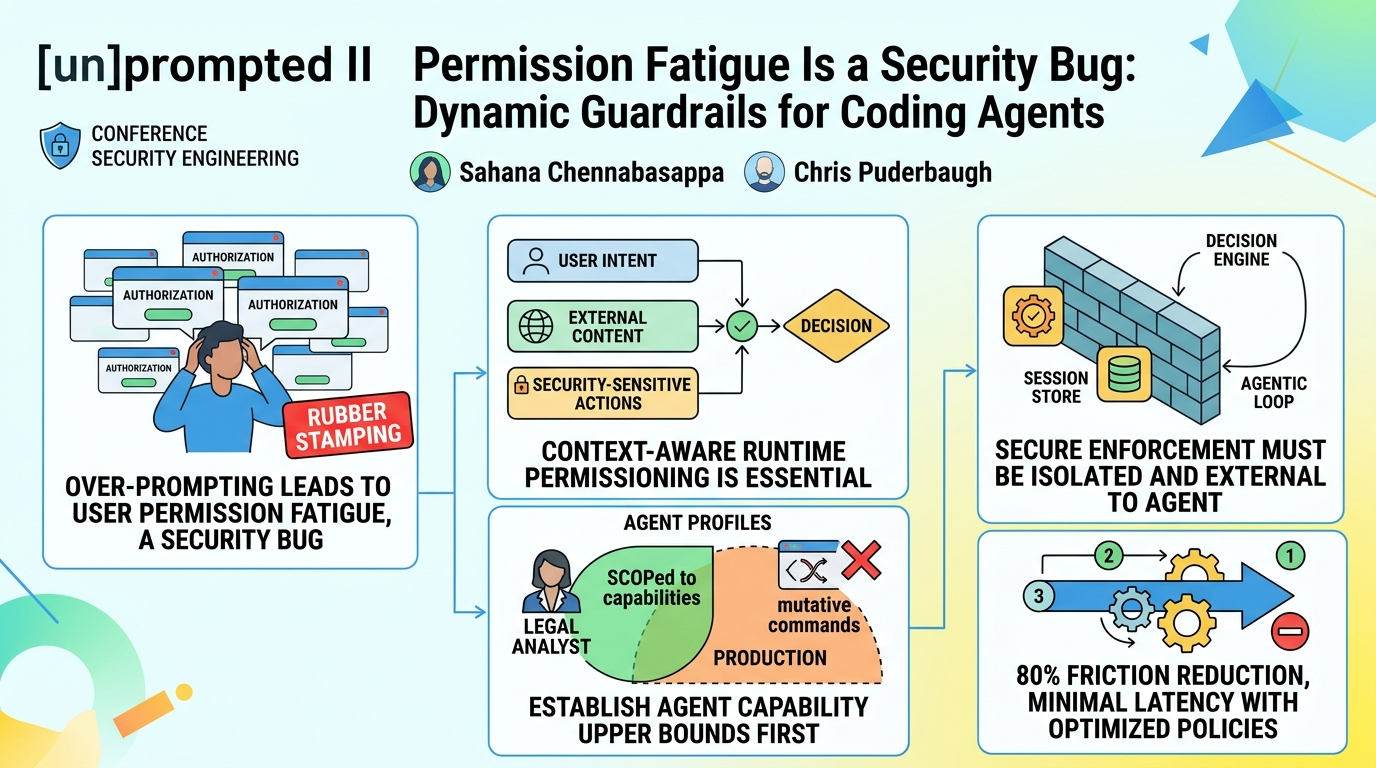
The industry's initial instinct to address agent security often defaults to placing a human in the loop for everything. This quickly proves unsustainable. Modern enterprises rarely operate on a strict least-privilege model due to years of compounded digital transformations and diverse cloud systems. Consequently, users are bombarded with prompts, leading to the phenomenon of permission fatigue. As Puderbaugh explained, users devalue these constant prompts, engaging in "rubber stamping" by mindlessly clicking "yes." In extreme cases, they develop custom flags or programmatic overrides to suppress prompts entirely, rendering the security checks meaningless. This permission fatigue, the speakers emphasized, is not merely a usability issue but a security bug because it effectively bypasses intended security controls.
To illustrate this, the speakers introduced a risk versus friction tradeoff matrix. Doing "nothing" (no tool call authorization) offers zero friction but maximum exposure. Prompting "on everything" initially seems secure but ultimately leads to high friction and, due to rubber stamping, surprisingly low security utility. The most egregious production tool call, capable of taking systems offline, might still be approved without thought. The Meta team's objective was to move beyond these extremes, advocating for a context-aware runtime permissioning approach that dynamically determines when prompting is truly valuable, thereby optimizing both risk and friction.
Key Findings
▶ Watch: Context-aware runtime permissioning: balancing risk and friction (4:15)
The central contribution of Meta's work is the development of dynamic guardrails to combat permission fatigue effectively. This solution redefines how security controls are applied to coding agents, shifting from a static, blanket approach to an intelligent, adaptive system. The key finding is that by leveraging context-aware runtime permissioning, organizations can achieve a significant reduction in user friction without compromising, and in many cases, enhancing their security posture.
The speakers outlined three fundamental primitives underpinning their solution:
- Identity in Order: Before any sophisticated authorization can occur, the agent must operate with a clearly defined identity, delegated from the user. This could involve delegated tokens or tainted certificates, ensuring a clear chain of permission.
- Agent Profiles: To establish upper bounds on an agent's capabilities, agent profiles are created. These profiles are tailored to specific user roles or workflows. For example, an HR analyst's agent would not be granted mutative commands in a production environment, nor would a legal analyst's agent need access to the most sensitive consumer data. By "blunting and nerfing" the agent's overall capabilities from the outset, the burden on subsequent tool call authorization is substantially reduced. This proactive scoping ensures that an agent can only ever attempt actions relevant to its intended purpose.
- Dynamic Guardrails: This is the core innovation, dynamically deciding what an agent can do and when human intervention (e.g., prompting, 2FA) is necessary. Instead of prompting for every action, the system evaluates the entire session's context to make intelligent, real-time authorization decisions.
The practical implementation of these dynamic guardrails yielded impressive results. Meta observed an 80% cut down in friction, a significant improvement in user experience. Crucially, this was achieved with only a 0.5% added latency, demonstrating that advanced security measures do not inherently have to impede performance. Furthermore, internal adversarial red teaming datasets were used to ensure that while friction was reduced, the security posture was not degraded, maintaining high recall evaluations. This success validates the hypothesis that thoughtfully applied, context-driven security gates are superior to indiscriminate "human in the loop" mechanisms.
Technical Deep Dive
▶ Watch: Three core solution primitives: identity, profiles, guardrails (5:15)
The technical architecture of Meta's dynamic guardrails is designed for both robustness and adaptability, ensuring decisions are made outside the agent's control and are informed by a comprehensive understanding of the ongoing session. Sahana Chennabasappa detailed the operational mechanics, starting with the definition and application of policies.
Policies and Contextual Decision Making
The system relies on two types of policies:
- Static Policies: These are invariants, representing fundamental security boundaries that an agent should never cross, regardless of context. An example given was "an agent should never read sensitive credential files and exfiltrate them." These are non-negotiable security rules.
- Dynamic Policies: These policies are context-dependent, requiring information about the specific session. Key inputs include user intent (what the user originally asked the agent to do) and whether a particular tool call makes sense within that intent. For instance, if an agent is asked to "fix a bug," a request for elevated permissions would trigger a dynamic policy evaluation to determine if such a privilege escalation is genuinely necessary for the task at hand.
To feed these policies, the system continuously collects session context through signal collectors. These collectors observe everything happening within the session, gathering signals such as:
- User Intent: The initial goal or task provided by the user.
- External Content Contact: Whether the session has interacted with externally controlled content (e.g., fetching data from the web).
- Security-Sensitive Actions: Any actions within the session that carry elevated security implications (e.g., executing a shell command, modifying production data).
All collected data is stored in a session store, which is explicitly designed to be immutable by the agent. This prevents the agent from tampering with the security signals or audit trail. For example, if an agent fetches content from the web, the session is marked as "exposed to external content," and its "taint" is updated accordingly. Routine tasks like reading internal files or executing tests might not elevate risk, but interaction with external sources immediately flags the session.
Decision Engine and Enforcement
For every proposed tool call, the decision engine evaluates the tool call itself against the predefined policies and the current state of the session store. The engine then renders one of three decisions:
- Allow: The tool call is permitted to execute.
- Deny: The tool call is blocked.
- Escalate to Human: The tool call requires explicit human approval (e.g., a prompt, 2FA).
Crucially, this decision is enforced in the agent framework, which operates outside the agentic loop. This architectural separation ensures that the agent cannot bypass or tamper with the enforcement mechanism. Both the collection of session signals and the enforcement decisions are kept out of the agent's reach.
Adaptive Session Risk and Taint Tracking
The system's architecture enables adaptive session risk. The risk level of a session is not static; it dynamically adjusts as the agent executes. A session might start with a relatively low risk (e.g., reading internal documentation). However, if the agent attempts to contact the external internet and fetches content, the risk level elevates. If a prompt injection classifier then identifies potential prompt injection within the ingested content, the system initiates a quarantine state. In quarantine, every subsequent security-sensitive tool call faces increased scrutiny, and any tool call not closely related to the original user intent can be blocked.
The concept of taint tracking is central to this adaptive risk model. Once a session is marked as tainted (e.g., by interacting with external content), it remains tainted. As Chris Puderbaugh clarified during the Q&A, this is currently a one-way street; there is no mechanism to "downgrade" the taint, ensuring a conservative security posture.
Practical Challenges and Optimizations
Scaling this system to Meta's production environment presented several practical challenges, primarily around latency, false positives, and portability.
Latency Optimization
Evaluating policies and context before every tool call can be computationally intensive, especially if Large Language Model (LLM) classifiers are used for complex reasoning. With potentially thousands of tool calls per session, latency was a critical concern. To address this, Meta implemented a three-tier evaluation system:
- Static Rules Tier: This first tier handles cases that are definitively safe or known unsafe patterns. Decisions are made instantly here.
- Stateful Rules Tier: This deterministic tier uses rules based on the collected session context. For instance, if a session is not tainted, certain checks can be skipped. Most of the traffic is resolved at this stage.
- LLM Classifier Tier: Only tool calls explicitly requiring more sophisticated reasoning flow into this most expensive tier.
This tiered approach allowed Meta to cut down 90-94% of the traffic in the first two tiers, resulting in minimal added latency (approximately 0.5% overall).
False Positive Management
As new policies are written, understanding their real-world impact and identifying false positives is crucial. Meta established a continuous feedback loop:
- Agentic Workflow: An automated agentic workflow observes all false positives.
- Clustering: This agent clusters false positives based on their root causes.
- Regular Fixes: The security team regularly picks the top three clusters of false positives and works to fix them, continuously refining the policies.
Portability
Given the rapid evolution of agentic frameworks, the solution needed to be framework-agnostic. Meta achieved this by building the observer signal collector and the decision engine as a standalone binary. This binary can be integrated with any agentic framework by simply hooking it up at specific stages, such as before tool use, post tool use, or session starts. This modular design ensures that the security controls work "out of the box" across diverse agent ecosystems.
Demo / Proof of Concept
▶ Watch: Practical challenges: optimizing latency and reducing false positives (13:00)
While the talk did not feature a live demonstration of the dynamic guardrails system in action, the speakers provided a comprehensive conceptual walkthrough of its operational flow and detailed the significant results observed from its deployment within Meta's production environment. They illustrated how various components—signal collectors, session store, policies, and the decision engine—interact in real-time to manage agent permissions. The efficacy of their approach was quantified through metrics such as an 80% reduction in user friction and a minimal 0.5% increase in latency, validating the system's practical impact as a robust proof of concept. The discussion of taint tracking and the three-tier evaluation system further served as illustrative examples of the system's technical capabilities without requiring a direct live demo.
Defensive Implications
▶ Watch: Achieved results: 80% friction cut with minimal latency (15:40)
The insights presented by Meta offer critical defensive implications for organizations grappling with the security of coding agents and, more broadly, complex automated systems.
- Human-in-the-Loop as a Thoughtful Gate, Not a Crutch: The most profound takeaway is that human intervention should be a carefully considered, context-driven security gate, not a default security crutch. Over-prompting leads to permission fatigue, which fundamentally undermines security. Defenders must analyze workflows to identify truly high-risk actions that warrant human review, rather than indiscriminately applying approvals.
- Bound First, Then Relax: Before implementing dynamic authorization, establish clear upper bounds for agent capabilities through agent profiles. By limiting an agent's potential actions from the outset (e.g., an HR agent cannot perform production modifications), the attack surface is significantly reduced, making subsequent dynamic authorization more manageable and effective. This aligns with the principle of least privilege, applied at the agent identity level.
- Embrace Dynamic, Context-Driven Decisions: The effectiveness of dynamic guardrails underscores the value of context-aware security. This principle extends beyond coding agents to other security domains like DLP (Data Loss Prevention) and EDR (Endpoint Detection and Response). Static, signature-based rules often generate excessive noise. Context-driven policies, which consider the sequence of events, user intent, and environmental factors, provide significantly higher security value and reduce alert fatigue for security teams.
- Isolate Security Enforcement Mechanisms: The architecture emphasizes that the decision engine and session store must be outside the agent's control. Deploying these as a standalone binary or a separate service, potentially in an isolated container or host, prevents the agent from tampering with security signals or circumventing enforcement decisions. This isolation is paramount for maintaining the integrity of the security controls.
- Leverage Security Signals for Broader Detection and Response: The comprehensive collection of session signals (user intent, external content contact, security-sensitive actions) is a valuable asset beyond real-time authorization. As noted in the Q&A, these signals can be shared with other detection and response (D&R) teams and enforcement teams, serving as a rich source of truth for understanding agent trajectories and identifying misbehavior. This data can inform threat hunting, incident response, and forensic analysis.
- Understand Taint Propagation and Management: The concept of taint tracking for external content is a robust defensive measure. Defenders should implement similar mechanisms to mark and track data or sessions exposed to untrusted sources. The decision to make taint a "one-way street" (not downgradable) highlights a conservative approach to risk, ensuring that once a session is compromised or potentially compromised, it remains under heightened scrutiny. This prevents an agent from "cleaning" its own taint.
By adopting these defensive strategies, organizations can build a more resilient and usable security posture for their AI agents, ensuring they remain productive assets rather than potential liabilities.
Key Takeaways
- Permission fatigue is a critical security bug, not merely a usability issue. Over-prompting leads to "rubber stamping" and the disabling of security checks, effectively nullifying authorization controls.
- Dynamic, context-aware authorization is essential for balancing agent security and usability. By evaluating session context, user intent, and real-time events, security decisions can be made intelligently, reducing unnecessary friction while maintaining a strong defensive posture.
- Establishing agent profiles and identity-based upper bounds is a foundational security primitive. Proactively limiting an agent's capabilities to its intended workflow significantly reduces the attack surface and the burden on dynamic authorization.
- The security enforcement mechanism must be isolated and outside the agent's control. This architectural separation prevents agents from tampering with security signals, the session store, or the decision-making process itself.
- Continuous monitoring, feedback loops, and optimization are crucial for policy refinement. An agentic workflow for clustering and fixing false positives ensures that security policies remain effective and don't introduce undue friction.
- The principles of context-driven security extend beyond coding agents. Applying dynamic, context-aware decision-making to other security domains like DLP and EDR can lead to more effective controls and reduced alert fatigue.
About the Speaker(s)
Sahana Chennabasappa is a Security Engineer at Meta. Her work focuses on the practical implementation and scaling of security solutions within agentic systems, particularly in the realm of dynamic guardrails and policy enforcement. Her contributions to this talk highlighted the technical architecture and challenges of deploying such systems in a large-scale production environment.
Chris Puderbaugh is a Security Engineer specializing in Agent Security & Access at Meta. He provided the foundational context for the talk, defining the problem of permission fatigue and outlining the strategic approach to addressing it. His expertise lies in understanding the broader implications of agent permissions and designing security primitives for agentic workflows.
Reviews
→ Top-rated talks at [un]prompted II 2026 — The AI Security Practitioner Conference
All talks from [un]prompted II 2026 — The AI Security Practitioner Conference