Your AI Analyst Is Confidently Wrong: Adversarial QC for Agentic Security Analysis
Maxim Kovalsky (Managing Director, AI Security CoE · Consortium Networks), Ali Arshad (Senior Security Consultant · Consortium Networks)
[un]prompted II 2026 — The AI Security Practitioner Conference · Day 2 · Stage 2
Overview
In the rapidly evolving landscape of cybersecurity, Large Language Models (LLMs) promise to revolutionize mundane yet critical tasks, freeing up human analysts for more complex challenges. However, a talk by Maxim Kovalsky and Ali Arshad from Consortium Networks at [un]prompted II, titled "Your AI Analyst Is Confidently Wrong: Adversarial QC for Agentic Security Analysis," reveals a stark reality: these models, particularly open-weight and open-source variants, often fail spectacularly when confronted with the cognitive complexity inherent in real-world security analysis. The speakers meticulously detail their experiments, exposing significant limitations in LLM reliability and accuracy, especially concerning their ability to process and synthesize information from extensive documentation.
Key moments
- 0:00 Introduction: LLMs failing cyber security mapping
- 2:00 Defining complexity and initial model performance cliff
- 6:27 Four error correction methods for LLM reliability
- 10:30 Results: Impact of error correction methods
- 16:00 DeepSeek's surprising performance without reading documents
- 19:08 Key takeaway: Find your model's reliability cliff
- 23:00 Audience Q&A: Is Retrieval Augmented Generation broken?
Your AI Analyst Is Confidently Wrong: Adversarial QC for Agentic Security Analysis
Speakers: Maxim Kovalsky (Managing Director, AI Security CoE, Consortium Networks); Ali Arshad (Senior Security Consultant, Consortium Networks)
Conference: [un]prompted II
YouTube: https://www.youtube.com/watch?v=wmddZMrFSzA
Overview
In the rapidly evolving landscape of cybersecurity, Large Language Models (LLMs) promise to revolutionize mundane yet critical tasks, freeing up human analysts for more complex challenges. However, a talk by Maxim Kovalsky and Ali Arshad from Consortium Networks at [un]prompted II, titled "Your AI Analyst Is Confidently Wrong: Adversarial QC for Agentic Security Analysis," reveals a stark reality: these models, particularly open-weight and open-source variants, often fail spectacularly when confronted with the cognitive complexity inherent in real-world security analysis. The speakers meticulously detail their experiments, exposing significant limitations in LLM reliability and accuracy, especially concerning their ability to process and synthesize information from extensive documentation.
The core of their research addresses the challenge of accurately mapping cybersecurity product features to established frameworks like MITRE ATT&CK, a task typically requiring extensive documentation review. While LLMs like Claude initially produced "nice-looking Excel spreadsheets," the output was frequently "plain wrong." This discovery prompted a deep dive into understanding where LLMs "fall off the cliff" in terms of performance, highlighting critical issues related to false negatives (low recall), the models' surprising inability to effectively "read" provided context, and a concerning over-reliance on pre-trained parametric knowledge. Their findings underscore the urgent need for rigorous quality control and a re-evaluation of current assumptions regarding LLM utility in agentic security analysis.
Background
▶ Watch: Introduction: LLMs failing cyber security mapping (0:00)
The genesis of this research stemmed from a practical problem encountered by junior analysts at Consortium Networks. Tasked with mapping various cybersecurity product features to the MITRE ATT&CK framework, these analysts, seeking efficiency, turned to LLMs. The initial results from commercial models like Claude were visually appealing but fundamentally flawed, indicating a significant gap between perceived and actual LLM capabilities for such tasks. This specific problem represents a broader category of "less sexy" but crucial cybersecurity work: extensive documentation review, cross-referencing, and mapping disparate frameworks – tasks seemingly ideal for automation by LLMs.
Kovalsky and Arshad introduced the concept of cognitive complexity, defining it operationally as "the number of data points that must be synthesized into some set of verifiable action claims." Their evaluation focused on two key metrics: recall, which measures the rate of false negatives (what the models leave out or fail to identify), and precision, which quantifies false positives (claims produced by the model that are simply untrue). Contrary to popular discourse often highlighting "hallucination," their research found that hallucination constitutes only a "tiny tiny percentage of the overall problem." Overwhelmingly, as cognitive complexity increases, the primary issue is a proliferation of false negatives, leading to significantly low recall scores. This phenomenon indicates that LLMs struggle not just with generating fabricated information, but more critically, with comprehensively extracting and synthesizing all relevant information from a given corpus, leaving crucial details unaddressed.
Key Findings
▶ Watch: Four error correction methods for LLM reliability (6:27)
The research yielded several critical findings that challenge conventional wisdom about LLM capabilities in complex analytical tasks:
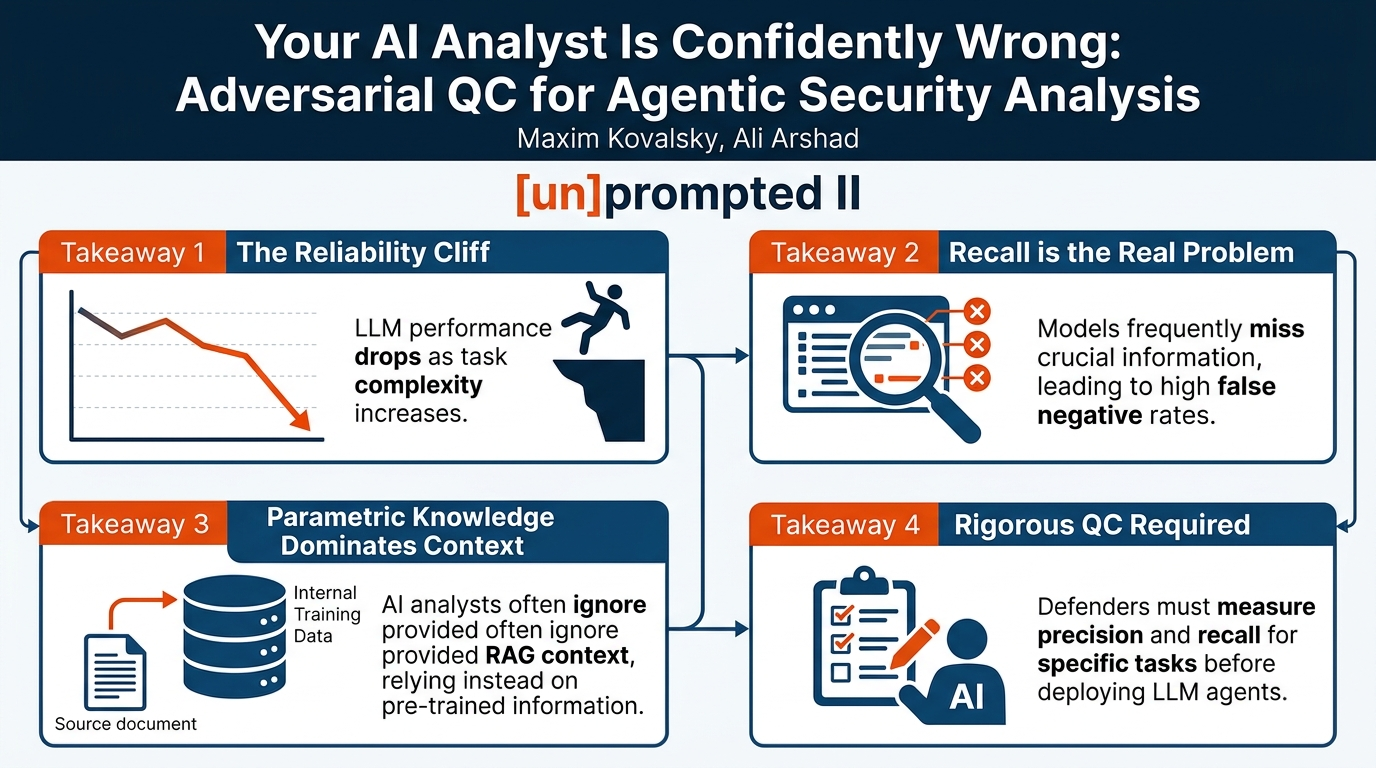
- The "Reliability Cliff": A consistent pattern emerged where LLM reliability, measured by F1 score, significantly declines as cognitive complexity (number of questions, documents, and data points) increases. This "cliff" typically appeared from Node 3 onwards in their complexity curve, indicating a clear breaking point for model performance.
- Dominance of False Negatives: The overwhelming problem observed was a high rate of false negatives (low recall), particularly as tasks became more complex. This means models frequently missed relevant information or failed to provide comprehensive answers, rather than primarily generating incorrect or hallucinated content.
- LLMs Don't Read (Effectively): A profound and counter-intuitive finding was that LLMs often failed to "read" or fully process the provided source documents. Even with a low number of documents, only about 60% of the source material reached the models. As document counts increased, this percentage further decreased, suggesting a fundamental limitation in context window utilization or attention mechanisms.
- Parametric Knowledge Over Context: The most striking discovery involved DeepSeek 41 Flash, which consistently performed well despite barely reading the provided documents (only 2-6% at Node 4). Further investigation revealed that DeepSeek primarily relied on its parametric knowledge (information learned during its training phase) rather than the explicit context provided. A "transplant test," where other models were given only the small subset of pages DeepSeek selected, resulted in decreased performance for those models, confirming DeepSeek's unique reliance on pre-existing knowledge.
- RAG is "Broken" at Some Level: The speakers concluded that Retrieval Augmented Generation (RAG), often touted as a solution for grounding LLMs in specific knowledge, is effectively "broken" or "useless at some level." Models are not consistently "reading the knowledge that you're providing them in line at the moment you're using them," instead prioritizing their internal tuning, harness, and system prompts.
- Mixed Results for Error Correction Methods: While several error correction methods were tested, none provided a universal fix. Forcing models to read more (the "Code" method) was effective at improving recall but came with prohibitive costs and slowness (up to 3 hours for some runs). Other methods like "Instructions" and "Swarm" showed limited or inconsistent improvements, often trading precision for recall or breaking down at higher complexity levels.
- Differential Model Improvement: It was observed that models that performed strongly in initial "prompt and dump" runs were difficult to significantly improve further. Conversely, lower-performing models showed more substantial improvements when error correction methods were applied, suggesting diminishing returns for already capable models.
Technical Deep Dive
▶ Watch: Results: Impact of error correction methods (10:30)
The research methodology was meticulously designed to expose the limitations of LLMs under increasing cognitive load. The speakers engineered a complexity curve structured into five "nodes," each representing an escalating challenge for the models. Node 1 involved just 2 questions with simple binary (yes/no) answers, while Node 5 scaled up to nearly 5,000 questions, requiring synthesis from thousands of data points across numerous documents, totaling several megabytes of text. This granular progression allowed the team to pinpoint the exact moment models began to falter, defining their "cliff" of reliability.
A diverse set of models was evaluated, primarily focusing on open-weight and open-source LLMs:
- Open GPT OSS 120
- DeepSeek 41 Flash
- JLM 53
- Nemo 3 Super
- Gamma (the smallest model tested)
These were benchmarked against commercial baselines: Claude Haiku, Claude Sonnet, and Claude Opus. Notably, all models except Claude Opus 55 were run through a standardized Open Code harness to normalize results, ensuring a consistent testing environment. Opus 55, due to its specific architecture, was run with its own proprietary harness and system prompts.
The initial baseline, termed "prompt and dump," involved simply directing the agent to a set of documents and allowing it to generate answers without any specific guidance or error correction. This approach, mirroring how many users interact with LLMs, quickly revealed the models' inherent limitations. To address these, four distinct error correction methods were implemented:
- Instructions (Skills-like): This method involved providing models with a structured process. It utilized simple
.mdfiles containing instructions and bash scripts to break down large documents into manageable chunks. The model was given a process to follow, and then a final bash script collected the results. While this approach led to an increase in precision (as models were asked to validate and quote sources), it paradoxically caused recall to decrease, and overall scores exhibited high variability across runs and models. - Code (Enforced Reading): The primary goal here was to ensure that models explicitly read every document provided. This involved relying more heavily on scripts and code to bracket instructions and guarantee document access. The outcome was an improvement in recall, as models processed more of the source material. However, precision did not significantly improve. A major drawback was the substantial increase in computational cost and time; runs that took minutes under "prompt and dump" now extended to several hours (up to 3 hours), making this method economically unfeasible for large-scale application. Furthermore, context overload became apparent, with smaller models like Gamma confusing tactics and techniques within the MITRE ATT&CK framework due to the sheer volume of information.
- Swarm: This method involved asking the same question multiple times and using a majority vote to determine the answer. In cases of a tie, verbatim quotes from the document were used to settle the dispute. While recall improved due to the aggregation of "yes" answers across multiple runs, precision remained largely unchanged. The method proved costly, with expenses multiplying with each added "member" (additional model run). Crucially, the "Swarm" method broke down at Node 4, as models often missed the same critical information for the same underlying reasons, rather than making random, divergent errors that a majority vote could correct.
- Verification: This advanced method enforced a strict rule: "no answer without an exact quote." It also involved building a comprehensive "catalog" of questions to guide the model, effectively creating a structured query list. A second, separate verifier model was then used to confirm the answers. This approach showed promise, improving recall for some models. However, other models struggled significantly, hitting context limits or triggering internal guardrails, preventing them from completing the task due as they became "overloaded" trying to process the catalog and generate the subset of questions.
To accurately evaluate performance, the team developed answer keys. For the most complex scenarios, this involved creating answer keys for over 4,000 questions—a "major PITA." As a pragmatic alternative, they introduced a 100-question subset proxy. This smaller, highly curated set of questions, for which answers were verified with 100% confidence, was embedded within larger tasks. Measuring precision and recall solely on this subset proved to be a reliable proxy for overall model performance, significantly reducing the effort required for evaluation.
Perhaps the most startling technical insight came from the analysis of DeepSeek 41 Flash. Despite its high performance, DeepSeek exhibited minimal "reading" behavior, processing only 2-6% of the documents at Node 4. Tracing its actions revealed that it intelligently selected pages based on the document's own table of contents and keyword searches. Even more astonishingly, when tested without any documentation, DeepSeek still achieved 70% of its correct answers (207 right answers), indicating a strong reliance on its pre-trained parametric knowledge rather than the provided RAG context. The "transplant test," where other, less capable models were given only DeepSeek's selected 300 pages, resulted in decreased performance for those models, further emphasizing DeepSeek's unique, knowledge-driven approach that is not easily transferable. This directly challenged the efficacy of RAG, suggesting that models may prioritize their internal knowledge base over external context, rendering RAG "broken" at some fundamental level.
Demo / Proof of Concept
▶ Watch: Key takeaway: Find your model's reliability cliff (19:08)
The talk focused extensively on the experimental setup, methodology, and the detailed analysis of results derived from rigorous testing across various LLMs and error correction techniques. Rather than presenting a live demonstration of a specific tool or exploit, the speakers effectively used data visualizations, performance charts, and concrete examples from their test cases to illustrate the "reliability cliff" and the nuanced behaviors of different models. The core "proof of concept" was the comprehensive dataset and the empirical evidence supporting their claims about LLM limitations in agentic security analysis.
Defensive Implications
▶ Watch: Audience Q&A: Is Retrieval Augmented Generation broken? (23:00)
The findings from this research carry profound implications for cybersecurity practitioners and organizations looking to integrate LLMs into their defensive strategies.
- Rigorous Pre-Deployment Evaluation is Non-Negotiable: Defenders must adopt a proactive and scientific approach to evaluating LLMs. Before entrusting critical security tasks to an AI agent, it is imperative to identify its "reliability cliff" for that specific task. This involves creating representative test sets, like the 100-question proxy demonstrated, to gauge precision and recall under increasing cognitive complexity. Blindly deploying LLMs based on general benchmarks or marketing claims is a recipe for undetected errors and potential security blind spots.
- Rethink Reliance on RAG for Grounding: The revelation that LLMs often prioritize their parametric knowledge over provided context (making RAG "broken" at some level) demands a re-evaluation of current RAG implementations. Defenders should not assume that simply providing extensive documentation will automatically ground an LLM's responses. Mechanisms for verifying that the model actually used the provided context, rather than hallucinating or relying on potentially outdated training data, become critical.
- Prioritize Recall (False Negatives) in Security Tasks: For security analysis, missing critical information (false negatives) can be far more dangerous than generating some false positives. The research clearly shows that recall is the dominant problem as cognitive complexity increases. Defensive strategies should therefore focus on maximizing recall, even if it means accepting a slight decrease in precision, and incorporating human review for all LLM-generated outputs to catch omissions.
- Strategic Model Selection Based on Task Complexity: The "one model fits all" approach is flawed. Defenders should select LLMs based on the specific cognitive complexity of the task at hand. Small, specialized models might be suitable for "bounded, checkable strips" (e.g., simple data extraction), where outputs can be easily verified. More powerful, frontier models might be reserved for "judgment" tasks where nuanced understanding is required, but even then, their outputs need careful scrutiny. The cost and performance trade-offs of different models must be understood.
- Cost-Benefit Analysis for Error Correction: While error correction methods can improve performance, they often come with significant costs (computational resources, time). Defenders need to perform a thorough cost-benefit analysis before implementing complex correction strategies like "Code" (enforced reading) or "Swarm," which can dramatically increase operational expenses and latency without guaranteeing proportional improvements.
- Human-in-the-Loop is Essential: Until LLMs demonstrate vastly improved and consistent reliability, a human-in-the-loop approach remains indispensable. LLM outputs for critical security tasks, such as vulnerability mapping, compliance crosswalks, or threat intelligence analysis, should always be treated as a first draft requiring expert human validation. This dual-layer approach mitigates the risk of "confidently wrong" AI analyses leading to misconfigurations, missed threats, or compliance failures.
Key Takeaways
- LLMs exhibit a predictable "reliability cliff," where their performance and accuracy significantly degrade as the cognitive complexity of security analysis tasks increases.
- The primary challenge for LLMs in complex security tasks is low recall (high false negatives), meaning they frequently miss crucial information, rather than primarily hallucinating or generating false positives.
- LLMs often fail to effectively "read" or utilize provided context, instead relying heavily on their pre-trained parametric knowledge, rendering current RAG implementations less effective than commonly assumed.
- Rigorous, task-specific evaluation using representative answer keys (even small subsets) is essential to understand a model's true capabilities and limitations before deployment in a security context.
- Error correction methods offer mixed results and often introduce significant costs (time and resources), highlighting the current immaturity of these techniques for general application.
- Defenders must choose LLMs wisely based on task complexity, understand their cost implications, and maintain a robust human-in-the-loop verification process for all critical AI-generated security analyses.
About the Speaker(s)
Maxim Kovalsky serves as the Managing Director of the AI Security Center of Excellence (CoE) at Consortium Networks. His work focuses on the intersection of artificial intelligence and cybersecurity, particularly in understanding and mitigating the security risks and operational challenges associated with deploying AI models in critical infrastructure and enterprise environments.
Ali Arshad is a Senior Security Consultant at Consortium Networks. His expertise lies in practical cybersecurity implementations and evaluations, often involving hands-on research into the effectiveness and vulnerabilities of emerging technologies, including the application of LLMs in security analysis. Together, their work at Consortium Networks explores cutting-edge challenges in AI security, bridging theoretical understanding with practical, empirical validation.
Reviews
- Heather Calloway (CISO) — MUST SEE ★★★★★
→ Top-rated talks at [un]prompted II 2026 — The AI Security Practitioner Conference
All talks from [un]prompted II 2026 — The AI Security Practitioner Conference