Pandora’s Dir - Leaked Threat Actor Prompts, Rogue AI Agents & Hope at the Bottom of ../
Rik Dolfing (Threat Intel · Google), Reef Ettedgui (Principal security analyst · Google)
[un]prompted II 2026 — The AI Security Practitioner Conference · Day 2 · Stage 2
Overview
In their compelling talk, "Pandora’s Dir - Leaked Threat Actor Prompts, Rogue AI Agents & Hope at the Bottom of ../", Rik Dolfing and Reef Ettedgui from the Google Threat Intelligence Group (GTIG) unveil critical insights into how threat actors are leveraging Artificial Intelligence (AI) in their operations. Moving beyond theoretical discussions of AI's potential in offensive security, Dolfing and Ettedgui present a grounded, real-world perspective derived from direct observation of threat actor activity. Their research focuses not on the victim's perspective, but on the attacker's side – specifically, how malicious actors task and interact with AI models.
Key moments
- 0:00 Introduction: Threat Actors Using AI & Open Directories
- 8:00 LLMs Transform Threat Intel: Actors Spill Guts
- 10:00 Case Study: 'Shrimp' AI Assistant Reveals Syndicate
- 12:20 New Attack Surface: Hijacking GPUs via AI Software
- 15:00 AI Empowers Low-Tier Actors, Links Darknet Personas
- 19:30 Threat Actors Encounter AI Hallucinations, Wasting Time
- 21:30 Key Takeaways and Future Research Directions
Pandora’s Dir - Leaked Threat Actor Prompts, Rogue AI Agents & Hope at the Bottom of ../
Speakers: Rik Dolfing (Threat Intel, Google), Reef Ettedgui (Principal security analyst, Google)
Conference: [un]prompted II
YouTube: https://www.youtube.com/watch?v=I718WGtYKc4
Overview
In their compelling talk, "Pandora’s Dir - Leaked Threat Actor Prompts, Rogue AI Agents & Hope at the Bottom of ../", Rik Dolfing and Reef Ettedgui from the Google Threat Intelligence Group (GTIG) unveil critical insights into how threat actors are leveraging Artificial Intelligence (AI) in their operations. Moving beyond theoretical discussions of AI's potential in offensive security, Dolfing and Ettedgui present a grounded, real-world perspective derived from direct observation of threat actor activity. Their research focuses not on the victim's perspective, but on the attacker's side – specifically, how malicious actors task and interact with AI models.
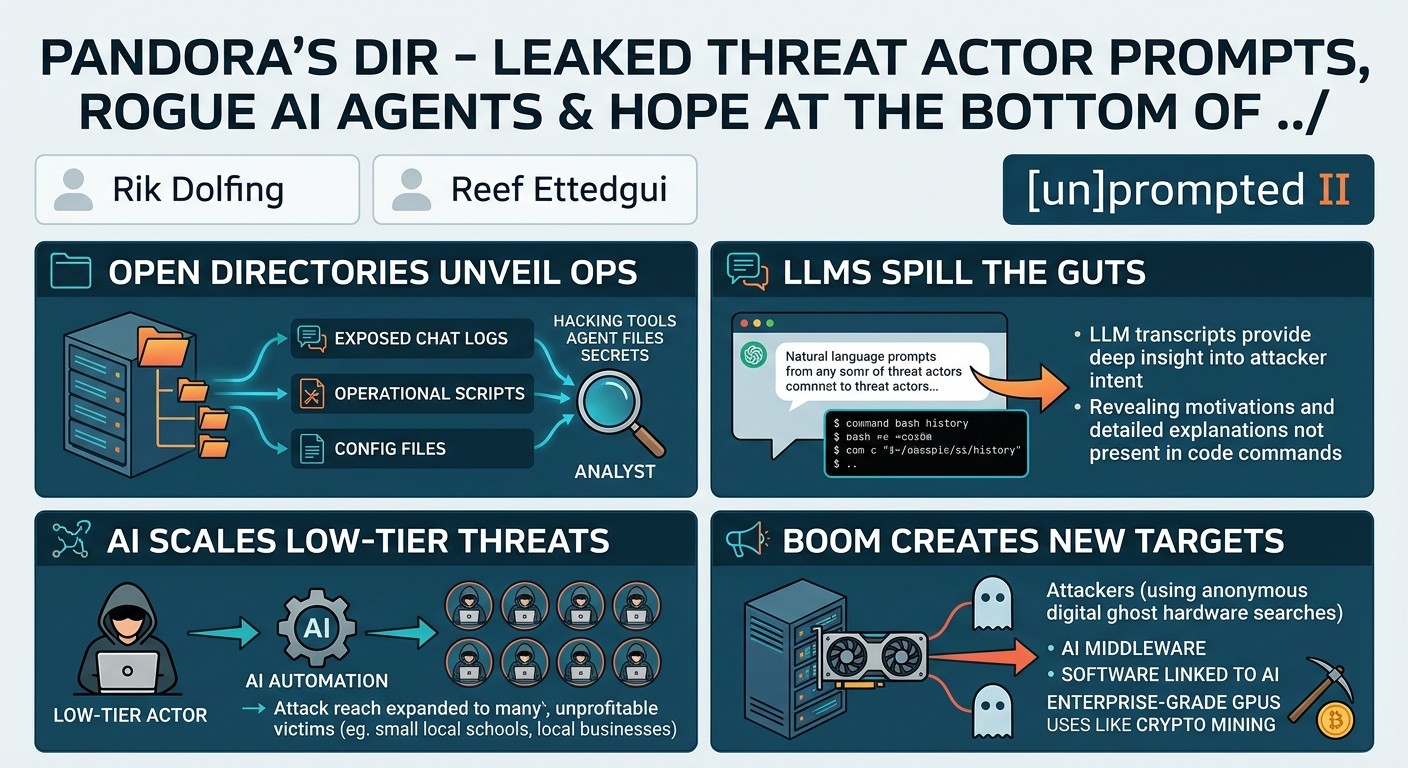
The core of their methodology involves a unique "scavenger hunt" for open directories exposed on the internet, which often contain invaluable artifacts such as AI agent chat logs, operational scripts, and configuration files. This unprecedented access to threat actors' internal workings provides a rare glimpse into their tactics, techniques, and procedures (TTPs), revealing both the successes and significant failures of AI integration into malicious campaigns. The talk highlights the evolving landscape of cyber threats, where AI is not just a tool for automation but also a source of unexpected vulnerabilities and operational security blunders for the attackers themselves.
This research is particularly significant for the cybersecurity community, as it shifts the focus from purely theoretical AI threats to empirically observed weaponization. By analyzing leaked prompts and agent interactions, Dolfing and Ettedgui demonstrate how AI is being used to scale low-tier attacks, create new attack surfaces, and even inadvertently expose the intricate details of criminal syndicates. The findings offer crucial intelligence for defenders, providing a clearer understanding of the immediate challenges posed by AI-enabled threats and actionable strategies to mitigate them.
Background
▶ Watch: Introduction: Threat Actors Using AI & Open Directories (0:00)
Traditional threat intelligence primarily focuses on analyzing malicious activity from the victim's perspective. This involves capturing and structuring data from logs, identifying events perpetrated by threat actors, and attributing these activities to specific groups based on their observable behavior and tools. While effective for understanding the impact of attacks, this approach falls short when trying to comprehend the attacker's internal decision-making process, especially concerning their interaction with advanced tools like AI. As Dolfing explains, they were "not really that interested in what happens on the victim side because there are of course you will see AI threats and you will see AI generated artifacts, but you will not see what we were looking for, the actual tasking and use of AI."
To bridge this visibility gap, the Google Threat Intelligence Group embarked on a novel research path: actively seeking out open directories on the internet. An open directory is essentially a server or storage location exposed to the public internet without proper access controls, akin to leaving one's personal computer open for anyone to see. These digital treasure troves, often resulting from basic operational security (OpSec) mistakes, provided an unfiltered view into the tools, data, and, crucially, the AI interactions of threat actors. Their initial reconnaissance revealed a consistent pattern of content within these directories, with approximately 80% containing hacking tools, alongside significant amounts of AI agent configuration files, credentials, and secrets.
Interestingly, the research also uncovered instances where AI itself contributed to these OpSec blunders. Dolfing cited examples where a simple AI query, such as "give me a link to download the Excel file," inadvertently led to the exposure of a server's root directory to the entire internet. This highlights a critical, often overlooked aspect of AI integration: its potential to introduce new forms of OpSec risks, even for malicious actors. The team adopted two primary analytical approaches: a comprehensive full directory analysis for a holistic understanding of an actor's environment, and specific artifact sniping, targeting framework-dependent files (e.g., database files storing AI agent flows, tasks, and operator commands) for deeper insights into AI workflows. This dual approach allowed them to navigate the vast volume of data, which quickly escalated to around a thousand interesting directories per day.
Developing a robust analysis pipeline was a significant undertaking, marked by several challenges. Initial attempts (dubbed "Prompt Haven" and "Token Woods") struggled with token context issues and severe hallucinations, where the AI would invent information not present in the data, making automated analysis unreliable. To overcome this, the team, led by Ettedgui, developed a framework of sub-agents, each specialized in evaluating specific aspects of the data (e.g., identifying threats to customers, PII exposure, or specific insights). This modular approach, referred to as "Minas Vel," significantly reduced false positives and improved the accuracy of their findings, bringing them to a point where results were "correct but not the entire truth," still requiring some human validation but continuously improving.
Key Findings
▶ Watch: Case Study: 'Shrimp' AI Assistant Reveals Syndicate (10:00)
The research uncovered several pivotal findings that redefine our understanding of AI's role in offensive security:
- Unprecedented Visibility into Threat Actor Operations: The most significant discovery is that Large Language Models (LLMs) provide an unparalleled window into the internal workings of threat actors. Unlike traditional bash histories, which offer cryptic commands, LLM transcripts are akin to an attacker "spilling their guts," overexplaining actions, detailing goals, and even revealing sensitive documents. This level of transparency makes threat intelligence "almost too easy" in some cases, allowing analysts to discern not just what an actor did, but why and how they did it, including instances where exploits failed (e.g., an actor "aggressively cursing the LLM").
- Grounded Reality, Not Apocalyptic Scenarios: While industry buzz often focuses on highly sophisticated, AI-driven zero-day discoveries, the reality observed in the wild is more pragmatic. The speakers emphasize that what they found "isn't the most apocalyptic AI scenario," but rather a "grounded realistic glimpse into how AI is really being weaponized." This involves semi-sophisticated actors and script kiddies using AI for basic operations like external scanning, Cloudflare bypass, and post-exploitation tasks, rather than autonomous vulnerability discovery.
- AI as a Personal Assistant and OpSec Blunder: The "Shrimp" case vividly illustrated AI's role as a personal assistant, extending beyond hacking. An actor nicknamed "Boskian" used their AI, "Shrimp," not only for basic hacking tasks (like breaching a financial target with noisy exploits) but also for personal organization, such as summarizing Telegram exports from their gambling syndicate chats and managing a personal crypto side hustle. This revealed the actor's entire world, inadvertently exposing an entire criminal syndicate on a silver platter due to poor OpSec and reliance on AI for mundane tasks.
- AI Boom Creates New Attack Surfaces: The very demand for AI infrastructure has inadvertently created a new target for financially motivated attackers. Instead of hunting for hardware directly, actors are now "hunting for the software that required the hardware." The talk detailed a case where an actor breached a San Francisco-based AI startup by targeting AI middleware software (e.g., disguised as Hugging Face model weights) to gain access to enterprise-grade GPUs for crypto mining. This strategy demonstrates a clever adaptation to exploit the AI ecosystem itself.
- Scaling Low-Tier Actors and Expanding Reach: AI significantly enhances the capabilities of less sophisticated threat actors. By automating tedious tasks like analyzing external Git repositories for open database credentials or API tokens, AI makes it cost-effective to target smaller entities like local schools or retail businesses, which were previously unprofitable. This allows low-tier actors to compromise a larger volume of targets, as seen in a campaign against 20+ victims in Brazil and another against two Asian government entities.
- Linking Anonymous Open Directories to Darknet Personas: The rich data found in open directories can be leveraged to connect anonymous digital footprints to real-world or darknet identities. This was demonstrated through two methods:
- Loot-to-Market Correlation: In the Brazilian case, the discovery of specific API tokens on a server, followed by their sale for $10,000 on a darknet initial access broker market in the same week, allowed for direct attribution and victim notification.
- OpSec Mistakes: An actor's personal Gmail account found within their Fofa config led to pivoting to a darknet persona with 200+ defacements and ultimately tracing them back to a student in Asia.
- Threat Actors Also Suffer from AI Hallucinations: AI's propensity for hallucinations is not exclusive to defenders. The research revealed instances where threat actors' AI agents would misidentify vulnerabilities or misinterpret tool outputs, leading to severe frustration, wasted time, and even self-inflicted Distributed Denial of Service (DDoS) attacks. One detailed case showed an AI agent spending 7.5 hours (totaling 2.5 days of actor time) attempting to exploit a non-existent vulnerability, writing 4,000 lines of Python code based on a hallucinated threat, effectively DDoS-ing itself.
Technical Deep Dive
▶ Watch: New Attack Surface: Hijacking GPUs via AI Software (12:20)
The technical foundation of this research lies in its novel approach to data collection and analysis, coupled with detailed case studies illustrating AI's practical application in cybercrime.
The initial phase involved identifying and accessing open directories—servers inadvertently exposed to the internet. This was achieved by building a collection pipeline that scaled from manual analysis to processing approximately 750 open directories daily. The sheer volume necessitated automation, but early attempts faced significant hurdles. The primary challenges were token context issues, where the AI struggled to process large amounts of data without losing coherence, and pervasive hallucinations, where the AI would generate plausible but false information, making the output unreliable.
To mitigate these issues, the team engineered a sophisticated framework of sub-agents. Instead of a single, monolithic AI attempting to analyze an entire directory, specialized agents were developed, each tasked with a narrow, specific analytical objective. For instance, one agent might be trained to identify potential PII, another to detect specific threat indicators, and yet another to assess the impact on a particular customer. This modular design, as Reef Ettedgui elaborated, allowed for more precise analysis, significantly reducing false positives and improving the overall accuracy of their findings. While still requiring some human validation, this sub-agent architecture was crucial for transforming raw data into actionable intelligence.
The talk presented several compelling cases that exemplify their findings:
Case 1: Shrimp – The Personal AI Assistant
This case centered around an actor known as "Boskian" and their AI assistant, "Shrimp." The initial compromise involved standard threat intelligence indicators like stage web shells and mobile spyware. However, the open directory also contained an active OpenClaw workspace and logs of interactions with Shrimp. Shrimp was observed performing basic but effective operations, such as running external scanners and bypassing Cloudflare, which were sufficient to breach a financial target. Post-breach, Shrimp attempted lateral movement using noisy, signature-based exploits like Log4Shell and basic SQL injection, leading to its detection and blocking by the Web Application Firewall (WAF). The most revealing aspect was Boskian's use of Shrimp as a general personal assistant. The actor fed Shrimp raw Telegram exports from an Asian-based gambling syndicate, tasking it to provide daily summaries. This inadvertently exposed the entire syndicate's operations. Furthermore, files related to the operator's personal crypto side hustle were found alongside hacking tools, offering a complete picture of the actor's activities.
Case 2: The AI Boom as an Attack Surface – GPU Hijacking
This case highlighted how the demand for AI resources creates new attack vectors. Financially motivated attackers, seeking to hijack enterprise-grade GPUs for crypto mining, couldn't simply search Shodan or Censys for hardware. Instead, they adapted their strategy to hunt for AI middleware software that required such hardware. The open directory of this actor showed various AI middleware tools. Their tactic proved successful, leading to the breach of a San Francisco-based AI startup. Once inside, the ruthless competition within this ecosystem became apparent: the actor used a script named GPU kill to aggressively terminate other hackers' processes, ensuring exclusive access to the GPU resources. To evade detection, they tailored their post-exploitation naming conventions, disguising payloads as legitimate Hugging Face model weights. Critically, they employed a GPU throttle script, continuously querying their own miner's API to monitor real-time temperatures and adjust resource usage, preventing overheating and the associated fan noise that would trigger data center alerts.
Case 3: Scaling Low-Tier Actors – Brazil and Asian Governments
Two examples demonstrated AI's ability to amplify the reach of less sophisticated actors. In a campaign targeting Brazil, an actor configured their AI with a system prompt setting it as a "based no hacking partner." This AI then enabled the compromise of over 20 different victims, including local schools and retail outlets. The campaign involved basic activities like reading external Git repositories and analyzing them for open database credentials and API tokens. While such targets are typically not cost-effective for manual attacks, AI automation made them profitable. In another instance, an actor targeting Asian government entities evolved their toolkit from legacy Python scripts and CLI commands to a fully autonomous AI setup equipped with a browser plugin (MCP) and "red teaming skills." This allowed a low-tier actor to compromise two government entities, planting a web shell and a fake admin account in one, and autonomously finding a flow to gain write access to reset email templates in another.
Case 4: The Hallucinating Agent – Self-DDoS by AI
This case provided a stark example of AI hallucinations impacting threat actors. Analysis of a 2.5 GB dump file revealed an autonomous agent's interaction logs. While 75% of its flows were autonomous, one particular sequence showed the AI identifying a supposed "open SSH vulnerability" at a specific IP. The agent then spent 60 minutes attempting to exploit it, changing tools (e.g., from OpenSSH to "Frog Slayer"), and generating 4,000 lines of Python code. However, it failed to validate the vulnerability or the tool's relevance, leading to a disconnect. The actor later intervened, realizing the AI had wasted 7.5 hours (equivalent to 2.5 days of operational time) attempting to exploit a non-existent threat, effectively causing a self-DDoS scenario due to the AI's fabrications.
These technical deep dives, supported by concrete examples and observed artifacts, underscore the practical implications of AI in offensive security, revealing both its enabling power and its inherent limitations for threat actors.
Demo / Proof of Concept
▶ Watch: Threat Actors Encounter AI Hallucinations, Wasting Time (19:30)
While no live demonstration or explicit proof-of-concept was presented during the talk, the speakers effectively illustrated their findings through several detailed case studies and examples of artifacts observed in the wild. The extensive collection of threat actor prompts, AI agent chat logs, operational scripts, and configuration files from open directories served as the empirical evidence underpinning their research.
The cases of "Shrimp," the GPU hijackers, and the low-tier actors scaling their campaigns provided concrete "demonstrations" of how AI is being weaponized in practice. Similarly, the 2.5GB autonomous agent dump file, detailing an AI's hallucination-induced self-DDoS, functioned as a compelling proof-of-concept for the challenges threat actors themselves face when integrating AI. These real-world examples, directly extracted from compromised environments, offer a more potent and credible validation of their claims than any simulated demo could provide, showcasing the immediate and tangible impact of AI in the current threat landscape.
Defensive Implications
▶ Watch: Key Takeaways and Future Research Directions (21:30)
The insights gleaned from this research offer several critical defensive implications for organizations and security professionals:
- Re-evaluate Operational Security (OpSec) Practices: The most immediate takeaway is the critical importance of robust OpSec. If threat actors are inadvertently exposing their entire operations, including AI prompts and personal data, due to misconfigurations or AI-induced errors, defenders must assume similar vulnerabilities exist within their own environments. Regular audits of internet-facing assets, strict access controls, and careful review of AI-generated configurations are paramount.
- Monitor for AI-Specific Attack Surfaces: The "AI boom" has created new targets. Defenders must recognize that AI middleware, GPU resources, and machine learning infrastructure are now prime targets for financially motivated attackers. This necessitates extending security monitoring and controls to these specialized environments, implementing solutions that can detect aggressive GPU usage, unusual process activity related to AI frameworks (e.g., Hugging Face), and tailored post-exploitation naming conventions.
- Leverage Threat Actor AI Interactions for Intelligence: The detailed nature of LLM transcripts from threat actors offers an unprecedented source of intelligence. Defenders can use this understanding of attacker intent, preferred tools, and even their failures to refine detection rules, improve attribution models, and anticipate future TTPs. This "spilling their guts" behavior provides a rich context that traditional log analysis often lacks.
- Anticipate Scaling of Low-Tier Threats: AI democratizes offensive capabilities, enabling less sophisticated actors to execute broader and more impactful campaigns. Organizations, especially smaller entities like local schools or retail businesses, can no longer assume they are too insignificant to be targeted. Basic security hygiene, strong authentication, and continuous monitoring for common vulnerabilities (e.g., open API tokens, exposed database credentials) become even more critical.
- Develop AI-Aware Detection and Response: Defenders need to evolve their detection capabilities to identify AI-generated artifacts or AI-driven attack patterns. This includes looking for unusual prompt structures in logs, specific AI agent framework files, and behavioral anomalies that might indicate an autonomous agent at work. Understanding how AI hallucinations manifest in attacker behavior (e.g., erratic or inefficient attacks, repeated failed attempts) can also provide detection opportunities.
- Focus on Data Leakage and PII Exposure: The "Shrimp" case highlighted how AI, when used as a personal assistant, can inadvertently expose vast amounts of sensitive data, including PII and syndicate communications. Organizations must implement strict policies and technical controls around the types of data fed into AI models, especially those used for summarization or analysis, to prevent accidental leakage.
- Contribute to AI-Centric Threat Taxonomies: The rapid evolution of AI frameworks necessitates a standardized way to classify and model AI-driven malicious activity. As Rik Dolfing mentioned, developing a robust taxonomy is crucial for consistent analysis and actionable strategies across the security community. Defenders should contribute to and adopt such frameworks to ensure a common understanding of this emerging threat landscape.
- Prepare for a High Volume of Noise: The sheer volume of data and the presence of "noise" from CTF players and AI hallucinations mean that automated analysis pipelines require sophisticated filtering. Defenders implementing AI-driven threat intelligence solutions must account for this challenge and incorporate human-in-the-loop validation to maintain accuracy.
Key Takeaways
- Open directories are a goldmine for threat intelligence, offering unparalleled visibility into threat actors' internal operations, AI prompts, and OpSec blunders.
- Large Language Models (LLMs) provide deep insights into attacker intent and failures, far beyond what traditional log analysis or bash histories can offer, revealing motivations, specific TTPs, and even frustration.
- AI scales the capabilities of low-tier actors, making previously unprofitable targets (like small businesses or local government entities) viable and increasing the overall volume of attacks.
- The AI boom itself creates new attack surfaces, with financially motivated threat actors targeting AI middleware and GPU infrastructure to exploit computational resources.
- Threat actors are also susceptible to AI hallucinations, leading to significant operational inefficiencies, wasted time, and even self-inflicted Distributed Denial of Service (DDoS) scenarios.
- Defenders must adapt OpSec, monitoring, and threat intelligence strategies to account for AI's dual role in both enabling sophisticated attacks and inadvertently exposing attacker operations.
About the Speaker(s)
Rik Dolfing is a Threat Intel professional at Google, where he contributes to the Google Threat Intelligence Group (GTIG). His work focuses on understanding the evolving landscape of cyber threats, particularly through novel research methodologies to uncover threat actor behaviors and motivations.
Reef Ettedgui is a Principal Security Analyst, also part of the Google Threat Intelligence Group (GTIG). He specializes in in-depth security analysis and plays a key role in developing advanced frameworks and pipelines to analyze complex threat actor activities and identify emerging attack patterns. Together, their expertise lies in dissecting malicious operations to provide actionable intelligence to the security community.
Reviews
→ Top-rated talks at [un]prompted II 2026 — The AI Security Practitioner Conference
All talks from [un]prompted II 2026 — The AI Security Practitioner Conference