Auditing Someone Else’s Confidential AI
Jagannadh Mellacheruvu (AI Security and Policy · Mirror Security)
[un]prompted II 2026 — The AI Security Practitioner Conference · Day 2 · Stage 2
Overview
In an era where Artificial Intelligence (AI) workloads increasingly migrate to cloud environments, the question of data security and verifiable trust becomes paramount. Jagannadh Mellacheruvu, an AI Security and Policy expert from Mirror Security, addressed this critical challenge in his talk, "Auditing Someone Else’s Confidential AI," at the [un]prompted II conference. The presentation delved into the inherent lack of transparency when running AI models on third-party cloud infrastructure, highlighting the difficulty in verifying what code actually executed, where it ran, and who had access to the data. This problem is particularly acute in regulated industries like banking and healthcare, where stringent compliance requirements (e.g., EU AI Act, HIPAA, ISO 42001) demand irrefutable proof of data integrity and confidentiality.
Key moments
- 0:00 Introduction: The 'trust tax' on confidential AI
- 6:00 What is Confidential AI and its core components?
- 9:00 Tool's 12 checks: Identity, Isolation, Version, Workloads, Location
- 14:00 Demo highlights NVIDIA token expiration vs. EU AI Act
- 17:00 Tool's checks map to EU AI Act, ISO, and Chips Act
- 18:00 Flaws of confidential AI; introducing Fully Homomorphic Encryption
- 22:45 Q&A: Challenges in cryptographically proving chip location
Auditing Someone Else’s Confidential AI
Speakers: Jagannadh Mellacheruvu (AI Security and Policy, Mirror Security)
Conference: [un]prompted II
YouTube: https://www.youtube.com/watch?v=In9PUwYPN78
Overview
In an era where Artificial Intelligence (AI) workloads increasingly migrate to cloud environments, the question of data security and verifiable trust becomes paramount. Jagannadh Mellacheruvu, an AI Security and Policy expert from Mirror Security, addressed this critical challenge in his talk, "Auditing Someone Else’s Confidential AI," at the [un]prompted II conference. The presentation delved into the inherent lack of transparency when running AI models on third-party cloud infrastructure, highlighting the difficulty in verifying what code actually executed, where it ran, and who had access to the data. This problem is particularly acute in regulated industries like banking and healthcare, where stringent compliance requirements (e.g., EU AI Act, HIPAA, ISO 42001) demand irrefutable proof of data integrity and confidentiality.
Mellacheruvu positioned the industry's current solution, Confidential AI, as a step towards addressing these concerns, albeit with significant limitations. While Confidential AI promises encrypted memory and hardware-backed attestation, the speaker pointed out the "trust tax" associated with its higher cost—often five to six times more expensive than standard GPU instances. More critically, he highlighted a fundamental gap: despite paying this premium, organizations often lack concrete, verifiable evidence that they are truly getting what they paid for. The talk's central contribution is an open-source tool designed to bridge this gap, allowing users to audit and verify the integrity of their Confidential AI workloads directly from the chip level, translating complex cryptographic attestations into actionable, auditor-friendly reports.
The talk is crucial for security leads, auditors, policy writers, and startup founders navigating the complex landscape of AI deployment in regulated sectors. Mellacheruvu, approaching the issue from a policy perspective rather than a purely technical one, emphasized the need for evidence directly from the hardware. His tool aims to provide a robust framework for continuous verification, ensuring that the promises of Confidential AI translate into tangible, auditable proof, thereby empowering organizations to meet regulatory demands and build genuine trust in their cloud AI operations.
Background
▶ Watch: Introduction: The 'trust tax' on confidential AI (0:00)
The pervasive adoption of AI models in cloud environments introduces significant security and privacy challenges. Traditionally, when an organization sends prompts, model weights, and sensitive customer data to a cloud-hosted AI, this information often resides in plaintext within the cloud provider's infrastructure. This exposes the data not only to the cloud provider itself but also potentially to neighboring tenants on shared hardware, or anyone with access to snapshots of the virtual machine. This inherent lack of transparency and control over sensitive AI data is a major concern, especially for industries operating under strict regulatory frameworks.
The industry's response to this vulnerability has been the development and promotion of Confidential AI. Conceptually, Confidential AI aims to create a "locked room" or a Trusted Execution Environment (TEE) within the hardware, ensuring that data and computations remain encrypted even while in use. Mellacheruvu broke down Confidential AI into three core components:
- Protected Memory: Data, prompts, and model weights are encrypted in memory, preventing unauthorized access even from privileged software on the host system.
- Key by the Owner: The encryption keys are controlled by the data owner, released only when specific conditions are met, ensuring that the owner retains ultimate control over their data's confidentiality.
- Hardware Attestation: The underlying hardware (the chip) cryptographically signs statements about its configuration, software stack, and integrity. This attestation serves as a verifiable proof that the TEE is correctly initialized and running the expected code.
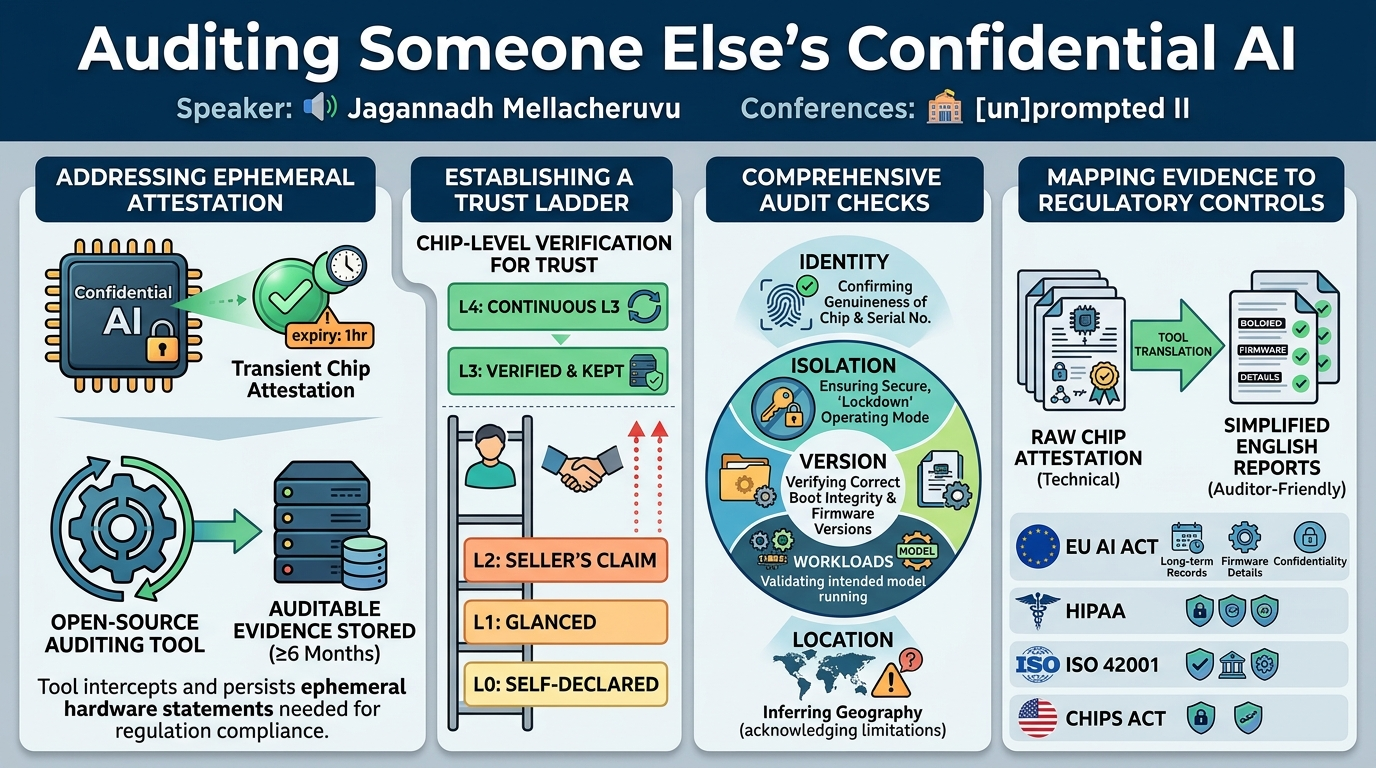
Despite these advancements, a critical gap persists. Mellacheruvu, drawing from his experience as a policy person, noted that auditors and security personnel frequently struggle to obtain verifiable evidence from cloud providers. Requests for proof of data isolation, execution integrity, or data residency often result in unverified logs or screenshots, which are easily manipulated or insufficient for stringent compliance. The speaker highlighted that while chips do sign attestations at the start of an instance, these crucial statements are often discarded, sometimes within as little as an hour (as with NVIDIA instances). This ephemeral nature of attestation prevents continuous auditing and long-term record-keeping, leaving a significant void in accountability and trust, especially when regulations like the EU AI Act demand records for six months or more. The motivation behind Mellacheruvu's work was to bridge this gap, transforming transient chip attestations into persistent, auditable evidence directly mappable to legal and regulatory controls.
Key Findings
▶ Watch: Tool's 12 checks: Identity, Isolation, Version, Workloads, Location (9:00)
The central finding presented by Jagannadh Mellacheruvu is that while Confidential AI offers hardware-backed security, the practical implementation often falls short in providing continuous, verifiable, and auditor-friendly evidence. Despite the significant "trust tax" paid for Confidential AI services, organizations frequently lack the necessary tools to confirm that their data and workloads are truly protected as advertised. This creates a critical compliance and accountability gap, especially for regulated industries.
Mellacheruvu's research and tool address this by demonstrating the feasibility and necessity of:
- Capturing Ephemeral Attestations: The tool's core functionality is to intercept and persist the cryptographically signed statements generated by Confidential AI chips, which are otherwise discarded (e.g., NVIDIA tokens expiring in an hour). This ensures that a continuous record of the hardware's state and integrity is maintained, addressing regulatory requirements for long-term data retention (e.g., the EU AI Act's six-month recordkeeping mandate).
- Verifiable and Continuous Auditing: The tool performs 12 distinct checks on the chip's attestation, categorized into five critical areas: Identity, Isolation, Version, Workloads, and Location. These checks move beyond simple "trust" to cryptographic verification, allowing users to confirm the genuineness of the chip, its secure operating mode, the integrity of its firmware and drivers, and the correct execution of specified models.
- Translating Technical Evidence into Policy Language: A key innovation is the tool's ability to transform raw, technical chip attestations into "simple English" reports. This makes the complex cryptographic evidence accessible and actionable for non-technical stakeholders such as auditors, policy writers, and security leads, enabling them to directly map chip-level assurances to specific regulatory controls (e.g., EU AI Act, HIPAA, ISO 42001, Chips Act).
- Establishing a Trust Ladder: Mellacheruvu introduced a "ladder of trust" (L0 to L4) to quantify the level of verifiable assurance. The tool elevates trust from L0 (self-declared, like a barista's claim) to L3 (chip statement verified and kept) and L4 (continuous L3 verification). This provides a standardized metric for evaluating the trustworthiness of Confidential AI deployments.
- Highlighting Confidential AI Limitations: The talk also candidly exposed inherent limitations of current Confidential AI solutions. Mellacheruvu noted that even with attestation, chips cannot cryptographically prove exact physical location (beyond weak TLS handshakes), precise compute amounts, or software licensing. Furthermore, Confidential AI remains susceptible to certain attacks like side-channel attacks if physical access to the chip is granted. This led to the introduction of Fully Homomorphic Encryption (FHE) as a potential future solution to overcome these fundamental constraints.
In essence, Mellacheruvu's key finding is that while Confidential AI provides a strong foundation for data protection, it requires an external, open-source auditing layer to deliver on its promise of verifiable trust and regulatory compliance. His tool provides this missing link, empowering organizations to gain true assurance over their confidential AI workloads.
Technical Deep Dive
▶ Watch: Demo highlights NVIDIA token expiration vs. EU AI Act (14:00)
The technical core of Mellacheruvu's presentation revolves around the mechanism of hardware attestation in Confidential AI and his tool's innovative approach to leverage it for continuous auditing. Confidential AI, as explained, establishes a Trusted Execution Environment (TEE), often implemented through CPU extensions like AMD SEV-SNP, Intel TDX, or NVIDIA Confidential Computing. Within this TEE, memory is encrypted, protecting data from unauthorized access by the host OS or hypervisor. The integrity of this environment is proven through attestation.
The current attestation process typically works as follows:
- Instance Boot: When a Confidential AI instance starts, the underlying hardware chip generates a signed statement (an attestation report). This report contains cryptographic hashes of the bootloader, firmware, software stack, and specific configuration parameters within the TEE.
- Cloud Verifier: This signed statement is then sent to a cloud-based attestation verifier.
- Key Release: If the attestation report matches an expected "golden" configuration, the verifier releases the encryption keys, allowing the VM to decrypt and access its data.
- Statement Discard: Crucially, after this initial verification, the signed statement is often discarded. Mellacheruvu specifically noted that NVIDIA's Confidential Computing tokens, for example, have a lifespan of only one hour.
Mellacheruvu's tool, developed by Mirror Security, intercepts and transforms this ephemeral attestation into a persistent, auditable record. Its process involves:
- Statement Capture: The tool connects to the Confidential AI instance and fetches the raw, cryptographically signed attestation statement directly from the chip.
- Verification and Grading: It then verifies the signature against the chip vendor's root of trust (e.g., AMD's root, Intel's root). Beyond simple signature verification, the tool performs 12 comprehensive checks against the captured statement and the user's declared expected build pipeline and model registry. These checks are categorized as:
- Identity: Verifies the genuineness of the chip and its serial number.
- Isolation: Ensures the TEE is operating in a secure, "lockdown" mode, debugging is off, the instance cannot be moved while running, and chips are linked securely.
- Version: Confirms correct boot integrity, matches firmware and driver versions against expected references.
- Workloads: Validates that the booted environment matches the intended release and identifies the specific model running.
- Location: Attempts to infer the geographical location, though Mellacheruvu acknowledged this is the weakest check due to inherent cryptographic limitations and reliance on less reliable methods like TLS handshakes or ping latency.
- Continuous Storage and Translation: Unlike the ephemeral nature of standard attestations, the tool stores these verified reports. It then translates the technical output into "simple English," making it digestible for auditors and policy makers. This continuous capture and storage address the regulatory requirements for long-term record-keeping, such as the EU AI Act's demand for six months of records (Article 12 and 19).
The tool’s output is a graded report, indicating success (green tick), missing information (question mark), or failure (red cross). This directly contributes to building a Trust Ladder:
- L0 (Self-declared): Basic trust, like a barista's claim.
- L1 (Glanced): Superficial verification.
- L2 (Seller's claim): Trusting the provider's word.
- L3 (Chip statement verified and kept): Achieved by the tool, providing cryptographic proof.
- L4 (Continuous L3): Ongoing, automated verification.
Mellacheruvu meticulously mapped these checks to various regulatory controls:
- EU AI Act: Annexure 4 (firmware version, hardware), Article 12 & 19 (records for 6 months), Article 15 (resilience, confidentiality). Specific checks like G1-G8, G10, G12 directly address these.
- ISO 42001: Asks about documented systems running approved changes.
- Chips Act & Export Rules: Inquire about tampering and key ownership.
While the tool significantly enhances the verifiability of Confidential AI, Mellacheruvu acknowledged its limitations and proposed Fully Homomorphic Encryption (FHE) as a more robust, mathematical solution for the future. FHE allows computation directly on encrypted data without ever decrypting it, eliminating concerns about data exposure even to the chip itself. This intrinsically solves problems like side-channel attacks, physical access risks, and the inability to cryptographically prove compute amount or licensing, which Confidential AI struggles with. FHE represents a paradigm shift where the owner holds the key, and the computation provider never sees the plaintext, offering a "mathematical promise" for ultimate confidentiality.
Demo / Proof of Concept
▶ Watch: Flaws of confidential AI; introducing Fully Homomorphic Encryption (18:00)
Jagannadh Mellacheruvu presented a recorded demonstration of his open-source auditing tool, showcasing its capabilities across different Confidential AI hardware platforms. The demo illustrated how the tool fetches, verifies, and grades attestation statements, providing a concrete example of the "trust ladder" in action.
The demonstration utilized three distinct sources:
- AMD Chip with TinFoil: TinFoil is an open-source tool for attestation on AMD SEV-SNP (Secure Encrypted Virtualization-Secure Nested Paging) enabled chips.
- NVIDIA Chip on a Voltage GPU Instance: This represented a self-operated instance, allowing Mellacheruvu to act as the operator.
- Intel Chips via Redfield Fallback Gateway: This provided a mechanism to retrieve attestation reports from Intel-based Confidential AI environments.
During the demo for the AMD chip with TinFoil, the tool executed a command that fetched the published attestation report from TinFoil, extracted data from the AMD chip report, and walked the signature back to AMD's root of trust. The results showed "6 out of 10" checks as successful. A key insight from this segment was the dynamic nature of attestation. When comparing two different versions of TinFoil instances, check "08" (related to release binding and fingerprint) correctly showed a negative result for the older version (version 145) but a positive result for the newer version (version 167). This highlighted the tool's ability to precisely identify discrepancies in hardware configuration or software versions, validating the chip's honesty even when a policy might fail due to version mismatch.
For Intel chips via Redfield Fallback Gateway, the tool was used to check an Intel attestation. Mellacheruvu described choosing a random number, which the chip then signed back. The tool applied its 12 questions, resulting in "3 out of 10" successful checks. It confirmed that the attestation chain correctly traced back to Intel's root, but noted that the code's own signature was not yet present on the laptop, indicating a partial verification.
The most illustrative part of the demo involved the NVIDIA chip on the Voltage GPU instance, which combined an Intel CPU and an NVIDIA GPU. Here, the tool demonstrated its crucial role in persistent record-keeping. Mellacheruvu showed that check "G09" (model bound) was green, confirming the model's fingerprint within the NVIDIA token. However, check "G10" was initially red. The explanation for this "red" status was critical: NVIDIA's attestation token is designed to live for only one hour, but the attestation being checked was "weeks old." This directly conflicted with regulatory requirements like the EU AI Act, which demands records for at least six months. To demonstrate the ephemeral nature and the tool's solution, Mellacheruvu then ran the same check on a fresh bundle captured minutes before the recording. In this scenario, "G10" flipped to green, proving that a fresh attestation passed, but underscoring the necessity of continuously capturing and storing these attestations to meet long-term compliance mandates.
The demo concluded with a summary dashboard, visually representing the results (green for attested, question mark for not answering, cross for no reply/not checked) for all three platforms: TinFoil (AMD), Intel, and Intel+NVIDIA (Voltage GPU). This comprehensive overview clearly articulated how the tool provides a verifiable receipt, transforming self-declared trust (L0) into a cryptographically verified and continuously maintained trust level (L3/L4), thereby empowering auditors with concrete evidence.
Defensive Implications
▶ Watch: Q&A: Challenges in cryptographically proving chip location (22:45)
The insights and the open-source tool presented by Jagannadh Mellacheruvu offer significant defensive implications for any organization leveraging cloud-based AI, especially those in regulated industries. The core message for defenders is to move beyond blind trust in cloud provider claims and embrace verifiable, hardware-backed evidence.
- Empowering Security Leads: Security leads can now demand and verify the integrity of their Confidential AI environments. Instead of relying on screenshots or generic logs, they can utilize the tool to obtain L3 trust-level chip statements—cryptographically verified and persistent records. This provides concrete evidence for internal audits, compliance reports, and demonstrating due diligence to regulators. It transforms the answer from "here are the logs" to "here is the chip statement, verified and kept."
- Strengthening Auditor Capabilities: Auditors, who often struggle with the technical intricacies of cloud AI, gain a powerful, user-friendly instrument. The tool converts complex cryptographic attestations into "simple English" reports, directly mapping to compliance frameworks like the EU AI Act, HIPAA, ISO 42001, and the Chips Act. This enables auditors to independently verify assertions about data residency, execution integrity, and software versions, moving towards a "four-eye principle" for AI security.
- Informing Policy and Regulation: Policy writers can leverage the tool's capabilities to draft more effective and enforceable regulations. By understanding precisely what information chips can and cannot attest to (e.g., verifiable firmware versions vs. elusive cryptographic location proof), they can create policies that demand specific, auditable proofs, rather than generic assurances. The tool directly addresses the EU AI Act's call for six-month record retention by providing the means to store continuous attestations.
- Enhancing Procurement and Vendor Management: Organizations can integrate the tool into their procurement processes for AI cloud services. They can demand that cloud providers offer attestation data compatible with this auditing framework, ensuring transparency and accountability from their vendors. Startup founders, particularly those serving regulated clients, can use this tool to provide irrefutable evidence of their infrastructure's integrity, building trust and facilitating client acquisition.
- Mitigating Confidential AI Limitations: While Confidential AI offers significant memory protection, Mellacheruvu highlighted its inherent weaknesses (e.g., inability to cryptographically prove exact location, compute amount, licensing, and vulnerability to side-channel attacks with physical access). The tool acts as a crucial layer to verify what Confidential AI can attest to, providing the best possible assurance within its current capabilities. For the limitations that cannot be addressed by attestation, the discussion of Fully Homomorphic Encryption (FHE) points to a long-term defensive strategy for ultimate data privacy, where computation occurs entirely on encrypted data, eliminating exposure risks even to the hardware itself.
In summary, the defensive implication is a shift from a reactive, trust-based security posture to a proactive, verify-based approach. By continuously auditing Confidential AI workloads at the chip level, defenders can build a robust, auditable security framework that meets stringent regulatory demands and protects sensitive AI data from evolving threats.
Key Takeaways
- Confidential AI's Promise vs. Reality: While Confidential AI offers hardware-backed protection for AI workloads in the cloud, its practical implementation often lacks continuous, verifiable evidence due to ephemeral attestation statements (e.g., NVIDIA tokens expiring in an hour).
- The Need for Auditable Proof: Regulatory frameworks like the EU AI Act, HIPAA, and ISO 42001 demand long-term record-keeping and verifiable proof of data integrity and execution, which standard Confidential AI deployments often fail to provide without additional tooling.
- An Open-Source Auditing Solution: Jagannadh Mellacheruvu's open-source tool addresses this gap by continuously capturing, verifying, and storing cryptographically signed chip attestations, translating complex technical data into auditor-friendly reports.
- Comprehensive Verification Framework: The tool performs 12 detailed checks across Identity, Isolation, Version, Workloads, and Location, enabling organizations to move from subjective trust (L0-L2) to verifiable, continuous cryptographic assurance (L3-L4).
- Limitations and Future Directions: While the tool significantly enhances Confidential AI's audibility, it acknowledges inherent limitations of current hardware attestation (e.g., inability to prove exact location or compute amount). Fully Homomorphic Encryption (FHE) is presented as a promising mathematical solution for future, ultimate data privacy, performing computations entirely on encrypted data.
- Empowering Stakeholders: The tool empowers security leads, auditors, policy writers, and startup founders to meet compliance requirements, build trust with clients, and make informed decisions about their AI infrastructure by providing concrete, verifiable evidence directly from the chip.
About the Speaker(s)
Jagannadh Mellacheruvu is an expert in AI Security and Policy, currently working with Mirror Security. His professional focus lies in addressing AI data exposure risks, as well as developing and implementing solutions for encrypted AI and secure memory management on AI workloads. Mellacheruvu approaches AI security from a unique policy-oriented perspective, emphasizing the critical need for verifiable evidence directly from the hardware level to ensure compliance with regulatory frameworks and build trust in cloud AI deployments. His work aims to bridge the gap between technical cryptographic assurances and the practical demands of auditors and policy makers in regulated industries.
Reviews
→ Top-rated talks at [un]prompted II 2026 — The AI Security Practitioner Conference
All talks from [un]prompted II 2026 — The AI Security Practitioner Conference