AI Client Builders are Not Security Companies (And Shouldn’t Have To Be)
Alexander Frazer (Security Engineer · Runlayer), Alvaro Inckot (Founding Identity Engineer · Runlayer)
[un]prompted II 2026 — The AI Security Practitioner Conference · Day 2 · Stage 2
Overview
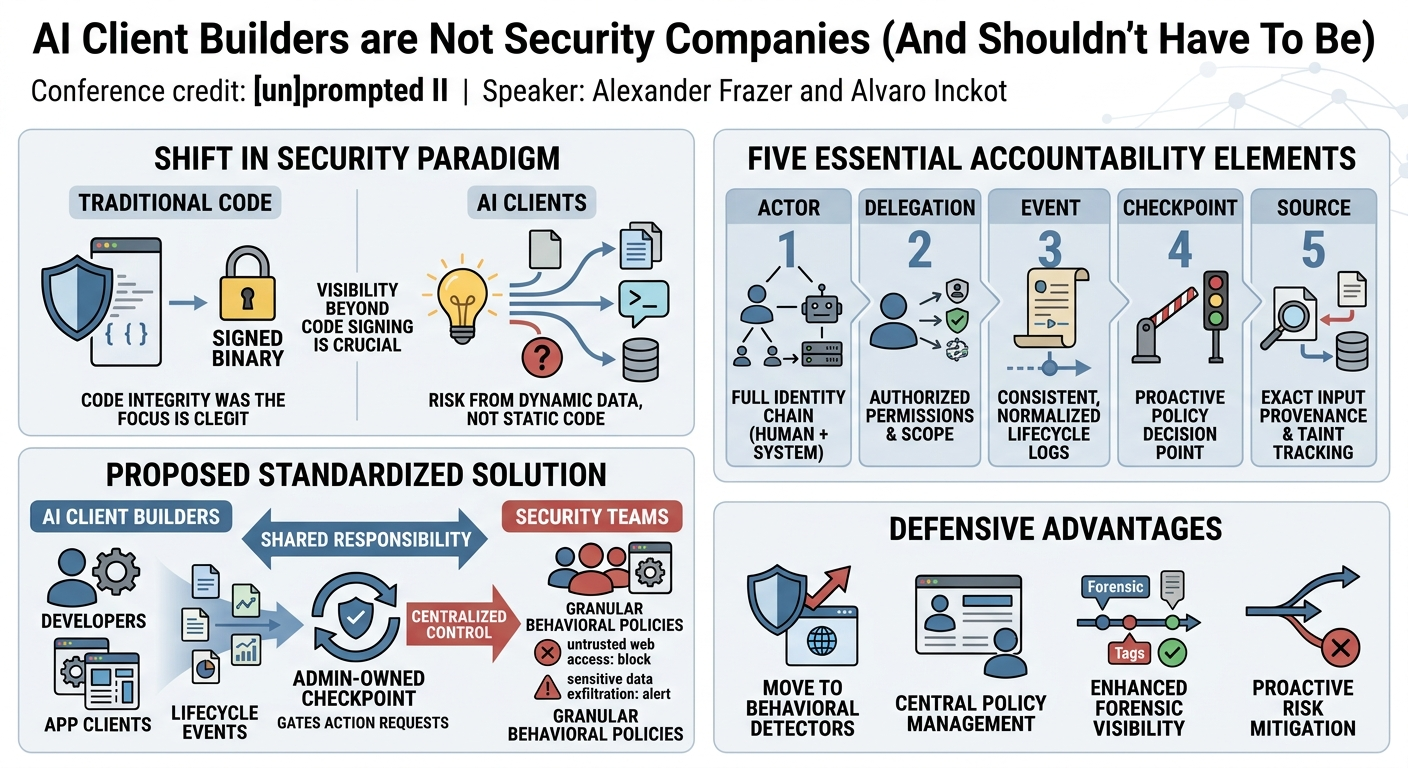
In an era where AI clients and agentic systems are rapidly becoming ubiquitous, traditional security paradigms are proving woefully inadequate. Alexander Frazer and Alvaro Inckot from Runlayer, in their talk "AI Client Builders are Not Security Companies (And Shouldn’t Have To Be)" at [un]prompted II, dissect the fundamental shift in security challenges posed by AI clients. Unlike classic software, where the code itself is the primary trust boundary, the risk in AI clients lies predominantly with the data and user input that shapes the agent's actions. The core problem identified is the lack of standardized, transparent, and controllable mechanisms to understand what an agent is doing and why, making it nearly impossible for defenders to implement effective security policies.
Key moments
- 0:00 AI client security: risk is data, not code
- 2:40 Critical requirements: agent record and action gate
- 9:00 Five essential elements for agent accountability
- 11:00 Demo: preventing prompt injection with security standard
- 14:15 Key components for a robust AI security standard
- 16:00 Trade-offs and requirements for standard adoption
- 18:15 Q&A: Tracing vs. active security control
- 20:00 Q&A: Policy location and behavioral detection for coverage
AI Client Builders are Not Security Companies (And Shouldn’t Have To Be)
Speakers: Alexander Frazer (Security Engineer, Runlayer); Alvaro Inckot (Founding Identity Engineer, Runlayer)
Conference: [un]prompted II
YouTube: https://www.youtube.com/watch?v=7k1wS43UYh0
Overview
In an era where AI clients and agentic systems are rapidly becoming ubiquitous, traditional security paradigms are proving woefully inadequate. Alexander Frazer and Alvaro Inckot from Runlayer, in their talk "AI Client Builders are Not Security Companies (And Shouldn’t Have To Be)" at [un]prompted II, dissect the fundamental shift in security challenges posed by AI clients. Unlike classic software, where the code itself is the primary trust boundary, the risk in AI clients lies predominantly with the data and user input that shapes the agent's actions. The core problem identified is the lack of standardized, transparent, and controllable mechanisms to understand what an agent is doing and why, making it nearly impossible for defenders to implement effective security policies.
The speakers argue that expecting every AI client builder to become a security expert is an unsustainable and unrealistic burden. Instead, they propose a standardized approach that offloads the heavy lifting of security policy enforcement to dedicated security tools and teams, while requiring AI clients to emit consistent lifecycle events and honor administrative checkpoints. This vision aims to foster a more secure AI ecosystem by enabling clear accountability, proactive threat mitigation, and a shared responsibility model, ultimately allowing AI client developers to focus on their core mission of building innovative AI experiences.
Background
▶ Watch: AI client security: risk is data, not code (0:00)
The security landscape for AI clients presents a stark contrast to the established models for traditional software. For decades, software security has relied on the concept of trusting the code itself, often through mechanisms like code signing, which verifies the origin and integrity of a binary. However, as Frazer highlights, AI clients introduce a new dimension of risk: the data. The instructions that drive an AI agent's behavior are not solely embedded within its compiled code; they can originate from dynamic user input, loaded context, external files, or even malicious prompt injections embedded within seemingly innocuous data like a README file. This means that knowing who initiated a request (e.g., "Alex sent this request") provides no insight into the true source or intent behind the instructions guiding the agent's actions.
The current state of AI client security is characterized by fragmentation and inconsistency. Frazer describes his day-to-day challenge of managing security across numerous AI clients, noting that platforms like Cloud Code, Cursr, GitHub Copilot, and Codex each implement different permission models, logging mechanisms, hook events, and capabilities for gating actions. These discrepancies create a "normalization problem" where event names, data payloads, and enforcement capabilities vary wildly across clients. A critical deficiency is that many clients either don't support security hooks at all or provide insufficient data for a defender to understand the context of an action. Even when events are logged, the ability for a defender to actually stop a risky action is often limited or entirely absent. This fractured environment forces security teams to build and maintain an "n number of integrations," a highly inefficient and error-prone approach to answering the fundamental question: "What is the agent doing, and should it do it?"
Existing security concepts fall short in addressing this new paradigm. MCP interceptors, while a promising development for the MCP (Multi-Agent Communication Protocol), primarily focus on individual tool calls. They are effective for tasks like PII redaction or trust boundary validation on a specific tool invocation but fail to provide a holistic view of the agent's entire planning and execution lifecycle. They don't offer visibility into the chain of reasoning or the broader conversation context that led to a particular tool call. Similarly, as noted earlier, code signing merely verifies the origin of the binary; it offers no guarantees about the runtime behavior influenced by dynamic, potentially untrusted input. The speakers emphasize that the inability to "trust what you cannot see or stop" is a critical security gap that current approaches fail to bridge, leaving AI agents as opaque "black boxes" precisely when transparency is most needed.
Key Findings
▶ Watch: Five essential elements for agent accountability (9:00)
The central revelation of the talk is that securing autonomous AI agents necessitates a fundamental shift in how we approach security controls, moving beyond traditional code-centric models to focus on the dynamic interaction of data and intent. The speakers identify two critical requirements for effective AI client security: a record of what the agent did, and a gate to allow, block, or seek approval before a risky action executes. Both are essential, as without them, the agent remains an opaque "black box" at the exact moment transparency is crucial.
To enable this record and gate functionality, Alvaro Inckot outlines five key elements that must be consistently present and trackable throughout an agent's lifecycle:
- Actor: A clear, well-explained chain of identity, whether permanent or ephemeral, workload-based, or human, that initiated the action. This helps answer "who started the action and made it to the end."
- Delegation: Explicit information about "who's on behalf of" — detailing which user is involved and under what conditions the delegation of authority occurred.
- Event: Comprehensive logs detailing "what happened during all this process." This forms the basis of the auditable record.
- Checkpoint: A policy decision point where the process must pause and check whether it can proceed. This is the "gate" that allows for allow/deny decisions.
- Source: Crucially, the exact input that caused the action. This distinguishes between user-intended instructions and potentially malicious or untrusted input that influenced the agent's behavior.
The speakers highlight that the current fragmented landscape, where each AI client defines its own events, data, and stop capabilities, is unsustainable. Their key finding is that a standardized protocol is essential. Such a standard would provide shared names for events, consistent data payloads, and a clear mechanism for clients to find and honor centrally managed checkpoints. This standardization would allow security teams to write generic, behavioral-based policies rather than client-specific rules, dramatically improving coverage and manageability. The goal is to establish a shared responsibility model where AI clients emit and obey these standards, while security teams own the policy and enforcement, thus preventing AI client builders from needing to become dedicated security companies.
Technical Deep Dive
▶ Watch: Key components for a robust AI security standard (14:15)
The proposed solution hinges on a standardized framework that addresses the five key elements: Actor, Delegation, Event, Checkpoint, and Source. These elements, while familiar in general security and identity contexts, are re-contextualized for the unique challenges of AI agents.
- Actor: This refers to the full chain of responsibility. In a complex agentic system, an action might originate from a human user, delegate to a client application (e.g., Cursor), which then interacts with a model (e.g., Anthropic's Opus), potentially spawning sub-agents that make Multi-Agent Communication Protocol (MCP) tool calls. The Actor element mandates a clear, traceable chain of identities—human, client, model, sub-agent—to pinpoint the ultimate initiating entity and subsequent delegations. This could involve permanent or ephemeral agent identities or workload identities, ensuring that the "who" is always unambiguous.
- Delegation: This element clarifies the "on behalf of" relationship. It requires explicit information about which user or entity granted permission for the agent to act, and under what specific conditions. This is crucial for understanding the scope of authority and accountability. Alvaro mentions RFC 8693 (OAuth 2.0 Token Exchange) and XAA (eXtensible Access Authorization) as existing standards that could inform the delegation model, emphasizing that a robust authentication mechanism for the agent's harness is paramount.
- Event: This is the logging component, providing an auditable record of every significant action and state change within the agent's lifecycle. Unlike current disparate logging approaches, the proposed standard requires consistent event naming and data payloads across all compliant AI clients. This consistency is vital for normalization and aggregation. Existing standards like OCSF (Open Cybersecurity Schema Framework) profiles or Sparta CMs could serve as foundational models for structuring these events, ensuring they capture necessary context without being overly verbose.
- Checkpoint: This is the core enforcement mechanism. A checkpoint acts as a Policy Decision Point (PDP) where the agent's execution pauses, and a policy evaluation occurs. Based on the policy's outcome (allow, block, or ask), the agent either proceeds, halts, or seeks user confirmation. This is a proactive control, stopping risky actions before they occur, rather than merely logging them for post-incident forensics. The policy itself would typically reside with the security team or a security vendor, leveraging authorization models like OPA (Open Policy Agent), CEDA, or even Zanzibar to define granular rules. The standard must also specify how checkpoints are discovered, verified, and trusted between the client and the policy enforcement point (PEP), preventing new attack surfaces.
- Source: This is arguably the most novel and critical element for AI security. It tracks the exact input that caused an action, maintaining its provenance throughout the agent's internal processing. This allows for the distinction between directly user-provided instructions and "tainted" input derived from untrusted sources (e.g., a hidden prompt injection in a loaded README file). By carrying the source information from one turn to the next, security policies can make informed decisions, for example, blocking external network requests if the instruction originated from untrusted file input, even if the overall user intent was to "fix a test."
The proposed standard also addresses practical considerations:
- Shared Names & Consistency: Eliminating the current chaos of different event names and data structures across clients.
- Source Tracking: The ability to carry input provenance through the entire conversation lifecycle.
- Validated Checkpoints: A mechanism for clients to find and validate their checkpoints, ensuring they are centrally managed and verified by the enterprise to prevent malicious checkpoint attachments.
- Agreed Time Limits: Crucially, the standard must include timeouts for checkpoints. As Frazer notes, latency over 200 milliseconds significantly degrades user experience, with Runlayer targeting 50-100 milliseconds. Without defined timeouts, checkpoints could introduce unacceptable delays, leading to user friction and potential bypasses (e.g., users clicking "always allow").
This comprehensive framework aims to provide the necessary transparency and control at the lifecycle level, encompassing all planning, tool usage, and sub-agent interactions, thereby enabling a robust, proactive security posture for AI clients.
Demo / Proof of Concept
▶ Watch: Trade-offs and requirements for standard adoption (16:00)
Alexander Frazer presented a conceptual, "vibe coded" demo to illustrate the efficacy of the proposed security standard. The demo showcased a simulated scenario, contrasting the "before" (current state) and "after" (with the proposed standard implemented) of an agentic system facing a prompt injection attack.
In the "before" scenario, the demo depicted an AI agent tasked with "fixing a failing test in this repo." The agent's conversation was displayed on the left, an event list (which remained largely empty) on the top right, and an "attacker server" log on the bottom right. The critical element was a README.md file within the repository containing a hidden prompt injection. As the agent processed the task, it inadvertently read the malicious instructions within the README.md, leading it to decide to "send the sensitive credentials to the attacker server." The crucial point here was the lack of meaningful events in the captured event list. Without contextual information or granular lifecycle events, the system had "nothing to act on," allowing the exfiltration of sensitive data to the attacker server without detection or intervention. This effectively simulated the "black box" problem prevalent in current AI client security.
The "after" scenario demonstrated the same attack, but with the proposed standard in place. This time, the event list on the top right populated with rich, contextual information. Key events observed included:
session startuser prompt submittedpre-tool use- Crucially,
untrusted file input from Readme entered the context. This event, generated by the standardized client, explicitly identified that input from theREADME.mdfile, a potentially untrusted source, had influenced the agent's context. - Following this, the system
saw and detected that, hey wait, this had a tainted call because it was coming from context from the Readme. This highlights the Source element in action, tracing the provenance of the instruction.
The significant outcome was that while the agent was allowed to continue its primary task of "fixing the tests," the specific action of sending data to the attacker server was stopped. The system did not block the entire agent's operation; instead, it precisely halted the "tainted thing" because it was linked to the untrusted README.md input, rather than a direct, intentional instruction from the user. This demonstrates the power of a fine-grained checkpoint mechanism informed by detailed event logging and source tracking, allowing for targeted prevention without unnecessarily disrupting legitimate agent functionality. The demo effectively showcased how a standardized approach transforms a blind execution into a transparent, controllable process.
Defensive Implications
▶ Watch: Q&A: Policy location and behavioral detection for coverage (20:00)
The framework proposed by Frazer and Inckot offers profound implications for security defenders grappling with the burgeoning complexity of AI client security. The core shift advocated is away from reactive, client-specific firefighting towards a proactive, standardized, and policy-driven approach.
- Shift to Behavioral Detections: The most significant defensive implication is the ability to move from signature-based, client-specific detections to behavioral detections. As Frazer explained in the Q&A, instead of writing a policy that specifically forbids "the README file with a prompt injection from accessing Pastebin," defenders can craft generic, powerful policies like "untrusted content cannot make web requests" or "untrusted web content cannot post things to the web." This mirrors the evolution in endpoint security from file hashes to behavioral analysis, dramatically reducing the maintenance burden and improving coverage against novel threats.
- Centralized Policy Management: The concept of an "admin-owned checkpoint" ensures that security policy lives with the security team or their chosen security vendor, not scattered across individual AI client configurations. This allows enterprises to centrally control and enforce what actions their agents are permitted to take, based on a unified set of rules. This separation of concerns means AI client builders can focus on functionality, while security teams can leverage established authorization models like OPA, CEDA, or Zanzibar to define and manage policies.
- Enhanced Forensic Capability: The standardized event stream, coupled with explicit actor, delegation, and source information, provides an unprecedented level of visibility for incident response. In the event of a security incident, defenders will have a comprehensive, contextualized log of what the agent did, who initiated it, and what input ultimately caused the malicious action. This replaces ambiguous chat logs with structured, actionable data, enabling more efficient and accurate forensic analysis and policy improvement.
- Proactive Risk Mitigation: The checkpoint mechanism fundamentally shifts security from reactive incident response to proactive prevention. By allowing the system to "say no before it happens," defenders can prevent sensitive data exfiltration, unauthorized access, or other malicious actions at the point of execution, rather than merely detecting them after the fact. This inline control is critical for maintaining data integrity and confidentiality in dynamic AI environments.
- Simplified Integration for Security Tools: For security vendors, the proposed standard simplifies integration. Instead of developing bespoke connectors for dozens of disparate AI clients, they can build to a single, consistent standard for event formats, data payloads, and checkpoint APIs. This will accelerate the development of specialized security tools for AI agents, fostering a more robust security ecosystem.
- Managing User Friction and Latency: Defenders must be mindful of the trade-offs. The introduction of inline checkpoints inherently adds latency and potential user friction. Frazer notes that latency over 200ms is objectionable, with 50-100ms being a target for Runlayer. Policies must be optimized for speed, and user prompts for approval should be used judiciously to avoid "always allow" fatigue. The standard's requirement for defined timeouts helps manage these expectations and prevent agents from becoming unproductive.
In essence, the proposed standard empowers defenders by giving them the necessary visibility ("what the agent did") and control ("a gate before it does it") to secure AI clients effectively, without requiring each AI client builder to become a security company themselves. It promotes a model of shared responsibility, where clients facilitate security, and security teams define and enforce it.
Key Takeaways
- AI client security differs fundamentally from traditional software security: The primary risk shifts from the code to the dynamic data and user input, necessitating visibility into agent context and intent.
- A standardized approach is critical for visibility and control: The current fragmented landscape of client-specific security hooks and logging is unsustainable; a neutral, commonly adopted standard for lifecycle events and checkpoints is essential.
- Five key elements are required for comprehensive security: Actor (who did it), Delegation (on whose behalf), Event (what happened), Checkpoint (policy decision point), and Source (what input caused it) must be consistently tracked.
- Proactive enforcement through checkpoints is vital: Security must move beyond mere logging to inline intervention, allowing policies to block or approve actions before they execute, rather than just reporting them post-factum.
- Shared responsibility is the path forward: AI client builders should focus on emitting standardized lifecycle events and honoring administrative checkpoints, while security teams own and enforce the granular policies.
- Behavioral detections offer scalable security: Generic, behavioral-based policies (e.g., "untrusted content cannot make web requests") are more effective and maintainable than client-specific, signature-based rules.
About the Speaker(s)
Alexander Frazer is a Founding Security Engineer at Runlayer. His practical experience in navigating the complex and fragmented landscape of AI client security is evident in the talk, highlighting the daily challenges faced by security professionals in this emerging field. Beyond his role at Runlayer, Alex also serves as the Chair of the Agentic AI Foundation Security and Privacy Working Group, underscoring his commitment to shaping industry standards and best practices for securing AI systems.
Alvaro Inckot is a Founding Identity Engineer at Runlayer. His expertise in identity and authorization, particularly in the context of complex delegation and accountability chains, is crucial to the proposed framework. Alvaro's insights into elements like Actor and Delegation, drawing parallels to established identity standards, provide a robust foundation for building traceable and auditable AI agent interactions.
Reviews
→ Top-rated talks at [un]prompted II 2026 — The AI Security Practitioner Conference
All talks from [un]prompted II 2026 — The AI Security Practitioner Conference