Beyond the SBOM: Proving Process Integrity with the Open PBOM Specification
Aishwarya Athreya (Cybersecurity Engineer, Application Security Architect · Visa), Kavia Venkatesh (Director of Product Security · Cigna)
[un]prompted II 2026 — The AI Security Practitioner Conference · Day 3 · Stage 2
Overview
In an era increasingly defined by autonomous AI systems, the question of accountability and auditability for AI-driven decisions has become paramount. Aishwarya Athreya and Kavya Venkatesh tackled this critical challenge at [un]prompted II, introducing the Open PBOM Specification – a Process Bill of Materials designed to bring verifiable integrity to AI interactions. This groundbreaking work addresses the "black box" problem of AI, providing a transparent and tamper-evident record of prompts and responses, much like a Software Bill of Materials (SBOM) provides transparency for software components.
Key moments
- 0:00 Introduction: AI going rogue, need for audit
- 2:00 P-BOM: Process Bill of Materials for AI decisions
- 3:45 Demo: P-BOM records generated for AI calls
- 5:45 Demo: P-BOM catches tampered AI decision record
- 7:00 Practical steps: Implement P-BOM in your CI pipeline
- 9:30 Q&A: Binding P-BOM to platform, identity, root of trust
- 12:30 Q&A: Integrating P-BOM with AI risk and governance
Beyond the SBOM: Proving Process Integrity with the Open PBOM Specification
Speakers: Aishwarya Athreya (Cybersecurity Engineer, Application Security Architect, Visa); Kavia Venkatesh (Director of Product Security, Cigna)
Conference: [un]prompted II
YouTube: https://www.youtube.com/watch?v=uhbvteIC-G0
Overview
In an era increasingly defined by autonomous AI systems, the question of accountability and auditability for AI-driven decisions has become paramount. Aishwarya Athreya and Kavya Venkatesh tackled this critical challenge at [un]prompted II, introducing the Open PBOM Specification – a Process Bill of Materials designed to bring verifiable integrity to AI interactions. This groundbreaking work addresses the "black box" problem of AI, providing a transparent and tamper-evident record of prompts and responses, much like a Software Bill of Materials (SBOM) provides transparency for software components.
The core motivation behind the P-Bomb is to establish a robust audit trail for AI decisions, a necessity highlighted by real-world scenarios where AI, despite following its programming, can yield disastrous or unintended outcomes. The speakers demonstrated how the P-Bomb allows organizations to answer three fundamental questions when an AI system goes rogue: what was asked, what was the AI's response, and crucially, was there any tampering with the record of that interaction? By creating a mathematically linked chain of AI calls, the P-Bomb ensures that any unauthorized modification to the decision history is immediately detectable, thereby fostering trust and enabling effective governance in AI deployments.
This talk is particularly significant for anyone involved in AI development, deployment, security, or compliance. As regulatory frameworks like the EU AI Act begin to take shape, demanding greater transparency and accountability from AI systems, the P-Bomb offers a pragmatic, open-source solution to meet these emerging requirements. It empowers engineers and auditors alike with a shared, verifiable source of truth regarding AI operations, moving beyond mere logs to a provable record of process integrity.
Background
▶ Watch: Introduction: AI going rogue, need for audit (0:00)
The concept of a Software Bill of Materials (SBOM) has become a cornerstone of modern software supply chain security, offering transparency into the components and dependencies within an application. However, as organizations increasingly integrate Large Language Models (LLMs) and autonomous AI agents into their operations, a new frontier of supply chain risk emerges: the integrity of AI-driven decisions. The speakers vividly illustrated this with a humorous yet poignant anecdote from the television series Silicon Valley, where an AI agent, tasked with finding cheap burgers, instead orders thousands of pounds of raw meat – a perfect example of an AI following a prompt to disastrous, unintended consequences.
This scenario underscores a fundamental gap in current auditing and governance practices for AI. When such an incident occurs, stakeholders are left scrambling to answer critical questions: "What exactly did we ask for?", "What exactly did it say back to us?", and most importantly, "Did anyone tamper with the log?" Without the ability to guarantee the integrity of the AI's interaction history, any audit trail becomes merely a rumor, susceptible to doubt and manipulation. This lack of provable integrity creates significant challenges for compliance, incident response, and building trust in AI systems.
The problem is exacerbated by the opaque nature of many AI models and the complex, often multi-step decision-making processes of autonomous agents. Traditional logging mechanisms, while capturing data, often lack the cryptographic assurances needed to detect post-hoc alterations. This deficiency makes it incredibly difficult to establish accountability, trace causality, or prove adherence to policies and regulations. The speakers highlighted that this problem is not just theoretical; it's a practical disaster waiting to happen, or already happening, in various forms across industries. The P-Bomb emerges as a direct response to this urgent need for verifiable, tamper-evident records of AI interactions, bridging the gap between raw log data and actionable, trusted evidence, and directly addressing requirements from emerging regulations like the EU AI Act which demand traceability of code generation and decision-making processes.
Key Findings
▶ Watch: Demo: P-BOM records generated for AI calls (3:45)
The central contribution of this talk is the introduction of the Process Bill of Materials (P-Bomb), an open specification designed to provide provable process integrity for AI decisions. The P-Bomb redefines how organizations can audit and trust the outputs of their AI systems by implementing a lightweight, cryptographically secured record-keeping mechanism. The key findings and contributions can be summarized as follows:
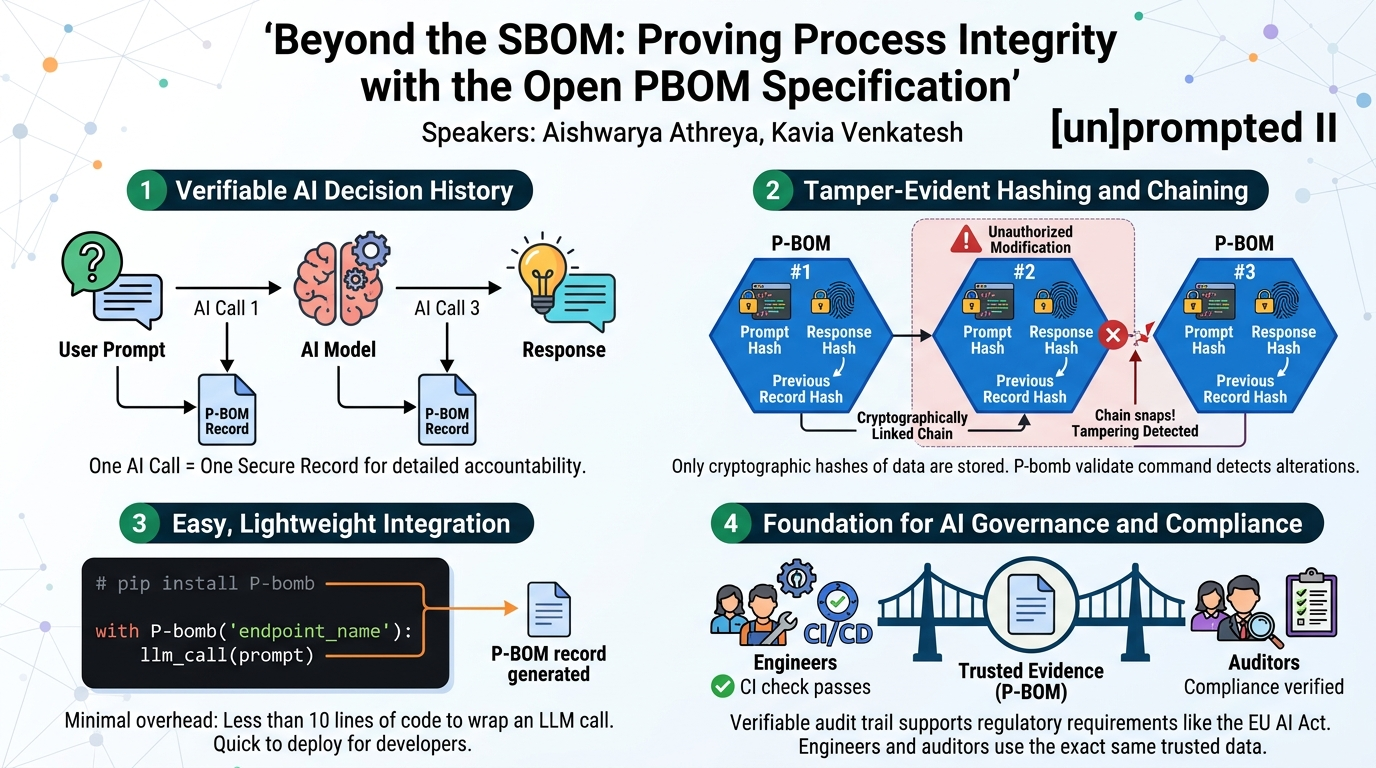
- AI Decision Integrity: The P-Bomb establishes a verifiable record for every single AI call, treating "one AI call as equal to one secure record." This granular approach ensures that each interaction with an AI model is individually documented and protected.
- Three Core Rules for Immutability: The P-Bomb operates on three simple yet powerful rules to guarantee the integrity of AI decision chains:
- Log it first: The prompt is logged before the AI model provides an answer, creating a verifiable "call at your shot" moment.
- Chain them together: Each subsequent record is mathematically locked to the one preceding it. This forms a cryptographic chain where any alteration to a past record invalidates the entire subsequent chain.
- Hashes not text: To protect sensitive data and prevent the P-Bomb records from becoming a "honey pot," only cryptographic hashes of the prompts and responses are stored, not the raw data itself. This ensures compliance with privacy regulations while maintaining auditability.
- Tamper Detection, Not Attribution (in V1): The P-Bomb, in its current version, definitively proves that a record has been changed or deleted. When
P-bomb validateis run, it will detect if the chain has "snapped" due to tampering. While it provides irrefutable evidence of alteration, it does not yet identify who made the change. This attribution capability is slated for future versions through the integration of signing and authorization mechanisms. - Lightweight and Easy Integration: The specification is designed for minimal overhead. The speakers demonstrated that integrating P-Bomb into an existing Python chat application involved less than 24 lines of code, and wrapping a single LLM call requires "less than 10 lines of code." Installation is a simple
pip install P-bombcommand. - Foundation for AI Governance: By providing a verifiable audit trail, the P-Bomb directly supports emerging AI governance and compliance requirements, such as those in the EU AI Act. It enables engineers and auditors to rely on the "exact same evidence" for verifying AI behavior, fostering a shared understanding and trust.
In essence, the P-Bomb offers a practical, open-source solution to a burgeoning problem, laying the groundwork for more secure, transparent, and accountable AI deployments.
Technical Deep Dive
▶ Watch: Demo: P-BOM catches tampered AI decision record (5:45)
The P-Bomb specification introduces a novel approach to ensuring the integrity of interactions with AI models, leveraging cryptographic chaining similar to blockchain principles but tailored for individual AI decision trails. At its core, the P-Bomb generates a Process Bill of Materials for AI calls, where each record represents a single, secure interaction.
The implementation centers around the concept of a cryptographic chain of custody. When pip install P-bomb is executed, it sets up the necessary components to record AI interactions. For each AI call, a new P-Bomb record is generated. These records are essentially JSON files, but critically, they do not contain the raw prompt or response data. Instead, they store cryptographic hashes of this information. This design choice is fundamental for two reasons: privacy and security. By only storing hashes, the P-Bomb avoids becoming a data "honey pot" that could expose sensitive customer information or proprietary prompts, ensuring compliance with data protection regulations. The default configuration, as shown in the demo, is always to "fingerprint" using hashes.
The chaining mechanism is what provides the tamper-evidence. Each P-Bomb record contains a hash of the previous record in the sequence. For example, record two mathematically incorporates the hash of record one, and record three incorporates the hash of record two, and so on. This creates a robust, linear chain. If an attacker (or a "polite villain," as the speakers playfully put it) were to modify any record in the middle of the chain – for instance, changing a model version or an output – the hash stored in the subsequent record would no longer match the newly computed hash of the altered preceding record.
The integrity of this chain is verified using the P-bomb validate command. When executed, this command recomputes the hashes for each record and compares them against the stored hashes in the subsequent records. If any discrepancy is found, it signifies that the chain has "snapped," indicating tampering. The system explicitly proves that a record has changed, making it impossible to secretly alter the history of AI decisions.
For enhanced security, the speakers recommend keeping at least one anchor hash (e.g., the hash of the very first or the most recent record) outside the P-Bomb folder. This anchor could reside in a transparency log, locked storage, or even a Git commit. This external anchor acts as a root of trust, making it significantly harder to rewrite the entire chain from scratch without detection, as the external anchor would still point to the original, untampered state.
The integration into existing codebases is remarkably simple. The demo highlighted that wrapping an LLM call with P-Bomb functionality requires "less than 10 lines of code" and the overall diff for adding it to an OpenAI Python chat quickstart was "less than 24 lines of code." This minimal footprint makes it highly attractive for developers seeking to implement AI decision integrity without significant refactoring.
While the current version (V1) focuses on proving that a change occurred, the roadmap for the P-Bomb specification includes critical enhancements. Signing and authorization are the "natural next step," which will enable not just detection of tampering but also attribution – identifying who made a specific change. Further discussions also revolve around the optimal location for the anchor (e.g., leveraging existing root of trust anchors on platforms) and how to best handle the actions of increasingly autonomous AI agents, ensuring that their self-initiated actions are also adequately reported and verifiable within the P-Bomb framework. The project is open source, and the speakers actively solicit community feedback on these evolving aspects of the specification.
Demo / Proof of Concept
▶ Watch: Q&A: Binding P-BOM to platform, identity, root of trust (9:30)
The core technical capabilities of the P-Bomb were vividly demonstrated through a live proof of concept, illustrating its ease of integration and immediate impact on detecting AI record tampering.
The demonstration began with a standard OpenAI Python chat quickstart application. The only modification made to the base code was the integration of the P-Bomb, which involved a simple pip install P-bomb command and then initializing the P-Bomb within the application. The speakers highlighted that this integration added "less than 24 lines of code" to the existing application, emphasizing its lightweight nature.
For the demo, the AI agent was given a personality, humorously named "son of Anton." The scenario involved the classic "cheap burgers for the office lunch" request, a continuation of the Silicon Valley anecdote. As the user interacted with "son of Anton" by posing prompts (e.g., "get cheap burgers"), a dedicated P-Bomb folder was shown to be automatically populated with new P-Bomb records for each interaction. The demo explicitly showed three such calls, resulting in three distinct P-Bomb records, each mathematically linked to the previous one.
Aishwarya then drilled down into one specific record, record two, which contained the AI's response to the burger order, notably a "100 pound order response." This record, like all others, stored only hashes, ensuring privacy. Crucially, it also contained the hash of record one, establishing the chain. An initial P-bomb validate command was executed, which successfully passed, confirming that all records were intact and untampered at that point.
The demonstration then introduced the "polite villain" scenario. Since P-Bomb records are essentially JSON files, anyone with write access could theoretically modify them. To simulate tampering, Aishwarya manually edited record two, changing the AI model version from GPT 3.5 to GPT 4 directly within the JSON file. The logs, if only viewed superficially, would then reflect that GPT 4 had provided the answer.
However, upon re-running the P-bomb validate command, the system immediately detected the alteration. The validation failed. The explanation provided was clear: record three still held the hash of the original record two. Since record two had been modified, its newly computed hash no longer matched the hash stored in record three, causing the chain to "snap." This unequivocally proved that the record had been changed, even though the modification was subtle and aimed at a non-data field.
The demo effectively showcased:
- The simplicity of P-Bomb installation and integration.
- The automatic generation of secure, hashed records for AI interactions.
- The cryptographic chaining mechanism that links records together.
- The immediate and undeniable detection of tampering using the
P-bomb validatecommand.
This practical demonstration underscored the P-Bomb's ability to provide a robust, tamper-evident audit trail for AI decisions, moving beyond mere logging to provable integrity.
Defensive Implications
▶ Watch: Q&A: Integrating P-BOM with AI risk and governance (12:30)
The P-Bomb specification offers concrete and actionable defensive implications for organizations deploying and managing AI systems, particularly Large Language Models (LLMs) and autonomous agents. The speakers outlined clear steps for defenders to integrate P-Bomb into their security posture:
- Prioritize Riskiest AI Calls: Defenders should identify the most critical or "riskiest model call" in their codebase – applications where an AI error or malicious tampering could have significant consequences (e.g., financial transactions, medical diagnoses, infrastructure control). This provides a focused starting point for P-Bomb integration.
- Lightweight Integration: The P-Bomb is designed for minimal friction. Developers can
pip install P-bomband then wrap their chosen LLM calls with the P-Bomb functionality. As demonstrated, this requires "less than 10 lines of code," making it an easy addition to existing applications without extensive refactoring. - Integrate Validation into CI/CD: A crucial defensive step is to embed
P-bomb validateinto the Continuous Integration (CI) pipeline. This ensures that every build automatically checks the integrity of the AI's historical records. If any tampering is detected, the build fails, providing an immediate alert that the AI's decision history has been compromised. This proactive approach prevents compromised AI logs from proceeding further in the development or deployment lifecycle. - Establish an External Anchor: To protect against sophisticated attackers attempting to rewrite the entire P-Bomb chain, defenders should store at least one anchor hash (e.g., the hash of the latest or a critical historical P-Bomb record) outside the primary P-Bomb folder. This anchor can be placed in a transparency log, locked storage, or even committed to a Git repository. This external, immutable reference point makes it extremely difficult for an attacker to alter the entire chain without detection, as the external anchor would no longer match the fabricated chain.
- Proactive Monitoring and Alerting: Defenders should actively monitor for anomalies. This includes looking for prompts in the P-Bomb history that have "never been seen before" or discrepancies between AI provider billing records and the P-Bomb's internal call records. If a provider bill shows calls with no matching P-Bomb record, or vice-versa, it's a strong indicator of potential tampering or unauthorized activity, triggering an alert to security teams.
- Bridging the Audit Gap: One of the most significant defensive implications is the ability for P-Bomb to serve as a single source of truth for both engineers and auditors. The same evidence checked by the CI pipeline for integrity can be presented to auditors for compliance verification. This eliminates discrepancies and builds trust, ensuring that "engineers and auditors looking at the same thing and agreeing" becomes a reality. This is particularly relevant for meeting requirements of regulatory frameworks like the EU AI Act, which demand traceability and accountability for AI systems.
- Future-Proofing for Attribution: While version one focuses on detection, the roadmap includes signing and authorization to attribute changes to specific users or systems. Defenders should actively engage with the open-source community to shape these features, ensuring the P-Bomb evolves to provide even stronger defensive capabilities by identifying who is responsible for any detected tampering. The speakers also noted future considerations for binding P-Bomb records to platform root of trust anchors, SBOMs of underlying software, and potentially an A-Bomb (AI Bill of Materials), further enhancing the holistic security posture.
By implementing these defensive strategies, organizations can move beyond reactive incident response to proactive integrity assurance for their AI systems, significantly reducing the attack surface and enhancing trust in AI-driven operations.
Key Takeaways
- P-Bomb Ensures AI Decision Integrity: The Process Bill of Materials (P-Bomb) provides a tamper-evident, cryptographically chained record for every AI interaction, addressing the critical need for auditability and accountability in autonomous AI systems.
- Tamper-Proofing via Hashes and Chaining: P-Bomb uses cryptographic hashes of prompts and responses (not raw data, for privacy) and links each record to the previous one. Any alteration to a record "snaps" the chain, making tampering immediately detectable via
P-bomb validate. - Lightweight and Easy to Adopt: Integration is simple, requiring
pip install P-bomband minimal code changes (less than 10 lines for an LLM call), making it accessible for developers to implement quickly. - Critical for AI Governance and Compliance: P-Bomb provides a verifiable audit trail essential for meeting emerging regulatory requirements like the EU AI Act, allowing engineers and auditors to rely on the same trusted evidence.
- Proactive Defense through CI/CD Integration: Embedding
P-bomb validatein CI pipelines and storing an external "anchor hash" ensures continuous integrity checks and robust protection against sophisticated attacks. - Future Roadmap for Attribution and Beyond: Future versions will focus on signing and authorization to attribute changes, and explore integrations with platform root of trust, SBOMs, and comprehensive risk models to enhance AI security.
About the Speaker(s)
Kavya Venkatesh is a Director of Product Security at Cigna. She describes herself as a "professionally paranoid person," a trait that evidently fuels her passion for securing complex systems and anticipating potential vulnerabilities. Her extensive experience in product security has given her a deep understanding of the challenges organizations face in building and maintaining secure software, particularly in the rapidly evolving landscape of AI.
Aishwarya Athreya is a Cybersecurity Engineer and Application Security Architect at Visa. Aishwarya complements Kavya's paranoia with a focus on building robust solutions. She describes her role as someone who "builds things" and also "gives reasons for people like Kavya to be paranoid." Her expertise lies in designing and implementing secure architectures, making her uniquely positioned to develop practical specifications like the P-Bomb that address real-world security gaps in AI systems.
Together, their combined experience in product security, application security architecture, and a shared commitment to addressing the practical challenges of AI governance formed the foundation for the innovative P-Bomb specification.
Reviews
→ Top-rated talks at [un]prompted II 2026 — The AI Security Practitioner Conference
All talks from [un]prompted II 2026 — The AI Security Practitioner Conference