Twelve Consoles, One Investigation
Sannan Iqbal (Senior Security Engineer · Oscar Health)
[un]prompted II 2026 — The AI Security Practitioner Conference · Day 3 · Stage 2
Overview
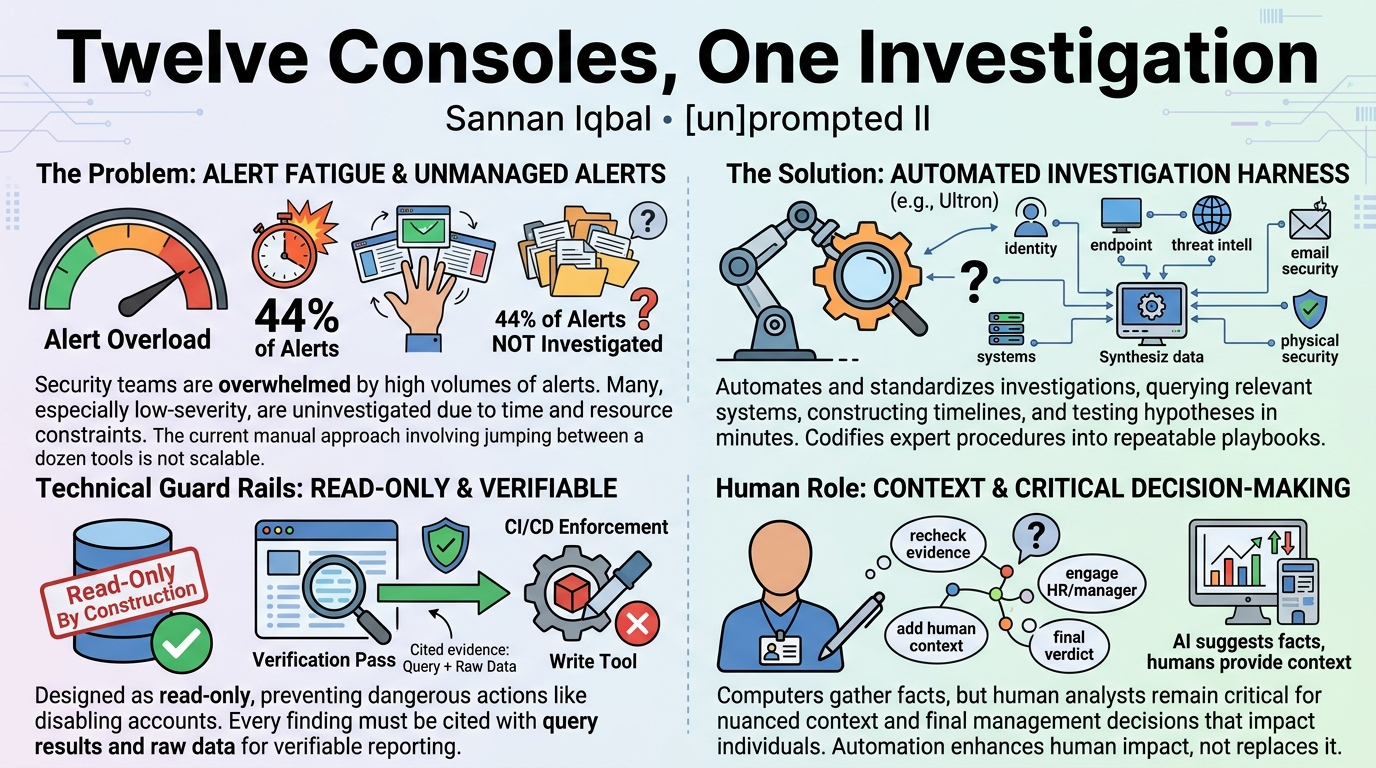
In "Twelve Consoles, One Investigation," Sannan Iqbal, a Senior Security Engineer at Oscar Health, addresses a critical challenge facing modern security operations centers: the overwhelming volume of alerts and the manual, inefficient processes required to investigate them. The talk introduces Ultron, an innovative investigation harness designed to automate and standardize security incident response. Iqbal highlights how the current paradigm of jumping between a dozen different security tools for a single alert leads to alert fatigue, inconsistent investigations, and a disturbing percentage of uninvestigated alerts, even for seemingly low-severity incidents.
Key moments
- 0:00 The Problem: Manual Security Investigations are Not Scalable
- 2:40 Introducing Ultron: An Automated Security Investigation Harness
- 6:30 Ensuring AI Safety: Ultron's Hard Guard Rails and Permissions
- 8:10 Ultron in Action: A Suspicious Login Case Walkthrough
- 9:10 Deep Dive: Detecting a VPN Leak Across Multiple Data Planes
- 11:40 Human Context: Why AI Should Not Make Final Decisions
- 14:40 Q&A: How Investigation Playbooks and Processes are Designed
- 16:00 Q&A: Measuring Ultron's Performance and Scaling for Autonomous Defense
Twelve Consoles, One Investigation
Speakers: Sannan Iqbal, Senior Security Engineer, Oscar Health
Conference: [un]prompted II
YouTube: https://www.youtube.com/watch?v=I0au7XXhAGQ
Overview
In "Twelve Consoles, One Investigation," Sannan Iqbal, a Senior Security Engineer at Oscar Health, addresses a critical challenge facing modern security operations centers: the overwhelming volume of alerts and the manual, inefficient processes required to investigate them. The talk introduces Ultron, an innovative investigation harness designed to automate and standardize security incident response. Iqbal highlights how the current paradigm of jumping between a dozen different security tools for a single alert leads to alert fatigue, inconsistent investigations, and a disturbing percentage of uninvestigated alerts, even for seemingly low-severity incidents.
Ultron aims to revolutionize this by sitting atop existing security infrastructure, acting as a read-only orchestrator that queries relevant systems, constructs timelines, and tests hypotheses in minutes rather than hours. This automation not only significantly speeds up the investigation process but also ensures a consistent, evidence-based approach to every alert. By codifying expert investigation procedures, Ultron empowers security teams to tackle the alert deluge effectively, freeing human analysts to focus on high-level context and decision-making rather than repetitive data collection.
The significance of Ultron lies in its ability to bring structure and scalability to an inherently chaotic and manual process. In an era where security teams are constantly battling a growing threat landscape with limited resources, a solution that can thoroughly investigate alerts, standardize procedures, and keep humans in the critical decision-making loop is invaluable. Iqbal's work offers a compelling vision for the future of security operations, emphasizing automation not as a replacement for human intelligence but as an enhancement that amplifies its impact.
Background
▶ Watch: The Problem: Manual Security Investigations are Not Scalable (0:00)
The genesis of Ultron stems from a pervasive problem in cybersecurity: the sheer volume of security alerts and the inadequate capacity of human analysts to investigate them thoroughly. Iqbal vividly paints a picture of a common scenario: a low-severity alert, such as a user connecting from a suspicious country, triggering a lengthy manual investigation involving up to 12 different security consoles. This process—pivoting from a Security Information and Event Management (SIM) system to an identity provider, threat intelligence feeds, endpoint detection and response (EDR), email security, and even HR systems—can consume 30 to 60 minutes of an analyst's time.
The scalability of such an approach is non-existent. As Iqbal points out, security teams receive "hundreds of thousands alerts a day," making it impossible to apply this level of scrutiny to every single one. Consequently, many low-severity alerts are merely glanced at and closed, or, worse, ignored entirely. A Cisco study conducted before the "AI boom" revealed that 44% of security alerts do not get investigated, a statistic that has only worsened since. This creates a dangerous blind spot, as seemingly low-priority alerts can often be precursors to significant breaches.
Compounding this issue is the lack of standardization in investigations. Different analysts, armed with varying levels of experience and individual methodologies, will approach the same alert differently, leading to inconsistent outcomes and missed details. The need for a codified, repeatable process became evident. To address these challenges, Ultron emerged as a fusion of two earlier projects: Alfred and Friday. Alfred provided the foundational "spine" – the plumbing, agents, connectors, central secrets management, permission rules, and CI/CD pipeline. Friday, developed in collaboration with Jim Roge, an ex-cyber law enforcement officer with over 20 years of experience, introduced an automated case review loop, incorporating read-only forensic drivers, on-device checks, and evidence discipline. Ultron combined these strengths to create a comprehensive investigation harness that tackles the core problems of alert fatigue, inconsistency, and unscalable manual processes head-on.
Key Findings
▶ Watch: Ensuring AI Safety: Ultron's Hard Guard Rails and Permissions (6:30)
The central discovery and contribution of Iqbal's talk is the Ultron investigation harness itself. This system represents a significant step forward in automating and standardizing security investigations, offering several key findings:
- Automation of Tedious Legwork: Ultron automates the repetitive and time-consuming task of querying multiple security systems. It doesn't replace existing tools but integrates with them, performing the initial data gathering, timeline construction, and hypothesis testing that typically consumes hours of an analyst's time. This reduces investigation time for complex cases from 30-60 minutes to approximately 4 minutes.
- Standardization of Investigations: By codifying expert investigation procedures—developed in collaboration with experienced cyber law enforcement—Ultron ensures a consistent and thorough approach to every alert. This eliminates the variability introduced by individual analyst experience levels, ensuring that even low-severity cases are investigated rigorously.
- Continuous and Comprehensive Alert Coverage: Ultron runs continuously, typically every 10 minutes, to pull new cases from the SIM. This ensures that "no alert gets ever ignored," providing a critical safety net against overlooked threats, especially those deemed low priority.
- Evidence-Based Reporting: A core tenet of Ultron is its commitment to transparency and verifiability. Every claim made in Ultron's report is backed by cited query results, the query itself, and the raw data. This strict evidence discipline builds trust and allows human analysts to easily verify findings.
- "Read-Only by Construction" Security Model: A crucial finding for building trust in AI-powered security tools is Ultron's robust permission model. It is designed to be read-only by construction, not by instruction, meaning dangerous write capabilities simply do not exist in its toolset. This is enforced through hard guard rails like HTTP GET-only connectors, egress filtering, and CI/CD pipelines that block the addition of any write-enabled tools.
- Human-in-the-Loop for Context and Decision-Making: While Ultron provides "high likelihood" findings with cited evidence, it explicitly avoids making "management decisions" about individuals. The system understands that "data cannot see context." Human analysts remain critical for rechecking evidence, engaging with HR or managers, and adding the nuanced human context necessary for final verdicts, especially when an outcome impacts an employee.
- Cross-Plane Investigation: The talk highlights that complex incidents often require correlating data across disparate "planes" – network, identity, device, and even the physical world. Ultron's ability to pull and correlate information from these different domains is key to uncovering subtle issues like VPN tunnel leaks that might be missed by examining individual data sources in isolation.
These findings collectively demonstrate Ultron's potential to transform security operations by increasing efficiency, consistency, and coverage, all while maintaining critical human oversight and trust.
Technical Deep Dive
▶ Watch: Deep Dive: Detecting a VPN Leak Across Multiple Data Planes (9:10)
Ultron's architecture is meticulously designed to provide an automated, secure, and verifiable investigation harness. At its core, it acts as an orchestration layer, sitting "on top" of existing security tools rather than replacing them.
The process begins with execution lease acquisition. Ultron first secures an execution lease, guaranteeing strict concurrent control to prevent any two investigation runs from overlapping. It then pulls a manageable batch of cases (up to five) directly from the SIM for investigation.
Before any queries are executed, Ultron performs a crucial health check for every underlying data source. This step is vital because "an empty query result and a dead log source look the exact same" without verifying uptime. Once data source health is established, Ultron spins up an isolated sub-agent for each case. Each sub-agent then executes a canonical playbook, systematically generating hypotheses, running queries against the various integrated systems, and constructing a unified timeline. A key aspect of this process is an "explicit, also, honest attempt to disprove its own theories," ensuring a rigorous and unbiased investigation.
The final stage for each sub-agent is to assemble an evidence-based report. A safety net, in the form of a watcher, pings the investigator if the entire pipeline ever fails or stalls, ensuring operational continuity.
A critical component of Ultron is its indicator-based routing, which determines where to look for relevant information. Unlike purely deterministic or generative AI approaches, Ultron employs a more structured method:
- Playbook Matching: It first attempts to match the alert to a predefined playbook type and category, which can be pulled from the SIM or other frameworks. Examples include "account takeover," "phishing," "insider geo-fraud," or "malware." Each playbook has its own sequence of investigation steps.
- Domain Routing: If no specific playbook matches, each indicator (e.g., an IP address, user ID, or hostname) is routed to its corresponding domain (e.g., an IP goes to the network domain, an identity to the identity domain, an endpoint to the endpoint domain).
- Iterative Routing: As new indicators are discovered during an investigation, they are routed again, allowing the system to dynamically expand its search.
- Playbook Generation Feedback Loop: If a case doesn't match any existing playbooks, a loop informs the analyst, facilitating the generation of a new playbook and thus contributing to the standardization process.
The security of Ultron is paramount, especially when integrating with sensitive security tools. Iqbal highlights a robust permission model with three tiers (ask, allow, deny) and four hard guard rails:
- Read-Only by Construction: Ultron is inherently designed to be read-only. Connectors are pinned to the HTTP GET method, ensuring egress filtering and preventing any write operations. Tools that could change a case or disable an account "just don't exist" in the toolset.
- CI/CD Enforcement: A CI pipeline blocks any build if someone attempts to add forbidden write-enabled tools to Ultron's toolset.
- Human Approval for "Ask" Tier: If an action doesn't align with automatic "allow" or "deny" rules (e.g., reading data directly from a laptop), it falls into the "ask" tier. If a human doesn't respond within 2 minutes, it's an automatic denial, providing a crucial human-in-the-loop guard rail.
- Report Verification: Every claim in Ultron's report must be substantiated with the cited query result, the query itself, and the raw data. A "verification pass throws out anything that's unquoted," ensuring data integrity and accountability.
This comprehensive technical design ensures that Ultron operates efficiently, securely, and transparently, providing high-fidelity, evidence-backed insights to security analysts.
Demo / Proof of Concept
▶ Watch: Human Context: Why AI Should Not Make Final Decisions (11:40)
Sannan Iqbal illustrates Ultron's capabilities by walking through a "fictional case that's being replayed" on screen, demonstrating how the harness processes a real-world scenario. The case begins with three seemingly low-severity alerts: the same user, same host, same second, connecting from a suspicious country, Laveria.
Ultron initiates its process by first verifying the health of the data sources. It then forms a central hypothesis: "Is this actually the user or is this actually the threat actor?" The system proceeds to query the 12 different security systems that a human analyst would typically consult, but in a matter of seconds. It pulls data from various "planes" – network, identity, and eventually the physical world – to construct a comprehensive picture. Ultron then systematically tests theories, such as "approved travel," "bad geo lookup," or "office shared network," and rules them out.
A critical moment in the demo occurs when Ultron needs to "prove exactly where the laptop physically is," which involves reading data directly from the device. This action falls under the "ask" tier of its permission model, requiring an analyst to explicitly type "yes" to proceed. The entire investigation, from alert to a high-likelihood verdict, concludes in approximately 4 minutes, a stark contrast to the 30 to 60 minutes a human would spend.
Iqbal then slows down to highlight the crucial network layer analysis from this demo case:
- Network Plane: Ultron observes 90 days of connections from a residential line in Texas, consistent with a work-from-home employee. Suddenly, for a 10-second blip, a connection appears from a residential line in Laveria, before immediately reverting to Texas. This anomaly strongly suggests a VPN tunnel dropping and a real connection leaking through.
- Cross-Reference: The network plane initially flags it as a US line from Texas. The identity provider does not identify the Laveria IP as a proxy or VPS, and threat intelligence feeds come back clean. Only the "10-second crack" is visible.
- Device Plane: The device is checked for client-side VPNs, but nothing is found. The device posture looks good, and the EDR shows no triggers.
- Physical Plane (after human approval): Ultron then investigates the physical plane. It detects a travel router gateway and a time zone manually forced to US, indicating potential concealment. Crucially, by examining Wi-Fi radio frequencies, it identifies that frequencies legal in Laveria are in use. Finally, a traceroute reveals a latency floor of over 140 milliseconds to an anycast IP, pointing to high path latency that strongly suggests traffic is being tunneled out of the United States.
Iqbal emphasizes that "each plane alone was a maybe, but together it is a verdict." The combined evidence points unequivocally to a VPN leak. The user had a hardwired connection to a small travel router, which then maintained an "always-on tunnel" relaying to their home connection in Texas. On the asset, no VPN software was detected, making the endpoint appear clean. On the network layer, only the egress from the Texas home IP was visible, except for that critical 10-second leak. This comprehensive, multi-plane analysis, driven by Ultron, successfully uncovers the truth behind the suspicious login.
Defensive Implications
▶ Watch: Q&A: Measuring Ultron's Performance and Scaling for Autonomous Defense (16:00)
The insights gleaned from Ultron's design and operation offer profound defensive implications for security teams:
- Prioritize Automation for Investigation Scaling: Organizations must recognize that manual security investigations are unsustainable. Investing in investigation harnesses or similar automation tools is no longer a luxury but a necessity to scale operations, combat alert fatigue, and ensure thoroughness across all alert severities. The demonstrated reduction from 30-60 minutes to 4 minutes per investigation highlights the immense efficiency gains.
- Standardize Investigation Playbooks: The talk underscores the importance of codifying investigation processes. Security teams should work to define clear, repeatable playbooks for common alert types (e.g., account takeover, phishing, geo-fraud). This ensures consistency, reduces reliance on individual analyst experience, and facilitates onboarding and training for junior team members.
- Adopt "Read-Only by Construction" Principles for Automated Tools: When integrating automated systems with critical security infrastructure, design them to be read-only by construction, not by instruction. This means actively removing dangerous write capabilities (like disabling accounts or changing configurations) from the toolset itself, enforcing it through HTTP GET-only connectors, egress filtering, and CI/CD pipelines. This builds trust and minimizes the risk of autonomous systems causing unintended damage or being exploited.
- Demand Evidence-Based Reporting: For any automated system providing security insights, mandate that every claim be explicitly cited with the underlying query, query results, and raw data. This ensures transparency, auditability, and allows human analysts to verify findings independently, fostering confidence in the automation's output.
- Maintain a Human-in-the-Loop for Context and Final Decisions: While automation excels at data collection and correlation, humans provide invaluable context. Defenders should design their processes to keep human analysts in the decision-making loop, particularly when the outcome impacts individuals (e.g., employee actions, HR involvement). This acknowledges that "data cannot see context" and that computers should not make management decisions.
- Cultivate Cross-Plane Visibility: The VPN leak example vividly demonstrates that complex security issues often manifest across multiple, seemingly disparate "planes" – network, identity, endpoint, and even the physical environment. Defenders must strive for integrated visibility and correlation capabilities that can pull and analyze data from all these sources to uncover subtle clues that might be missed in isolation.
- Educate Users on Secure Remote Work Practices: The case of the user circumventing security by using a personal travel router and an "always-on tunnel" highlights a user education gap. Organizations should educate employees on approved methods for remote access and the risks associated with unauthorized personal VPNs or network configurations that could lead to data leaks.
By embracing these defensive implications, security organizations can build more resilient, efficient, and trustworthy security operations capable of confronting the evolving threat landscape.
Key Takeaways
- The bottleneck in security operations is the manual disconnect between numerous GUIs. Investigating a single alert across "12 consoles" leads to significant time loss and alert fatigue, which an automated harness like Ultron effectively resolves.
- Automated investigation harnesses standardize processes and ensure thoroughness. By codifying expert playbooks, these systems guarantee that every alert, regardless of severity or analyst experience, receives a consistent and detailed investigation, preventing critical alerts from being overlooked.
- Build automated security tools with "read-only by construction" principles. Dangerous capabilities (e.g., disabling accounts, changing configurations) should be physically absent from the toolset and enforced via technical controls like HTTP GET-only connectors and CI/CD, rather than relying on instructions or policies.
- Every automated claim must be cited with verifiable evidence. To maintain trust and accountability, all findings from an automated system must be backed by the raw query, its results, and the underlying data, allowing human analysts to easily audit and confirm.
- Always keep humans in the decision-making loop. While automation provides facts and high-likelihood findings, human analysts are essential for adding critical context, understanding nuances, and making final decisions, especially when those decisions impact individuals. "A computer can never be held accountable."
- Complex security questions often require cross-plane correlation. Incidents like VPN leaks or sophisticated attacks necessitate correlating data across multiple domains—network, identity, device, and even physical context—to form a definitive verdict that no single data source could provide alone.
About the Speaker(s)
Sannan Iqbal is a Senior Security Engineer at Oscar Health. His work focuses on building innovative solutions to enhance security operations, as demonstrated by the development of Ultron. Iqbal's expertise lies in tackling the practical challenges faced by security teams, particularly in areas of alert management, investigation scalability, and process standardization. He emphasizes a pragmatic approach to security automation, ensuring that systems are not only efficient but also secure and transparent. His collaboration with Jim Roge, an ex-cyber law enforcement officer with over two decades of experience, highlights his commitment to integrating real-world investigative rigor into automated frameworks.
Reviews
→ Top-rated talks at [un]prompted II 2026 — The AI Security Practitioner Conference
All talks from [un]prompted II 2026 — The AI Security Practitioner Conference