We don’t need an LLM for That
Xenia Mountrouidou (Principal Applied AI Scientist · AppGate), Casey Wilson (Principal Software Engineer · BusinessLoans.com)
[un]prompted II 2026 — The AI Security Practitioner Conference · Day 3 · Stage 2
Overview
In an era saturated with hype around Large Language Models (LLMs), Xenia Mountrouidou and Casey Wilson presented a compelling, data-driven analysis challenging the assumption that LLMs are a panacea for all cybersecurity detection needs. Titled "We don’t need an LLM for That," their talk at [un]prompted II rigorously investigates whether LLMs can effectively replace or significantly enhance traditional machine learning (ML) models for detecting cyberattacks, specifically focusing on phishing emails and networking traffic. Their core objective was to move beyond anecdotal evidence and "vibes," providing hard numbers on performance, cost, and latency across a spectrum of models.
Key moments
- 0:00 Introduction: "We don't need an LLM for that"
- 2:20 Robust experimental setup and evaluation metrics
- 8:09 Five fundamental questions guiding the research
- 10:40 Phishing email detection: Fine-tuned SLMs excel
- 12:10 Network data: LLMs fail, traditional ML wins
- 14:00 New models: TaPFN 3 shines for tabular data
- 16:00 Practical recommendations for choosing models
- 18:00 Cost, latency, memory, and the future of tabular models
We don’t need an LLM for That
Speakers: Xenia Mountrouidou (Principal Applied AI Scientist, AppGate); Casey Wilson (Principal Software Engineer, BusinessLoans.com)
Conference: [un]prompted II
YouTube: https://www.youtube.com/watch?v=y9mpfY1TYYY
Overview
In an era saturated with hype around Large Language Models (LLMs), Xenia Mountrouidou and Casey Wilson presented a compelling, data-driven analysis challenging the assumption that LLMs are a panacea for all cybersecurity detection needs. Titled "We don’t need an LLM for That," their talk at [un]prompted II rigorously investigates whether LLMs can effectively replace or significantly enhance traditional machine learning (ML) models for detecting cyberattacks, specifically focusing on phishing emails and networking traffic. Their core objective was to move beyond anecdotal evidence and "vibes," providing hard numbers on performance, cost, and latency across a spectrum of models.
The speakers, both seasoned practitioners in applied AI and software engineering, address a critical question frequently posed by stakeholders: "Why should we train models anymore or even maintain rules when LLMs are so much easier to deploy?" This talk directly confronts that query by setting up a robust, replicable experiment using open-source, labeled data to compare zero-shot LLMs, fine-tuned LLMs, traditional ML models like XGBoost, and emerging decision models and tabular foundation models. The findings offer crucial guidance for security practitioners on selecting the most effective and efficient detection strategies for diverse data types, emphasizing that the "best" solution is highly context-dependent and often not the largest, most cutting-edge model.
Mountrouidou and Wilson’s research underscores that while LLMs show promise for text-based anomalies, their utility diminishes significantly for numerical or tabular data. Furthermore, the operational complexities, prohibitive costs, and increased latency associated with large LLMs often render them impractical for real-time security detection scenarios. The talk champions a nuanced approach, advocating for specialized, often smaller, fine-tuned models or novel tabular transformers where appropriate, demonstrating that strategic application of the right tool for the job—backed by empirical evidence—is paramount in the evolving threat landscape.
Background
▶ Watch: Introduction: "We don't need an LLM for that" (0:00)
The evolution of cybersecurity detection has mirrored the growth and complexity of the internet itself. As Xenia Mountrouidou recounted, early detection, exemplified by Cliff Stoll's "Cuckoo's Egg," involved manual analysis of logs for malicious activity in a world with only a handful of connected nodes. With the explosion of connectivity, this approach quickly became unscalable, leading to the development of deterministic rules (e.g., Sigma, Yara) that provided good accuracy and predictability for known threats.
The advent of data science introduced a paradigm shift, with machine learning practitioners asserting that rules could only detect what they were explicitly programmed to know. ML models, capable of identifying subtle patterns and anomalies in vast datasets, began to augment or replace rules, particularly for evolving threats where static signatures were insufficient. This era saw the rise of models like XGBoost as workhorses for tabular data in security.
Today, the cybersecurity community faces a new wave of technological disruption: Large Language Models. The widespread accessibility and impressive capabilities of LLMs have led to significant industry hype, prompting stakeholders to question the continued investment in traditional ML model training and maintenance. The perception is that LLMs offer a simpler, more powerful, and universally applicable solution. Mountrouidou and Wilson's research directly addresses this perception, asking: "Is an LLM as good as ML for detecting attacks?" and "Can we use a combination to get the best detector out there?" Their goal was to provide a definitive answer, supported by hard numbers, not vibes, on the efficacy, cost, and practicality of various models for real-world security classification and detection tasks.
Key Findings
▶ Watch: Five fundamental questions guiding the research (8:09)
The talk delivered several critical insights, fundamentally challenging the notion of LLMs as a universal solution for cybersecurity detection:
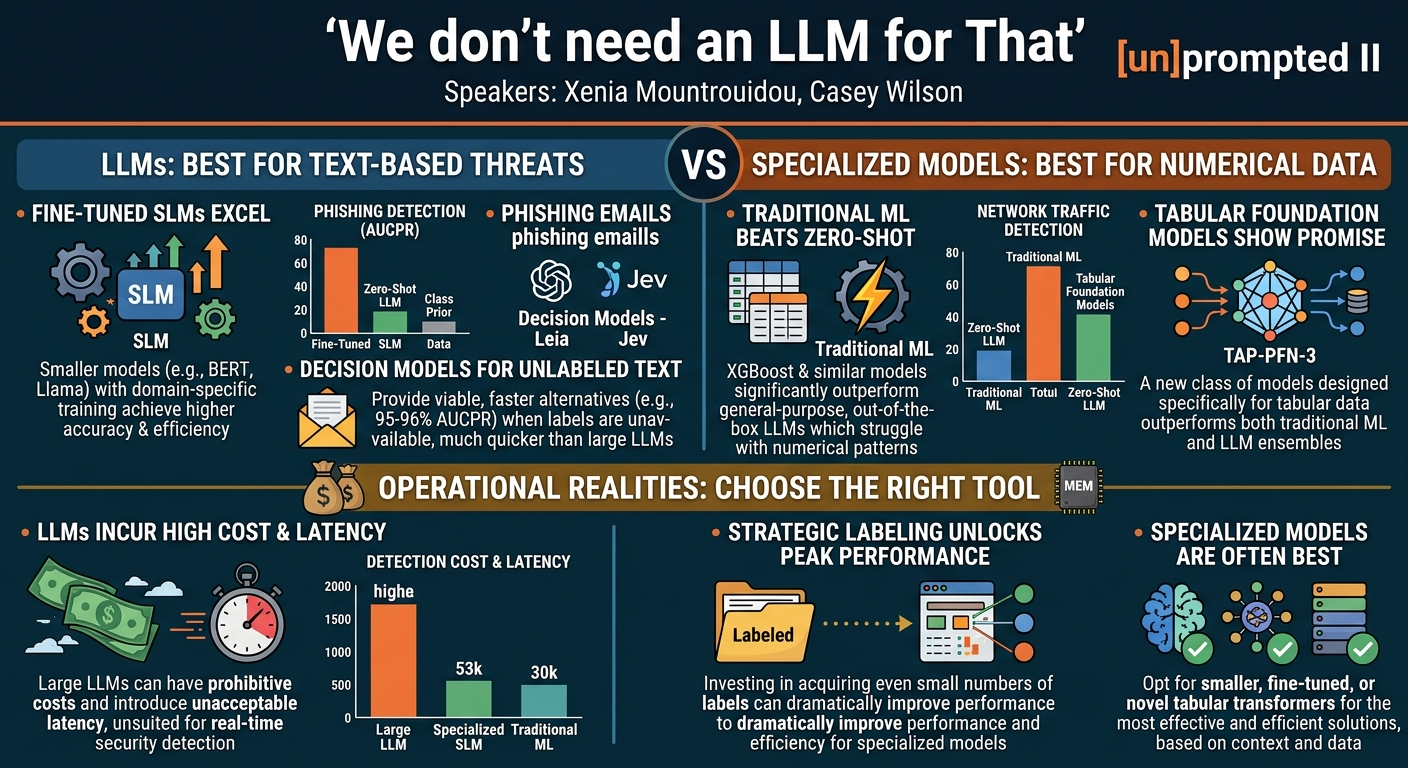
- Domain Specificity is Key: LLMs demonstrated strong performance for text-based threats like phishing emails, especially when fine-tuned. However, they performed poorly, often no better than random chance (the class prior), for numerical or tabular networking data in zero-shot configurations.
- Fine-Tuning Trumps Zero-Shot LLMs for Text: For phishing detection, smaller, fine-tuned models like Llama 3.2 and modern BERT achieved near-perfect AUCPR scores (99.8% and 99.7% respectively), outperforming even frontier LLMs like Gemini 3 Pro and Claude Sonnet (99% and 97%) in their zero-shot state. This highlights the immense value of domain-specific training.
- Traditional ML Still Dominates for Numerical Data (with a new challenger): For network detection, XGBoost significantly outperformed zero-shot LLMs. Crucially, fine-tuning LLMs on networking data did not yield substantial improvements over XGBoost, indicating a fundamental limitation of language models for non-textual patterns.
- Emergence of Tabular Foundation Models: The TAP-PFN-3 model, a tabular foundation model, emerged as a standout performer for network detection, single-handedly outperforming XGBoost and even complex ensembles of models. This suggests a promising new class of models specifically designed for tabular data.
- Decision Models for Unlabeled Text Data: For phishing detection without the availability of labels, decision models like Jev and Leia offered a viable solution, achieving respectable accuracy (95-96% AUCPR) and being much faster than large LLMs.
- Ensembles are Not Always the Winner: While ensembles (combining LLMs or decision models with traditional ML) showed some improvement for phishing detection, they did not surpass the performance of fine-tuned smaller models. For network detection, ensembles offered no improvement over the standalone TAP-PFN-3 model, adding complexity without commensurate benefit.
- Cost and Latency are Critical Operational Factors: Large LLMs incur significantly higher costs (e.g., $1,200 for 1 million emails with Claude vs. less than a cent for traditional ML) and introduce substantial latency, rendering them unsuitable for real-time, on-premises detection scenarios common in security. Smaller, fine-tuned models offer orders of magnitude better cost-efficiency and speed.
- The Power of Strategic Labeling: Even a small number of labels (e.g., a few hundred for phishing, a couple thousand for networking data) can dramatically improve the efficiency and performance of specialized models, making the investment in annotation queues highly worthwhile.
Technical Deep Dive
▶ Watch: Network data: LLMs fail, traditional ML wins (12:10)
The core of Mountrouidou and Wilson's presentation was a meticulously designed experimental setup, likened to "Lego bricks" that could be mixed and matched to explore various hypotheses. This robust methodology allowed for objective, quantifiable comparisons across diverse models and data types.
Data Selection and Preparation:
To ensure replicability and verifiability, all data used was open source and labeled, providing a clear ground truth for model training and evaluation.
- Strong Signal (Textual Data): For scenarios where LLMs were expected to perform well, the team utilized a dataset of 18,000 phishing emails from Hugging Face. Approximately 40% of these emails were malicious, representing the class prior.
- Weak Signal (Numerical/Tabular Data): For data types less suited to LLMs, two networking data sets were chosen:
- Mirai botnet data: A well-studied worm transmitted via Telnet. The data was processed in two forms: aggregated statistics (after image) and raw packets, further segmented into flows and single packets to give transformers every possible chance to find a signal.
- IDS data set: This dataset contained various types of attacks, with a class prior of about 20% malicious traffic. The slightly higher class prior than typical real-world benign-heavy datasets was noted as beneficial for training.
Feature Engineering:
Features are how models "understand" the data. The experiment explored two primary types:
- Numeric: Traditional tabular features, akin to an Excel spreadsheet, derived from the raw data.
- Embeddings: For text data, words were converted into numerical representations that captured their contextual meaning, enabling models to process semantic information.
Model Architectures and Training Regimes:
A wide array of models was tested, reflecting the current landscape of ML and AI:
- Traditional ML: XGBoost, a highly regarded gradient boosting framework, served as a baseline for tabular data.
- Language Models:
- Large Language Models (LLMs): Frontier models like Gemini 3 Pro, Claude Sonnet, and GPT OSS were tested in zero-shot configuration (given a prompt without prior training on the specific task) to assess their out-of-the-box capabilities.
- Small Language Models (SLMs): Smaller, deployable LLMs like Llama 3.2 were evaluated both zero-shot and after fine-tuning on the specific datasets, allowing them to become "experts."
- Encoder-only Models: Modern BERT was used, which takes a prompt and outputs numbers (embeddings) rather than text, enabling its integration with traditional tabular decision-making.
- Decision Models: Jev and Leia (an open-source version of Jev) were included as faster, accurate alternatives for decision-making based on prompts.
- Tabular Foundation Models: TAP-PFN-3, a relatively new model designed specifically for tabular data, was investigated for its potential.
Combination Architectures:
The researchers also explored hybrid approaches:
- Router Architecture: A cheaper, faster ML model performed initial classification. If it was highly confident (e.g., 90% certainty), it made the decision. If not, the input was routed to a more complex, deeper LLM for further analysis.
- Stacked Architecture (Meta-Learner): Two models worked in parallel, and a third meta-learner model combined their results to produce a final, optimized classification.
Metrics for Success:
Crucially, the team emphasized using appropriate metrics for security detection, which often involves highly imbalanced datasets (e.g., 99% benign traffic).
- Area Under the Curve Precision Recall (AUCPR): This was chosen as the primary metric, superior to simple accuracy. AUCPR effectively balances precision (how often the model is correct when it cries wolf – minimizing false positives) and recall (how sensitive the model is to actual incidents – minimizing missed incidents). In security, missing incidents can be catastrophic, while too many false positives can lead to alert fatigue. AUCPR provides a robust measure of a model's ability to maximize both.
Specific Results and Model Performance:
- Phishing Email Detection:
- Fine-tuned Llama 3.2 and modern BERT achieved near-perfect AUCPR scores (99.8% and 99.7%).
- Zero-shot frontier LLMs (Gemini 3 Pro, Claude Sonnet) also performed well (99% and 97%).
- The dramatic improvement of Llama 3.2 from 78% AUCPR (before fine-tuning) to near-perfect scores (after fine-tuning) underscored the value of domain adaptation.
- Jev and Leia performed well zero-shot (95-96%), making them good choices when labels are unavailable.
- TAP-PFN-3 with BERT embeddings also showed strong performance, approaching that of fine-tuned LLMs.
- Networking Data Detection:
- Zero-shot LLMs consistently performed at the class prior, essentially random chance, highlighting their inability to interpret numerical patterns without specific training.
- XGBoost, the traditional ML workhorse, significantly outperformed LLMs.
- Fine-tuning LLMs on networking data offered minimal improvement over XGBoost, indicating LLMs are not inherently suited for this data type.
- TAP-PFN-3 was the clear winner, outperforming XGBoost and all ensembles for network detection.
- Jev and Leia also struggled with networking data, performing at the class prior.
- Ensemble Performance: While ensembles helped for phishing detection (surpassing individual models but not fine-tuning), they provided no discernible benefit for network detection, failing to outperform TAP-PFN-3 alone. This suggests that the added complexity and cost of ensembles are not always justified.
Cost, Latency, and Memory:
The operational considerations were stark:
- Cost: Classifying 1 million emails with Claude could cost $1,200, whereas traditional ML costs less than a cent. Small fine-tuned models cost a few dollars to tens of dollars on rented GPUs.
- Latency: For real-time applications (e.g., zero-trust networking), sub-second detection is critical. Large LLMs introduce unacceptable latency. Even some small language models (like GPT OSS) showed surprisingly high latency without corresponding performance gains.
- Memory (RAM): Similar patterns were observed for memory consumption, favoring smaller, more efficient models for on-premise or resource-constrained deployments.
Demo / Proof of Concept
▶ Watch: New models: TaPFN 3 shines for tabular data (14:00)
While the talk did not feature a live, interactive software demonstration in the traditional sense, the entire presentation served as a comprehensive proof of concept for the rigorous experimental methodology and its findings. Mountrouidou and Wilson's "Lego bricks" approach to building and testing their detection systems effectively demonstrated the comparative performance of various models across different data types and configurations.
The detailed exposition of their experimental setup—including the selection of open-source, labeled data (phishing emails, Mirai botnet, IDS datasets), the feature engineering techniques (numeric, embeddings), the spectrum of models evaluated (XGBoost, zero-shot LLMs, fine-tuned SLMs, Jev, Leia, TAP-PFN-3), and the advanced metrics (AUCPR)—constituted a robust validation of their hypotheses. The presentation of empirical results, replete with specific AUCPR percentages for each model and data type, provided concrete evidence to support their conclusions regarding the strengths and weaknesses of LLMs versus traditional ML and specialized models in cybersecurity detection. This systematic, data-driven comparison itself was the "demonstration" of their central thesis: that not all detection problems require an LLM, and often, better, more cost-effective solutions exist.
Defensive Implications
▶ Watch: Cost, latency, memory, and the future of tabular models (18:00)
The findings from this research provide actionable intelligence for security defenders grappling with the proliferation of LLMs and the constant need for effective threat detection.
For Phishing and Text-Based Detection:
- With Labels: The clear recommendation is to leverage fine-tuned modern BERT. This model is small, highly accurate (near 99.7% AUCPR), and cost-effective, making it ideal for deployments where efficiency and performance are critical. The effort of acquiring a few hundred labels for fine-tuning is well worth the investment, as it dramatically improves detection efficacy.
- Without Labels: If labels are unavailable, Leia or Jev are excellent choices. These decision models offer good out-of-the-box accuracy (95-96% AUCPR) and are significantly faster and cheaper than large LLMs, providing a practical solution for immediate deployment.
For Network Flows and Numerical/Tabular Data Detection:
- With Labels (Raw Signal): The standout model is TAP-PFN-3. This new class of tabular foundation models outperformed all other options, including XGBoost and ensembles, demonstrating its superior capability for detecting anomalies in networking data.
- Cost-Constrained or Traditional Approach: If the cost of TAP-PFN-3 or its hosting is prohibitive, XGBoost remains a strong second-best option. It is a proven, efficient traditional ML model that still significantly outperforms zero-shot LLMs for this data type.
- Without Labels: This is a critical gap. The research explicitly states that "none of the tools that we have shown solve that problem." The primary recommendation for defenders in this scenario is to invest in acquiring labels for their data. Even a couple of thousand labels can enable the use of highly effective models like TAP-PFN-3 or XGBoost.
Operational Considerations (Cost, Latency, Memory):
- Prioritize Efficiency: For real-time, high-volume security operations, large LLMs are generally impractical due to their high cost, significant latency, and memory footprint. Defenders should favor smaller, specialized, and fine-tuned models that can operate within strict performance budgets, especially for on-premises or edge deployments (e.g., zero-trust agents requiring sub-second detection).
- Strategic Labeling: The talk strongly advocates for investing in labeling efforts. Even a relatively small number of labels (e.g., 500 emails every two months for phishing, or a few thousand for network data) can unlock peak model performance. Defenders should facilitate subject matter experts (security analysts) in creating annotation queues or exploring methods for generating natural labels from existing alert feedback loops, recognizing that this upfront investment yields significant dividends in detector efficiency and accuracy.
- Address Model Drift: Security models are susceptible to model drift as attacker tactics evolve. Defenders must implement continuous monitoring mechanisms to detect changes in data profiles and traffic patterns, ensuring models are retrained as often as necessary to maintain peak performance. This is an ongoing operational cost that must be factored in.
In essence, defenders should adopt a pragmatic, data-driven approach, carefully matching the detection tool to the specific data type and operational constraints, rather than blindly adopting the latest LLM technology.
Key Takeaways
- LLMs are not a universal solution for security detection. Their efficacy is highly dependent on the data type, excelling with text but struggling with numerical/tabular data without specific adaptation.
- Domain-specific fine-tuning is paramount for text-based threats. Smaller, fine-tuned models like modern BERT and Llama 3.2 achieve superior accuracy and efficiency for phishing detection compared to larger, zero-shot LLMs.
- Tabular foundation models like TAP-PFN-3 represent the future for numerical data detection. This new class of models significantly outperforms traditional ML and LLMs for networking data, offering a powerful, specialized solution.
- Cost, latency, and operational complexity heavily favor smaller, specialized models. Large LLMs are often too expensive and slow for real-time security detection, making them impractical for many critical use cases.
- Strategic labeling, even in small quantities, is a critical investment. Acquiring a few hundred to a couple thousand labels can dramatically enhance the performance and efficiency of specialized detectors, turning seemingly intractable problems into solvable ones.
- Traditional ML (e.g., XGBoost) remains a viable and robust option for numerical data, especially when cost-constrained. It continues to outperform zero-shot LLMs for network detection and serves as a strong alternative to TAP-PFN-3.
About the Speaker(s)
Xenia Mountrouidou, known to her friends as Dr. X, is a Principal Applied AI Scientist at AppGate. With over 15 years of experience in data science for security, Dr. Mountrouidou has a deep understanding of applying advanced analytical techniques to cybersecurity challenges, including her work in MDR (Managed Detection and Response) and zero-trust networking signal detection. Her expertise lies in developing efficient and effective models for real-time threat detection, often under strict latency and memory constraints. She is a co-author of the open-source GitHub repository, detailed paper, and blog associated with this research.
Casey Wilson is a Principal Software Engineer at BusinessLoans.com. His background in software engineering complements Dr. Mountrouidou's AI expertise, bringing a practical, implementation-focused perspective to the research. Together, they combined their skills to design and execute the robust experimental setup, ensuring the findings were not only scientifically sound but also operationally relevant.
Reviews
→ Top-rated talks at [un]prompted II 2026 — The AI Security Practitioner Conference
All talks from [un]prompted II 2026 — The AI Security Practitioner Conference