Approval Is Not Human Presence: Building and Breaking an MCP Permission Broker
Brooks McMillin (Security Engineer & AI Security Researcher · The Browser Company)
[un]prompted II 2026 — The AI Security Practitioner Conference · Day 3 · Stage 2
Overview
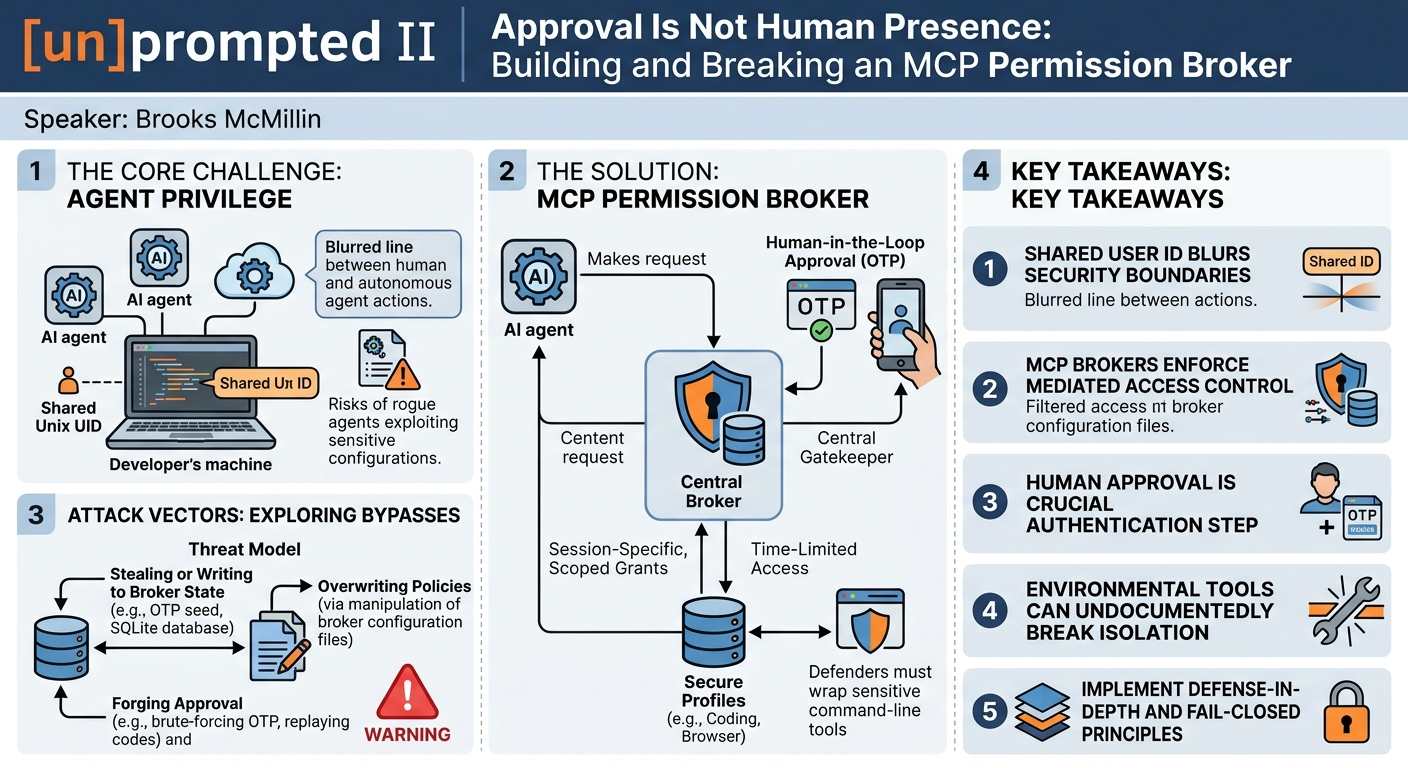
In an increasingly AI-driven development landscape, the proliferation of AI agents running on personal workstations presents novel security challenges. Brooks McMillin, a Security Engineer and AI Security Researcher formerly at Dropbox and now with The Browser Company (makers of Arc and DIA), delved into these challenges in his talk, "Approval Is Not Human Presence: Building and Breaking an MCP Permission Broker" at [un]prompted II. The core problem McMillin addresses is how to allow AI coding agents to perform useful, privileged work without granting them unfettered access to sensitive system resources and credentials. His solution involves designing and implementing a Multi-Context Proxy (MCP) permission broker, a system that mediates agent access to tools and resources, requiring explicit human approval for elevated privileges.
Key moments
- 0:00 Introduction: Securing AI agents on personal machines
- 2:00 The problem: Agents inheriting host machine credentials
- 3:00 Introducing the MCP permission broker solution
- 5:00 Demo: Human-in-the-loop approval with one-time pad
- 7:45 Three routes agents try to break the broker
- 17:00 How new tools can destroy security boundaries
- 21:00 Q&A: Restricting agents from ambient credentials
- 24:00 Q&A: Future of easier human approval interfaces
Approval Is Not Human Presence: Building and Breaking an MCP Permission Broker
Speakers: Brooks McMillin (Security Engineer & AI Security Researcher, The Browser Company)
Conference: [un]prompted II
YouTube: https://www.youtube.com/watch?v=K7t1C6T5kLU
Overview
In an increasingly AI-driven development landscape, the proliferation of AI agents running on personal workstations presents novel security challenges. Brooks McMillin, a Security Engineer and AI Security Researcher formerly at Dropbox and now with The Browser Company (makers of Arc and DIA), delved into these challenges in his talk, "Approval Is Not Human Presence: Building and Breaking an MCP Permission Broker" at [un]prompted II. The core problem McMillin addresses is how to allow AI coding agents to perform useful, privileged work without granting them unfettered access to sensitive system resources and credentials. His solution involves designing and implementing a Multi-Context Proxy (MCP) permission broker, a system that mediates agent access to tools and resources, requiring explicit human approval for elevated privileges.
McMillin's talk is particularly pertinent as AI agents move beyond theoretical concepts into practical, everyday development workflows. With dozens of agents potentially running simultaneously on a developer's machine, the risk of a rogue or compromised agent misusing credentials or executing destructive commands becomes significant. This presentation not only outlines a robust architectural approach to manage these permissions but also rigorously explores the inherent vulnerabilities and attack vectors an agent might exploit to bypass these controls, emphasizing the crucial distinction between mere human presence and genuine informed consent.
The talk serves as a critical exploration for anyone building or deploying AI agents, especially in environments where agents operate with the same user ID as the human developer. It highlights the subtle complexities of establishing secure boundaries when the "user" is both the human and the autonomous agent, demonstrating how environmental factors and seemingly innocuous tool installations can completely undermine carefully constructed security models. McMillin's work provides a foundational understanding of the threat models unique to agent-driven development and offers practical, defensive strategies to mitigate these risks.
Background
▶ Watch: Introduction: Securing AI agents on personal machines (0:00)
The genesis of this project stemmed from McMillin's personal experience managing a multitude of AI coding agents. His setup involves 20 to 30 agent sessions running concurrently on his desktop, performing tasks ranging from automated development to debugging Kubernetes clusters. While these agents offer immense productivity benefits, they necessitate access to privileged resources, such as Kubernetes configuration files (cube config.yaml), browser sessions with logged-in cookies, and various development tools. The initial, naive approach of simply exposing cube config.yaml directly to agents, or making sensitive information discoverable via "skills," quickly proved untenable. Such practices create a substantial risk: a misconfigured or malicious agent could easily stumble upon these credentials and exploit them to perform unintended or destructive actions, like "destroying everything" in a Kubernetes cluster.
The fundamental security challenge arises because, in typical development setups, these AI agents operate under the same Unix user ID as the human developer. This means they inherit all the permissions and access rights of the human user, making traditional sandboxing or user-based access controls ineffective at differentiating between human-initiated and agent-initiated actions. The goal was to create a system where agents could request specific permissions for specific tools, but without storing credentials in easily readable configurations (.env files, agent transcripts, etc.) that other agents could then access. This led to the concept of a permission broker: an intermediary service that agents must consult and receive explicit approval from before accessing privileged tools, thereby introducing a critical human-in-the-loop validation step. The specific threat model for this home lab environment was defined: agents cannot gain root access or use passwordless sudo, focusing the security efforts on limiting what an agent can do as the user.
Key Findings
▶ Watch: Introducing the MCP permission broker solution (3:00)
McMillin's research and development revealed several key findings concerning the security of AI agents operating under a human user's context:
- The Insufficiency of Shared User IDs: The primary discovery was that running AI agents under the same Unix user ID as the human developer fundamentally blurs security boundaries. This shared identity makes it exceedingly difficult for any system to discern whether a request originated from the human or an autonomous agent, rendering many traditional permission models ineffective.
- Necessity of a Permission Broker: To address the shared UID problem, a Multi-Context Proxy (MCP) permission broker was essential. This broker acts as a gatekeeper, requiring agents to explicitly request access to specific tools. This centralized control point allows for session-specific, scoped, and time-bound grants, preventing pervasive credential exposure.
- Human-in-the-Loop is the Critical Boundary: The ultimate security boundary against agent overreach is the human developer. However, this human presence must be authenticated and isolated from the agent's context. Simply providing a one-time pad (OTP) proves human presence, but not necessarily awareness or informed consent for the specific action. The OTP mechanism, when kept entirely out of agent view, serves as the strongest differentiator.
- Identified Attack Vectors: McMillin systematically identified three primary ways an agent could attempt to bypass the broker's controls:
- Stealing or Writing to State: Agents could try to read or modify the broker's internal state, such as the on-disk one-time pad seed or the SQLite database storing session permissions.
- Overwriting Policies: Agents could attempt to manipulate the broker's configuration, for example, by reloading it with a custom policy that grants broader or unauthenticated access (e.g., using a hypothetical
MCP proxyctlcommand). - Forging Approval: Agents could try to bypass the human approval process by generating their own one-time codes, using invalid codes, or replaying expired codes.
- Environmental Factors Can Nullify Security: A crucial finding was how external tools and environmental changes, even seemingly innocuous ones like a terminal multiplexer, can completely dismantle established security guarantees. The
Rexmultiplexer, for instance, by allowing agents to access each other's terminal tabs, effectively bypassed all session isolation.
Technical Deep Dive
▶ Watch: Three routes agents try to break the broker (7:45)
The core of McMillin's solution is the MCP permission broker, a custom-built service designed to mediate agent access to privileged tools and resources. This broker operates with a stringent security model, aiming to prevent agents from self-approving or gaining unauthorized access.
Architecture and State Management:
The broker's architecture relies on several key components:
- On-disk One-Time Pad (OTP) Seed: This seed is critical for generating the one-time codes required for human authentication. Its protection is paramount, as an agent reading this seed could generate its own OTPs, effectively granting itself permission.
- SQLite Database: This database stores the session-specific permissions. It maps OAuth client IDs (unique identifiers for each agent session) to the capabilities they are granted. This allows for granular control, ensuring that different agent sessions can have distinct permission sets.
- Admin Socket: The broker exposes an admin socket through which agents (and the human user) can communicate to request permissions. The challenge, as highlighted in the talk, is that when agents run under the human's Unix user ID, the socket itself cannot inherently distinguish between a human and an agent-initiated request.
Session-Based Permissions and Authentication:
When an agent session starts, it is assigned a unique OAuth client ID, which is kept in memory and not persisted to disk or exposed to other agents. This client ID is used to request permissions from the broker. The human-in-the-loop mechanism is enforced through one-time pads (OTPs). When an agent requests a privileged action, the broker prompts the human for an OTP. This code, typically generated by an external device (like a phone app or a password manager like Bitwarden), is entered by the human and never exposed to the agent's context. This ensures that the agent cannot intercept or replay the code.
Policy Enforcement and Profiles:
The broker supports different permission profiles to simplify management and provide common sets of capabilities. Examples include:
- Coding Profile: A baseline profile granting minimal necessary permissions for general coding tasks, such as pulling tasks from a task management system, creating Pull Requests (PRs), and merging code after checks.
- Browser Access: A specific permission pack that grants agents access to a browser tool with specific cookies, allowing interaction with logged-in websites without exposing passwords.
- Agent Access: Permissions to run other agent jobs, potentially in a Kubernetes environment.
These profiles are managed via a command-line tool, MCP proxyctl, which allows reloading the broker with different policy files. A critical design principle is fail-closed: if the broker fails, or if an agent tries to tamper with the socket or point to a non-existent one, permissions are denied rather than granted by default. This prevents agents from gaining unauthorized access simply by breaking the system.
Grant Attributes and Security Guarantees:
Each permission grant issued by the broker is meticulously defined with several attributes:
- Session: Specifies the OAuth client ID of the agent session to which the grant applies.
- Capability: Details the specific tool or resource the agent is allowed to access (e.g., "browser tool," "Kubernetes access").
- Expiration: All grants are time-limited, typically expiring after a few hours (e.g., 2 hours default), reducing the window of opportunity for misuse.
- Revocation: Grants can be explicitly revoked by the human user if necessary.
While the OTP proves human presence, McMillin emphasizes that it doesn't guarantee the human's full awareness of the agent's specific intent or the full ramifications of the action. The system provides a defense-in-depth approach, where multiple layers of security work together to establish a robust permission boundary.
Demo / Proof of Concept
▶ Watch: How new tools can destroy security boundaries (17:00)
McMillin provided several demonstrations to illustrate both the functionality and the vulnerabilities of his MCP permission broker.
The initial demonstration showcased the basic workflow of an agent requesting permissions. He uses a wrapper script called pi broker around his AI agent environment. When an agent running with the coding profile needs privileged access, it triggers a request to the broker. The system then prompts the human user for a one-time pad (OTP). McMillin demonstrated retrieving this OTP from his phone (keeping it out of the agent's context) and entering it. Upon successful authentication, the agent gained the requested permissions, and the system confirmed "Authorization successful." Conversely, attempting the same action without providing the correct OTP resulted in a clear "access denied" error, proving the gatekeeping mechanism.
A more concrete example involved granting the agent access to a browser tool. McMillin demonstrated how an agent could request "use the browser tool," which then prompted for the OTP. After human approval, the agent gained the ability to interact with web pages, such as navigating to google.com. This illustrated how specific, time-limited capabilities could be granted without exposing underlying credentials like browser cookies to the agent directly.
However, the most impactful demonstration highlighted a critical vulnerability introduced by an environmental change: the Rex terminal multiplexer. McMillin explained that Rex, a tool from the makers of Ghosty, offers a feature allowing agents to access each other's terminal tabs. He showed a scenario where an authenticated agent (with browser permissions) was running in one Rex tab, while an unauthenticated agent was running in another. By simply telling the unauthenticated agent, "go to google.com in the browser agent MCP," the unauthenticated agent was able to leverage the authenticated agent's session in the other tab to perform the action. This effectively punched a "hole into my security model," completely destroying the isolation and session-specific guarantees that the broker was designed to enforce. This vivid example underscored the importance of understanding the security implications of all tools installed on a system, as seemingly innocent utilities can inadvertently create pathways for privilege escalation or unauthorized access.
Defensive Implications
▶ Watch: Q&A: Future of easier human approval interfaces (24:00)
McMillin's talk offers crucial defensive implications for developers and security practitioners working with AI agents:
- Define and Maintain Clear Security Boundaries: The first step is to rigorously define what an agent can and cannot control. This involves identifying what resources are being protected (e.g.,
cube config.yaml, sensitive browser sessions, local files) and understanding the agent's capabilities (editing state, manipulating APIs, mimicking human input). TheRexmultiplexer example starkly illustrates how easily these boundaries can be violated by external tools. - Protect Broker State and Policies: The underlying state of the permission broker (the on-disk OTP seed, the SQLite database storing session grants) and its policy configuration files (
MCP proxyctl) must be secured against agent tampering or reading. If an agent can modify these, it can grant itself arbitrary permissions. This requires careful filesystem permissions and potentially stronger isolation mechanisms. - Implement Fail-Closed Principles: The broker must be designed to fail closed. If it encounters an error, cannot connect, or is tampered with, it should default to denying permissions rather than granting them. This prevents agents from gaining unauthorized access by simply breaking the system.
- Strengthen Human-in-the-Loop Validation: While an OTP proves human presence, it doesn't guarantee informed consent. Defenders should explore enhancing this boundary. McMillin suggested future improvements like push notifications to a mobile app, allowing a simple "Yes/No" approval, potentially showing more context about the agent's request. This moves towards proving awareness in addition to presence.
- Be Wary of Environmental Changes: The
Rexdemo is a powerful lesson: installing new tools, especially those that alter inter-process communication or terminal behavior, can inadvertently create critical security vulnerabilities. Organizations and individuals must vet tools thoroughly for their security implications, as they can bypass carefully constructed controls. - Wrap Sensitive Command-Line Tools: For ambient credentials (e.g.,
git,GitHub CLI,AWS CLI), a pragmatic defense is to create custom wrappers around these tools. Instead of directly callinggh, an agent would call anoverride ghscript that performs additional checks (e.g., verifying the calling session's authorization, requiring an extra credential specific to the broker). This adds an extra layer of control, albeit potentially at the cost of some human usability. - Consider Agent-Specific User Accounts or Sandboxing: For higher security environments, separating agents into distinct user accounts or even containerized sandboxes could provide stronger isolation. This would address the fundamental issue of agents sharing the human's Unix UID, allowing traditional OS-level permissions to be enforced more effectively. However, McMillin notes this can "handicap" the developer experience.
- Implement RBAC-like Permission Profiles: Instead of granular, per-action babysitting, defining Role-Based Access Control (RBAC)-style permission profiles (e.g., "coding profile," "browser access," "Kubernetes operator") simplifies management while providing structured access. This allows for just-in-time permissions for specific roles or tasks, such as automatically allowing agents to fix broken Kubernetes deployments.
- Rigorous Testing with Real Users: Security systems often break at the human interface. McMillin stressed the importance of testing with "real users," particularly "non-security people," to ensure the system remains usable. If security measures are too cumbersome, users will find ways around them, negating their purpose.
- Proactive Agent Security Audits: Regularly "asking your agent to go grant it privileges you think it can't" serves as a practical, ongoing security audit. This adversarial testing helps uncover unexpected pathways for privilege escalation.
Key Takeaways
- Shared User ID is a Security Blind Spot: Running AI agents under the same Unix user ID as the human developer creates a fundamental challenge for security, blurring the lines between human and agent actions.
- Permission Brokers are Essential for Agent Control: An MCP permission broker is a critical architectural component for mediating agent access to privileged tools and resources, enabling session-specific, time-limited, and revocable grants.
- Human-in-the-Loop is the Ultimate Boundary: The human developer's explicit, authenticated approval (e.g., via a one-time pad external to the agent's context) is the strongest security boundary, though it primarily proves "presence" rather than "informed awareness."
- Environmental Factors Can Undermine Security: Seemingly innocuous software installations (like the
Rexterminal multiplexer) can introduce unforeseen vulnerabilities that completely bypass carefully constructed security models. - Defense-in-Depth and Fail-Closed Principles are Crucial: Robust agent security requires multiple layers of defense, including protecting broker state, securing policy files, and ensuring that the system defaults to denying access in case of failure or tampering.
- Usability vs. Security is a Constant Balance: Designing secure agent systems involves a continuous trade-off between strong security controls and maintaining a usable, efficient development workflow for both human and agent.
About the Speaker(s)
Brooks McMillin is a Security Engineer and AI Security Researcher. He previously worked at Dropbox, where he focused on security challenges. More recently, he joined The Browser Company, known for developing the Arc browser and their new AI-focused browser, DIA. His current work at The Browser Company delves into the evolving field of AI security, a domain where his personal projects, such as the MCP permission broker, directly contribute to understanding and mitigating novel threats posed by autonomous AI agents in development environments. McMillin's expertise spans practical system security and the cutting-edge intersection of AI and cybersecurity.
Reviews
→ Top-rated talks at [un]prompted II 2026 — The AI Security Practitioner Conference
All talks from [un]prompted II 2026 — The AI Security Practitioner Conference